
Discovering JMP 11 provides a basic introduction to using JMP. For new users of JMP, this is a great place to start. The book also includes details about importing your data into JMP, analyzing the data, and sharing the results.
 talk-data.com
Topic
2093
tagged
Discovering JMP 11 provides a basic introduction to using JMP. For new users of JMP, this is a great place to start. The book also includes details about importing your data into JMP, analyzing the data, and sharing the results.
JMP 11 Basic Analysis covers the initial types of analyses that you often perform in JMP, such as univariate, bivariate, and oneway analyses. Creating tables of summary statistics with the Tabulate platform is included along with approximating sampling distributions using bootstrapping.

JMP 11 Consumer Research focuses on analyses that help users observe and predict subject's behavior, particularly those in the market research field. The Uplift platform predicts consumer behavior based on shifts in marketing efforts. Learn how to tabulate and summarize categorical responses with the Categorical platform. Factor Analysis rotates principal components to help identify which directions have the most variation among the variables. The book also covers Item Analysis, a method for identifying latent traits that might affect an individual's choices. And read about the Choice platform, which market researchers use to estimate probability in consumer spending.

The JMP 11 Design of Experiments Guide covers classic DOE designs (for example, full factorial, response surface, and mixture designs). Read about more flexible custom designs, which you generate to fit your particular experimental situation. And discover JMP's definitive screening designs, an efficient way to identify important factor interactions using fewer runs than required by traditional designs. The book also provides guidance on determining an appropriate sample size for your study.
Start with JMP 11 Essential Graphing to find the ideal graph for your data. The book begins with Graph Builder, a quick way to create graphs in a drag-and-drop window. Line charts, ellipses, box plots, and maps are just a few of the graphs available in Graph Builder. Find information about creating other types of plots: bubble plots, scatterplots, parallel plots, and more.

JMP 11 Fitting Linear Models focuses on the Fit Model platform and many of its personalities. Linear and logistic regression, analysis of variance and covariance, and stepwise procedures are covered. Also included are multivariate analysis of variance, mixed models, generalized models, and models based on penalized regression techniques.

The JMP 11 JSL Syntax Reference focuses on functions and their arguments, and messages that you send to objects and display boxes. Notes and examples are included.

Whether your model is deterministic, or involves necessary “noise†as well as a “signal,†JMP is equipped to handle your modeling needs. JMP 11 Multivariate Methods shows you how to take advantage of the modeling platforms Multivariate, Cluster, Discriminant, Principal Components, and Partial Least Squares.

JMP 11 Profilers covers the family of interactive profiling tools, which enable you to view cross-sections of any response surface. The book also includes details about plotting points and surfaces in a three-dimensional graph. JMP 11 Profilers covers the family of interactive profiling tools, which enable you to view cross-sections of any response surface. The book also includes details about plotting points and surfaces in a three-dimensional graph.

Quality and Process Methods describes tools for evaluating and improving processes. The book begins by discussing creating control charts, which let you visualize process measurements over time, quantify common cause variation, and identify special cause variation. Details about estimating your process capability based on measurement systems analysis studies are included. Lastly, the book discusses Pareto plots and cause-and-effect diagrams to identify root causes of variability.

JMP 11 Reliability and Survival Methods provides details about evaluating and improving reliability in a product or system and analyzing survival data for people and products. The book explains how to fit the best distribution to your time-to-event data or analyze destruction data. A few other topics include analyzing competing causes of failure, modeling reliability as improvements are made over time, and analyzing recurring events.

Scripting Guide provides details for taking advantage of the powerful JMP Scripting Language (JSL). Learn how to write and debug scripts, manipulate data tables, construct display boxes, create JMP applications, and more.

JMP 11 Specialized Models provides details about modeling techniques such as partitioning, neural networks, nonlinear regression, and time series analysis. Topics include the Gaussian platform, which is useful in analyzing computer simulation experiments. The book also covers the Response Screening platform, which is useful in testing the effect of a predictor when you have many responses.

Using JMP 11 shows you how to perform common tasks such as importing data, setting column properties, exporting analyses as graphics or HTML, and modifying JMP preferences. Details about connecting to SAS and working in the Formula Editor are also provided.
Filling the need for an introductory book on linear programming that discusses the important ways to mitigate parameter uncertainty, Introduction to Linear Optimization and Extensions with MATLAB® provides a concrete and intuitive yet rigorous introduction to modern linear optimization. In addition to fundamental topics, the book discusses current linear optimization technologies such as predictor-path following interior point methods for both linear and quadratic optimization as well as the inclusion of linear optimization of uncertainty i.e. stochastic programming with recourse and robust optimization. The author introduces both stochastic programming and robust optimization as frameworks to deal with parameter uncertainty. The author’s unusual approach—developing these topics in an introductory book—highlights their importance. Since most applications require decisions to be made in the face of uncertainty, the early introduction of these topics facilitates decision making in real world environments. The author also includes applications and case studies from finance and supply chain management that involve the use of MATLAB. Even though there are several LP texts in the marketplace, most do not cover data uncertainty using stochastic programming and robust optimization techniques. Most emphasize the use of MS Excel, while this book uses MATLAB which is the primary tool of many engineers, including financial engineers. The book focuses on state-of-the-art methods for dealing with parameter uncertainty in linear programming, rigorously developing theory and methods. But more importantly, the author’s meticulous attention to developing intuition before presenting theory makes the material come alive.

Mondrian in Action teaches business users and developers how to use Mondrian and related tools for strategic business analysis. You'll learn how to design and populate a data warehouse and present the data via a multidimensional model. You'll follow examples showing how to create a Mondrian schema and then expand it to add basic security based on the users' roles. About the Technology Mondrian is an open source, lightning-fast data analysis engine designed to help you explore your business data and perform speed-of-thought analysis. Mondrian can be integrated into a wide variety of business analysis applications and learning it requires no specialized technical knowledge. About the Book Mondrian in Action teaches you to use Mondrian for strategic business analysis. In it, you'll learn how to organize and present data in a multidimensional manner. You'll follow apt and thoroughly explained examples showing how to create a Mondrian schema and then expand it to add basic security based on users' roles. Developers will discover how to integrate Mondrian using its olap4j Java API and web service calls via XML for Analysis. What's Inside Mondrian from the ground up -- no experience required A primer on business analytics Using Mondrian with a variety of leading applications Optimizing and restricting business data for fast, secure analysis About the Reader Written for developers building data analysis solutions. Appropriate for tech-savvy business users and DBAs needing to query and report on data. About the Authors William D. Back is an Enterprise Architect and Director of Pentaho Services. Nicholas Goodman is a Business Intelligence pro who has authored training courses on OLAP and Mondrian. Julian Hyde founded Mondrian and is the project's lead developer. Quotes A wonderful introduction to Business Intelligence and Analytics. - Lorenzo De Leon, Authentify, Inc. A great overview of the Mondrian engine that guided me through all the technical details. - Alexander Helf, veenion GmbH A significant complement to the online documentation, and an excellent introduction to how to think about designing a data warehouse. - Mark Newman, Heads Up Analytics Comprehensive ... highly recommended. - Najib Coutya, IMD Group

Tap into the power of the most popular stochastic volatility model for pricing equity derivatives Since its introduction in 1993, the Heston model has become a popular model for pricing equity derivatives, and the most popular stochastic volatility model in financial engineering. This vital resource provides a thorough derivation of the original model, and includes the most important extensions and refinements that have allowed the model to produce option prices that are more accurate and volatility surfaces that better reflect market conditions. The book's material is drawn from research papers and many of the models covered and the computer codes are unavailable from other sources. The book is light on theory and instead highlights the implementation of the models. All of the models found here have been coded in Matlab and C#. This reliable resource offers an understanding of how the original model was derived from Ricatti equations, and shows how to implement implied and local volatility, Fourier methods applied to the model, numerical integration schemes, parameter estimation, simulation schemes, American options, the Heston model with time-dependent parameters, finite difference methods for the Heston PDE, the Greeks, and the double Heston model. A groundbreaking book dedicated to the exploration of the Heston model—a popular model for pricing equity derivatives Includes a companion website, which explores the Heston model and its extensions all coded in Matlab and C# Written by Fabrice Douglas Rouah a quantitative analyst who specializes in financial modeling for derivatives for pricing and risk management Engaging and informative, this is the first book to deal exclusively with the Heston Model and includes code in Matlab and C# for pricing under the model, as well as code for parameter estimation, simulation, finite difference methods, American options, and more. Note: The ebook version does not provide access to the companion files.
SAS Macro Language Magic: Discovering Advanced Techniques pushes the SAS macro language to the limit. It explores how even common tools, when used to their full advantage, can transform into amazing applications. This book assumes a basic knowledge of the SAS macro language and then shows how to apply that knowledge in new and different ways.
This book enables you to find a technique that you like and then explore it to discover what works and what the possibilities are. You can experiment, focusing more on the application and less on the syntax, while at the same time visualizing the SAS program you want to generate.
Discover and develop powerful programming techniques down the path to demystifying MACROS. All the tricks and secrets are revealed, enabling you to write SAS macros that work like MAGIC.
This book is part of the SAS Press program.

Would you like to be a top SAS programmer? Would you like to be the person that other SAS programmers turn to for solutions to programming problems? If so, then How to Become a Top SAS Programmer, written by Michael Raithel is the book for you.
This self-help book provides invaluable strategies for enhancing your SAS programming skills and introduces you to a wide variety of SAS resources that are readily available to you. Inside this book, you will learn: what makes a top SAS programmer fundamentals that every top SAS programmer should master ideas for advancing your SAS career within your organization where to find SAS documentation to learn new programming techniques how to participate in local and regional SAS user groups and SAS Global Forum how to make SAS training and certification work for you how to take part in SAS virtual communities to learn, contribute, and become well-known …and much more
Want to increase your SAS acumen, solidify the use of SAS in your organization, be a greater benefit to your organization as a SAS programmer, contribute to the world-wide SAS community, and enjoy good career growth? Michael’s book will help the novice SAS programmer or a seasoned professional to do all that and more.
Start reading it now and become the top SAS programmer in your organization who everyone goes to for insight and guidance into the many aspects of the SAS world!
This book is part of the SAS Press program.
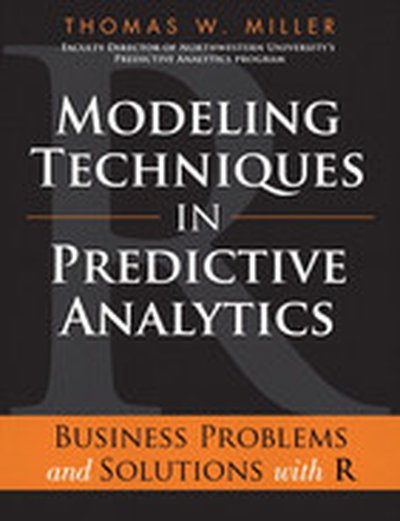
Today, successful firms compete and win based on analytics. Modeling Techniques in brings together all the concepts, techniques, and R code you need to excel in any role involving analytics. Thomas W. Miller’s unique balanced approach combines business context Predictive Analytics and quantitative tools, appealing to managers, analysts, programmers, and students alike. Miller addresses multiple business challenges and business cases, including segmentation, brand positioning, product choice modeling, pricing research, finance, sports, text analytics, sentiment analysis, and social network analysis. He illuminates the use of cross-sectional data, time series, spatial, and even spatio-temporal data. For each problem, Miller explains why the problem matters, what data is relevant, how to explore your data once you’ve identified it, and then how to successfully model that data. You’ll learn how to model data conceptually, with words and figures; and then how to model it with realistic R programs that deliver actionable insights and knowledge. Miller walks you through model construction, explanatory variable subset selection, and validation, demonstrating best practices for improving out-of-sample predictive performance. He employs data visualization and statistical graphics in exploring data, presenting models, and evaluating performance. All example code is presented in R, today’s #1 system for applied statistics, statistical research, and predictive modeling; code is set apart from other text so it’s easy to find for those who want it (and easy to skip for those who don’t).