talk-data.com talk-data.com

Topic

Data Governance

data_management compliance data_quality

38

tagged

Activity Trend

90 peak/qtr
2020-Q1 2026-Q1

Activities

Showing filtered results

Filtering by: Databricks DATA + AI Summit 2023 ×
Databricks Customers at Data + AI Summit

At this year's event, over 250 customers shared their data and AI journies. They showcased a wide variety of use cases, best practices and lessons from their leadership and innovation with the latest data and AI technologies.

See how enterprises are leveraging generative AI in their data operations and how innovative data management and data governance are fueling organizations as they race to develop GenAI applications. https://www.databricks.com/blog/how-real-world-enterprises-are-leveraging-generative-ai

To see more real-world use cases and customer success stories, visit: https://www.databricks.com/customers

Data + AI Summit Keynote Day 1 - Full
video
by Patrick Wendall (Databricks) , Fei-Fei Li (Stanford University) , Brian Ames (General Motors) , Ken Wong (Databricks) , Ali Ghodsi (Databricks) , Jackie Brosamer (Block) , Reynold Xin (Databricks) , Jensen Huang (NVIDIA)

Databricks Data + AI Summit 2024 Keynote Day 1

Experts, researchers and open source contributors — from Databricks and across the data and AI community gathered in San Francisco June 10 - 13, 2024 to discuss the latest technologies in data management, data warehousing, data governance, generative AI for the enterprise, and data in the era of AI.

Hear from Databricks Co-founder and CEO Ali Ghodsi on building generative AI applications, putting your data to work, and how data + AI leads to data intelligence.

Plus a fireside chat between Ali Ghodsi and Nvidia Co-founder and CEO, Jensen Huang, on the expanded partnership between Nvidia and Databricks to accelerate enterprise data for the era of generative AI

Product announcements in the video include: - Databricks Data Intelligence Platform - Native support for NVIDIA GPU acceleration on the Databricks Data Intelligence Platform - Databricks open source model DBRX available as an NVIDIA NIM microservice - Shutterstock Image AI powered by Databricks - Databricks AI/BI - Databricks LakeFlow - Databricks Mosaic AI - Mosaic AI Agent Framework - Mosaic AI Agent Evaluation - Mosaic AI Tools Catalog - Mosaic AI Model Training - Mosaic AI Gateway

In this keynote hear from: - Ali Ghodsi, Co-founder and CEO, Databricks (1:45) - Brian Ames, General Motors (29:55) - Patrick Wendall, Co-founder and VP of Engineering, Databricks (38:00) - Jackie Brosamer, Head of AI, Data and Analytics, Block (1:14:42) - Fei Fei Li, Professor, Stanford University and Denning Co-Director, Stanford Institute for Human-Centered AI (1:23:15) - Jensen Huang, Co-founder and CEO of NVIDIA with Ali Ghodsi, Co-founder and CEO of Databricks (1:42:27) - Reynold Xin, Co-founder and Chief Architect, Databricks (2:07:43) - Ken Wong, Senior Director, Product Management, Databricks (2:31:15) - Ali Ghodsi, Co-founder and CEO, Databricks (2:48:16)

Distributing Data Governance: How Unity Catalog Allows for a Collaborative Approach

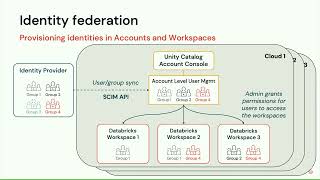
As one of the world’s largest providers of content delivery network (CDN) and security solutions, Akamai owns thousands of data assets of various shapes and sizes, some even go up to multiple PBs. Several departments within the company leverage Databricks for their data and AI workloads, which means we have over a hundred Databricks workspaces within a single Databricks account, where some of the assets are shared across products, and some are product-specific.

In this presentation, we will describe how to use the capabilities of Unity Catalog to distribute the administration burden between departments, while still maintaining a unified governance model.

We will also share the benefits we’ve found in using Unity Catalog, beyond just access management, such as:

  • Visibility into which data assets we have in the organization
  • Ability to identify and potentially eliminate duplicate data workloads between departments
  • Removing boilerplate code for accessing external sources
  • Increasing innovation of product teams by exposing the data assets in a better, more efficient way

Talk by: Gilad Asulin and Pulkit Chadha

Connect with us: Website: https://databricks.com Twitter: https://twitter.com/databricks LinkedIn: https://www.linkedin.com/company/databricks Instagram: https://www.instagram.com/databricksinc Facebook: https://www.facebook.com/databricksinc

Multicloud Data Governance on the Databricks Lakehouse

Across industries, a multicloud setup has quickly become the reality for large organizations. Multi-cloud introduces new governance challenges as permissions models often do not translate from one cloud to the other and if they do, are insufficiently granular to accommodate privacy requirements and principles of least privilege. This problem can be especially acute for data and AI workloads that rely on sharing and aggregating large and diverse data sources across business unit boundaries and where governance models need to incorporate assets such as table rows/columns and ML features and models.

In this session, we will provide guidelines on how best to overcome these challenges for companies that have adopted the Databricks Lakehouse as their collaborative space for data teams across the organization, by exploiting some of the unique product features of the Databricks platform. We will focus on a common scenario: a data platform team providing data assets to two different ML teams, one using the same cloud and the other one using a different cloud.

We will explain the step-by-step setup of a unified governance model by leveraging the following components and conventions:

  • Unity Catalog for implementing fine-grained access control across all data assets: files in cloud storage, rows and columns in tables and ML features and models
  • The Databricks Terraform provider to automatically enforce guardrails and permissions across clouds
  • Account level SSO Integration and identity federation to centralize administer access across workspaces
  • Delta sharing to seamlessly propagate changes in provider data sets to consumers in near real-time
  • Centralized audit logging for a unified view on what asset was accessed by whom

Talk by: Ioannis Papadopoulos and Volker Tjaden

Connect with us: Website: https://databricks.com Twitter: https://twitter.com/databricks LinkedIn: https://www.linkedin.com/company/databricks Instagram: https://www.instagram.com/databricksinc Facebook: https://www.facebook.com/databricksinc
Sponsored: Impetus | Accelerating ADP’s Business Transformation w/ a Modern Enterprise Data Platform

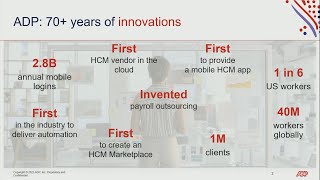
Learn How ADP’s Enterprise Data Platform Is used to drive direct monetization opportunities, differentiate its solutions, and improve operations. ADP is continuously searching for ways to increase innovation velocity, time-to-market, and improve the overall enterprise efficiency. Making data and tools available to teams across the enterprise while reducing data governance risk is the key to making progress on all fronts. Learn about ADP’s enterprise data platform that created a single source of truth with centralized tools, data assets, and services. It allowed teams to innovate and gain insights by leveraging cross-enterprise data and central machine learning operations.

Explore how ADP accelerated creation of the data platform on Databricks and AWS, achieve faster business outcomes, and improve overall business operations. The session will also cover how ADP significantly reduced its data governance risk, elevated the brand by amplifying data and insights as a differentiator, increased data monetization, and leveraged data to drive human capital management differentiation.

Talk by: Chetan Kalanki and Zaf Babin

Here’s more to explore: State of Data + AI Report: https://dbricks.co/44i2HBp The Data Team's Guide to the Databricks Lakehouse Platform: https://dbricks.co/46nuDpI

Connect with us: Website: https://databricks.com Twitter: https://twitter.com/databricks LinkedIn: https://www.linkedin.com/company/databricks Instagram: https://www.instagram.com/databricksinc Facebook: https://www.facebook.com/databricksinc
Enabling Data Governance at Enterprise Scale Using Unity Catalog

Amgen has invested in building modern, cloud-native enterprise data and analytics platforms over the past few years with a focus on tech rationalization, data democratization, overall user experience, increase reusability, and cost-effectiveness. One of these platforms is our Enterprise Data Fabric which focuses on pulling in data across functions and providing capabilities to integrate and connect the data and govern access. For a while, we have been trying to set up robust data governance capabilities which are simple, yet easy to manage through Databricks. There were a few tools in the market that solved a few immediate needs, but none solved the problem holistically. For use cases like maintaining governance on highly restricted data domains like Finance and HR, a long-term solution native to Databricks and addressing the below limitations was deemed important:

The way these tools were set up, allowed the overriding of a few security policies

  • Tools were not UpToDate with the latest DBR runtime
  • Complexity of implementing fine-grained security
  • Policy management – AWS IAM + In tool policies

To address these challenges, and for large-scale enterprise adoption of our governance capability, we started working on UC integration with our governance processes. With an aim to realize the following tech benefits:

  • Independent of Databricks runtime
  • Easy fine-grained access control
  • Eliminated management of IAM roles
  • Dynamic access control using UC and dynamic views

Today, using UC, we have to implement fine-grained access control & governance for the restricted data of Amgen. We are in the process of devising a realistic migration & change management strategy across the enterprise.

Talk by: Lakhan Prajapati and Jaison Dominic

Connect with us: Website: https://databricks.com Twitter: https://twitter.com/databricks LinkedIn: https://www.linkedin.com/company/databricks Instagram: https://www.instagram.com/databricksinc Facebook: https://www.facebook.com/databricksinc

Instacart on Why Engineers Shouldn't Write Data Governance Policies

Controlling permissions for accessing data assets can be messy, time consuming, and usually a combination of both. The teams responsible for creating the business rules that govern who should have access to what data are usually different from the teams responsible for administering the grants to achieve that access. On the other side of the equation, the end user who needs access to a data asset may be left waiting for grants to be made as the decision is passed between teams. That is, if they even know the correct path to getting access in the first place.

Separating the concerns of managing data governance at a business level and implementing data governance at an engineering level is the best way to clarify data access permissions. In practice, this involves building systems to enable data governance enforcement based on business rules, with little to no understanding of the individual system where the data lives.

In practice, with a concrete business rule, such as “only users from the finance team should have access to critical financial data,” we want a system that deals only with those constituent concepts. For example, “the data is marked as critical financial” and “the user is a part of the finance team.” By abstracting away any source system components, such as “the tables in the finance schema” and “someone who’s a member of the finance Databricks group,” the access policies applied will then model the business rules as closely as possible.

This session will focus on how to establish and align the processes, policies, and stakeholders involved in making this type of system work seamlessly. Sharing the experience and learnings of our team at Instacart, we will aim to help attendees streamline and simplify their data security and access strategies.

Talk by: Kieran Taylor and Andria Fuquen

Connect with us: Website: https://databricks.com Twitter: https://twitter.com/databricks LinkedIn: https://www.linkedin.com/company/databricks Instagram: https://www.instagram.com/databricksinc Facebook: https://www.facebook.com/databricksinc
Increasing Data Trust: Enabling Data Governance on Databricks Using Unity Catalog & ML-Driven MDM

As part of Comcast Effectv’s transformation into a completely digital advertising agency, it was key to develop an approach to manage and remediate data quality issues related to customer data so that the sales organization is using reliable data to enable data-driven decision making. Like many organizations, Effectv's customer lifecycle processes are spread across many systems utilizing various integrations between them. This results in key challenges like duplicate and redundant customer data that requires rationalization and remediation. Data is at the core of Effectv’s modernization journey with the intended result of winning more business, accelerating order fulfillment, reducing make-goods and identifying revenue.

In partnership with Slalom Consulting, Comcast Effectv built a traditional lakehouse on Databricks to ingest data from all of these systems but with a twist; they anchored every engineering decision in how it will enable their data governance program.

In this session, we will touch upon the data transformation journey at Effectv and dive deeper into the implementation of data governance leveraging Databricks solutions such as Delta Lake, Unity Catalog and DB SQL. Key focus areas include how we baked master data management into our pipelines by automating the matching and survivorship process, and bringing it all together for the data consumer via DBSQL to use our certified assets in bronze, silver and gold layers.

By making thoughtful decisions about structuring data in Unity Catalog and baking MDM into ETL pipelines, you can greatly increase the quality, reliability, and adoption of single-source-of-truth data so your business users can stop spending cycles on wrangling data and spend more time developing actionable insights for your business.

Talk by: Maggie Davis and Risha Ravindranath

Connect with us: Website: https://databricks.com Twitter: https://twitter.com/databricks LinkedIn: https://www.linkedin.com/company/databricks Instagram: https://www.instagram.com/databricksinc Facebook: https://www.facebook.com/databricksinc
Lineage System Table in Unity Catalog

Unity Catalog provides fully automated data lineage for all workloads in SQL, R, Python, Scala and across all asset types at Databricks. The aggregated view has been available to end users through data explorer and API. In this session, we are excited to share that lineage is available via delta table in their UC metastore. It stores full history of recent lineage records and it is near real time. Additionally, customers can query it through standard SQL interface. With that, customers can get significant operational insights about their workload for impact analysis, troubleshooting, quality assurance, data discovery, and data governance.

Together with the system table platform effort, which provides query history, job run operational data, audit logs and more, lineage table will be a critical piece to link all the data asset and entity asset together, providing better lakehouse observability and unification to customers.

Talk by: Menglei Sun

Connect with us: Website: https://databricks.com Twitter: https://twitter.com/databricks LinkedIn: https://www.linkedin.com/company/databricks Instagram: https://www.instagram.com/databricksinc Facebook: https://www.facebook.com/databricksinc
How Mars Achieved a People Analytics Transformation with a Modern Data Stack

People Analytics at Mars was formed two years ago as part of an ambitious journey to transform our HR analytics capabilities. To transform, we needed to build foundational services to provide our associates with helpful insights through fast results and resolving complex problems. Critical in that foundation are data governance and data enablement which is the responsibility of the Mars People Data Office team whose focus is to deliver high quality and reliable data that is reusable for current and future People Analytics use cases. Come learn how this team used Databricks in helping Mars achieve its People Analytics Transformation.

Talk by: Rachel Belino and Sreeharsha Alagani

Here’s more to explore: State of Data + AI Report: https://dbricks.co/44i2HBp The Data Team's Guide to the Databricks Lakehouse Platform: https://dbricks.co/46nuDpI

Connect with us: Website: https://databricks.com Twitter: https://twitter.com/databricks LinkedIn: https://www.linkedin.com/company/databricks Instagram: https://www.instagram.com/databricksinc Facebook: https://www.facebook.com/databricksinc
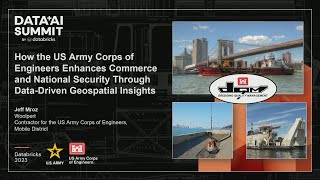
US Army Corp of Engineers Enhanced Commerce & National Sec Through Data-Driven Geospatial Insight

The US Army Corps of Engineers (USACE) is responsible for maintaining and improving nearly 12,000 miles of shallow-draft (9'-14') inland and intracoastal waterways, 13,000 miles of deep-draft (14' and greater) coastal channels, and 400 ports, harbors, and turning basins throughout the United States. Because these components of the national waterway network are considered assets to both US commerce and national security, they must be carefully managed to keep marine traffic operating safely and efficiently.

The National DQM Program is tasked with providing USACE a nationally standardized remote monitoring and documentation system across multiple vessel types with timely data access, reporting, dredge certifications, data quality control, and data management. Government systems have often lagged commercial systems in modernization efforts, and the emergence of the cloud and Data Lakehouse Architectures have empowered USACE to successfully move into the modern data era.

This session incorporates aspects of these topics: Data Lakehouse Architecture: Delta Lake, platform security and privacy, serverless, administration, data warehouse, Data Lake, Apache Iceberg, Data Mesh GIS: H3, MOSAIC, spatial analysis data engineering: data pipelines, orchestration, CDC, medallion architecture, Databricks Workflows, data munging, ETL/ELT, lakehouses, data lakes, Parquet, Data Mesh, Apache Spark™ internals. Data Streaming: Apache Spark Structured Streaming, real-time ingestion, real-time ETL, real-time ML, real-time analytics, and real-time applications, Delta Live Tables. ML: PyTorch, TensorFlow, Keras, scikit-learn, Python and R ecosystems data governance: security, compliance, RMF, NIST data sharing: sharing and collaboration, delta sharing, data cleanliness, APIs.

Talk by: Jeff Mroz

Connect with us: Website: https://databricks.com Twitter: https://twitter.com/databricks LinkedIn: https://www.linkedin.com/company/databricks Instagram: https://www.instagram.com/databricksinc Facebook: https://www.facebook.com/databricksinc
Advanced Governance with Collibra on Databricks

A data lake is only as good as its governance. Understanding what data you have, performing classification, defining/applying security policies and auding how it's used is the data governance lifecycle. Unity Catalog with its rich ecosystem of supported tools simplifies all stages of the data governance lifecycle. Learn how metadata can be hydrated, into Collibra directly from Unity Catalog. Once the metadata is available in Collibra we will demonstrate classification, defining security policies on the data and pushing those policies into Databricks. All access and usage of data is automatically audited with real time lineage provided in the data explorer as well as system tables.

Talk by: Leon Eller and Antonio Castelo

Connect with us: Website: https://databricks.com Twitter: https://twitter.com/databricks LinkedIn: https://www.linkedin.com/company/databricks Instagram: https://www.instagram.com/databricksinc Facebook: https://www.facebook.com/databricksin

Post-Merger: Implementing Unity Catalog Across Multiple Accounts

Warner Media and Discovery have recently merged to form Warner Bros Discovery. Owning two Databricks accounts and wanting to maintain their separation, our data governance team has successfully implemented Unity Catalog as our data governance solution across both accounts, allowing our teams to collaboratively and securely use the data assets of two organizations collaboratively and securely.

This session is aimed at sharing that success story, including initial challenges, our approach, our architecture, the actual implementation, and user success post-implementation.

Talk by: Ramprasad Koya and Susheel Lakshmipathi

Connect with us: Website: https://databricks.com Twitter: https://twitter.com/databricks LinkedIn: https://www.linkedin.com/company/databricks Instagram: https://www.instagram.com/databricksinc Facebook: https://www.facebook.com/databricksinc
What’s New With Platform Security and Compliance in the Databricks Lakehouse Platform

At Databricks, we know that data is one of your most valuable assets and alwasys must be protected, that’s why security is built into every layer of the Databricks Lakehouse Platform. Databricks provides comprehensive security to protect your data and workloads, such as encryption, network controls, data governance and auditing.

In this session, you will hear from Databricks product leaders on the platform security and compliance progress made over the past year, with demos on how administrators can start protecting workloads fast. You will also learn more about the roadmap that delivers on the Databricks commitment to you as the most trusted, compliant, and secure data and AI platform with the Databricks Lakehouse.

Talk by: Samrat Ray and David Veuve

Connect with us: Website: https://databricks.com Twitter: https://twitter.com/databricks LinkedIn: https://www.linkedin.com/company/databricks Instagram: https://www.instagram.com/databricksinc Facebook: https://www.facebook.com/databricksin

Future Data Access Control: Booz Allen Hamilton’s Way of Securing Databricks Lakehouse with Immuta

In this talk, I’ll review how we utilize Attribute-Based Access Control (ABAC) to enforce policy via Immuta. I’ll discuss the differences between the ABAC and legacy Role-Based Access Control (RBAC) approaches to control access and how the RBAC approach is not sufficient to keep up with today’s growing big data market. With so much data available, there also comes substantial risk. Data can contain many sensitive data elements, including PII and PHI. Industry leaders like Databricks are pushing the boundaries of data technology, which leads to constantly evolving data use cases. And that’s a good thing. However, the RBAC approach is struggling to keep up with those advancements.

So what is RBAC? It’s an approach to data access that permits system access based on the end-user’s role. For legacy systems, it’s meant as a simple but effective approach to securing data. Are you a manager? Then you’ll get access to data meant for managers. This is great for small deployments with clearly defined roles. Here at Booz Allen, we invested in Databricks because we have an environment of over 30 thousand users and billions of rows of data.

To mitigate this problem and align with our forward-thinking company standard, we introduced Immuta into our stack. Immuta uses ABAC to allow for dynamic data access control. Users are automatically assigned certain attributes, and access is based on those attributes instead of just their role. This allows for more flexibility and allows data access control to easily scale without the need to constantly map a user to their role. Using attributes, we can write policies in one place and have them applied across all our data platforms. This makes for a truly holistic data governance approach and provides immediate ROI and time savings for the company.

Talk by: Jeffrey Hess

Connect with us: Website: https://databricks.com Twitter: https://twitter.com/databricks LinkedIn: https://www.linkedin.com/company/databricks Instagram: https://www.instagram.com/databricksinc Facebook: https://www.facebook.com/databricksinc
Lakehouse Architecture to Advance Security Analytics at the Department of State

In 2023, the Department of State surged forward on implementing a lakehouse architecture to get faster, smarter, and more effective on cybersecurity log monitoring and incident response. In addition to getting us ahead of federal mandates, this approach promises to enable advanced analytics and machine learning across our highly federated global IT environment while minimizing costs associated with data retention and aggregation.

This talk will include a high-level overview of the technical and policy challenge and a technical deeper dive on the tactical implementation choices made. We’ll share lessons learned related to governance and securing organizational support, connecting between multiple cloud environments, and standardizing data to make it useful for analytics. And finally, we’ll discuss how the lakehouse leverages Databricks in multicloud environments to promote decentralized ownership of data while enabling strong, centralized data governance practices.

Talk by: Timothy Ahrens and Edward Moe

Connect with us: Website: https://databricks.com Twitter: https://twitter.com/databricks LinkedIn: https://www.linkedin.com/company/databricks Instagram: https://www.instagram.com/databricksinc Facebook: https://www.facebook.com/databricksinc
Sponsored: KPMG | Multicloud Enterprise Delta Sharing & Governance using Unity Catalog @ S&P Global

Cloud technologies have revolutionized global data access across a number of industries. However, many enterprise organizations face challenges in adopting these technologies effectively, as comprehensive cloud data governance strategies and solutions are complex and evolving – particularly in hybrid or multicloud scenarios involving multiple third parties. KPMG and S&P Global have harnessed the power of Databricks Lakehouse to create a novel approach.

By integrating Unity Catalogue, Delta Sharing, and the KPMG Modern Data Platform, S&P Global has enabled scalable, transformative cross-enterprise data sharing and governance. This demonstration highlights a collaboration between S&P Global Sustainable1 (S1) ESG program and the KPMG ESG Analytics Accelerators to enable large-scale SFDR ESG portfolio analytics. Join us to discover our solution that drives transformative change, fosters data-driven decision-making, and bolsters sustainability efforts in a wide range of industries.

Talk by: Niels Hanson,Dennis Tally

Here’s more to explore: A New Approach to Data Sharing: https://dbricks.co/44eUnT1

Connect with us: Website: https://databricks.com Twitter: https://twitter.com/databricks LinkedIn: https://www.linkedin.com/company/databricks Instagram: https://www.instagram.com/databricksinc Facebook: https://www.facebook.com/databricksinc
Databricks As Code:Effectively Automate a Secure Lakehouse Using Terraform for Resource Provisioning

At Rivian, we have automated more than 95% of our Databricks resource provisioning workflows using an in-house Terraform module, affording us a lean admin team to manage over 750 users. In this session, we will cover the following elements of our approach and how others can benefit from improved team efficiency.

  • User and service principal management
  • Our permission model on Unity Catalog for data governance
  • Workspace and secrets resource management
  • Managing internal package dependencies using init scripts
  • Facilitating dashboards, SQL queries and their associated permissions
  • Scaling source of truth Petabyte scale Delta Lake table ingestion jobs and workflows

Talk by: Jason Shiverick and Vadivel Selvaraj

Connect with us: Website: https://databricks.com Twitter: https://twitter.com/databricks LinkedIn: https://www.linkedin.com/company/databricks Instagram: https://www.instagram.com/databricksinc Facebook: https://www.facebook.com/databricksinc
A Technical Deep Dive into Unity Catalog's Practitioner Playbook

Get ready to take a deep dive into Unity Catalog and explore how it can simplify data, analytics and AI governance across multiple clouds. In this session, take a deep dive into Unity Catalog and the expert Databricks team will guide you through a hands-on demo, showcasing the latest features and best practices for data governance. You'll learn how to master Unity Catalog and gain a practical understanding of how it can streamline your analytics and AI initiatives. Whether you're migrating from Hive Metastore or just looking to expand your knowledge of Unity Catalog, this session is for you. Join us for a practical, hands-on deep dive into Unity Catalog and learn how to achieve seamless data governance while following best practices for data, analytics and AI governance.

Talk by: Zeashan Pappa and Ifigeneia Derekli

Connect with us: Website: https://databricks.com Twitter: https://twitter.com/databricks LinkedIn: https://www.linkedin.com/company/databricks Instagram: https://www.instagram.com/databricksinc Facebook: https://www.facebook.com/databricksin