talk-data.com talk-data.com

Topic

Dataflow

Google Cloud Dataflow

data_processing stream_processing google_cloud

4

tagged

Activity Trend

8 peak/qtr
2020-Q1 2026-Q1

Activities

Showing filtered results

Filtering by: O'Reilly Data Engineering Books ×
Data Engineering with Google Cloud Platform - Second Edition

Data Engineering with Google Cloud Platform is your ultimate guide to building scalable data platforms using Google Cloud technologies. In this book, you will learn how to leverage products such as BigQuery, Cloud Composer, and Dataplex for efficient data engineering. Expand your expertise and gain practical knowledge to excel in managing data pipelines within the Google Cloud ecosystem. What this Book will help me do Understand foundational data engineering concepts using Google Cloud Platform. Learn to build and manage scalable data pipelines with tools such as Dataform and Dataflow. Explore advanced topics like data governance and secure data handling in Google Cloud. Boost readiness for Google Cloud data engineering certification with real-world exam guidance. Master cost-effective strategies and CI/CD practices for data engineering on Google Cloud. Author(s) Adi Wijaya, the author of this book, is a Data Strategic Cloud Engineer at Google with extensive experience in data engineering and the Google Cloud ecosystem. With his hands-on expertise, he emphasizes practical solutions and in-depth knowledge sharing, guiding readers through the intricacies of Google Cloud for data engineering success. Who is it for? This book is ideal for data analysts, IT practitioners, software engineers, and data enthusiasts aiming to excel in data engineering. Whether you're a beginner tackling fundamental concepts or an experienced professional exploring Google Cloud's advanced capabilities, this book is designed for you. It bridges your current skills with modern data engineering practices on Google Cloud, making it a valuable resource at any stage of your career.
Data Engineering with Google Cloud Platform

In 'Data Engineering with Google Cloud Platform', you'll explore how to construct efficient, scalable data pipelines using GCP services. This hands-on guide covers everything from building data warehouses to deploying machine learning pipelines, helping you master GCP's ecosystem. What this Book will help me do Build comprehensive data ingestion and transformation pipelines using BigQuery, Cloud Storage, and Dataflow. Design end-to-end orchestration flows with Airflow and Cloud Composer for automated data processing. Leverage Pub/Sub for building real-time event-driven systems and streaming architectures. Gain skills to design and manage secure data systems with IAM and governance strategies. Prepare for and pass the Professional Data Engineer certification exam to elevate your career. Author(s) Adi Wijaya is a seasoned data engineer with significant experience in Google Cloud Platform products and services. His expertise in building data systems has equipped him with insights into the real-world challenges data engineers face. Adi aims to demystify technical topics and deliver practical knowledge through his writing, helping tech professionals excel. Who is it for? This book is tailored for data engineers and data analysts who want to leverage GCP for building efficient and scalable data systems. Readers should have a beginner-level understanding of topics like data science, Python, and Linux to fully benefit from the material. It is also suitable for individuals preparing for the Google Professional Data Engineer exam. The book is a practical companion for enhancing cloud and data engineering skills.

AI and Big Data on IBM Power Systems Servers

Abstract As big data becomes more ubiquitous, businesses are wondering how they can best leverage it to gain insight into their most important business questions. Using machine learning (ML) and deep learning (DL) in big data environments can identify historical patterns and build artificial intelligence (AI) models that can help businesses to improve customer experience, add services and offerings, identify new revenue streams or lines of business (LOBs), and optimize business or manufacturing operations. The power of AI for predictive analytics is being harnessed across all industries, so it is important that businesses familiarize themselves with all of the tools and techniques that are available for integration with their data lake environments. In this IBM® Redbooks® publication, we cover the best practices for deploying and integrating some of the best AI solutions on the market, including: IBM Watson Machine Learning Accelerator (see note for product naming) IBM Watson Studio Local IBM Power Systems™ IBM Spectrum™ Scale IBM Data Science Experience (IBM DSX) IBM Elastic Storage™ Server Hortonworks Data Platform (HDP) Hortonworks DataFlow (HDF) H2O Driverless AI We map out all the integrations that are possible with our different AI solutions and how they can integrate with your existing or new data lake. We also walk you through some of our client use cases and show you how some of the industry leaders are using Hortonworks, IBM PowerAI, and IBM Watson Studio Local to drive decision making. We also advise you on your deployment options, when to use a GPU, and why you should use the IBM Elastic Storage Server (IBM ESS) to improve storage management. Lastly, we describe how to integrate IBM Watson Machine Learning Accelerator and Hortonworks with or without IBM Watson Studio Local, how to access real-time data, and security. Note: IBM Watson Machine Learning Accelerator is the new product name for IBM PowerAI Enterprise. Note: Hortonworks merged with Cloudera in January 2019. The new company is called Cloudera. References to Hortonworks as a business entity in this publication are now referring to the merged company. Product names beginning with Hortonworks continue to be marketed and sold under their original names.

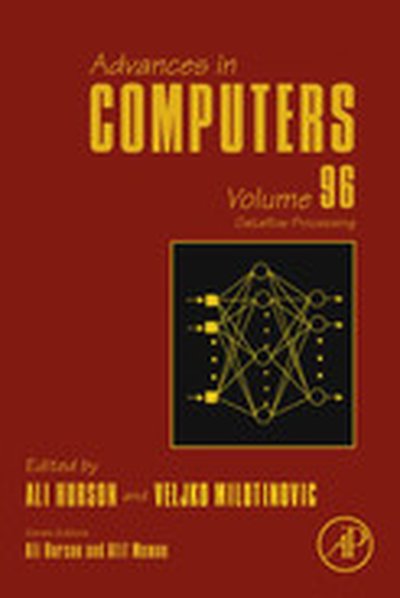
Dataflow Processing

Since its first volume in 1960, Advances in Computers has presented detailed coverage of innovations in computer hardware, software, theory, design, and applications. It has also provided contributors with a medium in which they can explore their subjects in greater depth and breadth than journal articles usually allow. As a result, many articles have become standard references that continue to be of significant, lasting value in this rapidly expanding field. In-depth surveys and tutorials on new computer technology Well-known authors and researchers in the field Extensive bibliographies with most chapters Many of the volumes are devoted to single themes or subfields of computer science