To achieve agentic optimization, D&A leaders must invest in active metadata and data ecosystems, develop FinOps maturity, and train AI models. This foundation enables efficient, automated decision-making for deploying and optimizing D&A resources. This session explores how these areas intersect, offering a holistic view of agentic capabilities, impacts and risks. Go beyond targeted agents and think big!
 talk-data.com
Topic
FinOps
finops
cloud_billing
53
tagged
Activity Trend
11
peak/qtr
2020-Q1
2026-Q2
Top Events
Data + AI Summit 2025
6
Microsoft Ignite 2025
6
Powering-up FinOps
5
Women in FinOps
4
Google Cloud Next '24
4
gartner-data-analytics-us-2026
3
Straight Data Talk
3
Secrets of Data Analytics Leaders
3
Google Cloud Next '25
3
gartner-data-analytics-uk-2025
3
FinOps sur Databricks (2/2)
2
Monster-Meeting Rhein-Main Januar 2026
1
D&A leaders struggle to prioritize and justify data management spend, especially amid cloud-driven cost unpredictability. Value stream analysis links data production to direct and indirect business outcomes, driving quantifiable benefits. This session will link core research on cost management and FinOps with a means of using active metadata to measure value resulting in holistic cost optimization.
AI spending continues unabated and so is the pressure on leaders. CIOs need to demonstrate the value of AI. CFOs need to calculate it. The c-suite needs to collaborate to create real value. Here we present Gartner's framework for a rigorous, repeatable approach to financial operations (FinOps) of AI initiatives. The focus is on the economics of business value, cost and risk of AI, GenAI and agentic AI.
Vortrag

Whether you have basic or mature cloud cost management practices in your organization, AI workloads add specific considerations. Learn how AI usage correlates to cost, what to monitor, and how to drive accountability for your AI investment, with Azure tools and industry best practices.
Discover how AI is transforming cloud operations in Azure. In this lab, you’ll use AI to investigate anomalies, correlate telemetry, and strengthen your monitoring posture. With Copilot's new agentic capabilities for optimization, you’ll identify and validate cost and carbon savings opportunities while advancing FinOps and sustainability practices. Together, these capabilities help you align workload health, streamline operations, and deliver lasting efficiency and sustainability.
Please RSVP and arrive at least 5 minutes before the start time, at which point remaining spaces are open to standby attendees.
FinOps has evolved from visibility to optimization and now to action. As AI workloads introduce new cost complexities, organizations can no longer afford analysis paralysis or endless dashboards. Enter FinOps 3.0: a shift where cost intelligence is embedded directly into engineering workflows, insights are contextual and role specific, and automation becomes a trusted ally rather than a leap of faith. Learn how to innovate faster, smarter, and more sustainably in the cloud in this session.
Discover how AI is transforming cloud operations in Azure. In this lab, you’ll use AI to investigate anomalies, correlate telemetry, and strengthen your monitoring posture. With Copilot's new agentic capabilities for optimization, you’ll identify and validate cost and carbon savings opportunities while advancing FinOps and sustainability practices. Together, these capabilities help you align workload health, streamline operations, and deliver lasting efficiency and sustainability.
Please RSVP and arrive at least 5 minutes before the start time, at which point remaining spaces are open to standby attendees.
Discover how AI is transforming cloud operations in Azure. In this lab, you’ll use AI to investigate anomalies, correlate telemetry, and strengthen your monitoring posture. With Copilot's new agentic capabilities for optimization, you’ll identify and validate cost and carbon savings opportunities while advancing FinOps and sustainability practices. Together, these capabilities help you align workload health, streamline operations, and deliver lasting efficiency and sustainability.
Please RSVP and arrive at least 5 minutes before the start time, at which point remaining spaces are open to standby attendees.
Refactoring our data warehouse from a legacy system with spaghetti-like model relationships into a medallion architecture, we implemented model labelling for improved finops. This allowed us to optimise queries, eliminate redundancies, and deliver faster results with greater team efficiency, providing more value to internal users.
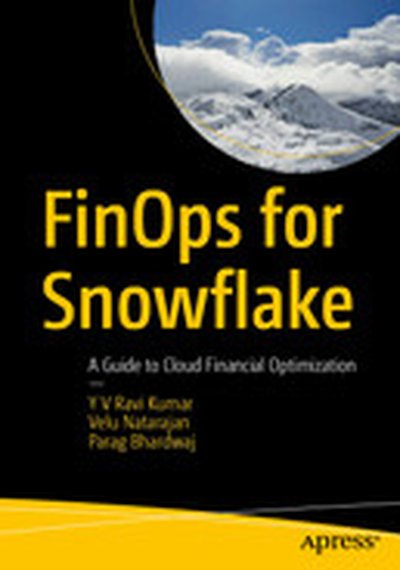
Unlock the full financial potential of your Snowflake environment. Learn how to cut costs, boost performance, and take control of your cloud data spend with FinOps for Snowflake—your essential guide to implementing a smart, automated, and Snowflake-optimized FinOps strategy. In today’s data-driven world, financial optimization on platforms like Snowflake is more critical than ever. Whether you're just beginning your FinOps journey or refining mature practices, this book provides a practical roadmap to align Snowflake usage with business goals, reduce costs, and improve performance—without compromising agility. Grounded in real-world case studies and packed with actionable strategies, FinOps for Snowflake shows how leading organizations are transforming their environments through automation, governance, and cost intelligence. You'll learn how to apply proven techniques for architecture tuning, workload and storage efficiency, and performance optimization—empowering you to make smarter, data-driven decisions. What You Will Learn Master FinOps principles tailored for Snowflake’s architecture and pricing model Enable collaboration across finance, engineering, and business teams Deliver real-time cost insights for smarter decision-making Optimize compute, storage, and Snowflake AI and ML services for efficiency Leverage Snowflake Cortex AI and Adoptive Warehouse/Compute for intelligent cost governance Apply proven strategies to achieve operational excellence and measurable savings Who this Book is For Data professionals, cloud engineers, FinOps practitioners, and finance teams seeking to improve cost visibility, operational efficiency, and financial accountability in Snowflake environments.
Discover how customers improved Snowflake consumption efficiency, accelerated time-to-market for new use cases, and enabled their organization with data-driven decision-making. In this session, we will walk through actionable insights on crafting a FinOps strategy to align cost efficiency with business goals, Building capabilities across the Visibility, Control, and Optimize phases of the FinOps framework, empowering people and processes for cost governance and operational excellence and leveraging Snowflake-native tools and third-party solutions for optimization.
Alors que de plus en plus d’entreprises passent de l’expérimentation au déploiement à grande échelle, la gestion des coûts - et donc du ROI - reste un défi souvent sous-estimé. De l’évaluation globale du TCO (direct et indirect) à l’optimisation via les FinOps, l’enjeu est d’abord culturel. À partir de retours d’expérience concrets, nous partagerons des clés pour garder le contrôle sur les coûts Data & IA.
by
Elliot Foreman
(ProsperOps)
,
Yuliia Tkachova
(Masthead Data)
,
Dumky de Wilde
(MotherDuck)
,
Andrew DeLave
(ProsperOps)
Elliot Foreman and Andrew DeLave from ProsperOps joined Yuliia and Dumky to discuss automated cloud cost optimization through commitment management. As Google go-to-market director and senior FinOps specialist, they explain how their platform manages over $4 billion in cloud spend by automating reserved instances, committed use discounts, and savings plans across AWS, Azure, and Google Cloud. The conversation covers the psychology behind commitment hesitation, break-even point mathematics for cloud discounts, workload volatility optimization, and why they avoid AI in favor of deterministic algorithms for financial decisions. They share insights on managing complex multi-cloud environments, the human vs automation debate in FinOps, and practical strategies for reducing cloud costs while mitigating commitment risks.
Come learn about the latest tools to keep your team under budget and optimize your data ROI. Managing the costs of data consumption, attributing to projects, and understanding TCO is top of mind for customers. We will discuss implementing FinOps, observability around cost management. Workloads, consumption, users, what they worked on - and how to optimize it all.
The session will cover how to use Unity Catalog governed system tables to understand what is happening in Databricks. We will touch on key scenarios for FinOps, DevOps and SecOps to ensure you have a well-observed Data Intelligence Platform. Learn about new developments in system tables and other features that will help you observe your Databricks instance.
Westat, a leader in data-driven research for 60 years+, has implemented a centralized Databricks platform to support hundreds of research projects for government, foundations, and private clients. This initiative modernizes Westat’s technical infrastructure while maintaining rigorous statistical standards and streamlining data science. The platform enables isolated project environments with strict data boundaries, centralized oversight, and regulatory compliance. It allows project-specific customization of compute and analytics, and delivers scalable computing for complex analyses. Key features include config-driven Infrastructure as Code (IaC) with Terragrunt, custom tagging and AWS cost integration for ROI tracking, budget policies with alerts for proactive cost management, and a centralized dashboard with row-level security for self-service cost analytics. This unified approach provides full financial visibility and governance while empowering data teams to deliver value. Audio for this session is delivered in the conference mobile app, you must bring your own headphones to listen.
This session is repeated. You’ve seen your usage grow on Databricks, across departments, use cases, product lines and users. What can you do to ensure your end-users (data practitioners) of the platform remain cost-efficient and productive, while staying accountable to your budget? We’ll discuss spend monitoring, chargeback models and developing a culture of cost efficiency by using Databricks tools.