Lightning talk focusing on FinOps by Adedeji Owalesi.
 talk-data.com
Topic
FinOps
finops
cloud_billing
53
tagged
Activity Trend
11
peak/qtr
2020-Q1
2026-Q2
Top Events
Data + AI Summit 2025
6
Microsoft Ignite 2025
6
Powering-up FinOps
5
Women in FinOps
4
Google Cloud Next '24
4
gartner-data-analytics-us-2026
3
Straight Data Talk
3
Secrets of Data Analytics Leaders
3
Google Cloud Next '25
3
gartner-data-analytics-uk-2025
3
FinOps sur Databricks (2/2)
2
Monster-Meeting Rhein-Main Januar 2026
1
Lightning talk focusing on FinOps by Alex Long.
Lightning talk focusing on FinOps by Reggie Kelley.
by
Leslie Nolan
(CME Group)
,
Scott Johnson
(Equifax)
,
Wallace Suleiman
(SAP)
,
Daniel Pettibone
(Google Cloud)
,
Eric Lam
(Google Cloud)
Google Cloud FinOps, a collaborative approach to managing costs and maximizing efficiency, has emerged as a critical strategy for cloud transformation. We’ll discuss the top five generative AI use cases poised to drive the adoption of cloud FinOps, including cost anomaly detection, financial forecasting, and cost optimization. Industry leaders from Equifax, SAP, and CME Group will join the spotlight to share their strategies and experiences to help you create better cloud FinOps practices with AI.
Click the blue “Learn more” button above to tap into special offers designed to help you implement what you are learning at Google Cloud Next 25.
Get practical advice to improve your cloud financial operations. Join us to learn about new features to avoid unexpected expenses and extract more value from your cloud investment.
Click the blue “Learn more” button above to tap into special offers designed to help you implement what you are learning at Google Cloud Next 25.
With the emergence of generative AI and the dazzling success it has achieved in just a few months, companies are asking a lot of questions about the relevance of AI and its fields of application overall domains. After DevOps, FinOps or even DevSecOps, it was time to attach the term AI to the profession of ops to give birth to AIOps practices where we will use AI to help ops on a daily basis and enable them to win considerable time with prevention, optimization or even smart assistance in their everyday work.
Click the blue “Learn more” button above to tap into special offers designed to help you implement what you are learning at Google Cloud Next 25.
Cost efficiency continues to drive IT decision-making, while businesses are simultaneously compelled to innovate using transformational technologies such as generative AI and CPU-based inferencing. In this session, you’ll learn how customers use the latest Google Cloud products powered by fourth-gen AMD EPYC™ processors to lower cloud operating costs, streamline FinOps, and make room in the budget for new applications.
By attending this session, your contact information may be shared with the sponsor for relevant follow up for this event only.
Click the blue “Learn more” button above to tap into special offers designed to help you implement what you are learning at Google Cloud Next 25.
This talk was recorded at Crunch Conference 2022. Zoltán and Gergely from Aliz.ai company spoke about FinOps examples using Google Cloud BigQuery.
"In this talk we will talk about the basics of FinOps concept and going to make an introduction to it through real life examples using BigQuery."
The event was organized by Crafthub.
You can watch the rest of the conference talks on our channel.
If you are interested in more speakers, tickets and details of the conference, check out our website: https://crunchconf.com/ If you are interested in more events from our company: https://crafthub.events/
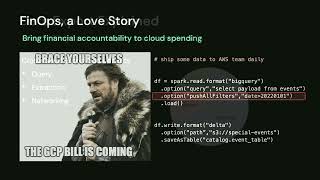
This session begins with data warehouse trivia and lessons learned from production implementations of multicloud data architecture. You will learn to design future-proof low latency data systems that focus on openness and interoperability. You will also gain a gentle introduction to Cloud FinOps principles that can help your organization reduce compute spend and increase efficiency.
Most enterprises today are multicloud. While an assortment of low-code connectors boasts the ability to make data available for analytics in real time, they post long-lasting challenges:
- Inefficient EDW targets
- Inability to evolve schema
- Forbiddingly expensive data exports due to cloud and vendor lock-in
The alternative is an open data lake that unifies batch and streaming workloads. Bronze landing zones in open format eliminate the data extraction costs required by proprietary EDW. Apache Spark™ Structured Streaming provides a unified ingestion interface. Streaming triggers allow us to switch back and forth between batch and stream with one-line code changes. Streaming aggregation enables us to incrementally compute on data that arrives near each other.
Specific examples are given on how to use Autoloader to discover newly arrived data and ensure exactly once, incremental processing. How DLT can be configured effectively to further simplify streaming jobs and accelerate the development cycle. How to apply SWE best practices to Workflows and integrate with popular Git providers, either using the Databricks Project or Databricks Terraform provider.
Talk by: Christina Taylor
Here’s more to explore: Big Book of Data Engineering: 2nd Edition: https://dbricks.co/3XpPgNV The Data Team's Guide to the Databricks Lakehouse Platform: https://dbricks.co/46nuDpI
Connect with us: Website: https://databricks.com Twitter: https://twitter.com/databricks LinkedIn: https://www.linkedin.com/company/databricks Instagram: https://www.instagram.com/databricksinc Facebook: https://www.facebook.com/databricksinc
Dan O'Brien and Kevin Petrie discuss FinOps, which is a cost governance discipline for cloud-based analytics and operational projects.
As enterprises grow more dependent on the cloud and as the economy convulses, FinOps will soon become mandatory. Published at: https://www.eckerson.com/articles/the-rise-of-finops-cost-governance-for-cloud-based-analytics
Data observability provides intelligence about data quality and data pipeline performance, contributing to the disciplines of DataOps and FinOps. Vendors such as DataKitchen, DataOps.live, Informatica, and Unravel offer solutions to help enterprises address these overlapping disciplines. Published at: https://www.eckerson.com/articles/the-blending-disciplines-of-data-observability-dataops-and-finops
This demo showcases Finout’s ability to manage and optimize cloud spend across Azure and services like Kubernetes, Datadog, and OpenAI. It highlights Finout’s unified “MegaBill” view for exploring Azure resources, subscriptions, and tags. The session introduces Virtual Tags for dynamic, rules-based cost allocation and covers shared cost distribution, dashboards, anomaly detection, and alerting—empowering teams to improve Azure cost efficiency.