talk-data.com talk-data.com

Topic

JSON

JavaScript Object Notation (JSON)

data_format lightweight web_development file_format

10

tagged

Activity Trend

9 peak/qtr
2020-Q1 2026-Q1

Activities

Showing filtered results

Filtering by: O'Reilly SQL Books ×
SQL for Data Analytics - Fourth Edition

Dive into the world of data analytics with 'SQL for Data Analytics'. This book takes you beyond simple query writing to teach you how to use SQL to analyze, interpret, and derive actionable insights from real-world data. By the end, you'll build technical skills that allow you to solve complex problems and demonstrate results using data. What this Book will help me do Understand how to create, manage, and utilize structured databases for analytics. Use advanced SQL techniques such as window functions and subqueries effectively. Analyze various types of data like geospatial, JSON, and time-series data in SQL. Apply statistical principles within the context of SQL for enhanced insights. Automate data workflows and presentations using SQL and Python integration. Author(s) The authors Jun Shan, Haibin Li, Matt Goldwasser, Upom Malik, and Benjamin Johnston bring together a wealth of knowledge in data analytics, database management, and applied statistics. Together, they aim to empower readers through clear explanations, practical examples, and a focus on real-world applicability. Who is it for? This book is aimed at data professionals and learners such as aspiring data analysts, backend developers, and anyone involved in data-driven decision-making processes. The ideal reader has a basic understanding of SQL and mathematics and is eager to extend their skills to tackle real-world data challenges effectively.

SQL Server 2025 Unveiled: The AI-Ready Enterprise Database with Microsoft Fabric Integration

Unveil the data platform of the future with SQL Server 2025—guided by one of its key architects . With built-in AI for application development and advanced analytics powered by Microsoft Fabric, SQL Server 2025 empowers you to innovate—securely and confidently. This book shows you how. Author Bob Ward, Principal Architect for the Microsoft Azure Data team, shares exclusive insights drawn from over three decades at Microsoft. Having worked on every version of SQL Server since OS/2 1.1, Ward brings unmatched expertise and practical guidance to help you navigate this transformative release. Ward covers everything from setup and upgrades to advanced features in performance, high availability, and security. He also highlights what makes this the most developer-friendly release in a decade: support for JSON, RegEx, REST APIs, and event streaming. Most critically, Ward explores SQL Server 2025’s advanced, scalable AI integrations, showing you how to build AI-powered applications deeply integrated with the SQL engine—and elevate your analytics to the next level. But innovation doesn’t come at the cost of safety: this release is built on a foundation of enterprise-grade security, helping you adopt AI safely and responsibly. You control which models to use, how they interact with your data, and where they run—from ground to cloud, or integrated with Microsoft Fabric. With built-in features like Row-Level Security (RLS), Transparent Data Encryption (TDE), Dynamic Data Masking, and SQL Server Auditing, your data remains protected at every layer. The AI age is here. Make sure your SQL Server databases are ready—and built for secure, scalable innovation . What You Will Learn [if !supportLists] · [endif]Grasp the fundamentals of AI to leverage AI with your data, using the industry-proven security and scale of SQL Server [if !supportLists] · [endif]Utilize AI models of your choice, services, and frameworks to build new AI applications [if !supportLists] · [endif]Explore new developer features such as JSON, Regular Expressions, REST API, and Change Event Streaming [if !supportLists] · [endif]Discover SQL Server 2025's powerful new engine capabilities to increase application concurrency [if !supportLists] · [endif]Examine new high availability features to enhance uptime and diagnose complex HADR configurations [if !supportLists] · Use new query processing capabilities to extend the performance of your application [if !supportLists] · [endif]Connect SQL Server to Azure with Arc for advanced management and security capabilities [if !supportLists] · [endif]Secure and govern your data using Microsoft Entra [if !supportLists] · [endif]Achieve near-real-time analytics with the unified data platform Microsoft Fabric [if !supportLists] · [endif]Integrate AI capabilities with SQL Server for enterprise AI [if !supportLists] · [endif]Leverage new tools such as SQL Server Management Studio and Copilot experiences to assist your SQL Server journey Who This Book Is For The SQL Server community, including DBAs, architects, and developers eager to stay ahead with the latest advancements in SQL Server 2025, and those interested in the intersection of AI and data, particularly how artificial intelligence (AI) can be seamlessly integrated with SQL Server to unlock deeper insights and smarter solutions

Fuzzy Data Matching with SQL

If you were handed two different but related sets of data, what tools would you use to find the matches? What if all you had was SQL SELECT access to a database? In this practical book, author Jim Lehmer provides best practices, techniques, and tricks to help you import, clean, match, score, and think about heterogeneous data using SQL. DBAs, programmers, business analysts, and data scientists will learn how to identify and remove duplicates, parse strings, extract data from XML and JSON, generate SQL using SQL, regularize data and prepare datasets, and apply data quality and ETL approaches for finding the similarities and differences between various expressions of the same data. Full of real-world techniques, the examples in the book contain working code. You'll learn how to: Identity and remove duplicates in two different datasets using SQL Regularize data and achieve data quality using SQL Extract data from XML and JSON Generate SQL using SQL to increase your productivity Prepare datasets for import, merging, and better analysis using SQL Report results using SQL Apply data quality and ETL approaches to finding similarities and differences between various expressions of the same data

SQL Query Design Patterns and Best Practices

This book, "SQL Query Design Patterns and Best Practices," provides a thorough and practical exploration of SQL query techniques that focus on efficiency, clarity, and maintainability. By learning and applying the patterns and methodologies outlined in this guide, readers will enhance their ability to solve complex data problems, optimize query performance, and work effectively with modern data platforms. What this Book will help me do Learn how to write efficient SQL queries by optimizing result sets, enabling better handling of large datasets. Master advanced SQL techniques, including the use of common table expressions and window functions for solving real-world challenges. Gain insights into query optimization with tools like query execution plans and indexes to boost database performance. Understand the interaction of modern data types such as JSON and their integration in SQL workflows. Organize and document SQL queries effectively using tools such as Jupyter notebooks for collaborative and reproducible work. Author(s) The authors of this book are seasoned SQL professionals with rich experience in database management and optimization. Steven Hughes, Ram Babu Singh, Shabbir Mala, and others bring their deep knowledge in SQL query practices and real-world problem-solving to this guide. With a commitment to helping readers harness the power of SQL, the authors have crafted content that is both technically robust and approachable for learners. Who is it for? This book is designed for SQL practitioners ranging from beginners to intermediate levels, including SQL developers, data analysts, and database enthusiasts. If you aim to refine your SQL skills, optimize query designs, and tackle complex data challenges, this book will serve as your reliable companion. Novice readers will quickly build a strong foundation, while experienced professionals will find valuable techniques to enhance their workflow.

SQL for Data Analytics - Third Edition

SQL for Data Analytics is an accessible guide to helping readers efficiently use SQL for data analytics tasks. You will learn the ins and outs of writing SQL queries, preparing datasets, and utilizing advanced features like geospatial data handling and window functions. Demystify the process of harnessing SQL to tackle analytical data challenges in a structured and hands-on way. What this Book will help me do Become proficient in preparing and managing datasets using SQL. Learn to write efficient SQL queries for summarizing and analyzing data. Master advanced SQL features, including window functions and JSON handling. Optimize SQL queries and automate analytical tasks for efficiency. Gain practical experience analyzing data with real-world scenarios. Author(s) The authors, Jun Shan, Matt Goldwasser, Upom Malik, and Benjamin Johnston, are experienced professionals in data analytics and database management. They bring a blend of technical expertise and practical insights to teaching SQL for analytics. Their collective knowledge ensures that the book caters to all levels, from foundational concepts to advanced techniques. Who is it for? This book is ideal for database engineers transitioning into analytics, backend engineers looking to deepen their understanding of production data, and data scientists or business analysts seeking to boost their SQL analytics skills. Readers should have a basic grasp of SQL and familiarity with statistics and linear algebra to fully benefit from the contents.

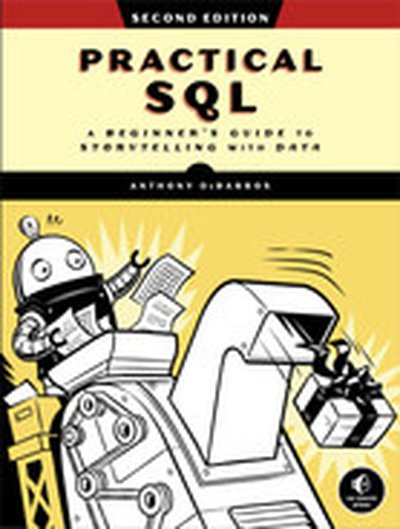
Practical SQL, 2nd Edition

Practical SQL is an approachable and fast-paced guide to SQL (Structured Query Language), the standard programming language for defining, organizing, and exploring data in relational databases. Anthony DeBarros, a journalist and data analyst, focuses on using SQL to find the story within your data. The examples and code use the open-source database PostgreSQL and its companion pgAdmin interface, and the concepts you learn will apply to most database management systems, including MySQL, Oracle, SQLite, and others.* You’ll first cover the fundamentals of databases and the SQL language, then build skills by analyzing data from real-world datasets such as US Census demographics, New York City taxi rides, and earthquakes from US Geological Survey. Each chapter includes exercises and examples that teach even those who have never programmed before all the tools necessary to build powerful databases and access information quickly and efficiently. You’ll learn how to: •Create databases and related tables using your own data •Aggregate, sort, and filter data to find patterns •Use functions for basic math and advanced statistical operations •Identify errors in data and clean them up •Analyze spatial data with a geographic information system (PostGIS) •Create advanced queries and automate tasks This updated second edition has been thoroughly revised to reflect the latest in SQL features, including additional advanced query techniques for wrangling data. This edition also has two new chapters: an expanded set of instructions on for setting up your system plus a chapter on using PostgreSQL with the popular JSON data interchange format. Learning SQL doesn’t have to be dry and complicated. Practical SQL delivers clear examples with an easy-to-follow approach to teach you the tools you need to build and manage your own databases. * Microsoft SQL Server employs a variant of the language called T-SQL, which is not covered by Practical SQL.

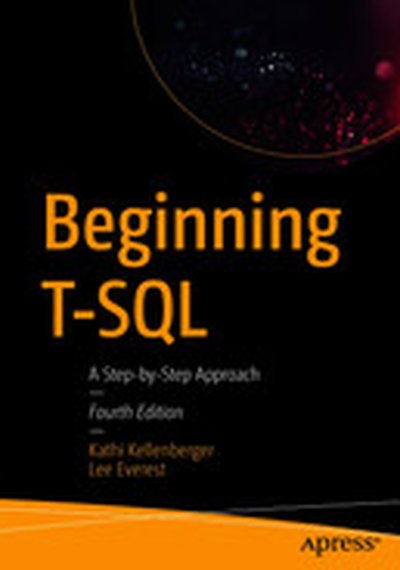
Beginning T-SQL: A Step-by-Step Approach

Get a performance-oriented introduction to the T-SQL language underlying the Microsoft SQL Server and Azure SQL database engines. This fourth edition is updated to include SQL Notebooks as well as up-to-date syntax and features for T-SQL on-premises and in the Azure cloud. Exercises and examples now include the WideWorldImporters database, the newest sample database from Microsoft for SQL Server. Also new in this edition is coverage of JSON from T-SQL, news about performance enhancements called Intelligent Query Processing, and an appendix on running SQL Server in a container on macOS or Linux. Beginning T-SQL starts you on the path to mastering T-SQL with an emphasis on best practices. Using the sound coding techniques taught in this book will lead to excellent performance in the queries that you write in your daily work. Important techniques such as windowing functions are covered to help you write fast-executing queries that solve real business problems.The book begins with an introduction to databases, normalization, and to setting up your learning environment. You will learn about the tools you need to use such as SQL Server Management Studio, Azure Data Studio, and SQL Notebooks. Each subsequent chapter teaches an aspect of T-SQL, building on the skills learned in previous chapters. Exercises in most chapters provide an opportunity for the hands-on practice that leads to true learning and distinguishes the competent professional. A stand-out feature in this book is that most chapters end with a Thinking About Performance section. These sections cover aspects of query performance relative to the content just presented, including the new Intelligent Query Processing features that make queries faster without changing code. They will help you avoid beginner mistakes by knowing about and thinking about performance from day 1. What You Will Learn Install a sandboxed SQL Server instance for learning Understand how relational databases are designed Create objects such as tables and stored procedures Query a SQL Server table Filter and order the results of a query Query and work with specialized data types such as XML and JSON Apply modern features such as window functions Choose correct techniques so that your queries perform well Who This Book Is For Anyone who wants to learn T-SQL from the beginning or improve their T-SQL skills; those who need T-SQL as an additional skill; and those who write queries such as application developers, database administrators, business intelligence developers, and data scientists. The book is also helpful for anyone who must retrieve data from a SQL Server database.

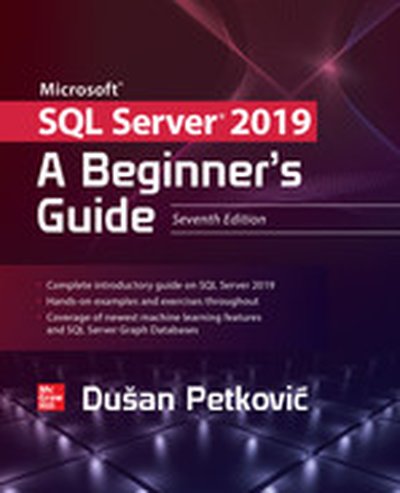
Microsoft SQL Server 2019: A Beginner's Guide, Seventh Edition, 7th Edition

Publisher's Note: Products purchased from Third Party sellers are not guaranteed by the publisher for quality, authenticity, or access to any online entitlements included with the product. Get Up to Speed on Microsoft® SQL Server® 2019 Quickly and Easily Start working with Microsoft SQL Server 2019 in no time with help from this thoroughly revised, practical resource. Filled with real-world examples and hands-on exercises, Microsoft SQL Server 2019: A Beginner’s Guide, Seventh Edition starts by explaining fundamental relational database system concepts. From there, you’ll learn how to write Transact-SQL statements, execute simple and complex database queries, handle system administration and security, and use powerful analysis and reporting tools. New topics such as SQL and JSON support, graph databases, and support for machine learning with R and Python are also covered in this step-by-step tutorial. • Install, configure, and customize Microsoft SQL Server 2019 • Create and modify database objects with Transact-SQL statements • Write stored procedures and user-defined functions • Handle backup and recovery, and automate administrative tasks • Tune your database system for optimal availability and reliability • Secure your system using authentication, encryption, and authorization • Work with SQL Server Analysis Services, Reporting Services, and other BI tools • Gain knowledge of relational storage, presentation, and retrieval of data stored in the JSON format • Manage graphs using SQL Server Graph Databases • Learn about machine learning support for R and Python

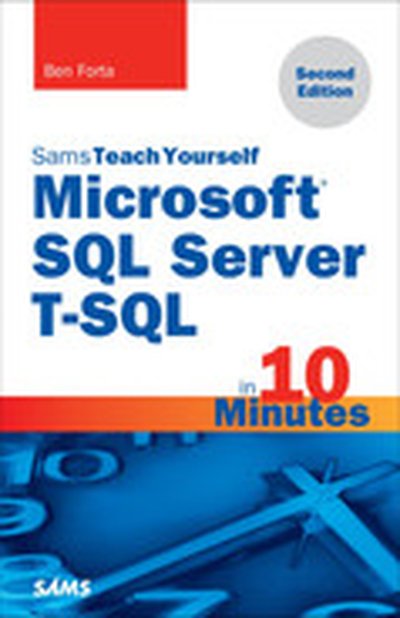
Sams Teach Yourself Microsoft® SQL Server T-SQL in 10 Minutes, Second Edition

Sams Teach Yourself Microsoft SQL Server T-SQL in 10 Minutes offers straightforward, practical answers when you need fast results. By working through the book’s 30 lessons of 10 minutes or less, you’ll learn what you need to know to take advantage of Microsoft SQL Server’s T-SQL language. This handy pocket guide starts with simple data retrieval and moves on to more complex topics, including the use of joins, subqueries, full text-based searches, functions and stored procedures, cursors, triggers, table constraints, XML, JSON, and much more. Learn how to… Use T-SQL in the Microsoft SQL Server environment Construct complex T-SQL statements using multiple clauses and operators Filter data so you get the information you need quickly Retrieve, sort, and format database contents Join two or more related tables Make SQL Server work for you with globalization and localization Create subqueries to pinpoint your data Automate your workload with triggers Create and alter database tables Work with views, stored procedures, and more Contents at a Glance 1 Understanding SQL 2 Introducing SQL Server 3 Working with SQL Server 4 Retrieving Data 5 Sorting Retrieved Data 6 Filtering Data 7 Advanced Data Filtering 8 Using Wildcard Filtering 9 Creating Calculated Fields 10 Using Data Manipulation Functions 11 Summarizing Data 12 Grouping Data 13 Working with Subqueries 14 Joining Tables 15 Creating Advanced Joins 16 Combining Queries 17 Full-Text Searching 18 Inserting Data 19 Updating and Deleting Data 20 Creating and Manipulating Tables 21 Using Views 22 Programming with T-SQL 23 Working with Stored Procedures 24 Using Cursors 25 Using Triggers 26 Managing Transaction Processing 27 Working with XML and JSON 28 Globalization and Localization 29 Managing Security 30 Improving Performance A The Example Tables B T-SQL Statement Syntax C T-SQL Datatypes D T-SQL Reserved Words

Pro SQL Server Internals, Second Edition

Improve your ability to develop, manage, and troubleshoot SQL Server solutions by learning how different components work "under the hood," and how they communicate with each other. The detailed knowledge helps in implementing and maintaining high-throughput databases critical to your business and its customers. You'll learn how to identify the root cause of each problem and understand how different design and implementation decisions affect performance of your systems. New in this second edition is coverage of SQL Server 2016 Internals, including In-Memory OLTP, columnstore enhancements, Operational Analytics support, Query Store, JSON, temporal tables, stretch databases, security features, and other improvements in the new SQL Server version. The knowledge also can be applied to Microsoft Azure SQL Databases that share the same code with SQL Server 2016. Pro SQL Server Internals is a book for developers and database administrators, and it covers multiple SQL Server versions starting with SQL Server 2005 and going all the way up to the recently released SQL Server 2016. The book provides a solid road map for understanding the depth and power of the SQL Server database server and teaches how to get the most from the platform and keep your databases running at the level needed to support your business. The book: Provides detailed knowledge of new SQL Server 2016 features and enhancements Includes revamped coverage of columnstore indexes and In-Memory OLTP Covers indexing and transaction strategies Shows how various database objects and technologies are implemented internally, and when they should or should not be used Demonstrates how SQL Server executes queries and works with data and transaction log What You Will Learn Design and develop database solutions with SQL Server. Troubleshoot design, concurrency, and performance issues. Choose the right database objects and technologies for the job. Reduce costs and improve availability and manageability. Design disaster recovery and high-availability strategies. Improve performance of OLTP and data warehouse systems through in-memory OLTP and Columnstore indexes. Who This Book Is For Developers and database administrators who want to design, develop, and maintain systems in a way that gets the most from SQL Server. This book is an excellent choice for people who prefer to understand and fix the root cause of a problem rather than applying a 'band aid' to it.