Join us to learn customer-proven strategies for AI-powered innovation and modernization, leveraging the best of public cloud, edge, sovereign, and cross-cloud infrastructure and services. See how leaders are achieving real business outcomes faster and more cost-effectively in industries like retail, healthcare, and even the most stringent regulated industries. Plus, see how Gemini is dramatically simplifying and reimagining cloud as we know it.
Click the blue “Learn more” button above to tap into special offers designed to help you implement what you are learning at Google Cloud Next 25.
 talk-data.com
Topic
LLM
Large Language Models (LLM)
nlp
ai
machine_learning
1405
tagged
Activity Trend
158
peak/qtr
2020-Q1
2026-Q2
Top Events
Check out Google’s recommended architecture for bringing agents to your products, powered by Gemini, Firebase, Google Cloud, and Angular.
Join Rackspace as we explore the "Power of Three", Microsoft Co-pilot in Power Platform, Microsoft 365, and Azure OpenAI. Through real-world use cases, discover the potential of agent-based solutions, using conversational AI assistants to revolutionize knowledge management, customer service, and business process automation that can integrate, retrieve, and act on data securely from diverse enterprise systems. See Rackspace Intelligent Technology Assistant (RITA) in action.
Build an AI-powered image detection game with Vertex AI in Firebase and Flutter. Begin to draw an object and watch Gemini analyze your doodle in real time and guess what you’re drawing. All in 20 seconds!
APIs dominate the web, accounting for the majority of all internet traffic. And more AI means more APIs, because they act as an important mechanism to move data into and out of AI applications, AI agents, and large language models (LLMs). So how can you make sure all of these APIs are secure? In this session, we’ll take you through OWASP’s top 10 API and LLM security risks, and show you how to mitigate these risks using Google Cloud’s security portfolio, including Apigee, Model Armor, Cloud Armor, Google Security Operations, and Security Command Center.
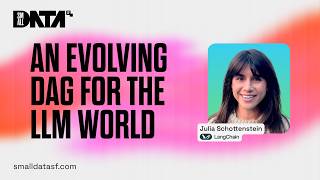
Directed Acyclic Graphs (DAGs) are the foundation of most orchestration frameworks. But what happens when you allow an LLM to act as the router? Acyclic graphs now become cyclic, which means you have to design for the challenges resulting from all this extra power. We'll cover the ins and outs of agentic applications and how to best use them in your work as a data practitioner or developer building today.
➡️ Follow Us LinkedIn: https://www.linkedin.com/company/small-data-sf/ X/Twitter : https://twitter.com/smalldatasf Website: https://www.smalldatasf.com/
Discover LangChain, the open-source framework for building powerful agentic systems. Learn how to augment LLMs with your private data, moving beyond their training cutoffs. We'll break down how LangChain uses "chains," which are essentially Directed Acyclic Graphs (DAGs) similar to data pipelines you might recognize from dbt. This structure is perfect for common patterns like Retrieval Augmented Generation (RAG), where you orchestrate steps to fetch context from a vector database and feed it to an LLM to generate an informed response, much like preparing data for analysis.
Dive into the world of AI agents, where the LLM itself determines the application's control flow. Unlike a predefined DAG, this allows for dynamic, cyclic graphs where an agent can iterate and improve its response based on previous attempts. We'll explore the core challenges in building reliable agents: effective planning and reflection, managing shared memory across multiple agents in a cognitive architecture, and ensuring reliability against task ambiguity. Understand the critical trade-offs between the dependability of static chains and the flexibility of dynamic LLM agents.
Introducing LangGraph, a framework designed to solve the agent reliability problem by balancing agent control with agency. Through a live demo in LangGraph Studio, see how to build complex AI applications using a cyclic graph. We'll demonstrate how a router agent can delegate tasks, execute a research plan with multiple steps, and use cycles to iterate on a problem. You'll also see how human-in-the-loop intervention can steer the agent for improved performance, a critical feature for building robust and observable agentic systems.
Explore some of the most exciting AI agents in production today. See how Roblox uses an AI assistant to generate virtual worlds from a prompt, how TripAdvisor’s agent acts as a personal travel concierge to create custom itineraries, and how Replit’s coding agent automates code generation and pull requests. These real-world examples showcase the practical power of moving from simple DAGs to dynamic, cyclic graphs for solving complex, agentic problems.
Did you know? You only need One API to Rule Them All! Google's Gen AI SDK provides a simple path to both the Gemini API and Vertex AI!
Play a game of pinball to learn about how Model Armor can protect your LLM app. Shoot shots to send prompts to Gemini, and watch as Model Armor detects and blocks prohibited prompts and responses.
Streamline data analytics workflows with AI assistance. Enhance data team productivity and reduce costs.
The Automotive AI Agent, powered by Gemini and Vertex AI, uses natural conversations to deliver intelligent responses and create next-generation vehicle experiences. The AI agent provides contextualized responses that keep up with your schedule and needs.
In the age of AI, SAP supercharges it’s portfolio with natively embedded AI features, AI agents, access to 40+ LLMs, and tools for developers to increase productivity. Developers find GitHub Copilot in VS Code invaluable in assisting with code writing in popular languages. With SAP's domain-specific Advanced Business Application Programming (ABAP) language, developers can work in its ecosystem through writing code in ABAP. SAP is now making a fine-tuned ABAP AI model available to help developers
This hands-on lab equips you with the practical skills to build and deploy a real-world AI-powered chat application leveraging the Gemini LLM APIs. You'll learn to containerize your application using Cloud Build, deploy it seamlessly to Cloud Run, and explore how to interact with the Gemini LLM to generate insightful responses. This hands-on experience will provide you with a solid foundation for developing engaging and interactive conversational applications.
If you register for a Learning Center lab, please ensure that you sign up for a Google Cloud Skills Boost account for both your work domain and personal email address. You will need to authenticate your account as well (be sure to check your spam folder!). This will ensure you can arrive and access your labs quickly onsite. You can follow this link to sign up!
This hands-on lab empowers you to build a cutting-edge multimodal question answering system using Google's Vertex AI and the powerful Gemini family of models. By constructing this system from the ground up, you'll gain a deep understanding of its inner workings and the advantages of incorporating visual information into Retrieval Augmented Generation (RAG). This hands-on experience equips you with the knowledge to customize and optimize your own multimodal question answering systems, unlocking new possibilities for knowledge discovery and reasoning.
If you register for a Learning Center lab, please ensure that you sign up for a Google Cloud Skills Boost account for both your work domain and personal email address. You will need to authenticate your account as well (be sure to check your spam folder!). This will ensure you can arrive and access your labs quickly onsite. You can follow this link to sign up!
Connecting LLMs to your secure, operational database involves complexity, security risks, and hallucinations. This session shows how to build context-aware AI agents directly on your existing data, going from live database to production-ready, secure AI agent in hours. You'll see how to ship personalized experiences that will define the next generation of software. RavenDB's CEO will demonstrate this approach.
It's finally possible to bring the awesome power of Large Language Models (LLMs) to your laptop. This talk will explore how to run and leverage small, openly available LLMs to power common tasks involving data, including selecting the right models, practical use cases for running small models, and best practices for deploying small models effectively alongside databases.
Bio: Jeffrey Morgan is the founder of Ollama, an open-source tool to get up and run large language models. Prior to founding Ollama, Jeffrey founded Kitematic, which was acquired by Docker and evolved into Docker Desktop. He has previously worked at companies including Docker, Twitter, and Google.
➡️ Follow Us LinkedIn: https://www.linkedin.com/company/small-data-sf/ X/Twitter : https://twitter.com/smalldatasf Website: https://www.smalldatasf.com/
Discover how to run large language models (LLMs) locally using Ollama, the easiest way to get started with small AI models on your Mac, Windows, or Linux machine. Unlike massive cloud-based systems, small open source models are only a few gigabytes, allowing them to run incredibly fast on consumer hardware without network latency. This video explains why these local LLMs are not just scaled-down versions of larger models but powerful tools for developers, offering significant advantages in speed, data privacy, and cost-effectiveness by eliminating hidden cloud provider fees and risks.
Learn the most common use case for small models: combining them with your existing factual data to prevent hallucinations. We dive into retrieval augmented generation (RAG), a powerful technique where you augment a model's prompt with information from a local data source. See a practical demo of how to build a vector store from simple text files and connect it to a model like Gemma 2B, enabling you to query your own data using natural language for fast, accurate, and context-aware responses.
Explore the next frontier of local AI with small agents and tool calling, a new feature that empowers models to interact with external tools. This guide demonstrates how an LLM can autonomously decide to query a DuckDB database, write the correct SQL, and use the retrieved data to answer your questions. This advanced tutorial shows you how to connect small models directly to your data engineering workflows, moving beyond simple chat to create intelligent, data-driven applications.
Get started with practical applications for small models today, from building internal help desks to streamlining engineering tasks like code review. This video highlights how small and large models can work together effectively and shows that open source models are rapidly catching up to their cloud-scale counterparts. It's never been a better time for developers and data analysts to harness the power of local AI.
Build Google Workspace add-ons to simplify your work or integrate your platform with ours. Use Gemini to start building on Workspace today.
Building an assistant capable of answering complex, company-specific questions and executing workflows requires first building a powerful Retrieval Augmented Generation (RAG) system. Founding engineer Eddie Zhou explains how Glean built its RAG system on Google Cloud— combining a domain-adapted search engine with dynamic prompts to harness the full capabilities of Gemini's reasoning engine. By attending this session, your contact information may be shared with the sponsor for relevant follow up for this event only.
Click the blue “Learn more” button above to tap into special offers designed to help you implement what you are learning at Google Cloud Next 25.
Access books or research papers worldwide – can Gemini seamlessly weave together info, summarize, and answer detailed questions with a long context window?
Discover how Apigee and Advanced API Security can help you stay protected from OWASP Top 10 API Security risks, and how to adopt a layered API security approach using Apigee and Cloud Armor together. You’ll also see how Apigee can send API security incident information to Google SecOps for centralized triage and correlation, and serve as an enforcement point for Model Armor to sanitize prompts and responses for LLMs fronted by APIs.
Transform vehicle operational data into actionable intelligence. Reduce maintenance downtime, optimize fleet operations, and make data-driven decisions through interactive diagnostics using Gemini models and BigQuery.