talk-data.com talk-data.com

Topic

Omni

Omni Analytics

bi data_visualization reporting

5

tagged

Activity Trend

7 peak/qtr
2020-Q1 2026-Q1

Activities

5 activities · Newest first

AWS re:Invent 2025 - [NEW LAUNCH] Amazon Nova 2 Omni: A new frontier in multimodal AI (AIM3324)

Amazon Nova 2 Omni is our most advanced and unified multimodal foundation model designed specifically for enterprise applications. It is the industry’s first reasoning model that processes text, images, video, and speech inputs while natively generating both text and images. Whether you're interested in creative workflows, customer experience, or enterprise productivity, this session will demonstrate how Nova 2 Omni’s unified multimodal architecture can drive innovation in your organization.

Learn more: More AWS events: https://go.aws/3kss9CP

Subscribe: More AWS videos: http://bit.ly/2O3zS75 More AWS events videos: http://bit.ly/316g9t4

ABOUT AWS: Amazon Web Services (AWS) hosts events, both online and in-person, bringing the cloud computing community together to connect, collaborate, and learn from AWS experts. AWS is the world's most comprehensive and broadly adopted cloud platform, offering over 200 fully featured services from data centers globally. Millions of customers—including the fastest-growing startups, largest enterprises, and leading government agencies—are using AWS to lower costs, become more agile, and innovate faster.
AWSreInvent #AWSreInvent2025 #AWS

AI for BI without the BS

Stuck on a treadmill of endless report building requests? Wondering how you can ship reliable AI products to internal users and even customers? Omni is a BI and embedded analytics platform on Databricks that lets users answer their own data questions – sometimes with a little AI help. No magic, no miracles – just smart tooling that cuts through the noise and leverages well-known concepts (semantic layer, anyone?) to improve accuracy and delight users. This talk is your blueprint for getting reliable AI use cases into production and reaching the promised land of contagious self-service.

Coalesce 2024: Move fast with dbt: Bringing speed back to your analytics workflow

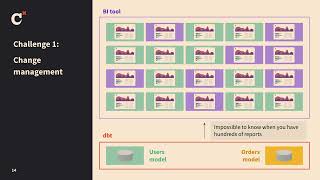
The workflow between dbt and BI is slowing us down. A simple change in dbt can require multiple teams to coordinate and hours of manual work to fix broken content. Valuable time is spent managing disconnected analytics tools that should work together seamlessly.

It’s time to tip the scales back toward speed — without compromising control. In this session, we’ll discuss how dbt and BI should work together. We’ll show you a workflow for moving fast in your BI tool, while still maintaining control of your data model in dbt.

Speaker: Chris Merrick Co-Founder & CTO Omni Analytics

Read the blog to learn about the latest dbt Cloud features announced at Coalesce, designed to help organizations embrace analytics best practices at scale https://www.getdbt.com/blog/coalesce-2024-product-announcements

The Future is Open: Data Streaming in an Omni-Cloud Reality

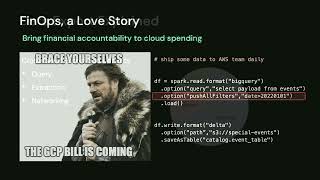
This session begins with data warehouse trivia and lessons learned from production implementations of multicloud data architecture. You will learn to design future-proof low latency data systems that focus on openness and interoperability. You will also gain a gentle introduction to Cloud FinOps principles that can help your organization reduce compute spend and increase efficiency. 

Most enterprises today are multicloud. While an assortment of low-code connectors boasts the ability to make data available for analytics in real time, they post long-lasting challenges:

  • Inefficient EDW targets
  • Inability to evolve schema
  • Forbiddingly expensive data exports due to cloud and vendor lock-in

The alternative is an open data lake that unifies batch and streaming workloads. Bronze landing zones in open format eliminate the data extraction costs required by proprietary EDW. Apache Spark™ Structured Streaming provides a unified ingestion interface. Streaming triggers allow us to switch back and forth between batch and stream with one-line code changes. Streaming aggregation enables us to incrementally compute on data that arrives near each other.

Specific examples are given on how to use Autoloader to discover newly arrived data and ensure exactly once, incremental processing. How DLT can be configured effectively to further simplify streaming jobs and accelerate the development cycle. How to apply SWE best practices to Workflows and integrate with popular Git providers, either using the Databricks Project or Databricks Terraform provider. 

Talk by: Christina Taylor

Here’s more to explore: Big Book of Data Engineering: 2nd Edition: https://dbricks.co/3XpPgNV The Data Team's Guide to the Databricks Lakehouse Platform: https://dbricks.co/46nuDpI

Connect with us: Website: https://databricks.com Twitter: https://twitter.com/databricks LinkedIn: https://www.linkedin.com/company/databricks Instagram: https://www.instagram.com/databricksinc Facebook: https://www.facebook.com/databricksinc