talk-data.com talk-data.com

Topic

PyTorch

deep_learning machine_learning neural_networks

7

tagged

Activity Trend

16 peak/qtr
2020-Q1 2026-Q1

Activities

Showing filtered results

Filtering by: O'Reilly AI & ML Books ×
Hands-On Machine Learning with Scikit-Learn and PyTorch

The potential of machine learning today is extraordinary, yet many aspiring developers and tech professionals find themselves daunted by its complexity. Whether you're looking to enhance your skill set and apply machine learning to real-world projects or are simply curious about how AI systems function, this book is your jumping-off place. With an approachable yet deeply informative style, author Aurélien Géron delivers the ultimate introductory guide to machine learning and deep learning. Drawing on the Hugging Face ecosystem, with a focus on clear explanations and real-world examples, the book takes you through cutting-edge tools like Scikit-Learn and PyTorch—from basic regression techniques to advanced neural networks. Whether you're a student, professional, or hobbyist, you'll gain the skills to build intelligent systems. Understand ML basics, including concepts like overfitting and hyperparameter tuning Complete an end-to-end ML project using scikit-Learn, covering everything from data exploration to model evaluation Learn techniques for unsupervised learning, such as clustering and anomaly detection Build advanced architectures like transformers and diffusion models with PyTorch Harness the power of pretrained models—including LLMs—and learn to fine-tune them Train autonomous agents using reinforcement learning

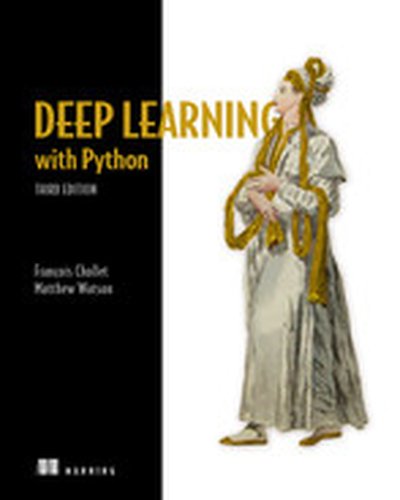
Deep Learning with Python, Third Edition

The bestselling book on Python deep learning, now covering generative AI, Keras 3, PyTorch, and JAX! Deep Learning with Python, Third Edition puts the power of deep learning in your hands. This new edition includes the latest Keras and TensorFlow features, generative AI models, and added coverage of PyTorch and JAX. Learn directly from the creator of Keras and step confidently into the world of deep learning with Python. In Deep Learning with Python, Third Edition you’ll discover: Deep learning from first principles The latest features of Keras 3 A primer on JAX, PyTorch, and TensorFlow Image classification and image segmentation Time series forecasting Large Language models Text classification and machine translation Text and image generation—build your own GPT and diffusion models! Scaling and tuning models With over 100,000 copies sold, Deep Learning with Python makes it possible for developers, data scientists, and machine learning enthusiasts to put deep learning into action. In this expanded and updated third edition, Keras creator François Chollet offers insights for both novice and experienced machine learning practitioners. You'll master state-of-the-art deep learning tools and techniques, from the latest features of Keras 3 to building AI models that can generate text and images. About the Technology In less than a decade, deep learning has changed the world—twice. First, Python-based libraries like Keras, TensorFlow, and PyTorch elevated neural networks from lab experiments to high-performance production systems deployed at scale. And now, through Large Language Models and other generative AI tools, deep learning is again transforming business and society. In this new edition, Keras creator François Chollet invites you into this amazing subject in the fluid, mentoring style of a true insider. About the Book Deep Learning with Python, Third Edition makes the concepts behind deep learning and generative AI understandable and approachable. This complete rewrite of the bestselling original includes fresh chapters on transformers, building your own GPT-like LLM, and generating images with diffusion models. Each chapter introduces practical projects and code examples that build your understanding of deep learning, layer by layer. What's Inside Hands-on, code-first learning Comprehensive, from basics to generative AI Intuitive and easy math explanations Examples in Keras, PyTorch, JAX, and TensorFlow About the Reader For readers with intermediate Python skills. No previous experience with machine learning or linear algebra required. About the Authors François Chollet is the co-founder of Ndea and the creator of Keras. Matthew Watson is a software engineer at Google working on Gemini and a core maintainer of Keras. Quotes Perfect for anyone interested in learning by doing from one of the industry greats. - Anthony Goldbloom, Founder of Kaggle A sharp, deeply practical guide that teaches you how to think from first principles to build models that actually work. - Santiago Valdarrama, Founder of ml.school The most up-to-date and complete guide to deep learning you’ll find today! - Aran Komatsuzaki, EleutherAI Masterfully conveys the true essence of neural networks. A rare case in recent years of outstanding technical writing. - Salvatore Sanfilippo, Creator of Redis

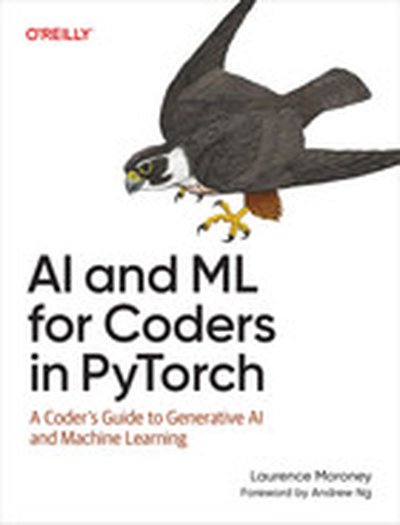
AI and ML for Coders in PyTorch

Eager to learn AI and machine learning but unsure where to start? Laurence Moroney's hands-on, code-first guide demystifies complex AI concepts without relying on advanced mathematics. Designed for programmers, it focuses on practical applications using PyTorch, helping you build real-world models without feeling overwhelmed. From computer vision and natural language processing (NLP) to generative AI with Hugging Face Transformers, this book equips you with the skills most in demand for AI development today. You'll also learn how to deploy your models across the web and cloud confidently. Gain the confidence to apply AI without needing advanced math or theory expertise Discover how to build AI models for computer vision, NLP, and sequence modeling with PyTorch Learn generative AI techniques with Hugging Face Diffusers and Transformers

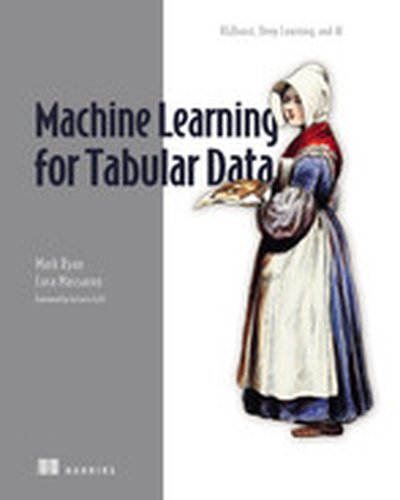
Machine Learning for Tabular Data

Business runs on tabular data in databases, spreadsheets, and logs. Crunch that data using deep learning, gradient boosting, and other machine learning techniques. Machine Learning for Tabular Data teaches you to train insightful machine learning models on common tabular business data sources such as spreadsheets, databases, and logs. You’ll discover how to use XGBoost and LightGBM on tabular data, optimize deep learning libraries like TensorFlow and PyTorch for tabular data, and use cloud tools like Vertex AI to create an automated MLOps pipeline. Machine Learning for Tabular Data will teach you how to: Pick the right machine learning approach for your data Apply deep learning to tabular data Deploy tabular machine learning locally and in the cloud Pipelines to automatically train and maintain a model Machine Learning for Tabular Data covers classic machine learning techniques like gradient boosting, and more contemporary deep learning approaches. By the time you’re finished, you’ll be equipped with the skills to apply machine learning to the kinds of data you work with every day. About the Technology Machine learning can accelerate everyday business chores like account reconciliation, demand forecasting, and customer service automation—not to mention more exotic challenges like fraud detection, predictive maintenance, and personalized marketing. This book shows you how to unlock the vital information stored in spreadsheets, ledgers, databases and other tabular data sources using gradient boosting, deep learning, and generative AI. About the Book Machine Learning for Tabular Data delivers practical ML techniques to upgrade every stage of the business data analysis pipeline. In it, you’ll explore examples like using XGBoost and Keras to predict short-term rental prices, deploying a local ML model with Python and Flask, and streamlining workflows using large language models (LLMs). Along the way, you’ll learn to make your models both more powerful and more explainable. What's Inside Master XGBoost Apply deep learning to tabular data Deploy models locally and in the cloud Build pipelines to train and maintain models About the Reader For readers experienced with Python and the basics of machine learning. About the Authors Mark Ryan is the AI Lead of the Developer Knowledge Platform at Google. A three-time Kaggle Grandmaster, Luca Massaron is a Google Developer Expert (GDE) in machine learning and AI. He has published 17 other books. Quotes

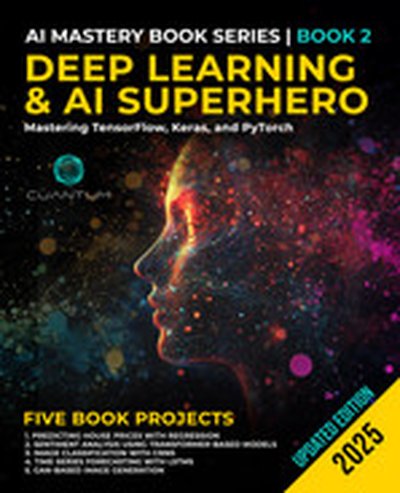
Deep Learning and AI Superhero

"Deep Learning and AI Superhero" is an extensive resource for mastering the core concepts and advanced techniques in AI and deep learning using TensorFlow, Keras, and PyTorch. This comprehensive guide walks you through topics from foundational neural network concepts to implementing real-world machine learning solutions. You will gain hands-on experience and theoretical knowledge to elevate your AI development skills. What this Book will help me do Develop a solid foundation in neural networks, their structure, and their training methodologies. Understand and implement deep learning models using TensorFlow and Keras effectively. Gain experience using PyTorch for creating, training, and optimizing advanced machine learning models. Learn advanced applications such as CNNs for computer vision, RNNs for sequential data, and Transformers for natural language processing. Deploy AI models on cloud and edge platforms through practical examples and optimized workflows. Author(s) Cuantum Technologies LLC has established itself as a pioneer in creating educational resources for advanced AI technologies. Their team consists of experts and practitioners in the field, combining years of industry and academic experience. Their books are crafted to ensure readers can practically apply cutting-edge AI techniques with clarity and confidence. Who is it for? This book is ideally suited for software developers, AI enthusiasts, and data scientists who have a basic understanding of programming and machine learning concepts. It's perfect for those seeking to enhance their skills and tackle real-world AI challenges. Whether your goals are professional development, research, or personal learning, you'll find practical and detailed guidance throughout this book.

Math and Architectures of Deep Learning

Shine a spotlight into the deep learning “black box”. This comprehensive and detailed guide reveals the mathematical and architectural concepts behind deep learning models, so you can customize, maintain, and explain them more effectively. Inside Math and Architectures of Deep Learning you will find: Math, theory, and programming principles side by side Linear algebra, vector calculus and multivariate statistics for deep learning The structure of neural networks Implementing deep learning architectures with Python and PyTorch Troubleshooting underperforming models Working code samples in downloadable Jupyter notebooks The mathematical paradigms behind deep learning models typically begin as hard-to-read academic papers that leave engineers in the dark about how those models actually function. Math and Architectures of Deep Learning bridges the gap between theory and practice, laying out the math of deep learning side by side with practical implementations in Python and PyTorch. Written by deep learning expert Krishnendu Chaudhury, you’ll peer inside the “black box” to understand how your code is working, and learn to comprehend cutting-edge research you can turn into practical applications. About the Technology Discover what’s going on inside the black box! To work with deep learning you’ll have to choose the right model, train it, preprocess your data, evaluate performance and accuracy, and deal with uncertainty and variability in the outputs of a deployed solution. This book takes you systematically through the core mathematical concepts you’ll need as a working data scientist: vector calculus, linear algebra, and Bayesian inference, all from a deep learning perspective. About the Book Math and Architectures of Deep Learning teaches the math, theory, and programming principles of deep learning models laid out side by side, and then puts them into practice with well-annotated Python code. You’ll progress from algebra, calculus, and statistics all the way to state-of-the-art DL architectures taken from the latest research. What's Inside The core design principles of neural networks Implementing deep learning with Python and PyTorch Regularizing and optimizing underperforming models About the Reader Readers need to know Python and the basics of algebra and calculus. About the Author Krishnendu Chaudhury is co-founder and CTO of the AI startup Drishti Technologies. He previously spent a decade each at Google and Adobe. Quotes Machine learning uses a cocktail of linear algebra, vector calculus, statistical analysis, and topology to represent, visualize, and manipulate points in high dimensional spaces. This book builds that foundation in an intuitive way–along with the PyTorch code you need to be a successful deep learning practitioner. - Vineet Gupta, Google Research A thorough explanation of the mathematics behind deep learning! - Grigory Sapunov, Intento Deep learning in its full glory, with all its mathematical details. This is the book! - Atul Saurav, Genworth Financial

Machine Learning with PyTorch and Scikit-Learn

Machine Learning with PyTorch and Scikit-Learn is a comprehensive resource for developers looking to dive deep into the world of machine learning. It introduces foundational concepts alongside practical implementations using Python and leading libraries such as PyTorch and Scikit-Learn. With well-explained techniques and real-world examples, you'll gain the knowledge needed to design, build, and optimize machine learning systems. What this Book will help me do Understand and apply core concepts in machine learning using Scikit-Learn. Develop and deploy deep learning models using PyTorch efficiently. Configure and optimize neural networks, transformers, and GANs for various applications. Handle and preprocess data effectively for building robust models. Follow best practices for model evaluation, tuning, and deployment. Author(s) Sebastian Raschka, Yuxi (Hayden) Liu, and Vahid Mirjalili are experienced professionals in the field of machine learning with extensive teaching and writing backgrounds. They bring their expertise in Python and machine learning frameworks like PyTorch to provide both theoretical and practical insights helpful for learners. Their combined knowledge ensures a thorough and engaging learning experience suited for aspiring data scientists. Who is it for? This book is tailored for Python developers and data scientists eager to master machine learning and deep learning techniques. If you're familiar with Python programming and possess fundamental knowledge of calculus and linear algebra, you will find this book incredibly insightful. Whether you're entering the field or seeking to enhance your expertise, this resource caters to your professional growth in building advanced machine learning systems.