talk-data.com talk-data.com

Topic

R

R (Language)

programming_language statistical_computing data_analysis

37

tagged

Activity Trend

1 peak/qtr
2020-Q1 2026-Q1

Activities

37 activities · Newest first

Hands-On Programming with R

Learn how to program by diving into the R language, and then use your newfound skills to solve practical data science problems. With this book, you’ll learn how to load data, assemble and disassemble data objects, navigate R’s environment system, write your own functions, and use all of R’s programming tools. RStudio Master Instructor Garrett Grolemund not only teaches you how to program, but also shows you how to get more from R than just visualizing and modeling data. You’ll gain valuable programming skills and support your work as a data scientist at the same time. Work hands-on with three practical data analysis projects based on casino games Store, retrieve, and change data values in your computer’s memory Write programs and simulations that outperform those written by typical R users Use R programming tools such as if else statements, for loops, and S3 classes Learn how to write lightning-fast vectorized R code Take advantage of R’s package system and debugging tools Practice and apply R programming concepts as you learn them

R Quick Syntax Reference

The R Quick Syntax Reference is a handy reference book detailing the intricacies of the R language. Not only is R a free, open-source tool, R is powerful, flexible, and has state of the art statistical techniques available. With the many details which must be correct when using any language, however, the R Quick Syntax Reference makes using R easier. Starting with the basic structure of R, the book takes you on a journey through the terminology used in R and the syntax required to make R work. You will find looking up the correct form for an expression quick and easy. With a copy of the R Quick Syntax Reference in hand, you will find that are able to use the multitude of functions available to the R user and are even able to write your own functions to explore and analyze data. Takes you through learning R, from download to statistical analysis. Clears the confusion around object types and how to use and convert the types. Tells you how to search for statistical techniques using the R help pages. What you'll learn Download R and R packages for your platform. Work with R within your file structure. Enter data from the keyboard and from external files. Determine and assign modes, classes, and types of objects Do calculations using the computational tools in R. Use R functions and create new functions. Who this book is for The R Quick Syntax Reference is for statisticians and other data analysts who are starting to use the R language. It is also for veteran R users who want a quick reference to the language. The book is an excellent choice for the busy data scientist who likes to experiment with new ways of analysis and who needs the flexibility of the data editing available in R.

Practical Data Science with R

NEWER EDITION AVAILABLE IN MEAP Practical Data Science with R, Second Edition is now available in the Manning Early Access Program. An eBook of this older edition is included at no additional cost when you buy the revised edition! You may still purchase Practical Data Science with R (First Edition) using the Buy options on this page. Practical Data Science with R lives up to its name. It explains basic principles without the theoretical mumbo-jumbo and jumps right to the real use cases you'll face as you collect, curate, and analyze the data crucial to the success of your business. You'll apply the R programming language and statistical analysis techniques to carefully explained examples based in marketing, business intelligence, and decision support. About the Technology Business analysts and developers are increasingly collecting, curating, analyzing, and reporting on crucial business data. The R language and its associated tools provide a straightforward way to tackle day-to-day data science tasks without a lot of academic theory or advanced mathematics. About the Book Practical Data Science with R shows you how to apply the R programming language and useful statistical techniques to everyday business situations. Using examples from marketing, business intelligence, and decision support, it shows you how to design experiments (such as A/B tests), build predictive models, and present results to audiences of all levels. What's Inside Data science for the business professional Statistical analysis using the R language Project lifecycle, from planning to delivery Numerous instantly familiar use cases Keys to effective data presentations About the Reader This book is accessible to readers without a background in data science. Some familiarity with basic statistics, R, or another scripting language is assumed. About the Authors Nina Zumel and John Mount are cofounders of a San Francisco-based data science consulting firm. Both hold PhDs from Carnegie Mellon and blog on statistics, probability, and computer science at win-vector.com. Quotes A unique and important addition to any data scientist’s library. - From the Foreword by Jim Porzak, Cofounder Bay Area R Users Group Covers the process end-to-end, from data exploration to modeling to delivering the results. - Nezih Yigitbasi, Intel Full of useful gems for both aspiring and experienced data scientists. - Fred Rahmanian, Siemens Healthcare Hands-on data analysis with real-world examples. Highly recommended. - Dr. Kostas Passadis, IPTO

R for Everyone: Advanced Analytics and Graphics

Statistical Computation for Programmers, Scientists, Quants, Excel Users, and Other Professionals Using the open source R language, you can build powerful statistical models to answer many of your most challenging questions. R has traditionally been difficult for non-statisticians to learn, and most R books assume far too much knowledge to be of help. R for Everyone is the solution. Drawing on his unsurpassed experience teaching new users, professional data scientist Jared P. Lander has written the perfect tutorial for anyone new to statistical programming and modeling. Organized to make learning easy and intuitive, this guide focuses on the 20 percent of R functionality you’ll need to accomplish 80 percent of modern data tasks. Lander’s self-contained chapters start with the absolute basics, offering extensive hands-on practice and sample code. You’ll download and install R; navigate and use the R environment; master basic program control, data import, and manipulation; and walk through several essential tests. Then, building on this foundation, you’ll construct several complete models, both linear and nonlinear, and use some data mining techniques. By the time you’re done, you won’t just know how to write R programs, you’ll be ready to tackle the statistical problems you care about most. COVERAGE INCLUDES • Exploring R, RStudio, and R packages • Using R for math: variable types, vectors, calling functions, and more • Exploiting data structures, including data.frames, matrices, and lists • Creating attractive, intuitive statistical graphics • Writing user-defined functions • Controlling program flow with if, ifelse, and complex checks • Improving program efficiency with group manipulations • Combining and reshaping multiple datasets • Manipulating strings using R’s facilities and regular expressions • Creating normal, binomial, and Poisson probability distributions • Programming basic statistics: mean, standard deviation, and t-tests • Building linear, generalized linear, and nonlinear models • Assessing the quality of models and variable selection • Preventing overfitting, using the Elastic Net and Bayesian methods • Analyzing univariate and multivariate time series data • Grouping data via K-means and hierarchical clustering • Preparing reports, slideshows, and web pages with knitr • Building reusable R packages with devtools and Rcpp • Getting involved with the R global community

Learning R

Learn how to perform data analysis with the R language and software environment, even if you have little or no programming experience. With the tutorials in this hands-on guide, youâ??ll learn how to use the essential R tools you need to know to analyze data, including data types and programming concepts. The second half of Learning R shows you real data analysis in action by covering everything from importing data to publishing your results. Each chapter in the book includes a quiz on what youâ??ve learned, and concludes with exercises, most of which involve writing R code. Write a simple R program, and discover what the language can do Use data types such as vectors, arrays, lists, data frames, and strings Execute code conditionally or repeatedly with branches and loops Apply R add-on packages, and package your own work for others Learn how to clean data you import from a variety of sources Understand data through visualization and summary statistics Use statistical models to pass quantitative judgments about data and make predictions Learn what to do when things go wrong while writing data analysis code

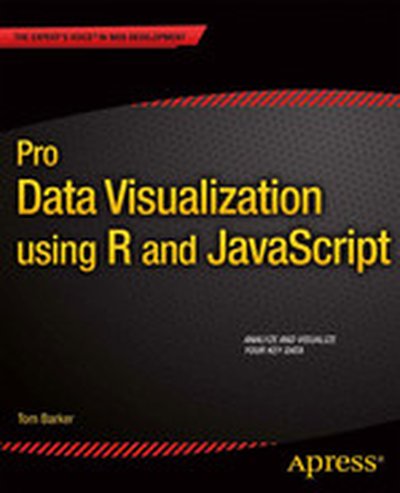
Pro Data Visualization using R and JavaScript

Pro Data Visualization using R and JavaScript makes the R language approachable, and promotes the idea of data gathering and analysis. You'll see how to use R to interrogate and analyze your data, and then use the D3 JavaScript library to format and display that data in an elegant, informative, and interactive way. You will learn how to gather data effectively, and also how to understand the philosophy and implementation of each type of chart, so as to be able to represent the results visually. With the popularity of the R language, the art and practice of creating data visualizations is no longer the preserve of mathematicians, statisticians, or cartographers. As technology leaders, we can gather metrics around what we do and use data visualizations to communicate that information. Pro Data Visualization using R and JavaScript combines the power of the R language with the simplicity and familiarity of JavaScript to display clear and informative data visualizations. Gathering and analyzing empirical data is the key to truly understanding anything. We can track operational metrics to quantify the health of our products in production. We can track quality metrics of our projects, and even use our data to identify bad code. Visualizing this data allows anyone to read our analysis and easily get a deep understanding of the story the data tells. What you'll learn A rich understanding of how to gather, and analyze empirical data How to tell a story with data using data visualizations What types of data visualizations are best to use for the story that you want to tell with your data A comprehensive introduction to the R language, covering all the essentials Exploration of how to construct interactive data visualizations using JavaScript and JavaScript libraries Who this book is for Developers at all levels interested in data visualization, beginning to intermediate engineering managers, statisticians, mathematicians, economists and any others interested in data visualization.

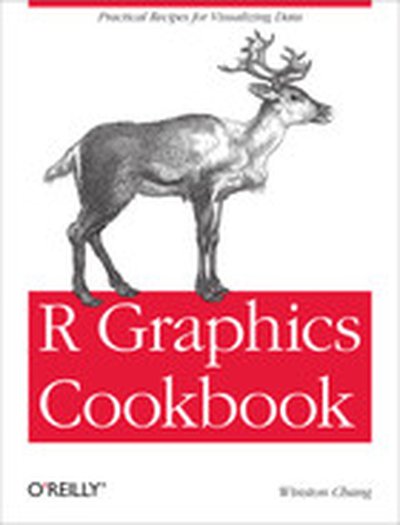
R Graphics Cookbook

This practical guide provides more than 150 recipes to help you generate high-quality graphs quickly, without having to comb through all the details of R’s graphing systems. Each recipe tackles a specific problem with a solution you can apply to your own project, and includes a discussion of how and why the recipe works. Most of the recipes use the ggplot2 package, a powerful and flexible way to make graphs in R. If you have a basic understanding of the R language, you’re ready to get started. Use R’s default graphics for quick exploration of data Create a variety of bar graphs, line graphs, and scatter plots Summarize data distributions with histograms, density curves, box plots, and other examples Provide annotations to help viewers interpret data Control the overall appearance of graphics Render data groups alongside each other for easy comparison Use colors in plots Create network graphs, heat maps, and 3D scatter plots Structure data for graphing

The R Book, 2nd Edition

Hugely successful and popular text presenting an extensive and comprehensive guide for all R users The R language is recognized as one of the most powerful and flexible statistical software packages, enabling users to apply many statistical techniques that would be impossible without such software to help implement such large data sets. R has become an essential tool for understanding and carrying out research. This edition: Features full colour text and extensive graphics throughout. Introduces a clear structure with numbered section headings to help readers locate information more efficiently. Looks at the evolution of R over the past five years. Features a new chapter on Bayesian Analysis and Meta-Analysis. Presents a fully revised and updated bibliography and reference section. Is supported by an accompanying website allowing examples from the text to be run by the user. Praise for the first edition: '...if you are an R user or wannabe R user, this text is the one that should be on your shelf. The breadth of topics covered is unsurpassed when it comes to texts on data analysis in R.' (The American Statistician, August 2008) 'The High-level software language of R is setting standards in quantitative analysis. And now anybody can get to grips with it thanks to The R Book...' ( Professional Pensions, July 2007)

The Essential R Reference

An essential library of basic commands you can copy and paste into R The powerful and open-source statistical programming language R is rapidly growing in popularity, but it requires that you type in commands at the keyboard rather than use a mouse, so you have to learn the language of R. But there is a shortcut, and that's where this unique book comes in. A companion book to Visualize This: The FlowingData Guide to Design, Visualization, and Statistics, this practical reference is a library of basic R commands that you can copy and paste into R to perform many types of statistical analyses. Whether you're in technology, science, medicine, business, or engineering, you can quickly turn to your topic in this handy book and find the commands you need. Comprehensive command reference for the R programming language and a companion book to Visualize This: The FlowingData Guide to Design, Visualization, and Statistics Combines elements of a dictionary, glossary, and thesaurus for the R language Provides easy accessibility to the commands you need, by topic, which you can cut and paste into R as needed Covers getting, saving, examining, and manipulating data; statistical test and math; and all the things you can do with graphs Also includes a collection of utilities that you'll find useful Simplify the complex statistical R programming language with The Essential R Reference.

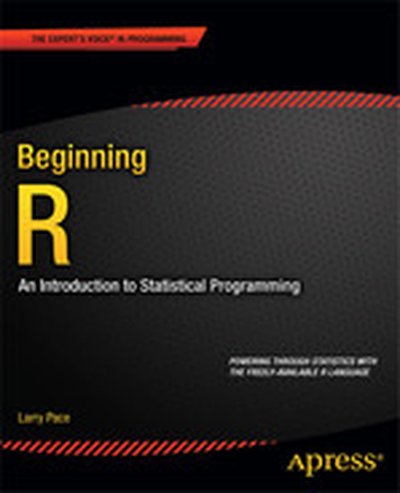
Beginning R: An Introduction to Statistical Programming

Beginning R: An Introduction to Statistical Programming is a hands-on book showing how to use the R language, write and save R scripts, build and import data files, and write your own custom statistical functions. R is a powerful open-source implementation of the statistical language S, which was developed by AT&T. R has eclipsed S and the commercially-available S-Plus language, and has become the de facto standard for doing, teaching, and learning computational statistics. R is both an object-oriented language and a functional language that is easy to learn, easy to use, and completely free. A large community of dedicated R users and programmers provides an excellent source of R code, functions, and data sets. R is also becoming adopted into commercial tools such as Oracle Database. Your investment in learning R is sure to pay off in the long term as R continues to grow into the go to language for statistical exploration and research. Covers the freely-available R language for statistics Shows the use of R in specific uses case such as simulations, discrete probability solutions, one-way ANOVA analysis, and more Takes a hands-on and example-based approach incorporating best practices with clear explanations of the statistics being done What you'll learn Acquire and install R Import and export data and scripts Generate basic statistics and graphics Program in R to write custom functions Use R for interactive statistical explorations Implement simulations and other advanced techniques Who this book is for Beginning R: An Introduction to Statistical Programming is an easy-to-read book that serves as an instruction manual and reference for working professionals, professors, and students who want to learn and use R for basic statistics. It is the perfect book for anyone needing a free, capable, and powerful tool for exploring statistics and automating their use.

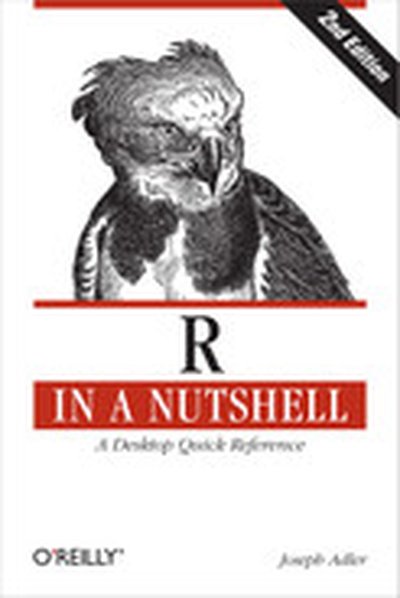
R in a Nutshell, 2nd Edition

If you’re considering R for statistical computing and data visualization, this book provides a quick and practical guide to just about everything you can do with the open source R language and software environment. You’ll learn how to write R functions and use R packages to help you prepare, visualize, and analyze data. Author Joseph Adler illustrates each process with a wealth of examples from medicine, business, and sports. Updated for R 2.14 and 2.15, this second edition includes new and expanded chapters on R performance, the ggplot2 data visualization package, and parallel R computing with Hadoop. Get started quickly with an R tutorial and hundreds of examples Explore R syntax, objects, and other language details Find thousands of user-contributed R packages online, including Bioconductor Learn how to use R to prepare data for analysis Visualize your data with R’s graphics, lattice, and ggplot2 packages Use R to calculate statistical fests, fit models, and compute probability distributions Speed up intensive computations by writing parallel R programs for Hadoop Get a complete desktop reference to R

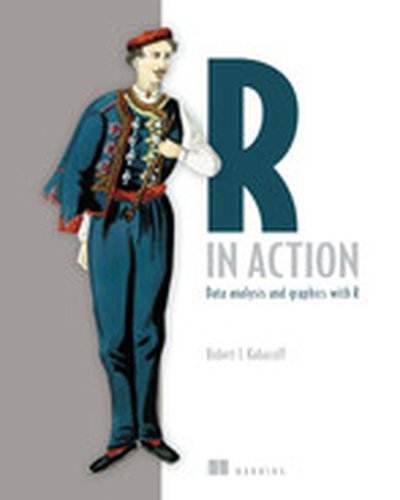
R in Action

R in Action is the first book to present both the R system and the use cases that make it such a compelling package for business developers. The book begins by introducing the R language, including the development environment. Focusing on practical solutions, the book also offers a crash course in practical statistics and covers elegant methods for dealing with messy and incomplete data using features of R. About the Technology R is a powerful language for statistical computing and graphics that can handle virtually any data-crunching task. It runs on all important platforms and provides thousands of useful specialized modules and utilities. This makes R a great way to get meaningful information from mountains of raw data. About the Book R in Action is a language tutorial focused on practical problems. It presents useful statistics examples and includes elegant methods for handling messy, incomplete, and nonnormal data that are difficult to analyze using traditional methods. And statistical analysis is only part of the story. You'll also master R's extensive graphical capabilities for exploring and presenting data visually. What's Inside Practical data analysis, step by step Interfacing R with other software Using R to visualize data Over 130 graphs Eight reference appendixes About the Reader About the Author Dr. Rob Kabacoff is a seasoned researcher who specializes in data analysis. He has taught graduate courses in statistical programming and manages the Quick-R website at statmethods.net. Quotes Lucid and engaging...and fun way to learn R! - Amos A. Folarin, University College London Finally, a book that brings R to the real world. - Charles Malpas, University of Melbourne R from a programmer's point of view. - Philipp K. Janert, Principal Value, LLC A great balance of targeted tutorials and in-depth examples. - Landon Cox, 360VL, Inc. An excellent introduction and reference from the author of the best R website. - Christopher Williams, University of Idaho

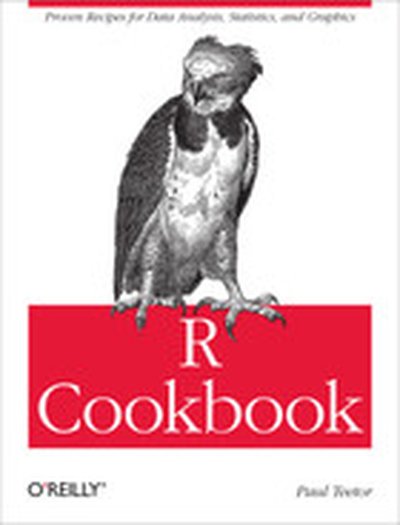
R Cookbook

With more than 200 practical recipes, this book helps you perform data analysis with R quickly and efficiently. The R language provides everything you need to do statistical work, but its structure can be difficult to master. This collection of concise, task-oriented recipes makes you productive with R immediately, with solutions ranging from basic tasks to input and output, general statistics, graphics, and linear regression. Each recipe addresses a specific problem, with a discussion that explains the solution and offers insight into how it works. If you’re a beginner, R Cookbook will help get you started. If you’re an experienced data programmer, it will jog your memory and expand your horizons. You’ll get the job done faster and learn more about R in the process. Create vectors, handle variables, and perform other basic functions Input and output data Tackle data structures such as matrices, lists, factors, and data frames Work with probability, probability distributions, and random variables Calculate statistics and confidence intervals, and perform statistical tests Create a variety of graphic displays Build statistical models with linear regressions and analysis of variance (ANOVA) Explore advanced statistical techniques, such as finding clusters in your data "Wonderfully readable, R Cookbook serves not only as a solutions manual of sorts, but as a truly enjoyable way to explore the R language—one practical example at a time."—Jeffrey Ryan, software consultant and R package author

R in a Nutshell

Why learn R? Because it's rapidly becoming the standard for developing statistical software. R in a Nutshell provides a quick and practical way to learn this increasingly popular open source language and environment. You'll not only learn how to program in R, but also how to find the right user-contributed R packages for statistical modeling, visualization, and bioinformatics. The author introduces you to the R environment, including the R graphical user interface and console, and takes you through the fundamentals of the object-oriented R language. Then, through a variety of practical examples from medicine, business, and sports, you'll learn how you can use this remarkable tool to solve your own data analysis problems. Understand the basics of the language, including the nature of R objects Learn how to write R functions and build your own packages Work with data through visualization, statistical analysis, and other methods Explore the wealth of packages contributed by the R community Become familiar with the lattice graphics package for high-level data visualization Learn about bioinformatics packages provided by Bioconductor "I am excited about this book. R in a Nutshell is a great introduction to R, as well as a comprehensive reference for using R in data analytics and visualization. Adler provides 'real world' examples, practical advice, and scripts, making it accessible to anyone working with data, not just professional statisticians."

R Programming for Bioinformatics

Due to its data handling and modeling capabilities as well as its flexibility, R is becoming the most widely used software in bioinformatics. R Programming for Bioinformatics explores the programming skills needed to use this software tool for the solution of bioinformatics and computational biology problems. Drawing on the author’s first-hand experiences as an expert in R, the book begins with coverage on the general properties of the R language, several unique programming aspects of R, and object-oriented programming in R. It presents methods for data input and output as well as database interactions. The author also examines different facets of string handling and manipulations, discusses the interfacing of R with other languages, and describes how to write software packages. He concludes with a discussion on the debugging and profiling of R code. With numerous examples and exercises, this practical guide focuses on developing R programming skills in order to tackle problems encountered in bioinformatics and computational biology.

Statistical Computing with R

Computational statistics and statistical computing are two areas that employ computational, graphical, and numerical approaches to solve statistical problems, making the versatile R language an ideal computing environment for these fields. One of the first books on these topics to feature R, Statistical Computing with R covers the traditiona

The R Book

The high-level language of R is recognized as one of the most powerful and flexible statistical software environments, and is rapidly becoming the standard setting for quantitative analysis, statistics and graphics. R provides free access to unrivalled coverage and cutting-edge applications, enabling the user to apply numerous statistical methods ranging from simple regression to time series or multivariate analysis. Building on the success of the author's bestselling Statistics: An Introduction using R, The R Book is packed with worked examples, providing an all inclusive guide to R, ideal for novice and more accomplished users alike. The book assumes no background in statistics or computing and introduces the advantages of the R environment, detailing its applications in a wide range of disciplines. Provides the first comprehensive reference manual for the R language, including practical guidance and full coverage of the graphics facilities. Introduces all the statistical models covered by R, beginning with simple classical tests such as chi-square and t-test. Proceeds to examine more advance methods, from regression and analysis of variance, through to generalized linear models, generalized mixed models, time series, spatial statistics, multivariate statistics and much more. The R Book is aimed at undergraduates, postgraduates and professionals in science, engineering and medicine. It is also ideal for students and professionals in statistics, economics, geography and the social sciences.