talk-data.com talk-data.com

Topic

SAS

statistical_software analytics data_management

296

tagged

Activity Trend

8 peak/qtr
2020-Q1 2026-Q1

Activities

296 activities · Newest first

Carpenter's Guide to Innovative SAS Techniques

Carpenter's Guide to Innovative SAS Techniques offers advanced SAS programmers an all-in-one programming reference that includes advanced topics not easily found outside the depths of SAS documentation or more advanced training classes. Art Carpenter has written fifteen chapters of advanced tips and techniques, including topics on data summary, data analysis, and data reporting. Special emphasis is placed on DATA step techniques that solve complex data problems. There are numerous examples that illustrate advanced techniques that take advantage of formats, interface with the macro language, and utilize the Output Delivery System. Additional topics include operating system interfaces, table lookup techniques, and the creation of customized reports.

JMP 10 Scripting Guide

The JMP 10 Scripting Guide provides extensive instructions for using the powerful JMP Scripting Language (JSL). This book begins with an introduction to JSL terminology, examples of how to write your own scripts, and details on script development tools such as the debugger and editor. A description of the language elements follows along with examples of writing JSL scripts to manipulate data tables, platforms, display objects, three-dimensional graphs, and matrices. Learn how to integrate JMP with SAS, R, and Microsoft Excel. Design applications in a drag-and-drop interface called Application Builder, and create add-ins to extend JMP functionality with Add-In Builder. Other topics include examples of scripts for common tasks and a syntax reference, which defines the functions, operators, and messages used in JSL.

SAS/GRAPH: Beyond the Basics

Robert Allison's SAS/GRAPH: Beyond the Basics collects examples that demonstrate a variety of techniques you can use to create custom graphs using SAS/GRAPH software. SAS/GRAPH is known for its flexibility and power, but few people know how to use it to its full potential. Written for the SAS programmer with experience using Base SAS to work with data, the book includes examples that can be used in a variety of industry sectors. SAS/GRAPH: Beyond the Basics will help you create the exact graph you want.

Building Business Intelligence Using SAS

Business intelligence (BI) software provides an interface for multiple audiences to dissect, discover, and decide what the data means. These reporting tools make dynamic information available to all users, giving everyone the ability to manipulate results and further understand the business. There is significant power in reducing the data gatekeeper role in your organization so that each person can quickly interact with data and uncover additional value. SAS offers a BI solution that provides mechanisms to reach every level of the organization. Each tool in this solution provides a different amount of complexity and functionality to aid a broad deployment. Building Business Intelligence Using SAS: Content Development Examples, by Tricia Aanderud and Angela Hall, clarifies how you can fully leverage each SAS BI solution component to ensure a successful implementation.

Focusing on the SAS BI Clients, the authors provide a quick-start guide loaded with examples and tips that will help users move quickly from using only one of the SAS BI Clients to using a significant portion of the system. So if you are a SAS BI or SAS Enterprise BI user, but you aren't yet using all the components of the solution, this book is the resource that you need. In addition, the tips and techniques provided in this book will prove invaluable for advanced SAS BI and SAS Enterprise BI users who are studying for SAS Certified BI Content Developer certification.

This book is part of the SAS Press program.

Teaching Elementary Statistics with JMP

Chris Olsen's Teaching Elementary Statistics with JMP demonstrates this powerful software, offering the latest research on "best practice" in teaching statistics and how JMP can facilitate it. Just as statistics is data in a context, this book presents JMP in a context: teaching statistics. Olsen includes numerous examples of interesting data and intersperses JMP techniques and statistical analyses with thoughts from the statistics education literature. Intended for high school-level and college-level instructors who use JMP in teaching elementary statistics, the book uniquely provides a wide variety of data sets that will be of interest to a broad range of teachers and students. This book is part of the SAS Press program.

Customer Segmentation and Clustering Using SAS Enterprise Miner, Second Edition, 2nd Edition
In Customer Segmentation and Clustering Using SAS Enterprise Miner, Second Edition, Randy Collica employs SAS Enterprise Miner and the most commonly available techniques for customer relationship management (CRM). You will learn how to segment customers more intelligently and to achieve, or at least get closer to, the one-to-one customer relationship that today's businesses want. Step-by-step examples and exercises clearly illustrate the concepts of segmentation and clustering in the context of CRM. The book is divided into four parts. Part 1 reviews the basics of segmentation and clustering at an introductory level, providing examples from a variety of industries. Part 2 offers an in-depth treatment of segmentation with practical topics such as when and how to update your models and clustering with many attributes. Part 3 goes beyond traditional segmentation practices to introduce recommended strategies for clustering product affinities, handling missing data, and incorporating textual records into your predictive model with SAS Text Miner software. Part 4 takes segmentation to a new level with advanced techniques such as clustering of product associations, developing segmentation scoring models from customer survey data, combining segmentations using ensemble segmentation, and segmentation of customer transactions.

Updates to the second edition include four new chapters in Part 4, Chapters 13-16, that introduce new and advanced analytic techniques that can be valuable in many customer segmentation applications. In addition, Chapter 9 has a new section on using the Imputation node in SAS Enterprise Miner to accomplish missing data imputation, compared to PROC MI used in earlier sections of Chapter 9. Also included are business insights and motivations for selection settings and analytical decisions on many of the examples included in this second edition.

This straightforward guide will appeal to anyone who seeks to better understand customers or prospective customers. Additionally, professors and students will find the book well suited for a business data mining analytics course in an MBA program or related course of study. You should understand basic statistics, but no prior knowledge of data mining or SAS Enterprise Miner is required.

This book is part of the SAS Press program.

SAS Statistics by Example

In SAS Statistics by Example, Ron Cody offers up a cookbook approach for doing statistics with SAS. Structured specifically around the most commonly used statistical tasks or techniques--for example, comparing two means, ANOVA, and regression--this book provides an easy-to-follow, how-to approach to statistical analysis not found in other books.

For each statistical task, Cody includes heavily annotated examples using ODS Statistical Graphics procedures such as SGPLOT, SGSCATTER, and SGPANEL that show how SAS can produce the required statistics. Also, you will learn how to test the assumptions for all relevant statistical tests. Major topics featured include descriptive statistics, one- and two-sample tests, ANOVA, correlation, linear and multiple regression, analysis of categorical data, logistic regression, nonparametric techniques, and power and sample size.

This is not a book that teaches statistics. Rather, SAS Statistics by Example is perfect for intermediate to advanced statistical programmers who know their statistics and want to use SAS to do their analyses.

This book is part of the SAS Press program.

SAS® 9.3 ODS Graphics: Getting Started with Business and Statistical Graphics

SAS 9.3 ODS Graphics: Getting Started with Business and Statistical Graphics provides an overview and quick-start examples of ODS Graphics functionality, which is an extension of the SAS Output Delivery System (ODS). Many SAS procedures use ODS Graphics functionality to produce graphs as automatically as they produce tables. In addition, SAS provides a full suite of ODS Graphics software that facilitates the creation of custom, stand-alone graphs. This software includes the Graph Template Language, ODS Graphics procedures, ODS Graphics Designer, and ODS Graphics Editor. This ebook also explains how the ODS Graphics software components complement each other, and how they can be used together.

SAS Certification Prep Guide: Base Programming for SAS 9, Third Edition
New and experienced SAS users who want to prepare for the Base Programming for SAS 9 exam will find the SAS Certification Prep Guide: Base Programming for SAS 9 to be an invaluable, convenient, and comprehensive resource that covers all of the objectives tested on the exam. Major topics include importing and exporting raw data files, creating and modifying SAS data sets, and identifying and correcting data syntax and programming logic errors. You will also become familiar with the enhancements and new functionality that are available in SAS 9.

Each chapter includes a quiz on the chapter's contents. This guide provides you with a solid study resource as well as a go-to reference for your library.

SAS® Certification Prep Guide: Advanced Programming for SAS®9, Third Edition

Prepares you to take the Advanced Programming for SAS 9 exam. Major topics include SQL processing with SAS, the SAS macro language, advanced SAS programming techniques, and optimizing SAS programs. You will also become familiar with the enhancements and new functionality that are available in SAS 9.

IBM System Storage DS3500 Introduction and Implementation Guide

This IBM® Redbooks® publication introduces the IBM System Storage® DS3500, providing an overview of its design and specifications, and describing in detail how to set up, configure, and administer it. This edition covers updates and functions available with the DS3500 Storage Manager Version 10.70 (firmware level 7.70). IBM has combined best-of-breed development with leading 6 Gbps host interface and drive technology in the IBM System Storage DS3500 Express. With its simple, efficient, and flexible approach to storage, the DS3500 is a cost-effective, fully integrated complement to System x® servers, BladeCenter®, and Power Systems™. Offering substantial improvements at a price that will fit most budgets, the DS3500 delivers superior price to performance ratios, functionality, scalability, and ease-of-use for the entry-level storage user. The DS3500 supports intermixing four 1 Gbps iSCSI or four 8 Gbps FC host ports with its native 6 Gbps SAS interfaces. This flexible and multi-purpose dual protocol approach allows organizations to implement a single storage system to support all of their shared storage requirements, there by maximizing productivity, reliability, and cost. Delivering solid input/output per second (IOPS) and throughput, the DS3500 controllers offer balanced and sustainable performance. The DS3500 can effectively double the performance of the previous DS3000 series of storage systems in both throughput and IOPS. The DS3500 DS Storage Manager is the same management software offered with the DS5000 and DS4000® series. Now, any of these storage systems can be viewed and managed from a single interface. This allows for consolidated management of these various storage systems and a reduced learning curve. The DS3500 also supports enhanced remote mirroring over FC host ports, which is also compatible with the DS5000 and DS4000 series. This allows for low-cost backup and recovery with a DS5000 and DS4000 at a production site and a DS3500 at the secondary site. This book is intended for customers, IBM Business Partners, and IBM technical professionals who want to learn more about the capabilities and advanced functions of the IBM System Storage DS3500 with Storage Manager Software. It also targets those who have a DS3500 storage system and need detailed advice on how to configure and manage it.

Statistical Programming with SAS/IML Software

SAS/IML software is a powerful tool for data analysts because it enables implementation of statistical algorithms that are not available in any SAS procedure. Rick Wicklin's Statistical Programming with SAS/IML Software is the first book to provide a comprehensive description of the software and how to use it. He presents tips and techniques that enable you to use the IML procedure and the SAS/IML Studio application efficiently. In addition to providing a comprehensive introduction to the software, the book also shows how to create and modify statistical graphs, call SAS procedures and R functions from a SAS/IML program, and implement such modern statistical techniques as simulations and bootstrap methods in the SAS/IML language. Written for data analysts working in all industries, graduate students, and consultants, Statistical Programming with SAS/IML Software includes numerous code snippets and more than 100 graphs.

This book is part of the SAS Press program.

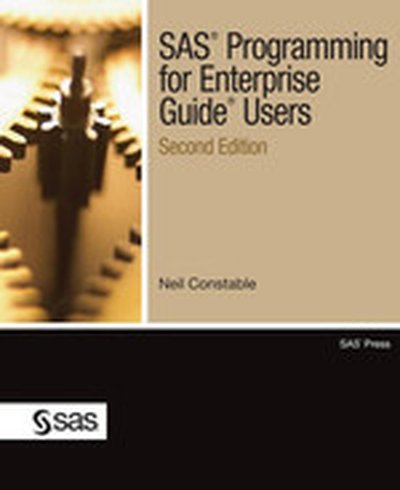
SAS Programming for Enterprise Guide Users, Second Edition

New and updated for SAS Enterprise Guide 4.2!

In this pragmatic, example-driven book, author Neil Constable demonstrates how you can use SAS code to enhance the capabilities of SAS Enterprise Guide. Designed to help you gain extra value from the products you already have, SAS Programming for Enterprise Guide Users contains tips and techniques that show you a variety of features that cannot be accessed directly through the task interfaces. In all cases, techniques are shown with examples that you can try and test, plus additional exercises are included to give you more practice. The end result is more efficient and resilient use of SAS Enterprise Guide in a wider variety of business areas.

Included is a discussion of the following subject areas: the Output Delivery System, advanced formatting, macro variables and macros, advanced reporting using PROC REPORT, highlighting in reports, hyperlinking between reports and graphs, data manipulation using SQL, data manipulation using the DATA step, extended graphics.

By adding small amounts of code in key areas, SAS Enterprise Guide users can get more out of the product than the tasks reveal. Users should be familiar with the SAS Enterprise Guide user interface and tasks. No programming experience is necessary.

This book is part of the SAS Press program.

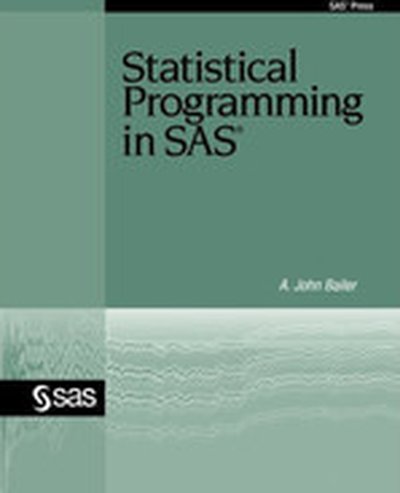
Statistical Programming in SAS®

In Statistical Programming in SAS, author A. John Bailer integrates SAS tools with interesting statistical applications and uses SAS 9.2 as a platform to introduce programming ideas for statistical analysis, data management, and data display and simulation. Written using a reader-friendly and narrative style, the book includes extensive examples and case studies to present a well-structured introduction to programming issues. This book has two parts. The first part addresses the nuts and bolts of programming, including fostering good programming habits, getting external data sets into SAS to construct an analysis data set, generating basic descriptive statistical summaries, producing customized tables, generating more attractive output, and producing high-quality graphical displays. The second part emphasizes programming in the context of a DATA step, in macros, and in SAS/IML software. Examples of statistical methods and concepts not always encountered in basic statistics courses (for example, bootstrapping, randomization tests, and jittering) are used to illustrate programming ideas. This book provides extensive illustrations of the new ODS Statistical Graphics procedures in SAS, a description of the new ODS Graphics Editor, and a brief introduction to some of the capabilities of SAS/IML Studio, such as producing dynamically linked data displays and invoking R from SAS.

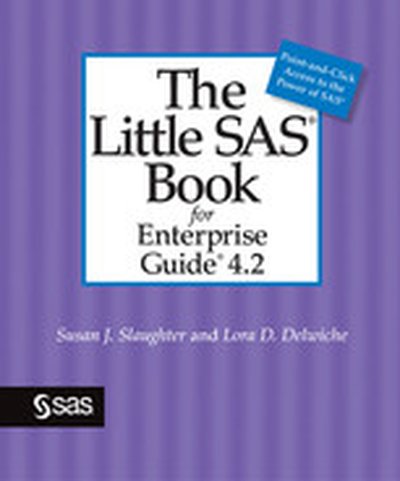
The Little SAS Book for Enterprise Guide 4.2
Whether you are using SAS Enterprise Guide for the first time or transitioning to the newest release, this is the book for you! With The Little SAS Book for Enterprise Guide 4.2, award-winning authors Susan Slaughter and Lora Delwiche help you quickly become productive in the SAS Enterprise Guide point-and-click environment. A series of carefully designed tutorials help you master the basics of the tasks you'll want to do most frequently. The reference section of the book expands on the tutorial topics, covering specific features in more depth. Completely rewritten and updated with new features for SAS Enterprise Guide 4.2, this edition supports SAS Enterprise Guide 4.2, SAS Enterprise Guide 4.3, and SAS Enterprise Guide 5.1.

This book is part of the SAS Press program.

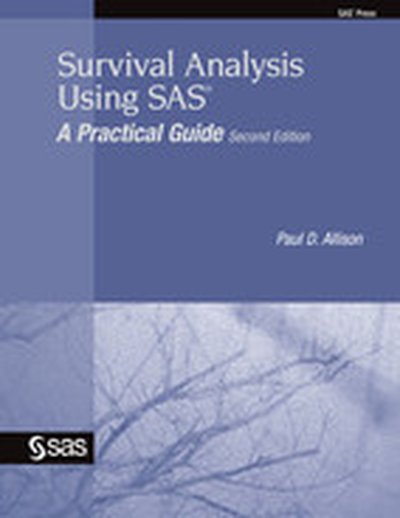
Survival Analysis Using SAS

Easy to read and comprehensive, Survival Analysis Using SAS: A Practical Guide, Second Edition, by Paul D. Allison, is an accessible, data-based introduction to methods of survival analysis. Researchers who want to analyze survival data with SAS will find just what they need with this fully updated new edition that incorporates the many enhancements in SAS procedures for survival analysis in SAS 9. Although the book assumes only a minimal knowledge of SAS, more experienced users will learn new techniques of data input and manipulation. Numerous examples of SAS code and output make this an eminently practical book, ensuring that even the uninitiated become sophisticated users of survival analysis. The main topics presented include censoring, survival curves, Kaplan-Meier estimation, accelerated failure time models, Cox regression models, and discrete-time analysis. Also included are topics not usually covered in survival analysis books, such as time-dependent covariates, competing risks, and repeated events.

Survival Analysis Using SAS: A Practical Guide, Second Edition, has been thoroughly updated for SAS 9, and all figures are presented using ODS Graphics. This new edition also documents major enhancements to the STRATA statement in the LIFETEST procedure; includes a section on the PROBPLOT command, which offers graphical methods to evaluate the fit of each parametric regression model; introduces the new BAYES statement for both parametric and Cox models, which allows the user to do a Bayesian analysis using MCMC methods; demonstrates the use of the counting process syntax as an alternative method for handling time-dependent covariates; contains a section on cumulative incidence functions; and describes the use of the new GLIMMIX procedure to estimate random-effects models for discrete-time data.

This book is part of the SAS Press program.

SAS Functions by Example, Second Edition, 2nd Edition

Fully updated for SAS 9.2, Ron Cody's SAS Functions by Example, Second Edition, is a must-have reference for anyone who programs in Base SAS. With the addition of functions new to SAS 9.2, this comprehensive reference manual now includes more than 200 functions, including new character, date and time, distance, probability, sort, and special functions. This new edition also contains more examples for existing functions and more details concerning optional arguments.

Like the first edition, the new edition also includes a list of SAS programs, an alphabetic list of all the functions in the book, and a comprehensive index of functions and tasks. Beginning and experienced SAS users will benefit from this useful reference guide to SAS functions.

This book is part of the SAS Press program.

Numbers Rule Your World: The Hidden Influence of Probabilities and Statistics on Everything You Do

WHAT ARE THE ODDS YOU'LL WIN THE LOTTERY? How long will your kids wait in line at Disney World? Who decides that “standardized tests” are fair? Why do highway engineers build slow-moving ramps? What does it mean, statistically, to be an “Average Joe”? NUMBERS RULE YOUR WORLD In the popular tradition of eye-opening bestsellers like Freakonomics, The Tipping Point, and Super Crunchers, this fascinating book from renowned statistician and blogger Kaiser Fung takes you inside the hidden world of facts and figures that affect you every day, in every way. These are the statistics that rule your life, your job, your commute, your vacation, your food, your health, your money, and your success. This is how engineers calculate your quality of living, how corporations determine your needs, and how politicians estimate your opinions. These are the numbers you never think about-even though they play a crucial role in every single aspect of your life. What you learn may surprise you, amuse you, or even enrage you. But there's one thing you won't be able to deny: Numbers Rule Your World… "An easy read with a big benefit." —Fareed Zakaria, CNN "For those who have anxiety about how organization data-mining is impacting their world, Kaiser Fung pulls back the curtain to reveal the good and the bad of predictive analytics." —Ian Ayres,Yale professor and author of Super Crunchers: Why Thinking By Numbers is the New Way to Be Smart "A book that engages us with stories that a journalist would write, the compelling stories behind the stories as illuminated by the numbers, and the dynamics that the numbers reveal." —John Sall, Executive Vice President, SAS Institute "Little did I suspect, when I picked up Kaiser Fung's book, that I would become so entranced by it - an illuminating and accessible exploration of the power of statistical analysis for those of us who have no prior training in a field that he explores so ably." —Peter Clarke, author of Keynes: The Rise, Fall, and Return of the 20th Century's Most Influential Economist "A tremendous book. . . . If you want to understand how to use statistics, how to think with numbers and yet to do this without getting lost in equations, if you've been looking for the book to unlock the door to logical thinking about problems, well, you will be pleased to know that you are holding that book in your hands." —Daniel Finkelstein, Executive Editor, The Times of London "I thoroughly enjoyed this accessible book and enthusiastically recommend it to anyone looking to understand and appreciate the role of statistics and data analysis in solving problems and in creating a better world." —Michael Sherman, Texas A&M University, American Statistician