talk-data.com talk-data.com

Topic

SAS

statistical_software analytics data_management

296

tagged

Activity Trend

8 peak/qtr
2020-Q1 2026-Q1

Activities

296 activities · Newest first

Common Statistical Methods for Clinical Research with SAS Examples, Third Edition, 3rd Edition

Glenn Walker and Jack Shostak's Common Statistical Methods for Clinical Research with SAS Examples, Third Edition, is a thoroughly updated edition of the popular introductory statistics book for clinical researchers. This new edition has been extensively updated to include the use of ODS graphics in numerous examples as well as a new emphasis on PROC MIXED. Straightforward and easy to use as either a text or a reference, the book is full of practical examples from clinical research to illustrate both statistical and SAS methodology. Each example is worked out completely, step by step, from the raw data.

Common Statistical Methods for Clinical Research with SAS Examples, Third Edition, is an applications book with minimal theory. Each section begins with an overview helpful to nonstatisticians and then drills down into details that will be valuable to statistical analysts and programmers. Further details, as well as bonus information and a guide to further reading, are presented in the extensive appendices. This text is a one-source guide for statisticians that documents the use of the tests used most often in clinical research, with assumptions, details, and some tricks--all in one place.

This book is part of the SAS Press program.
Statistical Graphics in SAS®: An Introduction to the Graph Template Language and the Statistical Graphics Procedures

The Graph Template Language (GTL) and the Statistical Graphics (SG) procedures are powerful new additions to SAS for creating high-quality statistical graphics. Warren F. Kuhfeld's Statistical Graphics in SAS: An Introduction to the Graph Template Language and the Statistical Graphics Procedures provides a parallel and example-driven introduction to the SG procedures and the GTL. Most graphs in the book are produced in at least two ways. Each example provides prototype code for getting started with the GTL and with the SG procedures. While you do not need to write a template to make many useful graphs, understanding the GTL enables you to create custom graphs that cannot be produced by the SG procedures. Knowing the GTL also helps you modify the sometimes complex templates that SAS provides. Written for anyone interested in statistical graphics, Statistical Graphics in SAS is a comprehensive introduction to these two aspects of ODS Graphics. It helps you understand the basics of what you can do with the SG procedures as well as how you can go beyond that by using the full power of the GTL.

Combining and Modifying SAS® Data Sets: Examples Second Edition

Building on the popularity of the first edition, Michele Burlew has revised this popular examples book to include expanded content and new features of SAS software. Completely updated for SAS 9.2, Combining and Modifying SAS Data Sets: Examples, Second Edition, presents examples that show solutions to common programming tasks that involve combining, modifying, and reshaping data sets. Expanded examples demonstrate how to combine data sets vertically and horizontally; retrieve data from lookup tables; modify and update data sets; combine summary and detail data sets; reshape and transpose observations in a data set; and manipulate data in a data set with utilities and functions. The tools used to combine and modify data sets include the SET, MERGE, MODIFY, and UPDATE statements in the DATA step; joins and set operators in PROC SQL; BY-group processing; indexes; hash objects in the DATA step; the use of PROC FORMAT and hash tables as table lookups; and generation data sets. Unique features of this book include the following: Examples are grouped by task, not by code, so you can easily find a solution to a particular task; alternative solutions are presented in addition to the main examples; most examples that combine and modify data sets include both a DATA step and a PROC SQL solution; many examples include a "Closer Look" section that describes in-depth how the example helps you complete the task; and each example stands on its own so you do not need to read the book from beginning to end. Designed for SAS programmers at all levels, this examples book will help simplify the challenging task of combining and modifying data sets.

Output Delivery System: The Basics and Beyond

Incorporating broad coverage of the best ODS features in one book, Output Delivery System: The Basics and Beyond goes beyond Lauren Haworth's original ODS text to demonstrate the many new and enhanced features of ODS and SAS 9.2. With SAS 9.2, ODS provides a myriad of choices for reporting and displaying analytical results with a greater variety of formatting selections and output destinations. As experienced SAS users, Lauren E. Haworth, Cynthia L. Zender, and Michele M. Burlew know how important it is to be able to produce customized output in different formats to meet the needs of clients.Geared toward all levels of SAS users, Output Delivery System: The Basics and Beyond is an example-driven book that presents each of the wide array of ODS techniques in an easy-to-use, two-page layout, with the text and code on one page and the resulting output on the facing page. The book begins with basic syntax and progresses to more complex techniques and custom styles. You will learn to take basic SAS output and transform it into an HTML page, a word-processor-friendly RTF file, or printer-friendly PDF output. You'll learn how to generate a table of contents page for RTF and PDF files, generate bookmarks for PDF files, and generate custom page numbering for those destinations. You will also learn the basic concepts of changing style templates, using table templates with the DATA step, and using tagset templates to generate custom markup language tags and output. Other new features of ODS are also discussed, such as the ODS Graphics Framework and the new ODS Statistical Graphics procedures.

Categorical Data Analysis Using The SAS® System, 2nd Edition

Statisticians and researchers will find this book auseful discussion of categorical data analysis techniques as well as an invaluable aid in applying these methods with the SAS System. Practical examples from a broad range of applications illustrate the use of the FREQ, LOGISTIC, GENMOD, and CATMOD procedures in a variety of analyses. Other procedures discussed include the PHREG and NPAR1WAY procedures. Topics discussed include assessing association in contingency tables and sets of tables, logistic regression and conditional logistic regression, weighted least squares modeling, repeated measurements analyses, loglinear models, and bioassay analysis. The second edition has been revised for use with Version 8 of the SAS System. New topics include additional exact tests, generalized estimating equations, use of the CLASS statement in the LOGISTIC procedure, exact logistic regression using the LOGISTIC procedure, and comparisons of the use of subject-specific models versus population-averaged models. Supports releases 6.07 and higher of SAS software.

SAS® Certification Prep Guide: Base Programming for SAS®9 Second Edition

New and experienced SAS users who want to prepare for the Base Programming for SAS 9 exam will find the SAS Certification Prep Guide: Base Programming for SAS 9, Second Edition, to be an invaluable, convenient, and comprehensive resource that covers all of the objectives tested on the exam. Major topics include importing and exporting raw data files, creating and modifying SAS data sets, and identifying and correcting data syntax and programming logic errors. You will also become familiar with the enhancements and new functionality that are available in SAS 9. Each chapter includes a quiz on the chapter's contents, and the book includes a free CD-ROM with tutorials, practice data, and sample programs to further reinforce and test your SAS skills. This guide and the accompanying CD-ROM provide you with a solid study resource as well as a go-to reference for your library.

SAS® Certification Prep Guide: Advanced Programming for SAS®9 Second Edition

The SAS Certification Prep Guide: Advanced Programming for SAS 9, Second Edition, prepares you to take the Advanced Programming for SAS 9 exam. Major topics include SQL processing with SAS, the SAS macro language, advanced SAS programming techniques, and optimizing SAS programs. You will also become familiar with the enhancements and new functionality that are available in SAS 9. Experienced SAS users who want to prepare for this exam will find this guide to be an invaluable, convenient, and comprehensive resource that covers all of the objectives tested on the exam. The text contains quizzes that enable you to test your understanding of material in each chapter. Additionally, solutions to all quizzes are included at the back of the book. Candidates must earn the SAS Certified Base Programmer Credential for SAS 9 before taking the SAS Advanced Programming for SAS 9 exam.

Business Intelligence Success Factors: Tools for Aligning Your Business in the Global Economy

Praise for Business Intelligence Success Factors: Tools for Aligning your business in the Global Economy "Olivia Parr Rud does a remarkable job of weaving together many topics in a strategic way. As 'quants,' we're fascinated with data and fact-based decision-making. But success only comes when you consider the human factor, especially effective communications. Making topics like evolutionary biology, complexity science, and systems thinking relevant for business success is a unique and compelling view. As Max Frisch said, 'We hired workers and human beings came instead.'" —Anne Milley, Senior Director, Technology Product Marketing, SAS "Business Intelligence Success Factors is a must-read for anyone implementing BI on an organizational level. This book explains the business landscape and the underlying reasons for our current volatility, offering clear guidance on navigating our information rich global economy." —Ron Powell, Editorial Director, Business Intelligence Network Transform challenges into opportunities with emerging Business Intelligence technologies Written by an expert in data mining and statistical analysis, this valuable resource unveils the connection between the increased use of BI and the need for new, proven theories and models in BI, as well as the guidance to implement them successfully in your organization. Are you ready to become adaptable? Learn how to harness today's rapidly evolving global economy with Business Intelligence Success Factors.

Just Enough SAS®: A Quick-Start Guide to SAS® for Engineers

In Just Enough SAS: A Quick-Start Guide to SAS for Engineers, Robert Rutledge provides "just enough" instruction on a broad variety of topics so that a new SAS user can become productive very quickly. Although most of the material in the book is geared toward a general audience, engineers will especially benefit from the focus on analysis of quality and reliability data found in Chapters 9 and 10 as well as in the examples throughout the book. This comprehensive text, prepared using SAS 9.2, can be used both as a tutorial for getting started with SAS and as a reference for details that even experienced SAS users find themselves looking up over and over again. In addition, the companion code to the book includes a set of commonly used utility macros that allow SAS users to wield maximum power with minimal effort. A complete bibliography provides readers with numerous opportunities for further learning.Topics addressed include bringing data into SAS from a spreadsheet or relational database, plotting data with ODS Statistical Graphics, summarizing and manipulating data for analysis using DATA steps and procedures, publishing results on the Internet and in PDF and RTF, creating appropriate plots of data using PROC GPLOT and PROC GCHART and the newer statistical graphics procedures, with particular emphasis on quality control and reliability analysis - key areas for engineers working in high-tech manufacturing and development, and using the SAS macro language to streamline and automate data analysis projects.New SAS users will find Rutledge's book useful as a quick-start guide to doing meaningful work with SAS, and experienced users will find numerous tips and techniques for improving and extending their coding methods.

Foundation XML and E4X for Flash and Flex

XML is the lingua franca of the Web. All designers and developers working in a web environment need a sound understanding of XML and its role in application development. Many software packages and organizations allow for the exchange of data using an XML format. Web services and RSS feeds are now commonplace. For those working with Flash and Flex, a thorough understanding of XML is particularly important. XML documents are one option for the data provided to SWF applications. Flash and Flex can load, display, and modify XML content. These applications can also send XML content to other applications for updating or for use in different situations. ActionScript 3.0 introduced some fundamental changes to the way in which Flash and Flex applications work with XML. One significant change is that XML is now a native data type. ActionScript 3.0 also introduced new classes and a different framework for working with external documents. These changes are based on the E4X ECMAScript standard, and they streamline and simplify the process for working with XML in Flash and Flex. In Foundation XML and E4X for Flash and Flex, Sas Jacobs gives you an introduction to XML and E4X. She explores the XML and XMLList classes and explains E4X expressions, providing examples for both Flash and Flex. In addition to explaining how to incorporate XML documents in Shockwave Flash applications, Sas shows you approaches specific to Flash and Flex and explores real-world usage. The book finishes with two case studies. In the first, you will learn how to consume and display information and images from Flickr using Flash. In the second, you will work with Adobe Kuler in Flex. Whether you are a designer or developer, this book will help you work with XML and make the transition from ActionScript 2.0 to ActionScript 3.0. It will also provide you with an excellent grounding if you are new to Flash and Flex.

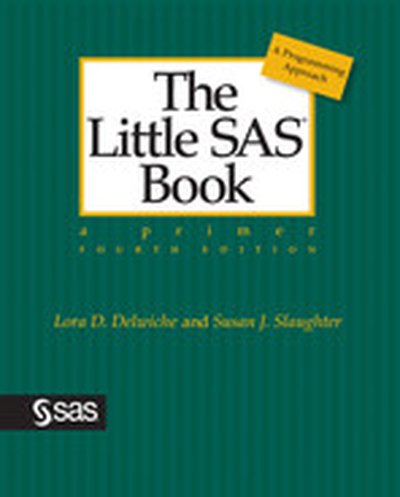
The Little SAS® Book: A Primer, Fourth Edition

Now in its fourth edition, The Little SAS Book is a classic, helping many people learn SAS programming. Authors Lora Delwiche and Susan Slaughter's friendly, easy-to-read writing style gently introduces readers to the most commonly used features of the SAS language. Topics include basic SAS concepts such as the DATA and PROC steps, inputting data, modifying and combining data sets, summarizing data, producing reports, and debugging SAS programs. Each topic is presented in a self-contained two-page layout complete with examples and graphics. This clear and concise format enables new users to get up and running quickly, while the examples allow readers to type in the program and see it work! New topics in the fourth edition include ODS Graphics for statistical procedures, PROC SGPLOT for graphics, creating new variables in PROC REPORT with a COMPUTE block, WHERE= data set option, SORTSEQ=LINGUISTIC option in PROC SORT, and more functions, including ANYALPHA, CAT, PROPCASE, and YRDIF.

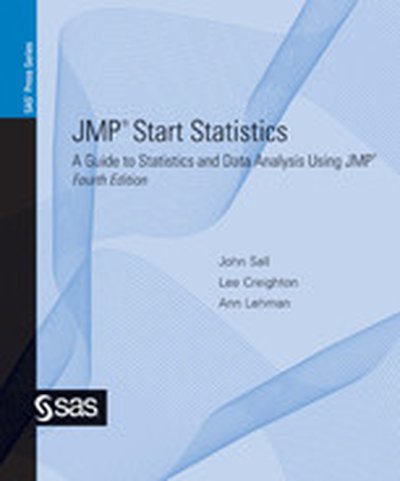
JMP® Start Statistics: A Guide to Statistics and Data Analysis Using JMP®, 4th Edition

JMP Start Statistics: A Guide to Statistics and Data Analysis Using JMP, Fourth Edition, is a complete and orderly introduction to analyzing data using JMP statistical discovery software from SAS. A mix of software manual and statistics text, this book provides hands-on tutorials with just the right amount of conceptual and motivational material to illustrate how to use JMP's intuitive interface for data analysis. Each chapter features concept-specific tutorials, examples, brief reviews of concepts, step-by-step illustrations, and exercises. Written by John Sall, Lee Creighton, and Ann Lehman, this book is a great tool for statistics students or practitioners needing a software-related statistics review.

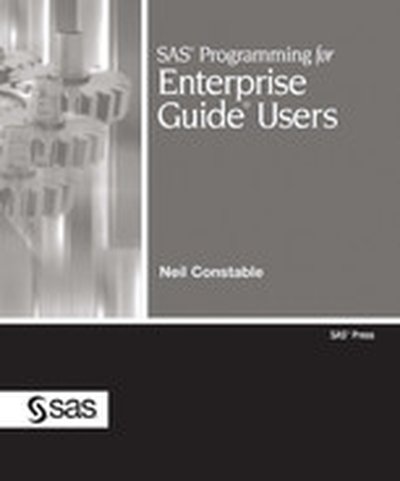
SAS® Programming for Enterprise Guide® Users

In this pragmatic, example-driven book, author Neil Constable demonstrates how you can use SAS code to enhance the capabilities of SAS Enterprise Guide. Designed to help you gain extra value from the products you already have, SAS Programming for Enterprise Guide Users contains tips and techniques that show you a variety of features that cannot be accessed directly through the task interfaces. In all cases, techniques are shown with examples that you can try and test, plus additional exercises are included to give you more practice. The end result is more efficient and resilient use of SAS Enterprise Guide in a wider variety of business areas. Included is a discussion of the following subject areas: the Output Delivery System advanced formatting macro variables and macros advanced reporting using PROC REPORT highlighting in reports hyperlinking between reports and graphs data manipulation using SQL data manipulation using the DATA step extended graphics By adding small amounts of code in key areas, SAS Enterprise Guide users can get more out of the product than the tasks reveal. Users should be familiar with the SAS Enterprise Guide user interface and tasks. No programming experience is necessary.

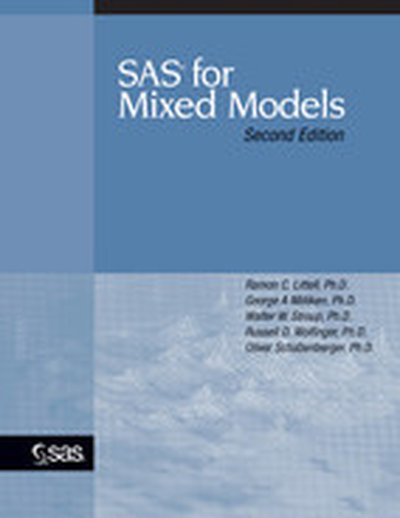
SAS for Mixed Models, Second Edition, 2nd Edition
The indispensable, up-to-date guide to mixed models using SAS. Discover the latest capabilities available for a variety of applications featuring the MIXED, GLIMMIX, and NLMIXED procedures in SAS for Mixed Models, Second Edition, the comprehensive mixed models guide for data analysis, completely revised and updated for SAS 9 by authors Ramon Littell, George Milliken, Walter Stroup, Russell Wolfinger, and Oliver Schabenberger. The theory underlying the models, the forms of the models for various applications, and a wealth of examples from different fields of study are integrated in the discussions of these models: random effect only and random coefficients models; split-plot, multilocation, and repeated measures models; hierarchical models with nested random effects; analysis of covariance models; spatial correlation models; generalized linear mixed models; and nonlinear mixed models.

Professionals and students with a background in two-way ANOVA and regression and a basic knowledge of linear models and matrix algebra will benefit from the topics covered.

This book is part of the SAS Press program.
SAS For Dummies

Created in partnership with SAS, this book explores SAS, a business intelligence software that can be used in any business setting or enterprise for data delivery, reporting, data mining, forecasting, statistical analysis, and more. SAS employee and technologist Stephen McDaniel combines real-world expertise and a friendly writing style to introduce readers to SAS basics. It covers crucial topics such as getting various types of data into the software, producing reports, working with the data, basic SAS programming, macros, and working with SAS and databases.

SAS® Macro Programming Made Easy, Second Edition

Need help understanding the SAS macro facility? You will find all the answers that you need in this easy-to-follow book! Michele Burlew puts her decades of macro programming experience to work for you as she guides you through the basics, as well as the more complex features of the SAS macro facility. Updated extensively for SAS 9, this book includes plenty of examples and step-by-step instructions. You will learn the elements of the macro facility (macro variables, macro programs, macro language), how to write a macro program, macro programming techniques, tips on using the macro facility, how the macro facility fits into SAS, and about the interfaces between the macro facility and other components of SAS. New topics for the second edition include using SAS 9 macro and SAS language features, debugging macro programs, adding error checking to macro programs, and building a library of utility macro programs. Beginning macro programmers will learn to write SAS macro programs quickly and efficiently. More experienced macro programmers will find this book useful to refresh their conceptual knowledge and expand on their macro programming skills. It is also important to note that the macro facility is a highly popular part of SAS and found in the job requirements for many SAS programming jobs. In addition, macro facility concepts are tested on the SAS Advanced Programming Exam. The book assumes some SAS programming experience, including knowledge of how to write a DATA step and how to use SAS procedures.

Learning SAS by Example
Learn to program SAS by example!

If you like learning by example, then Learning SAS by Example: A Programmer's Guide makes it easy to learn SAS programming. In an instructive and conversational tone, author Ron Cody clearly explains each programming technique and then illustrates it with one or more real-life examples, followed by a detailed description of how the program works. The text is divided into four major sections: Getting Started; DATA Step Processing; Presenting and Summarizing Your Data; and Advanced Topics. Subjects addressed include: Reading data from external sources Learning details of DATA step programming Subsetting and combining SAS data sets Understanding SAS functions and working with arrays Creating reports with PROC REPORT and PROC TABULATE Learning to use the SAS Output Delivery System Getting started with the SAS macro language Introducing PROC SQL

You can test your knowledge and hone your skills by solving the problems at the end of each chapter. (Solutions to odd-numbered problems are located at the back of this book. Solutions to all problems are available to instructors by visiting Ron Cody's author page for details.) This book is intended for beginners and intermediate users. Readers should know how to enter and submit a SAS program from their operating system.

This book is part of the SAS Press program.
Pharmaceutical Statistics Using SAS

Pharmaceutical Statistics Using SAS: A Practical Guide offers extensive coverage of cutting-edge biostatistical methodology used in drug development and the practical problems facing today's drug developers. Written by well-known experts in the pharmaceutical industry Alex Dmitrienko, Christy Chuang-Stein, and Ralph D'Agostino, it provides relevant tutorial material and SAS examples to help readers new to a certain area of drug development quickly understand and learn popular data analysis methods and apply them to real-life problems. Step-by-step, the book introduces a wide range of data analysis problems encountered in drug development and illustrates them using a wealth of case studies from actual pre-clinical experiments and clinical studies. The book also provides SAS code for solving the problems. Among the topics addressed are these:

drug discovery experiments to identify promising chemical compounds animal studies to assess the toxicological profile of these compounds clinical pharmacology studies to examine the properties of new drugs in healthy human subjects Phase II and Phase III clinical trials to establish therapeutic benefits of experimental drugs.

Additional features include a discussion of methodological issues, practical advice from subject-matter experts, and review of relevant regulatory guidelines. Most chapters are self-contained and include a fair amount of high-level introductory material to make them accessible to a broad audience of pharmaceutical scientists. This book will also serve as a useful reference for regulatory scientists as well as academic researchers and graduate students.

This book is part of the SAS Press program.
Data Preparation for Analytics Using SAS

Written for anyone involved in the data preparation process for analytics, Gerhard Svolba's Data Preparation for Analytics Using SAS offers practical advice in the form of SAS coding tips and tricks, and provides the reader with a conceptual background on data structures and considerations from a business point of view. The tasks addressed include viewing analytic data preparation in the context of its business environment, identifying the specifics of predictive modeling for data mart creation, understanding the concepts and considerations of data preparation for time series analysis, using various SAS procedures and SAS Enterprise Miner for scoring, creating meaningful derived variables for all data mart types, using powerful SAS macros to make changes among the various data mart structures, and more!

In the Know...SAS(R) Tips and Techniques From Around the Globe, Second Edition

You'll gain a world of knowledge through Phil Mason's inventive tips and techniques. Updated and expanded to cover the breadth of functionality offered in SAS 8 and SAS 9, In the Know...SAS Tips and Techniques From Around the Globe, Second Edition, is packed with timeless classics and plenty of new material addressing such popular topics as the DATA step, SQL, macros, functions, ODS, and much more. Each tip is presented in a self-contained format that is both informative and easy to use. Every chapter contains a collection of related tips with frequent use of code and log examples to help improve productivity. Users of all levels will discover how to save time and effort by incorporating the wisdom found in these practical tips.