talk-data.com talk-data.com

Topic

SAS

statistical_software analytics data_management

296

tagged

Activity Trend

8 peak/qtr
2020-Q1 2026-Q1

Activities

296 activities · Newest first

PROC DOCUMENT by Example Using SAS
PROC DOCUMENT by Example Using SAS demonstrates the practical uses of the DOCUMENT procedure, a part of the Output Delivery System, in SAS 9.3. Michael Tuchman explains how to work with PROC DOCUMENT, which is designed to store your SAS procedure output for replay at a later time without having to rerun your original SAS code. You’ll learn how to:

save a collection of procedure output, descriptive text, and supporting graphs that can be replayed as a single unit save output once and distribute that same output in a variety of ODS formats such as HTML, CSV, and PDF create custom reports by comparing output from the same procedure run at different points in time create a table of contents for your output modify the appearance of both textual and graphical ODS output even if the original data is no longer available or easily accessible manage your tabular and graphical output by using descriptive labels, titles, and footnotes rearrange the original order of output in a procedure to suit your needs

After using this book, you’ll be able to quickly and easily create libraries of professional-looking output that are accessible at any time.

This book is part of the SAS Press program.

PROC SQL: Beyond the Basics Using SAS, Second Edition

Kirk Lafler's PROC SQL: Beyond the Basics Using SAS, Second Edition, offers a step-by-step example-driven guide that helps readers master the language of PROC SQL. Packed with analysis and examples illustrating an assortment of PROC SQL options, statements, and clauses, this book can be approached in a number of ways. Users can read it cover-to-cover or selectively by chapter; they can use the extensive index to find content of interest or refer to the helpful "Summary" that precede each chapter to look for help on a specific topic.

The second edition explores new and powerful features in SAS 9.3, and includes such topics as adding data to a table with a SET clause; bulk loading data from Microsoft Excel; distinguishing between DATA step merges and PROC SQL joins; rules for designing indexes; cardinality and index selectivity; and demystifying join algorithms. It also features an expanded discussion of CASE expressions, and new sections on complex query applications, and grouping and performance. Delving into the workings of PROC SQL with greater analysis and discussion, PROC SQL: Beyond the Basic Using SAS, Second Edition, examines a broad range of topics and provides greater detail about this powerful database language using discussion and numerous real-world examples.

This book is part of the SAS Press program.

Getting Started with the Graph Template Language in SAS

You've just received a new survey of study results, and you need to quickly create custom graphical views of the data. Or, you've completed your analysis, and you need graphs to present the results to your audience, in the style that they prefer. Now, you can create custom graphs quickly and easily with Getting Started with the Graph Template Language in SAS, without having to understand all of the Graph Template Language (GTL) features first.

This book will get you started building graphs immediately and will guide you toward a better understanding of the GTL, one step at a time. It shows you the most common approaches to a variety of graphs along with information that you can use to build more complex graphs from there. Sanjay Matange offers expert tips, examples, and techniques, with a goal of providing you with a solid foundation in using the GTL so that you can progress to more sophisticated, adaptable graphs as you need them.

Ultimately, Getting Started with the Graph Template Language in SAS allows you to bypass the learning curve. It teaches you how to quickly create custom, aesthetically pleasing graphs that present your data with maximum clarity and minimum clutter.

This book is part of the SAS Press program.

Discovering Partial Least Squares with JMP

Partial Least Squares (PLS) is a flexible statistical modeling technique that applies to data of any shape. It models relationships between inputs and outputs even when there are more predictors than observations. Using JMP statistical discovery software from SAS, Discovering Partial Least Squares with JMP explores PLS and positions it within the more general context of multivariate analysis.

Ian Cox and Marie Gaudard use a “learning through doing” style. This approach, coupled with the interactivity that JMP itself provides, allows you to actively engage with the content. Four complete case studies are presented, accompanied by data tables that are available for download. The detailed “how to” steps, together with the interpretation of the results, help to make this book unique.

Discovering Partial Least Squares with JMP is of interest to professionals engaged in continuing development, as well as to students and instructors in a formal academic setting. The content aligns well with topics covered in introductory courses on: psychometrics, customer relationship management, market research, consumer research, environmental studies, and chemometrics. The book can also function as a supplement to courses in multivariate statistics and to courses on statistical methods in biology, ecology, chemistry, and genomics.

While the book is helpful and instructive to those who are using JMP, a knowledge of JMP is not required, and little or no prior statistical knowledge is necessary. By working through the introductory chapters and the case studies, you gain a deeper understanding of PLS and learn how to use JMP to perform PLS analyses in real-world situations.

This book motivates current and potential users of JMP to extend their analytical repertoire by embracing PLS. Dynamically interacting with JMP, you will develop confidence as you explore underlying concepts and work through the examples. The authors provide background and guidance to support and empower you on this journey.

This book is part of the SAS Press program.

SAS Macro Language Magic

SAS Macro Language Magic: Discovering Advanced Techniques pushes the SAS macro language to the limit. It explores how even common tools, when used to their full advantage, can transform into amazing applications. This book assumes a basic knowledge of the SAS macro language and then shows how to apply that knowledge in new and different ways.

This book enables you to find a technique that you like and then explore it to discover what works and what the possibilities are. You can experiment, focusing more on the application and less on the syntax, while at the same time visualizing the SAS program you want to generate.

Discover and develop powerful programming techniques down the path to demystifying MACROS. All the tricks and secrets are revealed, enabling you to write SAS macros that work like MAGIC.

This book is part of the SAS Press program.
How to Become a Top SAS Programmer

Would you like to be a top SAS programmer? Would you like to be the person that other SAS programmers turn to for solutions to programming problems? If so, then How to Become a Top SAS Programmer, written by Michael Raithel is the book for you.

This self-help book provides invaluable strategies for enhancing your SAS programming skills and introduces you to a wide variety of SAS resources that are readily available to you. Inside this book, you will learn: what makes a top SAS programmer fundamentals that every top SAS programmer should master ideas for advancing your SAS career within your organization where to find SAS documentation to learn new programming techniques how to participate in local and regional SAS user groups and SAS Global Forum how to make SAS training and certification work for you how to take part in SAS virtual communities to learn, contribute, and become well-known …and much more

Want to increase your SAS acumen, solidify the use of SAS in your organization, be a greater benefit to your organization as a SAS programmer, contribute to the world-wide SAS community, and enjoy good career growth? Michael’s book will help the novice SAS programmer or a seasoned professional to do all that and more.

Start reading it now and become the top SAS programmer in your organization who everyone goes to for insight and guidance into the many aspects of the SAS world!

This book is part of the SAS Press program.
SAS Business Intelligence for the Health Care Industry

SAS Business Intelligence for the Health Care Industry: Practical Applications teaches health care executives, managers, providers, and business analysts how to use SAS Business Intelligence (BI) tools to convert data into knowledge and value at all levels in the health care industry.

This book demonstrates how SAS BI solutions can be applied to the health care industry and offers detailed explanations of code and tasks in an approachable case study format. All applications are created with sample data that has the richness and complexity of operational health care data. Topics include:

using SAS Add-In for Microsoft Office and SAS Stored Processes technology to better track and forecast revenues and margins

creating OLAP and relational web reports that enable care management programs to locate and assist the neediest patients

implementing data access restrictions on OLAP and relational data in accordance with the industry’s need for secure data access

creating dashboards to help executives monitor their health care organization

With its level of depth and perfect blend of technology and business contexts, this book provides health care analysts, researchers, and statisticians with information and examples that can be used effectively and immediately. It is an indispensable aid to the health care professional in keeping up with a fast-changing industry.

This book is part of the SAS Press program.
IBM System Storage DCS3700 Introduction and Implementation Guide

The IBM® System Storage® DCS3700 consists of IBM System Storage DCS3700 storage subsystem and IBM System Storage DCS3700 expansion unit. The DCS3700 features the latest technologies, including 6 Gbps SAS and 8 Gbps Fibre Channel host interfaces, along with 6 Gbps SAS drives. The DCS3700 also features a 10 Gbps iSCSI host interface with an optional Performance Modules system. The DCS3700 provides a simple, efficient, and flexible approach to storage that is based on seven generations of design knowledge and firmware development. The DCS3700 can act as a cost-effective and fully integrated complement to IBM System x® servers, IBM BladeCenter®, and IBM Power Systems™ for various intensive computing environments. This IBM Redbooks® publication specifically addresses the hardware features, configuration, and implementation of the DCS3700. It presents detailed descriptions of the hardware configurations and options that are offered with the DCS3700. It then presents the concepts and functions that are used in planning and managing the storage subsystems, such as multipathing and path failover. This book offers a step-by-step guide to using the IBM Storage Manager to create arrays, logical drives, and other basic (and advanced) management tasks. This publication also contains practical information about diagnostic tests and troubleshooting, and includes practical examples about how to use scripts and the command-line interface (CLI).

Segmentation and Lifetime Value Models Using SAS

Help your organization determine the value of its customer relationships with Segmentation and Lifetime Value Models Using SAS. This book contains a wealth of information that will help you perform analyses to identify your customers and make informed marketing investments. It answers core questions on customer relationship management (CRM), provides an overall framework for thinking about CRM, and offers real-world examples across a variety of industries.

Edward C. Malthouse introduces you to a number of useful models, ranging from simple to more complicated examples, and discusses their applications. You'll learn about segmentation models for identifying groups of customers and about lifetime value models for estimating the future value of the segments. You'll learn how to prepare data and estimate models using Base SAS, SAS/STAT, SAS/IML, and SQL.

Marketing analysts, CRM analysts, database managers, and anyone looking to address the challenges of allocating marketing resources to different customer groups will benefit from the concepts and exercises in this book. Analysts will learn how to approach unique business problems. Managers will gain a sense of what's possible and what to ask of their analytics departments.

This book is part of the SAS Press program.
Numbersense: How to Use Big Data to Your Advantage

How to make simple sense of complex statistics--from the author of Numbers Rule Your World We live in a world of Big Data--and it's getting bigger every day. Virtually every choice we make hinges on how someone generates data . . . and how someone else interprets it--whether we realize it or not. Where do you send your child for the best education? Big Data. Which airline should you choose to ensure a timely arrival? Big Data. Who will you vote for in the next election? Big Data. The problem is, the more data we have, the more difficult it is to interpret it. From world leaders to average citizens, everyone is prone to making critical decisions based on poor data interpretations. In Numbersense, expert statistician Kaiser Fung explains when you should accept the conclusions of the Big Data "experts"--and when you should say, "Wait . . . what?" He delves deeply into a wide range of topics, offering the answers to important questions, such as: How does the college ranking system really work? Can an obesity measure solve America's biggest healthcare crisis? Should you trust current unemployment data issued by the government? How do you improve your fantasy sports team? Should you worry about businesses that track your data? Don't take for granted statements made in the media, by our leaders, or even by your best friend. We're on information overload today, and there's a lot of bad information out there. Numbersense gives you the insight into how Big Data interpretation works--and how it too often doesn't work. You won't come away with the skills of a professional statistician. But you will have a keen understanding of the data traps even the best statisticians can fall into, and you'll trust the mental alarm that goes off in your head when something just doesn't seem to add up. Praise for Numbersense " Numbersense correctly puts the emphasis not on the size of big data, but on the analysis of it. Lots of fun stories, plenty of lessons learned—in short, a great way to acquire your own sense of numbers!" Thomas H. Davenport, coauthor of Competing on Analytics and President’s Distinguished Professor of IT and Management, Babson College "Kaiser’s accessible business book will blow your mind like no other. You’ll be smarter, and you won’t even realize it. Buy. It. Now." Avinash Kaushik, Digital Marketing Evangelist, Google, and author, Web Analytics 2.0 "Each story in Numbersense goes deep into what you have to think about before you trust the numbers. Kaiser Fung ably demonstrates that it takes skill and resourcefulness to make the numbers confess their meaning." John Sall, Executive Vice President, SAS Institute "Kaiser Fung breaks the bad news—a ton more data is no panacea—but then has got your back, revealing the pitfalls of analysis with stimulating stories from the front lines of business, politics, health care, government, and education. The remedy isn’t an advanced degree, nor is it common sense. You need Numbersense." Eric Siegel, founder, Predictive Analytics World, and author, Predictive Analytics "I laughed my way through this superb-useful-fun book and learned and relearned a lot. Highly recommended!" Tom Peters, author of In Search of Excellence

Decision Trees for Analytics Using SAS Enterprise Miner

Decision Trees for Analytics Using SAS Enterprise Miner is the most comprehensive treatment of decision tree theory, use, and applications available in one easy-to-access place. This book illustrates the application and operation of decision trees in business intelligence, data mining, business analytics, prediction, and knowledge discovery. It explains in detail the use of decision trees as a data mining technique and how this technique complements and supplements data mining approaches such as regression, as well as other business intelligence applications that incorporate tabular reports, OLAP, or multidimensional cubes.

An expanded and enhanced release of Decision Trees for Business Intelligence and Data Mining Using SAS Enterprise Miner, this book adds up-to-date treatments of boosting and high-performance forest approaches and rule induction. There is a dedicated section on the most recent findings related to bias reduction in variable selection. It provides an exhaustive treatment of the end-to-end process of decision tree construction and the respective considerations and algorithms, and it includes discussions of key issues in decision tree practice.

Analysts who have an introductory understanding of data mining and who are looking for a more advanced, in-depth look at the theory and methods of a decision tree approach to business intelligence and data mining will benefit from this book.

This book is part of the SAS Press program.
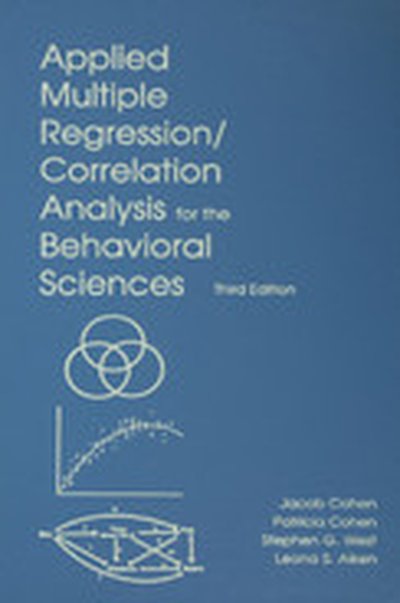
Applied Multiple Regression/Correlation Analysis for the Behavioral Sciences, 3rd Edition

This classic text on multiple regression is noted for its nonmathematical, applied, and data-analytic approach. Readers profit from its verbal-conceptual exposition and frequent use of examples. The applied emphasis provides clear illustrations of the principles and provides worked examples of the types of applications that are possible. Researchers learn how to specify regression models that directly address their research questions. An overview of the fundamental ideas of multiple regression and a review of bivariate correlation and regression and other elementary statistical concepts provide a strong foundation for understanding the rest of the text. The third edition features an increased emphasis on graphics and the use of confidence intervals and effect size measures, and an accompanying website with data for most of the numerical examples along with the computer code for SPSS, SAS, and SYSTAT, at www.psypress.com/9780805822236 . Applied Multiple Regression serves as both a textbook for graduate students and as a reference tool for researchers in psychology, education, health sciences, communications, business, sociology, political science, anthropology, and economics. An introductory knowledge of statistics is required. Self-standing chapters minimize the need for researchers to refer to previous chapters.

Simulating Data with SAS

Data simulation is a fundamental technique in statistical programming and research. Rick Wicklin's Simulating Data with SAS brings together the most useful algorithms and the best programming techniques for efficient data simulation in an accessible how-to book for practicing statisticians and statistical programmers.

This book discusses in detail how to simulate data from common univariate and multivariate distributions, and how to use simulation to evaluate statistical techniques. It also covers simulating correlated data, data for regression models, spatial data, and data with given moments. It provides tips and techniques for beginning programmers, and offers libraries of functions for advanced practitioners.

As the first book devoted to simulating data across a range of statistical applications, Simulating Data with SAS is an essential tool for programmers, analysts, researchers, and students who use SAS software.

This book is part of the SAS Press program.

JMP for Basic Univariate and Multivariate Statistics, 2nd Edition

JMP Start Statistics: A Guide to Statistics and Data Analysis Using JMP, Fifth Edition, is the perfect mix of software manual and statistics text. Authors John Sall, Ann Lehman, Mia Stephens, and Lee Creighton provide hands-on tutorials with just the right amount of conceptual and motivational material to illustrate how to use the intuitive interface for data analysis in JMP. Each chapter features concept-specific tutorials, examples, brief reviews of concepts, step-by-step illustrations, and exercises.

JMP Start Statistics, Fifth Edition, includes many new features of JMP 10, including an enhanced ability to manage a JMP session by easily tracking open and recently opened JMP tables; scripts, analyses, JMP projects, and other files; vastly expanded tools for instructors to demonstrate statistical concepts and interactive scripts to help students grasp difficult topics; Split-Plot designs with examples; examples of Graph Builder and Control Chart Builder; and new features that make the software easier to use.

This book is part of the SAS Press program.

PROC TEMPLATE Made Easy

This straightforward guide to PROC TEMPLATE shows you how to build your own custom styles and tables in SAS. You'll learn how to create new styles to match your organization's standards or simply to increase your report's aesthetic potential build custom tables with complex structures and traffic lighting to make them easier to read and interpret manage your templates and share them with other SAS users

Written for all levels of users, PROC TEMPLATE Made Easy guides you through the process of writing templates. Beginners will benefit from learning how to do so from the ground up. Intermediate and advanced users will learn the more complex features of PROC TEMPLATE as well as how to use styles in the Base SAS reporting procedures. This book explains how PROC TEMPLATE saves templates and teaches you how to create shareable template stores, allowing you to customize your working environment. The visual appendixes of all style attributes and graph colors serve as an essential reference for anyone using PROC TEMPLATE.

PROC TEMPLATE allows you to take advantage of all that the Output Delivery System has to offer, and PROC TEMPLATE Made Easy teaches you how.

This book is part of the SAS Press program.