talk-data.com talk-data.com

Event

O'Reilly Data Engineering Books

2001-10-19 – 2027-05-25 Oreilly Visit website ↗

Activities tracked

395

Collection of O'Reilly books on Data Engineering.

Filtering by: Analytics ×

Sessions & talks

Showing 351–375 of 395 · Newest first

Search within this event →
IBM InfoSphere Streams: Accelerating Deployments with Analytic Accelerators

This IBM® Redbooks® publication describes visual development, visualization, adapters, analytics, and accelerators for IBM InfoSphere® Streams (V3), a key component of the IBM Big Data platform. Streams was designed to analyze data in motion, and can perform analysis on incredibly high volumes with high velocity, using a wide variety of analytic functions and data types. The Visual Development environment extends Streams Studio with drag-and-drop development, provides round tripping with existing text editors, and is ideal for rapid prototyping. Adapters facilitate getting data in and out of Streams, and V3 supports WebSphere MQ, Apache Hadoop Distributed File System, and IBM InfoSphere DataStage. Significant analytics include the native Streams Processing Language, SPSS Modeler analytics, Complex Event Processing, TimeSeries Toolkit for machine learning and predictive analytics, Geospatial Toolkit for location-based applications, and Annotation Query Language for natural language processing applications. Accelerators for Social Media Analysis and Telecommunications Event Data Analysis sample programs can be modified to build production level applications. Want to learn how to analyze high volumes of streaming data or implement systems requiring high performance across nodes in a cluster? Then this book is for you. Please note that the additional material referenced in the text is not available from IBM.
Leveraging DB2 10 for High Performance of Your Data Warehouse

Building on the business intelligence (BI) framework and capabilities that are outlined in InfoSphere Warehouse: A Robust Infrastructure for Business Intelligence, SG24-7813, this IBM® Redbooks® publication focuses on the new business insight challenges that have arisen in the last few years and the new technologies in IBM DB2® 10 for Linux, UNIX, and Windows that provide powerful analytic capabilities to meet those challenges. This book is organized in to two parts. The first part provides an overview of data warehouse infrastructure and DB2 Warehouse, and outlines the planning and design process for building your data warehouse. The second part covers the major technologies that are available in DB2 10 for Linux, UNIX, and Windows. We focus on functions that help you get the most value and performance from your data warehouse. These technologies include database partitioning, intrapartition parallelism, compression, multidimensional clustering, range (table) partitioning, data movement utilities, database monitoring interfaces, infrastructures for high availability, DB2 workload management, data mining, and relational OLAP capabilities. A chapter on BLU Acceleration gives you all of the details about this exciting DB2 10.5 innovation that simplifies and speeds up reporting and analytics. Easy to set up and self-optimizing, BLU Acceleration eliminates the need for indexes, aggregates, or time-consuming database tuning to achieve top performance and storage efficiency. No SQL or schema changes are required to take advantage of this breakthrough technology. This book is primarily intended for use by IBM employees, IBM clients, and IBM Business Partners.

SAP HANA Cookbook

"SAP HANA Cookbook" is a hands-on guide to learning SAP HANA, a powerful in-memory database platform. Through over 50 practical recipes, you'll understand the inner workings of SAP HANA's architecture, and learn techniques to optimize operations and analytics. What this Book will help me do Understand SAP HANA's architecture and in-memory capabilities. Effectively load and integrate data from various source systems. Develop and optimize SAP HANA models such as attribute, analytical, and calculation views. Gain proficiency in using the SAP HANA SQL scripting language. Master user and role management for secure and efficient SAP HANA operation. Author(s) This book is authored by industry specialists with extensive experience in SAP HANA technology. Drawing from real-world projects, the authors provide nuanced insights and practical guidance, enabling readers to implement SAP HANA solutions effectively. Who is it for? This book is suited for solution architects, developers, and managers seeking to develop expertise in SAP HANA. Whether you are new to SAP technologies or looking to deepen your skillset, this resource provides comprehensive and actionable guidance.

Data Just Right: Introduction to Large-Scale Data & Analytics

Making Big Data Work: Real-World Use Cases and Examples, Practical Code, Detailed Solutions Large-scale data analysis is now vitally important to virtually every business. Mobile and social technologies are generating massive datasets; distributed cloud computing offers the resources to store and analyze them; and professionals have radically new technologies at their command, including NoSQL databases. Until now, however, most books on “Big Data” have been little more than business polemics or product catalogs. is different: It’s a completely practical and indispensable guide for every Big Data decision-maker, implementer, and strategist. Data Just Right Michael Manoochehri, a former Google engineer and data hacker, writes for professionals who need practical solutions that can be implemented with limited resources and time. Drawing on his extensive experience, he helps you focus on building applications, rather than infrastructure, because that’s where you can derive the most value. Manoochehri shows how to address each of today’s key Big Data use cases in a cost-effective way by combining technologies in hybrid solutions. You’ll find expert approaches to managing massive datasets, visualizing data, building data pipelines and dashboards, choosing tools for statistical analysis, and more. Throughout, the author demonstrates techniques using many of today’s leading data analysis tools, including Hadoop, Hive, Shark, R, Apache Pig, Mahout, and Google BigQuery. Coverage includes Mastering the four guiding principles of Big Data success—and avoiding common pitfalls Emphasizing collaboration and avoiding problems with siloed data Hosting and sharing multi-terabyte datasets efficiently and economically “Building for infinity” to support rapid growth Developing a NoSQL Web app with Redis to collect crowd-sourced data Running distributed queries over massive datasets with Hadoop, Hive, and Shark Building a data dashboard with Google BigQuery Exploring large datasets with advanced visualization Implementing efficient pipelines for transforming immense amounts of data Automating complex processing with Apache Pig and the Cascading Java library Applying machine learning to classify, recommend, and predict incoming information Using R to perform statistical analysis on massive datasets Building highly efficient analytics workflows with Python and Pandas Establishing sensible purchasing strategies: when to build, buy, or outsource Previewing emerging trends and convergences in scalable data technologies and the evolving role of the Data Scientist

Big Data Application Architecture Q&A: A Problem - Solution Approach

Big Data Application Architecture Pattern Recipes provides an insight into heterogeneous infrastructures, databases, and visualization and analytics tools used for realizing the architectures of big data solutions. Its problem-solution approach helps in selecting the right architecture to solve the problem at hand. In the process of reading through these problems, you will learn harness the power of new big data opportunities which various enterprises use to attain real-time profits. Big Data Application Architecture Pattern Recipes answers one of the most critical questions of this time 'how do you select the best end-to-end architecture to solve your big data problem?'. The book deals with various mission critical problems encountered by solution architects, consultants, and software architects while dealing with the myriad options available for implementing a typical solution, trying to extract insight from huge volumes of data in real-time and across multiple relational and non-relational data types for clients from industries like retail, telecommunication, banking, and insurance. The patterns in this book provide the strong architectural foundation required to launch your next big data application. The architectures for realizing these opportunities are based on relatively less expensive and heterogeneous infrastructures compared to the traditional monolithic and hugely expensive options that exist currently. This book describes and evaluates the benefits of heterogeneity which brings with it multiple options of solving the same problem, evaluation of trade-offs and validation of 'fitness-for-purpose' of the solution. What you'll learn Major considerations in building a big data solution Big data application architectures problems for specific industries What are the components one needs to build and end-to-end big data solution? Does one really need a real-time big data solution or an off-line analytics batch solution? What are the operations and support architectures for a big data solution? What are the scalability considerations, and options for a Hadoop installation? Who this book is for CIOs, CTOs, enterprise architects, and software architects Consultants, solution architects, and information management (IM) analysts who want to architect a big data solution for their enterprise

Query Acceleration for Business Using IBM Informix Warehouse Accelerator

IBM® Informix® Warehouse Accelerator is a state-of-the-art in-memory database that uses affordable innovations in memory and processor technology and trends in novel ways to boost query performance. It is a disruptive technology that changes how organizations provide analytics to its operational and historical data. Informix Warehouse Accelerator uses columnar, in-memory approach to accelerate even the most complex warehouse and operational queries without application changes or tuning. This IBM Redbooks® publication provides a comprehensive look at the technology and architecture behind the system. It contains information about the tools, data synchronization, and query processing capabilities of Informix Warehouse Accelerator, and provides steps to implement data analysis by using Informix Warehouse Accelerator within an organization. This book is intended for IBM Business Partners and clients who are looking for low-cost solutions to boost data warehouse query performance.

Introduction to IBM Real-time Compression Appliances

Continuing its commitment to developing and delivering industry-leading storage technologies, IBM is introducing the IBM Real-time Compression Appliances for NAS, an innovative new storage offering that delivers essential storage efficiency technologies, combined with exceptional ease of use and performance. In an era when the amount of information, particularly in unstructured files, is exploding, but budgets for storing that information are stagnant, IBM Real-time Compression technology offers a powerful tool for better information management, protection, and access. IBM Real-time Compression can help slow the growth of storage acquisition, reducing storage costs while simplifying both operations and management. It also enables organizations to keep more data available for use rather than storing it offsite or on harder-to-access tape, so they can support improved analytics and decision making. IBM Real-time Compression Appliances provide on-line storage optimization through real-time data compression, delivering dramatic cost reduction without performance degradation. This IBM® Redbooks® publication is an easy-to-follow guide that describes how to design solutions successfully using IBM Real-time Compression Appliances (IBM RTCAs). It provides practical installation examples, ease of use, remote management, high availability, and administration techniques. Furthermore, it explains best practices for RTCA solution design, application integration, and practical RTCA use cases.

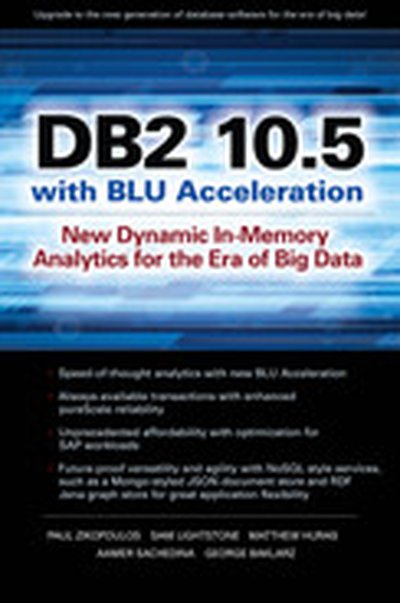
DB2 10.5 with BLU Acceleration

UPGRADE TO THE NEW GENERATION OF DATABASE SOFTWARE FOR THE ERA OF BIG DATA! If big data is an untapped natural resource, how do you find the gold hidden within? Leaders realize that big data means all data, and are moving quickly to extract more value from both structured and unstructured application data. However, analyzing this data can prove costly and complex, especially while protecting the availability, performance and reliability of essential business applications. In the new era of big data, businesses require data systems that can blend always-available transactions with speed-of-thought analytics. DB2 10.5 with BLU Acceleration provides this speed, simplicity, and affordability while making it easier to build next-generation applications with NoSQL features, such as a mongo-styled JSON document store, a graph store, and more. Dynamic in-memory columnar processing and other innovations deliver faster insights from more data, and enhanced pureScale clustering technology delivers high-availability transactions with application-transparent scalability for business continuity. With this book, you'll learn about the power and flexibility of multiworkload, multi-platform database software. Use the comprehensive knowledge from a team of DB2 developers and experts to get started with the latest DB2 trial version you can download at ibm.com/developerworks/downloads/im/db2/. Stay up to date on DB2 by visiting ibm.com/db2/.

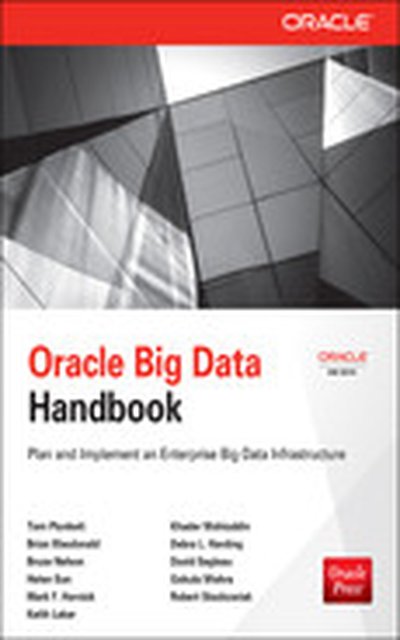
Oracle Big Data Handbook

Transform Big Data into Insight "In this book, some of Oracle's best engineers and architects explain how you can make use of big data. They'll tell you how you can integrate your existing Oracle solutions with big data systems, using each where appropriate and moving data between them as needed." -- Doug Cutting, co-creator of Apache Hadoop Cowritten by members of Oracle's big data team, Oracle Big Data Handbook provides complete coverage of Oracle's comprehensive, integrated set of products for acquiring, organizing, analyzing, and leveraging unstructured data. The book discusses the strategies and technologies essential for a successful big data implementation, including Apache Hadoop, Oracle Big Data Appliance, Oracle Big Data Connectors, Oracle NoSQL Database, Oracle Endeca, Oracle Advanced Analytics, and Oracle's open source R offerings. Best practices for migrating from legacy systems and integrating existing data warehousing and analytics solutions into an enterprise big data infrastructure are also included in this Oracle Press guide. Understand the value of a comprehensive big data strategy Maximize the distributed processing power of the Apache Hadoop platform Discover the advantages of using Oracle Big Data Appliance as an engineered system for Hadoop and Oracle NoSQL Database Configure, deploy, and monitor Hadoop and Oracle NoSQL Database using Oracle Big Data Appliance Integrate your existing data warehousing and analytics infrastructure into a big data architecture Share data among Hadoop and relational databases using Oracle Big Data Connectors Understand how Oracle NoSQL Database integrates into the Oracle Big Data architecture Deliver faster time to value using in-database analytics Analyze data with Oracle Advanced Analytics (Oracle R Enterprise and Oracle Data Mining), Oracle R Distribution, ROracle, and Oracle R Connector for Hadoop Analyze disparate data with Oracle Endeca Information Discovery Plan and implement a big data governance strategy and develop an architecture and roadmap

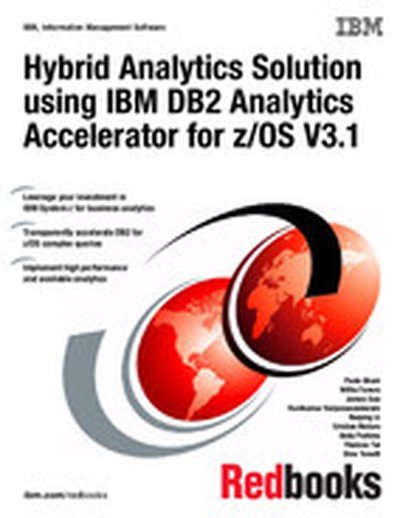
Hybrid Analytics Solution using IBM DB2 Analytics Accelerator for z/OS V3.1

The IBM® DB2® Analytics Accelerator Version 3.1 for IBM z/OS® (simply called Accelerator in this book) is a union of the IBM System z® quality of service and IBM Netezza® technology to accelerate complex queries in a DB2 for z/OS highly secure and available environment. Superior performance and scalability with rapid appliance deployment provide an ideal solution for complex analysis. In this IBM Redbooks® publication, we provide technical decision-makers with a broad understanding of the benefits of Version 3.1 of the Accelerator's major new functions. We describe their installation and the advantages to existing analytical processes as measured in our test environment. We also describe the IBM zEnterprise® Analytics System 9700, a hybrid System z solution offering that is surrounded by a complete set of optional packs to enable customers to custom tailor the system to their unique needs..

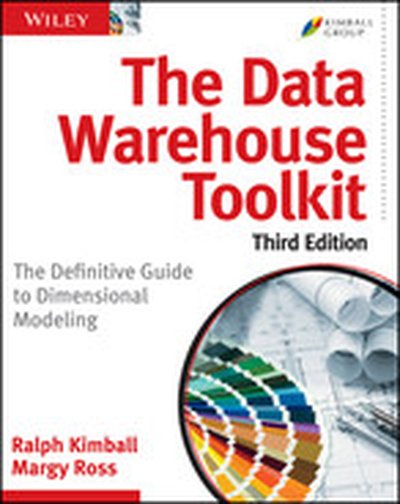
The Data Warehouse Toolkit: The Definitive Guide to Dimensional Modeling, 3rd Edition

Updated new edition of Ralph Kimball's groundbreaking book on dimensional modeling for data warehousing and business intelligence! The first edition of Ralph Kimball's The Data Warehouse Toolkit introduced the industry to dimensional modeling, and now his books are considered the most authoritative guides in this space. This new third edition is a complete library of updated dimensional modeling techniques, the most comprehensive collection ever. It covers new and enhanced star schema dimensional modeling patterns, adds two new chapters on ETL techniques, includes new and expanded business matrices for 12 case studies, and more. Authored by Ralph Kimball and Margy Ross, known worldwide as educators, consultants, and influential thought leaders in data warehousing and business intelligence Begins with fundamental design recommendations and progresses through increasingly complex scenarios Presents unique modeling techniques for business applications such as inventory management, procurement, invoicing, accounting, customer relationship management, big data analytics, and more Draws real-world case studies from a variety of industries, including retail sales, financial services, telecommunications, education, health care, insurance, e-commerce, and more Design dimensional databases that are easy to understand and provide fast query response with The Data Warehouse Toolkit: The Definitive Guide to Dimensional Modeling, 3rd Edition.

Disruptive Possibilities: How Big Data Changes Everything

Big data has more disruptive potential than any information technology developed in the past 40 years. As author Jeffrey Needham points out in this revealing book, big data can provide unprecedented visibility into the operational efficiency of enterprises and agencies. Disruptive Possibilities provides an historically-informed overview through a wide range of topics, from the evolution of commodity supercomputing and the simplicity of big data technology, to the ways conventional clouds differ from Hadoop analytics clouds. This relentlessly innovative form of computing will soon become standard practice for organizations of any size attempting to derive insight from the tsunami of data engulfing them. Replacing legacy silos—whether they’re infrastructure, organizational, or vendor silos—with a platform-centric perspective is just one of the big stories of big data. To reap maximum value from the myriad forms of data, organizations and vendors will have to adopt highly collaborative habits and methodologies.

Big Data Imperatives: Enterprise 'Big Data' Warehouse, 'BI' Implementations and Analytics

Big Data Imperatives, focuses on resolving the key questions on everyone's mind: Which data matters? Do you have enough data volume to justify the usage? How you want to process this amount of data? How long do you really need to keep it active for your analysis, marketing, and BI applications? Big data is emerging from the realm of one-off projects to mainstream business adoption; however, the real value of big data is not in the overwhelming size of it, but more in its effective use. This book addresses the following big data characteristics: Very large, distributed aggregations of loosely structured data - often incomplete and inaccessible Petabytes/Exabytes of data Millions/billions of people providing/contributing to the context behind the data Flat schema's with few complex interrelationships Involves time-stamped events Made up of incomplete data Includes connections between data elements that must be probabilistically inferred Big Data Imperatives explains 'what big data can do'. It can batch process millions and billions of records both unstructured and structured much faster and cheaper. Big data analytics provide a platform to merge all analysis which enables data analysis to be more accurate, well-rounded, reliable and focused on a specific business capability. Big Data Imperatives describes the complementary nature of traditional data warehouses and big-data analytics platforms and how they feed each other. This book aims to bring the big data and analytics realms together with a greater focus on architectures that leverage the scale and power of big data and the ability to integrate and apply analytics principles to data which earlier was not accessible. This book can also be used as a handbook for practitioners; helping them on methodology,technical architecture, analytics techniques and best practices. At the same time, this book intends to hold the interest of those new to big data and analytics by giving them a deep insight into the realm of big data. What you'll learn Understanding the technology, implementation of big data platforms and their usage for analytics Big data architectures Big data design patterns Implementation best practices Who this book is for This book is designed for IT professionals, data warehousing, business intelligence professionals, data analysis professionals, architects, developers and business users.

Real-Time Big Data Analytics: Emerging Architecture

Five or six years ago, analysts working with big datasets made queries and got the results back overnight. The data world was revolutionized a few years ago when Hadoop and other tools made it possible to getthe results from queries in minutes. But the revolution continues. Analysts now demand sub-second, near real-time query results. Fortunately, we have the tools to deliver them. This report examines tools and technologies that are driving real-time big data analytics.

Using R to Unlock the Value of Big Data: Big Data Analytics with Oracle R Enterprise and Oracle R Connector for Hadoop

The Oracle Press Guide to Big Data Analytics using R Cowritten by members of the Big Data team at Oracle, this Oracle Press book focuses on analyzing data with R while making it scalable using Oracle’s R technologies. Using R to Unlock the Value of Big Data provides an introduction to open source R and describes issues with traditional R and database interaction. The book then offers in-depth coverage of Oracle’s strategic R offerings: Oracle R Enterprise, Oracle R Distribution, ROracle, and Oracle R Connector for Hadoop. You can practice your new skills using the end-of-chapter exercises.

Implementing IBM InfoSphere BigInsights on IBM System x

As world activities become more integrated, the rate of data growth has been increasing exponentially. And as a result of this data explosion, current data management methods can become inadequate. People are using the term big data (sometimes referred to as Big Data) to describe this latest industry trend. IBM® is preparing the next generation of technology to meet these data management challenges. To provide the capability of incorporating big data sources and analytics of these sources, IBM developed a stream-computing product that is based on the open source computing framework Apache Hadoop. Each product in the framework provides unique capabilities to the data management environment, and further enhances the value of your data warehouse investment. In this IBM Redbooks® publication, we describe the need for big data in an organization. We then introduce IBM InfoSphere® BigInsights™ and explain how it differs from standard Hadoop. BigInsights provides a packaged Hadoop distribution, a greatly simplified installation of Hadoop and corresponding open source tools for application development, data movement, and cluster management. BigInsights also brings more options for data security, and as a component of the IBM big data platform, it provides potential integration points with the other components of the platform. A new chapter has been added to this edition. Chapter 11 describes IBM Platform Symphony®, which is a new scheduling product that works with IBM Insights, bringing low-latency scheduling and multi-tenancy to IBM InfoSphere BigInsights. The book is designed for clients, consultants, and other technical professionals.

Advanced Case Management with IBM Case Manager

Organizations face case management challenges that require insight, responsiveness, and collaboration. IBM® Case Manager, Version 5.1.1, is an advanced case management product that unites information, process, and people to provide the 360-degree view of case information and achieve optimized outcomes. With IBM Case Manager, knowledge workers can extract critical case information through integrated business rules, collaboration, and analytics. This easy access to information enhances decision making ability and leads to more successful case outcomes. IBM Case Manager also helps capture industry best practices in frameworks and templates to empower business users and accelerate return on investment. This IBM Redbooks® publication introduces the case management concept. It includes the reason for and benefits of case management, and why it is different from the traditional business process management or content management. In addition, this book addresses how you can design and build a case management solution with IBM Case Manager, and integrate that solution with external products and components. This book is intended to provide IT architects and IT specialists with the high-level concepts of case management and the capabilities of IBM Case Manager. In addition, it serves as a practical guide for IT professionals who are responsible for designing, building, and deploying IBM Case Manager solutions.

IBM Real-time Compression Appliance Version 4.1

Continuing its commitment to developing and delivering industry-leading storage technologies, IBM is introducing the IBM Real-time Compression Appliance for NAS, an innovative new storage offering that delivers essential storage efficiency technologies, combined with exceptional ease of use and performance. In an era when the amount of information, particularly in unstructured files, is exploding, but budgets for storing that information are stagnant, IBM Real-time Compression technology offers a powerful tool for better information management, protection and access. IBM Real-time Compression can help slow the growth of storage acquisition, reducing storage costs while simplifying both operations and management. It also enables organizations to keep more data available for use rather than storing it offsite or on tape that is more difficult to access, so they can support improved analytics and decision-making. IBM Real-time Compression Appliance provides online storage optimization through real-time data compression, delivering dramatic cost reduction without performance degradation. This IBM Redbooks publication is for system administrators and IT architects. It describes the enhancements made in version 4.1 of the Real-time Compression Appliance as compared to previous releases. This book is a companion to the publication Introduction to IBM Real-time Compression Appliances, SG24-7953.

Extending z/OS System Management Functions with IBM zAware

This IBM® Redbooks® publication explains the capabilities of the IBM System z® Advanced Workload Analysis Reporter (IBM zAware), and shows how you can use it as an integral part of your existing System z management tools. IBM zAware is an integrated, self-learning, analytics solution for IBM z/OS® that helps identify unusual system behavior in near real time. It is designed to help IT personnel improve problem determination so they can restore service quickly and improve overall availability. The book gives you a conceptual description of the IBM zAware appliance. It will help you to understand how it fits into the family of IBM mainframe system management tools that include Runtime Diagnostics, Predictive Failure Analysis (PFA), IBM Health Checker for z/OS, and z/OS Management Facility (z/OSMF). You are provided with the information you need to get IBM zAware up and running so you can start to benefit from its capabilities immediately. You will learn how to manage an IBM zAware environment, and see how other products can use the IBM zAware Application Programming Interface to extract information from IBM zAware for their own use. The target audience includes system programmers, system operators, configuration planners, and system automation analysts.

IBM Platform Computing Integration Solutions

This IBM® Redbooks® publication describes the integration of IBM Platform Symphony® with IBM BigInsights™. It includes IBM Platform LSF® implementation scenarios that use IBM System x® technologies. This IBM Redbooks publication is written for consultants, technical support staff, IT architects, and IT specialists who are responsible for providing solutions and support for IBM Platform Computing solutions. This book explains how the IBM Platform Computing solutions and the IBM System x platform can help to solve customer challenges and to maximize systems throughput, capacity, and management. It examines the tools, utilities, documentation, and other resources that are available to help technical teams provide solutions and support for IBM Platform Computing solutions in a System x environment. In addition, this book includes a well-defined and documented deployment model within a System x environment. It provides a planned foundation for provisioning and building large scale parallel high-performance computing (HPC) applications, cluster management, analytics workloads, and grid applications.

MongoDB Applied Design Patterns

Whether you’re building a social media site or an internal-use enterprise application, this hands-on guide shows you the connection between MongoDB and the business problems it’s designed to solve. You’ll learn how to apply MongoDB design patterns to several challenging domains, such as ecommerce, content management, and online gaming. Using Python and JavaScript code examples, you’ll discover how MongoDB lets you scale your data model while simplifying the development process. Many businesses launch NoSQL databases without understanding the techniques for using their features most effectively. This book demonstrates the benefits of document embedding, polymorphic schemas, and other MongoDB patterns for tackling specific big data use cases, including: Operational intelligence: Perform real-time analytics of business data Ecommerce: Use MongoDB as a product catalog master or inventory management system Content management: Learn methods for storing content nodes, binary assets, and discussions Online advertising networks: Apply techniques for frequency capping ad impressions, and keyword targeting and bidding Social networking: Learn how to store a complex social graph, modeled after Google+ Online gaming: Provide concurrent access to character and world data for a multiplayer role-playing game

Hadoop Beginner's Guide

Hadoop Beginner's Guide introduces you to the essential concepts and practical applications of Apache Hadoop, one of the leading frameworks for big data processing. You will learn how to set up and use Hadoop to store, manage, and analyze vast amounts of data efficiently. With clear examples and step-by-step instructions, this book is the perfect starting point for beginners. What this Book will help me do Understand the trends leading to the adoption of Hadoop and determine when to use it effectively in your projects. Build and configure Hadoop clusters tailored to your specific needs, enabling efficient data processing. Develop and execute applications on Hadoop using Java and Ruby, with practical examples provided. Leverage Amazon AWS and Elastic MapReduce to deploy Hadoop on the cloud and manage hosted environments. Integrate Hadoop with relational databases using tools like Hive and Sqoop for effective data transfer and querying. Author(s) The author of Hadoop Beginner's Guide is an experienced data engineer with a focus on big data technologies. They have extensive experience deploying Hadoop in various industries and are passionate about making complex systems accessible to newcomers. Their approach combines technical depth with an understanding of the needs of learners, ensuring clarity and relevance throughout the book. Who is it for? This book is designed for professionals who are new to big data processing and want to learn Apache Hadoop from scratch. It is ideal for system administrators, data analysts, and developers with basic programming knowledge in Java or Ruby looking to get started with Hadoop. If you have an interest in leveraging Hadoop for scalable data management and analytics, this book is for you. By the end, you'll gain the confidence and skills to utilize Hadoop effectively in your projects.

ElasticSearch Server

ElasticSearch Server is an excellent resource for mastering the ElasticSearch open-source search engine. This book takes you through practical steps to implement, configure, and optimize search capabilities, suitable for various data sets and applications, making faster and more accurate search outcomes accessible. What this Book will help me do Understand the core concepts of ElasticSearch, including data indexing, dynamic mapping, and search analysis. Develop practical skills in writing queries and filters to retrieve precise and relevant results. Learn to set up and efficiently manage ElasticSearch clusters for scalability and real-time performance. Implement advanced ElasticSearch functions like autocompletion, faceting, and geo-search. Utilize optimization techniques for cluster monitoring, health-checks, and tuning for reliable performance. Author(s) The authors of ElasticSearch Server are industry professionals with extensive experience in search technologies and system architecture. They have contributed to multiple tools and publications in the field of data search and analytics. Their writing aims to distill complex technical concepts into practical knowledge, making it valuable for readers from all backgrounds. Who is it for? This book is perfect for developers, system architects, and IT professionals seeking a robust and scalable search solution for their projects. Whether you're new to ElasticSearch or looking to deepen your expertise, this book will serve as a practical guide to implement ElasticSearch effectively. The only prerequisites are a basic understanding of databases and general query concepts, so prior search server knowledge is not required.

IBM Platform Computing Solutions

This IBM® Platform Computing Solutions Redbooks® publication is the first book to describe each of the available offerings that are part of the IBM portfolio of Cloud, analytics, and High Performance Computing (HPC) solutions for our clients. This IBM Redbooks publication delivers descriptions of the available offerings from IBM Platform Computing that address challenges for our clients in each industry. We include a few implementation and testing scenarios with selected solutions. This publication helps strengthen the position of IBM Platform Computing solutions with a well-defined and documented deployment model within an IBM System x® environment. This deployment model offers clients a planned foundation for dynamic cloud infrastructure, provisioning, large-scale parallel HPC application development, cluster management, and grid applications. This IBM publication is targeted to IT specialists, IT architects, support personnel, and clients. This book is intended for anyone who wants information about how IBM Platform Computing solutions use IBM to provide a wide array of client solutions.

MapReduce Design Patterns

Until now, design patterns for the MapReduce framework have been scattered among various research papers, blogs, and books. This handy guide brings together a unique collection of valuable MapReduce patterns that will save you time and effort regardless of the domain, language, or development framework you’re using. Each pattern is explained in context, with pitfalls and caveats clearly identified to help you avoid common design mistakes when modeling your big data architecture. This book also provides a complete overview of MapReduce that explains its origins and implementations, and why design patterns are so important. All code examples are written for Hadoop. Summarization patterns: get a top-level view by summarizing and grouping data Filtering patterns: view data subsets such as records generated from one user Data organization patterns: reorganize data to work with other systems, or to make MapReduce analysis easier Join patterns: analyze different datasets together to discover interesting relationships Metapatterns: piece together several patterns to solve multi-stage problems, or to perform several analytics in the same job Input and output patterns: customize the way you use Hadoop to load or store data "A clear exposition of MapReduce programs for common data processing patterns—this book is indespensible for anyone using Hadoop." --Tom White, author of Hadoop: The Definitive Guide