talk-data.com talk-data.com

Event

PyData Boston 2025

2025-12-08 – 2025-12-10 PyData

Activities tracked

65

Sessions & talks

Showing 26–50 of 65 · Newest first

Search within this event →

The Column's the limit: interactive exploration of larger than memory data sets in a notebook with Polars and Buckaroo

2025-12-10
talk

Notebooks struggle when data vastly exceeds RAM: pagination hacks, fragile sampling, and surprise OOMs. Buckaroo is a modern data table for notebooks built to quickly make sense of dataframes by providing search, summary stats, and scrolling with every view. This talk reviews how Buckaroo uses out‑of‑core design patterns, viewport streaming, lazy Polars pipelines, batched background stats, and a series cache to make interactive exploration fast and reliable on commodity laptops. We’ll walk through the lifecycle of opening a large Parquet/CSV file: detecting formats, avoiding full materialization, fetching only requested row/column ranges, and throttling UI updates for smoothness. We’ll show how column‑level hashing (via a lightweight Rust extension) enables stable, cache keys so warm loads render the first viewport and stats in under a second. CSV specifics and a practical CSV→Parquet streaming path round out the approach. The ideas are tool‑agnostic and reproducible with the open‑source PyData stack; Buckaroo serves as a concrete reference implementation. You’ll leave with guidelines and snippets to bring these patterns to your own workflows.
Uncertainty-Guided AI Red Teaming: Efficient Vulnerability Discovery in LLMs

2025-12-10
talk

AI red teaming is crucial for identifying security and safety vulnerabilities (e.g., jailbreaks, prompt injection, harmful content generation) of Large Language Models. However, manual and brute-force adversarial testing is resource-intensive and often inefficiently consumes time and compute resources exploring low-risk regions of the input space. This talk introduces a practical, Python-based methodology for accelerating red teaming using model uncertainty quantification (UQ).

Embracing Noise: How Data Corruption Can Make Models Smarter

Embracing Noise: How Data Corruption Can Make Models Smarter

2025-12-10 Watch
talk

Machine learning often assumes clean, high-quality data. Yet the real world is noisy, incomplete, and messy, and models trained only on sanitized datasets become brittle. This talk explores the counterintuitive idea that deliberately corrupting data during training can make models more robust. By adding structured noise, masking inputs, or flipping labels, we can prevent overfitting, improve generalization, and build systems that survive real world conditions. Attendees will leave with a clear understanding of why “bad data” can sometimes lead to better models.

Who is Python for? EVERYONE (and why that matters)

Who is Python for? EVERYONE (and why that matters)

2025-12-10 Watch
talk

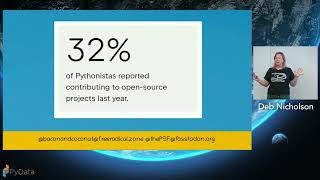
Python is controlled by the community and that its vast library of packages remain free for anyone to use and open for anyone to add to -- and that's no accident. Open communities that share and learn together are how we will build the kind of future we want to live in. If you've ever wondered who is in charge of Python, how it exists as a perennially free resource and why anyone would do that, this talk is for you!

Wrappers and Extenders: Companion Packages for Python Projects

Wrappers and Extenders: Companion Packages for Python Projects

2025-12-10 Watch
talk

Many Python users want features that don’t fit within the boundaries of their favorite libraries. Instead of forking or waiting on a pull request, you can build your own wrapper or extender package. This talk introduces the principles of designing companion packages that enhance existing libraries without changing their core code, using gt-extras as a case study. You’ll learn how to structure, document, and distribute your own add-ons to extend the tools you rely on.

Breakfast & Registration

2025-12-10
talk

Conference Social Event at Naco Taco

2025-12-09
talk

Join us for the PyData Boston Social!

Lightning Talks

2025-12-09
talk
The Boringly Simple Loop Powering GenAI Apps

The Boringly Simple Loop Powering GenAI Apps

2025-12-09 Watch
talk

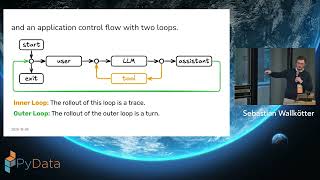
Do you feel lost in the jungle of GenAI frameworks and buzzwords? Here's a way out. Take any GenAI app, peel away the fluff, and look at its core. You'll find the same pattern: a boringly simple nested while loop. I will show you how this loop produces chat assistants, AI agents, and multi-agent systems. Then we'll cover how RAG, tool-calling, and memory are like lego bricks we add as needed. This gives you a first-principles based map. Use it to build GenAI apps from scratch; no frameworks needed.

Break

2025-12-09
talk
The SAT math gap: gender difference or selection bias?

The SAT math gap: gender difference or selection bias?

2025-12-09 Watch
talk
Allen Downey (Brilliant.org | Olin College)

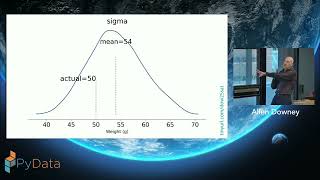
Why do male test takers consistently score about 30 points higher than female test takers on the mathematics section of the SAT? Does this reflect an actual difference in math ability, or is it an artifact of selection bias—if young men with low math ability are less likely to take the test than young women with the same ability?

This talk presents a Bayesian model that estimates how much of the observed difference can be explained by selection effects. We’ll walk through a complete Bayesian workflow, including prior elicitation with PreliZ, model building in PyMC, and validation with ArviZ, showing how Bayesian methods disentangle latent traits from observed outcomes and separate the signal from the noise.

No prior knowledge of Bayesian statistics is required; attendees should be familiar with Python and common probability distributions.

Keynote by Lisa Amini- What’s Next in AI for Data and Data Management?

Keynote by Lisa Amini- What’s Next in AI for Data and Data Management?

2025-12-09 Watch
talk

Advances in large language models (LLMs) have propelled a recent flurry of AI tools for data management and operations. For example, AI-powered code assistants leverage LLMs to generate code for dataflow pipelines. RAG pipelines enable LLMs to ground responses with relevant information from external data sources. Data agents leverage LLMs to turn natural language questions into data-driven answers and actions. While challenges remain, these advances are opening exciting new opportunities for data scientists and engineers. In this talk, we will examine recent advances, along with some still incubating in research labs, with the goal of understanding where this is all heading, and present our perspective on what’s next for AI in data management and data operations.

Lunch

2025-12-09
talk
Where Have All the Metrics Gone?

Where Have All the Metrics Gone?

2025-12-09 Watch
talk
RAG

How exactly does one validate the factuality of answers from a Retrieval-Augmented Generation (RAG) system? Or measure the impact of the new system prompt for your customer service agent? What do you do when stakeholders keep asking for "accuracy" metrics that you simply don't have? In this talk, we’ll learn how to define (and measure) what “good” looks like when traditional model metrics don’t apply.

Using Traditional AI and LLMs to Automate Complex and Critical Documents in Healthcare

2025-12-09
talk

Informed Consent Forms (ICFs) are critical documents in clinical trials. They are the first, and often most crucial, touchpoint between a patient and a clinical trial study. Yet the process of developing them is laborious, high-stakes, and heavily regulated. Each form must be tailored to jurisdictional requirements and local ethics boards, reviewed by cross-functional teams, and written in plain language that patients can understand. Producing them at scale across countries and disease areas demands manual effort and creates major operational bottlenecks. We used a combination of traditional AI and large language models to autodraft the ICF across clinical trial types, across countries and across disease areas at scale. The build, test, iteration and deployment offers both technical and non technical lessons learned for generative AI applications for complex documents at scale and for meaningful impact.

Break

2025-12-09
talk

The Lifecycle of a Jupyter Environment: From Exploration to Production-Grade Pipelines

2025-12-09
talk

Most data science projects start with a simple notebook—a spark of curiosity, some exploration, and a handful of promising results. But what happens when that experiment needs to grow up and go into production?

This talk follows the story of a single machine learning exploration that matures into a full-fledged ETL pipeline. We’ll walk through the practical steps and real-world challenges that come up when moving from a Jupyter notebook to something robust enough for daily use.

We’ll cover how to:

  • Set clear objectives and document the process from the beginning
  • Break messy notebook logic into modular, reusable components
  • Choose the right tools (Papermill, nbconvert, shell scripts) based on your workflow—not just the hype
  • Track environments and dependencies to make sure your project runs tomorrow the way it did today
  • Handle data integrity, schema changes, and even evolving labels as your datasets shift over time

And as a bonus: bring your results to life with interactive visualizations using tools like PyScript, Voila, and Panel + HoloViz

Keynote by Isabel Zimmerman

Keynote by Isabel Zimmerman

2025-12-09 Watch
talk

Isabel is a Senior Software Engineer at Posit, PBC.

Opening Notes

2025-12-09
talk

Registration & Breakfast

2025-12-09
talk
Generative Programming with Mellea: from Agentic Soup to Robust Software

Generative Programming with Mellea: from Agentic Soup to Robust Software

2025-12-08 Watch
talk

Agentic frameworks make it easy to build and deploy compelling demos. But building robust systems that use LLMs is difficult because of inherent environmental non-determinism. Each user is different, each request is different; the very flexibility that makes LLMs feel magical in-the-small also makes agents difficult to wrangle in-the-large.

Developers who have built large agentic-like systems know the pain. Exceptional cases multiply, prompt libraries grow, instructions are co-mingled with user input. After a few iterations, an elegant agent evolves into a big ball of mud.

This hands-on tutorial introduces participants to Mellea, an open-source Python library for writing structured generative programs. Mellea puts the developer back in control by providing the building blocks needed to circumscribe, control, and mediate essential non-determinism.

Going multi-modal: How to leverage the lastest multi-modal LLMs and deep learning models on real world applications

2025-12-08
talk
LLM

Multimodal deep learning models continue improving rapidly, but creating real-world applications that effectively leverage multiple data types remains challenging. This hands-on tutorial covers model selection, embedding storage, fine-tuning, and production deployment through two practical examples: a historical manuscript search system and flood forecasting with satellite imagery and time series data.

"Save your API Keys for someone else" -- Using the HuggingFace and Ollama ecosystems to run good-enough LLMs on your laptop

2025-12-08
talk

In this 90 minute tutorial we'll get anyone with some basic Python and Command Line skills up and running with their own 100% laptop based set of LLMs, and explain some successful patterns for leveraging LLMs in a data analysis environment. We'll also highlight pit-falls waiting to catch you out, and encourage you that your pre-GenAI analytics skills are still relevant today and likely will be for the foreseeable future by demonstrating the limits of LLMs for data analysis tasks.

Break

2025-12-08
talk

Break

2025-12-08
talk