talk-data.com talk-data.com

Topic

data-science-tasks

849

tagged

Activity Trend

1 peak/qtr
2020-Q1 2026-Q1

Activities

849 activities · Newest first

Prediction Revisited

A thought-provoking and startlingly insightful reworking of the science of prediction In Prediction Revisited: The Importance of Observation, a team of renowned experts in the field of data-driven investing delivers a ground-breaking reassessment of the delicate science of prediction for anyone who relies on data to contemplate the future. The book reveals why standard approaches to prediction based on classical statistics fail to address the complexities of social dynamics, and it provides an alternative method based on the intuitive notion of relevance. The authors describe, both conceptually and with mathematical precision, how relevance plays a central role in forming predictions from observed experience. Moreover, they propose a new and more nuanced measure of a prediction’s reliability. Prediction Revisited also offers: Clarifications of commonly accepted but less commonly understood notions of statistics Insight into the efficacy of traditional prediction models in a variety of fields Colorful biographical sketches of some of the key prediction scientists throughout history Mutually supporting conceptual and mathematical descriptions of the key insights and methods discussed within With its strikingly fresh perspective grounded in scientific rigor, Prediction Revisited is sure to earn its place as an indispensable resource for data scientists, researchers, investors, and anyone else who aspires to predict the future from the data-driven lessons of the past.
The Tableau Workshop

The Tableau Workshop offers a comprehensive, hands-on guide to mastering data visualization with Tableau. Through practical exercises and engaging examples, you will learn how to prepare, analyze, and visualize data to uncover valuable business insights. By completing this book, you will confidently understand the key concepts and tools needed to create impactful data-driven visual stories. What this Book will help me do Master the use of Tableau Desktop and Tableau Prep for data visualization tasks. Gain the ability to prepare and process data for effective analysis. Learn to choose and utilize the most appropriate chart types for different scenarios. Develop the skills to create interactive dashboards that engage stakeholders. Understand how to perform calculations to extract deeper insights from data. Author(s) Sumit Gupta, None Pinto, Shweta Savale, JC Gillet None, and None Cherven are experts in the field of data analytics and visualization. With diverse backgrounds in business intelligence and hands-on experience with industry tools like Tableau, they bring valuable insights to this book. Their collaborative effort offers practical, real-world knowledge tailored to help learners excel in Tableau and data visualization. With their passion for making technical concepts accessible, they guide readers step by step through their learning journey. Who is it for? This book is ideal for professionals, analysts, or students looking to delve into the world of data visualization with Tableau. Whether you're a complete beginner seeking foundational knowledge, or an intermediate user aiming to refine your skills, this book offers the practical insights you need. It's designed for those who want to master Tableau tools, explore meaningful data insights, and effectively communicate them through engaging dashboards and stories.

Excel Dashboards & Reports For Dummies, 4th Edition

It’s time for some truly “Excel-lent” spreadsheet reporting Beneath the seemingly endless rows and columns of cells, the latest version of Microsoft Excel boasts an astonishing variety of features and capabilities. But how do you go about tapping into some of that power without spending all of your days becoming a spreadsheet guru? It’s easy. You grab a copy of the newest edition of Excel Dashboards & Reports For Dummies and get ready to blow the pants off your next presentation audience! With this book, you’ll learn how to transform those rows and columns of data into dynamic reports, dashboards, and visualizations. You’ll draw powerful new insights from your company’s numbers to share with your colleagues – and seem like the smartest person in the room while you’re doing it. Excel Dashboards & Reports For Dummies offers: Complete coverage of the latest version of Microsoft Excel provided in the Microsoft 365 subscription Strategies to automate your reporting so you don’t have to manually crunch the numbers every week, month, quarter, or year Ways to get new perspectives on old data, visualizing it so you can find solutions no one else has seen before If you’re ready to make your company’s numbers and spreadsheets dance, it’s time to get the book that’ll have them moving to your tune in no time. Get Excel Dashboards & Reports For Dummies today.

Data Analytics, Computational Statistics, and Operations Research for Engineers

This book investigates the role of data mining in computational statistics for machine learning. It offers applications that can be used in various domains and examines the role of transformation functions in optimizing problem statements.

Modeling and Simulation with Simulink®

The essential, intermediate and advanced topics of Simulink are covered in the book. The concept of multi-domain physical modeling concept and tools in Simulink are illustrated with examples for engineering systems and multimedia information. The combination of Simulink and numerical optimization methods provides new approaches for solving problems, where solutions are not known otherwise.

Time Series Analysis on AWS

Time Series Analysis on AWS is your guide to building and deploying powerful forecasting models and identifying anomalies in your time series data. With this book, you will explore effective strategies for modern time series analysis using Amazon Web Services' powerful AI/ML tools. What this Book will help me do Master the fundamental concepts of time series and its applications using industry-relevant examples. Understand time series forecasting with Amazon Forecast and how to deliver actionable business insights. Build and deploy anomaly detection systems using Amazon Lookout for Equipment for predictive maintenance. Learn to utilize Amazon Lookout for Metrics to identify business operational anomalies effectively. Gain practical experience applying AWS ML tools to real-world time series data challenges. Author(s) None Hoarau is a data scientist with extensive experience in utilizing machine learning to solve real-world problems. Combining strong programming skills with domain expertise, they focus on developing applications leveraging AWS AI services. This book reflects their passion for making technical topics accessible and actionable for professionals. Who is it for? This book is ideal for data analysts, business analysts, and data scientists eager to enhance their skills in time series analysis. It suits readers familiar with statistical concepts but new to machine learning. If you're aiming to solve business problems using data and AWS tools, this resource is tailored for you.

What Is Causal Inference?

Causal inference lies at the heart of our ability to understand why things happen by helping us predict the results of our actions. This process is vital for businesses that aspire to turn data and information into valuable knowledge. With this report, data scientists and analysts will learn a principled way of thinking about causality, using a suite of causal inference techniques now available. Authors Hugo Bowne-Anderson, a data science consultant, and Mike Loukides, vice president of content strategy at O'Reilly Media, introduce causality and discuss randomized control trials (RCTs), key aspects of causal graph theory, and much-needed techniques from econometrics. You'll explore: Techniques from econometrics, including randomized control trials, the causality gold standard used in A/B-testing The constant-effects model for dealing with all things not being equal across the groups you're comparing Regression for dealing with confounding variables and selection bias Instrumental variables to estimate causal relationships in situations where regression won't work Techniques from causal graph theory including forks and colliders, the graphical tools for representing common causal patterns Backdoor and front-door adjustments for making causal inferences in the presence of confounders

Statistical Analysis with Excel For Dummies, 5th Edition

Become a stats superstar by using Excel to reveal the powerful secrets of statistics Microsoft Excel offers numerous possibilities for statistical analysis—and you don’t have to be a math wizard to unlock them. In Statistical Analysis with Excel For Dummies, fully updated for the 2021 version of Excel, you’ll hit the ground running with straightforward techniques and practical guidance to unlock the power of statistics in Excel. Bypass unnecessary jargon and skip right to mastering formulas, functions, charts, probabilities, distributions, and correlations. Written for professionals and students without a background in statistics or math, you’ll learn to create, interpret, and translate statistics—and have fun doing it! In this book you’ll find out how to: Understand, describe, and summarize any kind of data, from sports stats to sales figures Confidently draw conclusions from your analyses, make accurate predictions, and calculate correlations Model the probabilities of future outcomes based on past data Perform statistical analysis on any platform: Windows, Mac, or iPad Access additional resources and practice templates through Dummies.com For anyone who’s ever wanted to unleash the full potential of statistical analysis in Excel—and impress your colleagues or classmates along the way—Statistical Analysis with Excel For Dummies walks you through the foundational concepts of analyzing statistics and the step-by-step methods you use to apply them.

Innovative Data Integration and Conceptual Space Modeling for COVID, Cancer, and Cardiac Care

In recent years, scientific research and translation medicine have placed increased emphasis on computational methodology and data curation across many disciplines, both to advance underlying science and to instantiate precision-medicine protocols in the lab and in clinical practice. The nexus of concerns related to oncology, cardiology, and virology (SARS-CoV-2) presents a fortuitous context within which to examine the theory and practice of biomedical data curation. Innovative Data Integration and Conceptual Space Modeling for COVID, Cancer, and Cardiac Care argues that a well-rounded approach to data modeling should optimally embrace multiple perspectives inasmuch as data-modeling is neither a purely formal nor a purely conceptual discipline, but rather a hybrid of both. On the one hand, data models are designed for use by computer software components, and are, consequently, constrained by the mechanistic demands of software environments; data modeling strategies must accept the formal rigors imposed by unambiguous data-sharing and query-evaluation logic. In particular, data models are not well-suited for software-level deployment if such models do not translate seamlessly to clear strategies for querying data and ensuring data integrity as information is moved across multiple points. On the other hand, data modeling is, likewise, constrained by human conceptual tendencies, because the information which is managed by databases and data networks is ultimately intended to be visualized/utilized by humans as the end-user. Thus, at the intersection of both formal and humanistic methodology, data modeling takes on elements of both logico-mathematical frameworks (e.g., type systems and graph theory) and conceptual/philosophical paradigms (e.g., linguistics and cognitive science). The authors embrace this two-sided aspect of data models by seeking non-reductionistic points of convergence between formal and humanistic/conceptual viewpoints, and by leveraging biomedical contexts (viz., COVID, Cancer, and Cardiac Care) so as to provide motivating examples and case-studies in this volume. Provides an analysis of how conceptual spaces and related cognitive linguistic approaches can inspire programming and query-processing models Outlines the vital role that data modeling/curation has played in significant medical breakthroughs Presents readers with an overview of how information-management approaches intersect with precision medicine, providing case studies of data-modeling in concrete scientific practice Explores applications of image analysis and computer vision in the context of precision medicine Examines the role of technology in scientific publishing, replication studies, and dataset curation

Change Detection and Image Time-Series Analysis 1

Change Detection and Image Time Series Analysis 1 presents a wide range of unsupervised methods for temporal evolution analysis through the use of image time series associated with optical and/or synthetic aperture radar acquisition modalities. Chapter 1 introduces two unsupervised approaches to multiple-change detection in bi-temporal multivariate images, with Chapters 2 and 3 addressing change detection in image time series in the context of the statistical analysis of covariance matrices. Chapter 4 focuses on wavelets and convolutional-neural filters for feature extraction and entropy-based anomaly detection, and Chapter 5 deals with a number of metrics such as cross correlation ratios and the Hausdorff distance for variational analysis of the state of snow. Chapter 6 presents a fractional dynamic stochastic field model for spatio temporal forecasting and for monitoring fast-moving meteorological events such as cyclones. Chapter 7 proposes an analysis based on characteristic points for texture modeling, in the context of graph theory, and Chapter 8 focuses on detecting new land cover types by classification-based change detection or feature/pixel based change detection. Chapter 9 focuses on the modeling of classes in the difference image and derives a multiclass model for this difference image in the context of change vector analysis.

Introduction to Probability

INTRODUCTION TO PROBABILITY Discover practical models and real-world applications of multivariate models useful in engineering, business, and related disciplines In Introduction to Probability: Multivariate Models and Applications, a team of distinguished researchers delivers a comprehensive exploration of the concepts, methods, and results in multivariate distributions and models. Intended for use in a second course in probability, the material is largely self-contained, with some knowledge of basic probability theory and univariate distributions as the only prerequisite. This textbook is intended as the sequel to Introduction to Probability: Models and Applications. Each chapter begins with a brief historical account of some of the pioneers in probability who made significant contributions to the field. It goes on to describe and explain a critical concept or method in multivariate models and closes with two collections of exercises designed to test basic and advanced understanding of the theory. A wide range of topics are covered, including joint distributions for two or more random variables, independence of two or more variables, transformations of variables, covariance and correlation, a presentation of the most important multivariate distributions, generating functions and limit theorems. This important text: Includes classroom-tested problems and solutions to probability exercises Highlights real-world exercises designed to make clear the concepts presented Uses Mathematica software to illustrate the text’s computer exercises Features applications representing worldwide situations and processes Offers two types of self-assessment exercises at the end of each chapter, so that students may review the material in that chapter and monitor their progress Perfect for students majoring in statistics, engineering, business, psychology, operations research and mathematics taking a second course in probability, Introduction to Probability: Multivariate Models and Applications is also an indispensable resource for anyone who is required to use multivariate distributions to model the uncertainty associated with random phenomena.

Hands-on Matplotlib: Learn Plotting and Visualizations with Python 3

Learn the core aspects of NumPy, Matplotlib, and Pandas, and use them to write programs with Python 3. This book focuses heavily on various data visualization techniques and will help you acquire expert-level knowledge of working with Matplotlib, a MATLAB-style plotting library for Python programming language that provides an object-oriented API for embedding plots into applications. You'll begin with an introduction to Python 3 and the scientific Python ecosystem. Next, you'll explore NumPy and ndarray data structures, creation routines, and data visualization. You'll examine useful concepts related to style sheets, legends, and layouts, followed by line, bar, and scatter plots. Chapters then cover recipes of histograms, contours, streamplots, and heatmaps, and how to visualize images and audio with pie and polar charts. Moving forward, you'll learn how to visualize with pcolor, pcolormesh, and colorbar, and how to visualize in 3D in Matplotlib, create simple animations, and embed Matplotlib with different frameworks. The concluding chapters cover how to visualize data with Pandas and Matplotlib, Seaborn, and how to work with the real-life data and visualize it. After reading Hands-on Matplotlib you'll be proficient with Matplotlib and able to comfortably work with ndarrays in NumPy and data frames in Pandas. What You'll Learn Understand Data Visualization and Python using Matplotlib Review the fundamental data structures in NumPy and Pandas Work with 3D plotting, visualizations, and animations Visualize images and audio data Who This Book Is For Data scientists, machine learning engineers and software professionals with basic programming skills.

Tableau for Business Users: Learn to Automate and Simplify Dashboards for Better Decision Making

Learn Tableau by working through concrete examples and issues that you are likely to face in your day-to-day work. Author Shankar Arul starts by teaching you the fundamentals of data analytics before moving on to the core concepts of Tableau. You will learn how to create calculated fields, and about the currently available calculation functionalities in Tableau, including Basic Expressions, Level of Detail (LOD) Expressions, and Table Calculations. As the book progresses, you’ll be walked through comparisons and trend calculations using tables. A concluding chapter on dashboarding will show you how to build actionable dashboards to communicate analysis and visualizations. You’ll also see how Tableau can complement and communicate with Excel. After completing this book, you will be ready to tackle the challenges of data analytics using Tableau without getting bogged down by the technicalities of the tool. What Will You Learn Master the core concepts of Tableau Automate and simplify dashboards to help business users Understand the basics of data visualization techniques Leverage powerful features such as parameters, table calculations, level of detail expressions, and more Who is This book For Business analysts, data analysts, as well as financial analysts.

Maximizing Tableau Server

Maximizing Tableau Server guides you on how to make the most of your Tableau Server experience. You'll learn to organize, share, and interact with dashboards and data sources effectively. This book empowers you to enhance your productivity with Tableau Server and achieve seamless collaboration with your team. What this Book will help me do Navigate Tableau Server's interface to locate and customize content easily. Manage and organize Tableau Server content for efficient collaboration. Share, download, and interact with dashboards, enhancing user productivity. Automate tasks such as subscriptions and data refresh schedules. Apply best practices to optimize dashboard performance and usability. Author(s) None Sarsfield and None Locker are seasoned data professionals with extensive knowledge of Tableau. They have guided many organizations in utilizing Tableau Server to its full potential. Their practical insights and step-by-step approach demystify Tableau Server for readers of all backgrounds. Who is it for? This book is perfect for BI developers, data analysts, and professionals who are new to Tableau Server. If you're aiming to streamline the way you handle and share dashboards and want actionable advice on enhancing efficiency, this book is ideal for you. Basic familiarity with web navigation is all that is needed.

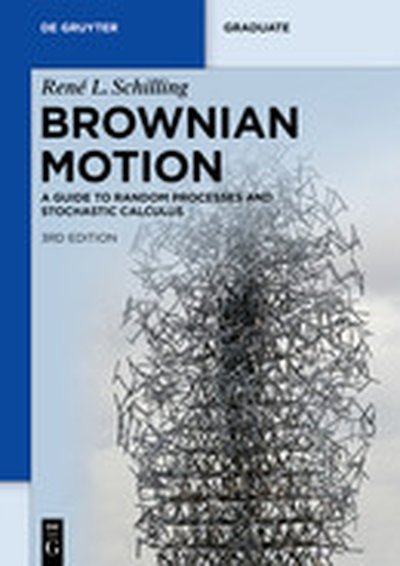
Brownian Motion, 3rd Edition

Stochastic processes occur everywhere in the sciences, economics and engineering, and they need to be understood by (applied) mathematicians, engineers and scientists alike. This book gives a gentle introduction to Brownian motion and stochastic processes, in general. Brownian motion plays a special role, since it shaped the whole subject, displays most random phenomena while being still easy to treat, and is used in many real-life models. Im this new edition, much material is added, and there are new chapters on ''Wiener Chaos and Iterated Itô Integrals'' and ''Brownian Local Times''.

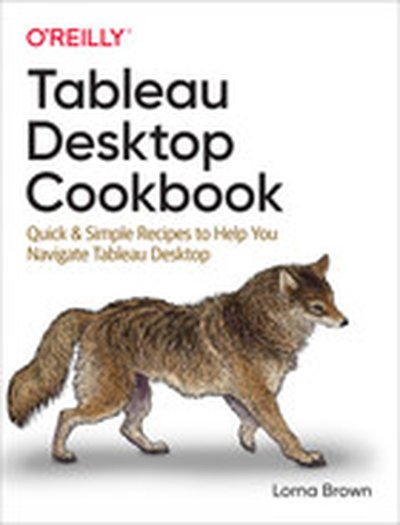
Tableau Desktop Cookbook

Whether you're a beginner just learning how to create data visualizations or a Jedi who's already used Tableau for years, this cookbook has a recipe for everyone. Author Lorna Brown provides more than 100 practical recipes to enhance the way you build Tableau dashboards--and helps you understand your data through the power of Tableau Desktop's interactive datavisualizations. With this cookbook, Tableau beginners will learn hands-on how this unique self-serve tool works, while experienced users will find this book to be an ideal reference guide on how to employ specific techniques. It also links you to online resources and community features, such as Tableau Tip Tuesday and Workout Wednesday. By the time you reach the end, you'll be a competent user of Tableau Desktop. You'll learn how to: Build both basic and complex data visualizations with Tableau Desktop Gain hands-on experience with Tableau's latest features, including set and parameter actions Create interactive dashboards to support business questions Improve your analytical skills to enhance the visualizations you've already created Learn data visualization skills and best practices to help you and your organization

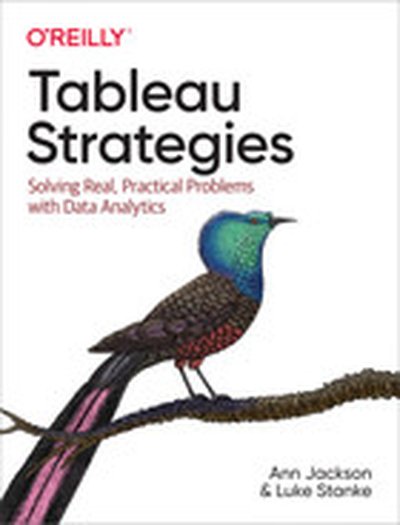
Tableau Strategies

If you want to increase Tableau's value to your organization, this practical book has your back. Authors Ann Jackson and Luke Stanke guide data analysts through strategies for solving real-world analytics problems using Tableau. Starting with the basics and building toward advanced topics such as multidimensional analysis and user experience, you'll explore pragmatic and creative examples that you can apply to your own data. Staying competitive today requires the ability to quickly analyze and visualize data and make data-driven decisions. With this guide, data practitioners and leaders alike will learn strategies for building compelling and purposeful visualizations, dashboards, and data products. Every chapter contains the why behind the solution and the technical knowledge you need to make it work. Use this book as a high-value on-the-job reference guide to Tableau Visualize different data types and tackle specific data challenges Create compelling data visualizations, dashboards, and data products Learn how to generate industry-specific analytics Explore categorical and quantitative analysis and comparisons Understand geospatial, dynamic, statistical, and multivariate analysis Communicate the value of the Tableau platform to your team and to stakeholders