“This book should satisfy those who want a different perspective than the official Oracle documentation. It will cover all important aspects of a data warehouse while giving the necessary examples to make the reading a lively experience.
 talk-data.com
Topic
5765
tagged
“This book should satisfy those who want a different perspective than the official Oracle documentation. It will cover all important aspects of a data warehouse while giving the necessary examples to make the reading a lively experience.
XML has become the lingua franca for representing business data, for exchanging information between business partners and applications, and for adding structure–and sometimes meaning—to text-based documents. XML offers some special challenges and opportunities in the area of search: querying XML can produce very precise, fine-grained results, if you know how to express and execute those queries.For software developers and systems architects: this book teaches the most useful approaches to querying XML documents and repositories. This book will also help managers and project leaders grasp how “querying XML fits into the larger context of querying and XML. Querying XML provides a comprehensive background from fundamental concepts (What is XML?) to data models (the Infoset, PSVI, XQuery Data Model), to APIs (querying XML from SQL or Java) and more. * Presents the concepts clearly, and demonstrates them with illustrations and examples; offers a thorough mastery of the subject area in a single book. * Provides comprehensive coverage of XML query languages, and the concepts needed to understand them completely (such as the XQuery Data Model).* Shows how to query XML documents and data using: XPath (the XML Path Language); XQuery, soon to be the new W3C Recommendation for querying XML; XQuery's companion XQueryX; and SQL, featuring the SQL/XML * Includes an extensive set of XQuery, XPath, SQL, Java, and other examples, with links to downloadable code and data samples.
The soup-to-nuts guide on all things SQL! SQL, or structured query language, is the international standard language for creating and maintaining relational databases. It is the basis of all major databases in use today and is essential for the storage and retrieval of database information. This fun and friendly guide takes SQL and all its related topics and breaks it down into easily digestible pieces for you to understand. You'll get the goods on relational database design, development, and maintenance, enabling you to start working with SQL right away! Provides an overview of the SQL language and examines how it is integral for the storage and retrieval of database information Includes updates to SQL standards as well as any new features Explores SQL concepts, relational database development, SQL queries, data security, database tuning, and more Addresses the relationship between SQL and programming as well as SQL and XML If you're looking for an up-to-date sequel to the bestelling first edition of SQL All-in-One For Dummies, then this is the book for you!
There's nothing wrong with “living in the now”—except that it's only part of our story. If we underuse or misuse our past, we're losing a tremendous source of wisdom and self-knowledge. The problem isn't the past itself, it's that we don't use it well. John Schuster exposes the many ways we ignore, distort, or become captive to our pasts and explains how we can tap into this underutilized treasure trove. He shows how to systematically recall key images and experiences that have influenced us, for good or ill, and reclaim the positive experiences—deepen our understanding of their impact and use them to guide our going forward. The negative experiences must be recast—reinterpreted so that they no longer lessen our possibilities but rather serve to expand our understanding of who we are and what we can be. Schuster's enlightening and entertaining stories as well as simple and compelling techniques will enable you to make your past sing and play and work for you.
Foundations of SQL Server 2008 R2 Business Intelligence introduces the exciting gamut of business intelligence tools included with SQL Server 2008. Microsoft has designed SQL Server 2008 to be more than just a database. It's a complete business intelligence (BI) platform. The database is at the core, and surrounding the database are tools for data mining, modeling, reporting, analyzing, charting, and integration with other, enterprise-level software packages. SQL Server 2008 puts an incredible amount of BI functionality at your disposal. But how do you take advantage of it? That's what this book is all about. Authors Guy Fouché and Lynn Langit show how to implement end-to-end BI solutions using SQL Server Analysis Services (SSAS), SQL Server Integration Services (SSIS), SQL Server Reporting Services (SSRS), and other tools in the Microsoft BI toolkit. You'll learn about all-new features such as PowerPivot and Report Builder 3.0. Also provided are clear examples of predictive analysis made possible through powerful data mining features in SQL Server. If you're an analyst or developer working with SQL Server 2008 who is charged with delivering results that drive business success, you can't afford to be without this book; you can't afford to ignore the powerful BI suite that Microsoft has placed at your disposal. Provides the "big picture" of Microsoft's BI tool suite Covers PowerPivot and other game-changing technologies introduced alongside SQL Server 2008 Release 2 Gives a practical analysis of features based on real-world practices What you'll learn Apply dimensional- and fact-based modeling to create OLAP schemas Optimize data extraction and transformation with SQL Server Integration Services Develop OLAP and data-mining solutions using SQL Server Analysis Services Create compelling reports using the new Report Builder 3.0 in SQL Server Reporting Services Deliver self-service business-intelligence via Microsoft PowerPivot Manage and maintain control over your business intelligence environment Who this book is for Foundations of SQL Server 2008 R2 Business Intelligence is for business intelligence analysts and developers wanting to employ the full stack of business intelligence tools that are part of SQL Server. The book also appeals to database administrators managing databases in support of business intelligence efforts.
ActiveMQ in Action is all you'll need to master ActiveMQ. It starts from the anatomy of a JMS message and moves quickly through connectors, message persistence, authentication, and authorization. By following a running example (a stock portfolio app), you'll pick up the best practices distilled by the authors from their long and deep involvement with this technology. About the Technology The Apache ActiveMQ message broker is an open source implementation of the Java Message Service spec. It makes for a reliable hub in any message-oriented enterprise application and integrates beautifully with Java EE containers, ESBs, and other JMS providers. About the Book What's Inside How to design message-based apps How to implement EI patterns using Camel How to administer ActiveMQ How to integrate with Geronimo, JBoss, Spring, and more About the Reader This book requires a working knowledge of Java, but no previous experience with ActiveMQ or other message brokers is needed. About the Authors Bruce Snyder is a co-founder of Apache Geronimo, a committer for ActiveMQ, Camel, and ServiceMix, and a member of various JCP expert groups. Dejan Bosanac is an ActiveMQ committer. Rob Davies is a co-founder of ActiveMQ, ServiceMix, and Camel. Quotes Covers everything you need to know about ActiveMQ. - Pratik Patel, AT&T A vital resource. - John Merryman, Yodle Complete and comprehensive, a must-have resource. - Rod Biresch, Chariot Solutions Authors have in-depth knowledge of ActiveMQ. - Roberto J. Rojas, Chariot Solutions Covers the basics, and then goes way beyond. - Jeff Davis, Author of Open Source SOA
Beginning Oracle Application Express 4 introduces one of the most talked about development platforms to come out of Oracle Corporation in years. Oracle Application Express, called APEX for short, enables rapid and easy development of web-based applications that make full use of Oracle Database. The release of APEX 4 brings a huge leap forward in terms of functionality and usability for both the developer and the end user. Power users and programmers alike can quickly put together robust and scalable applications for use by one person, by a department, by an entire company. Whether you're new to Oracle or an old hand who's yet to test the waters of APEX, Beginning Oracle Application Express 4 introduces the processes and best practices you'll need to become proficient with APEX. The book shows off the programming environment, the utilities and tools available, and then continues by walking through the process of building a working system from the ground up. While the book assumes a foundational knowledge of SQL and PL/SQL, all code used is documented and explained so that those new to the languages will not be lost. Covers brand-new functionality in APEX 4 Provides fully documented and explained example code Guides you through creating a working and fully deployable application What you'll learn Provides fully documented and explained example code Guides you through creating a working and fully deployable application Design, code, and troubleshoot APEX applications Create forms and generate reports Apply best-practices to database and application design Create intuitive navigation that inspires confidence amongst users Secure your applications from outside attack Deploy applications for one, a dozen, or hundreds of users Who this book is for Beginning Oracle Application Express 4 is for programmers and power users wanting to create rich, data-centric applications that are web-based, and that rest on Oracle's industry-leading database technology.
"Do everything that is necessary and absolutely nothing that is not." This IBM® Redbooks® publication, written at a Data Center Fabric Manager v10.1.4 and Fabric Operating System v6.4 level, consolidates critical information while also covering procedures and tasks that you are likely to encounter on a daily basis when implementing an IBM b-type SAN. The products that we describe in this book have more functionality than we can possibly cover in a single book. A storage area network (SAN) is a powerful infrastructure for consolidation, distance solutions, and data sharing. The quality applications that the IBM SAN portfolio provides can help you take full advantage of the benefits of the SAN. In this book, we cover the latest additions to the IBM b-type SAN family and show how you can implement them in an open systems environment. In particular, we focus on the Fibre Channel Protocol (FCP) environment. We address the key concepts that these products bring to the market and, in each case, we provide an overview of the functions that are essential to building a robust SAN environment.
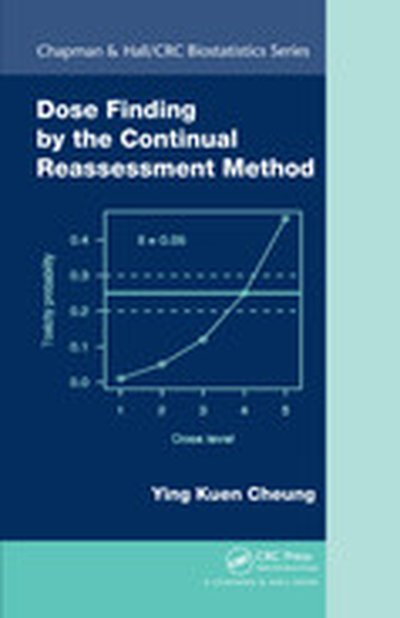
This book presents the continual reassessment method (CRM) as a tool for dose-finding studies. With a focus on the implementation and practice of the CRM and its variations, it explains how the CRM may be calibrated and extended to suit common clinical settings.
This practical guide offers a short course on scaling CouchDB to meet the capacity needs of your distributed application. Through a series of scenario-based examples, this book lets you explore several methods for creating a system that can accommodate growth and meet expected demand. In the process, you learn about several tools that can help you with replication, load balancing, clustering, and load testing and monitoring. Apply performance tips for tuning your database Replicate data, using Futon and CouchDB’s RESTful interface Distribute CouchDB’s workload through load balancing Learn options for creating a cluster of CouchDB nodes, including BigCouch, Lounge, and Pillow Conduct distributed load testing with Tsung
Statistical data are not always precise numbers, or vectors, or categories. Real data are frequently what is called fuzzy. Examples where this fuzziness is obvious are quality of life data, environmental, biological, medical, sociological and economics data. Also the results of measurements can be best described by using fuzzy numbers and fuzzy vectors respectively. Statistical analysis methods have to be adapted for the analysis of fuzzy data. In this book, the foundations of the description of fuzzy data are explained, including methods on how to obtain the characterizing function of fuzzy measurement results. Furthermore, statistical methods are then generalized to the analysis of fuzzy data and fuzzy a-priori information. Key Features: Provides basic methods for the mathematical description of fuzzy data, as well as statistical methods that can be used to analyze fuzzy data. Describes methods of increasing importance with applications in areas such as environmental statistics and social science. Complements the theory with exercises and solutions and is illustrated throughout with diagrams and examples. Explores areas such quantitative description of data uncertainty and mathematical description of fuzzy data. This work is aimed at statisticians working with fuzzy logic, engineering statisticians, finance researchers, and environmental statisticians. It is written for readers who are familiar with elementary stochastic models and basic statistical methods.
Best Practices for Deploying and Managing Master Data Services (MDS) Effectively manage master data and drive better decision making across your enterprise with detailed instruction from two MDS experts. Microsoft SQL Server 2008 R2 Master Data Services Implementation & Administration shows you how to use MDS to centralize the management of key data within your organization. Find out how to build an MDS model, establish hierarchies, govern data access, and enforce business rules. Legacy system integration and security are also covered. Real-world programming examples illustrate the material presented in this comprehensive guide. Create a process-agnostic solution for managing your business domains Learn how to take advantage of the data modeling capabilities of MDS Manage hierarchies and consolidations across your organization Import data by using SQL Server Integration Services and T-SQL statements Ensure data accuracy and completeness by using business rules and versioning Employ role-based security at functional, object, and attribute levels Design export views and publish data to subscribing systems Use Web services to progrmmatically interact with your implementation
Business Research Methods provides students with the knowledge, understanding and necessary skills to complete a business research. The reader is taken step-by-step through a range of contemporary research methods, while numerous worked examples and real-life case studies bring to life the realities of undertaking these researchs. Emphasis on data analysis is the key strength of this book. The book uses the latest software packages: MS Excel (2007), SPSS 17 and Minitab 15 to solve statistical data analysis. The complexity of multivariate analysis is also dealt with the help of these three softwares.
PowerPivot comprises a set of technologies for easy access to data mining and business intelligence analysis from Microsoft Excel and SharePoint. Power users and developers alike can create sophisticated, online analytic processing (OLAP) solutions using PowerPivot for Excel, and then share those solutions with other users via PowerPivot for SharePoint. Data can be pulled in from any of the leading database platforms, as well as from spreadsheets and flat files. PowerPivot for Business Intelligence Using Excel and SharePoint is your key to mastering PowerPivot. The book takes a scenario-based approach to showing you how to collect data, to mine that data through insightful analysis, and to draw conclusions that drive business performance. Each chapter in the book is focused on a specific challenge that you'll encounter when using PowerPivot. Each chapter takes you through a solution technique that's been proven in the real world. Covers the leading technology for bringing data analytics to the desktop Presents real-world solutions to real-world scenarios Written by a Microsoft Virtual Technical Specialist (VTS) for Business Intelligence What you'll learn Install and verify the PowerPivot software Integrated existing, available data to deliver business intelligence Leverage Time Intelligence to report change over time Write Data Analysis Expressions (DAX) to create custom measures Identify and implement solutions for role-playing dimensions Recognize and work-around PowerPivot's missing features Who this book is for PowerPivot Solutions for Excel and SharePoint is aimed at information workers and data analysts who typically use Excel to drive business decisions. The book shows how you can apply PowerPivot to problems typically addressed through complicated and arcane spreadsheet techniques. Business people without the time and interest in learning Excel arcane will especially appreciate how PowerPivot enables them to easily create models and perform analysis far in advance of anything they could do using Excel alone.
With more than 200 practical recipes, this book helps you perform data analysis with R quickly and efficiently. The R language provides everything you need to do statistical work, but its structure can be difficult to master. This collection of concise, task-oriented recipes makes you productive with R immediately, with solutions ranging from basic tasks to input and output, general statistics, graphics, and linear regression. Each recipe addresses a specific problem, with a discussion that explains the solution and offers insight into how it works. If you’re a beginner, R Cookbook will help get you started. If you’re an experienced data programmer, it will jog your memory and expand your horizons. You’ll get the job done faster and learn more about R in the process. Create vectors, handle variables, and perform other basic functions Input and output data Tackle data structures such as matrices, lists, factors, and data frames Work with probability, probability distributions, and random variables Calculate statistics and confidence intervals, and perform statistical tests Create a variety of graphic displays Build statistical models with linear regressions and analysis of variance (ANOVA) Explore advanced statistical techniques, such as finding clusters in your data "Wonderfully readable, R Cookbook serves not only as a solutions manual of sorts, but as a truly enjoyable way to explore the R language—one practical example at a time."—Jeffrey Ryan, software consultant and R package author
The rapid spread and adoption of production storage area networks (SANs) has fueled the need for multiprotocol routers. The routers provide improved scalability, security, and manageability by enabling devices in separate SAN fabrics to communicate without merging fabrics into a single, large SAN fabric. This capability enables clients to initially deploy separate SAN solutions at the departmental and data center levels. Then, clients can consolidate these separate solutions into large enterprise SAN solutions as their experience and requirements grow and change. Alternatively, multiprotocol routers can help to connect existing enterprise SANs for a variety of reasons. For instance, the introduction of Small Computer System Interface over IP (iSCSI) provides for the connection of low-end, low-cost hosts to enterprise SANs. The use of an Internet Protocol (IP) in the Fibre Channel (FC) environment provides for resource consolidation and disaster recovery planning over long distances. And the use of FC-FC routing services provides connectivity between two or more fabrics without having to merge them into a single SAN. This IBM® Redbooks® publication targets storage network administrators, system designers, architects, and IT professionals who sell, design, or administer SANs. It introduces you to products, concepts, and technology in the IBM System Storage™ SAN Routing portfolio, which is based on Brocade products and technology. This book shows the features of these products and examples of how you can deploy and use them.

This Element is an excerpt from Overhauling America's Healthcare Machine: Stop the Bleeding and Save Trillions (9780132173254) by Douglas A. Perednia. Available in print and digital formats. We’re paying more for healthcare than anyone else on in the world. Are we really getting what we’re paying for? To justify the status quo, politicians, insurers, and the media say many stupid things--as when they remind us we have the “best healthcare in the world.” The implication: We’re getting what we’re paying for, and the high price is simply the cost of being #1. But is this really true? Most of these pronouncements are consistently, suspiciously vague....
Maximize Oracle Exadata Capabilities Leverage all of the powerful features available in the Oracle Exadata Database Machine using the proven techniques inside this Oracle Press guide. Written by Oracle experts, Achieving Extreme Performance with Oracle Exadata shows you how to take full advantage of this complete, optimized package of software, servers, and storage. Best practices for enterprise deployments, high availability, administration, backup and recovery, data warehousing, online transaction processing, consolidation, and migration are included in this authoritative resource. Take advantage of the tightly integrated hardware and software in the Oracle Exadata Database Machine Work with Oracle Exadata software features, including Smart Scans, Oracle Exadata Hybrid Columnar Compression, storage indexes, Oracle Exadata Smart Flash Cache, and I/O Resource Manager Understand Oracle Exadata Database Machine balanced hardware architecture Architect, administer, and monitor Oracle Exadata Storage Servers Deploy data warehouses on the Oracle Exadata Database Machine Run online transaction processing (OLTP) workloads on the Oracle Exadata Database Machine Consolidate databases with and migrate databases to the Oracle Exadata Database Machine
Best practices and invaluable advice from world-renowned data warehouse experts In this book, leading data warehouse experts from the Kimball Group share best practices for using the upcoming "Business Intelligence release" of SQL Server, referred to as SQL Server 2008 R2. In this new edition, the authors explain how SQL Server 2008 R2 provides a collection of powerful new tools that extend the power of its BI toolset to Excel and SharePoint users and they show how to use SQL Server to build a successful data warehouse that supports the business intelligence requirements that are common to most organizations. Covering the complete suite of data warehousing and BI tools that are part of SQL Server 2008 R2, as well as Microsoft Office, the authors walk you through a full project lifecycle, including design, development, deployment and maintenance. Features more than 50 percent new and revised material that covers the rich new feature set of the SQL Server 2008 R2 release, as well as the Office 2010 release Includes brand new content that focuses on PowerPivot for Excel and SharePoint, Master Data Services, and discusses updated capabilities of SQL Server Analysis, Integration, and Reporting Services Shares detailed case examples that clearly illustrate how to best apply the techniques described in the book The accompanying Web site contains all code samples as well as the sample database used throughout the case studies The Microsoft Data Warehouse Toolkit, Second Edition provides you with the knowledge of how and when to use BI tools such as Analysis Services and Integration Services to accomplish your most essential data warehousing tasks.
Learn how to create MapReduce views in CouchDB that let you query the document-oriented database for meaningful data. With this short and concise ebook, you'll get step-by-step instructions and lots of sample code to create and explore several MapReduce views, using an example database you construct.