
All of the product innovation and open source project updates Databricks announced at Data + AI Summit–in less than 5 min.
 talk-data.com
Topic
561
tagged
All of the product innovation and open source project updates Databricks announced at Data + AI Summit–in less than 5 min.
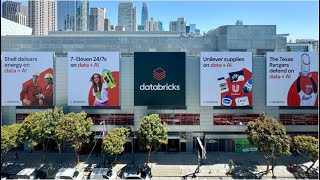
At this year's event, over 250 customers shared their data and AI journies. They showcased a wide variety of use cases, best practices and lessons from their leadership and innovation with the latest data and AI technologies.
See how enterprises are leveraging generative AI in their data operations and how innovative data management and data governance are fueling organizations as they race to develop GenAI applications. https://www.databricks.com/blog/how-real-world-enterprises-are-leveraging-generative-ai
To see more real-world use cases and customer success stories, visit: https://www.databricks.com/customers
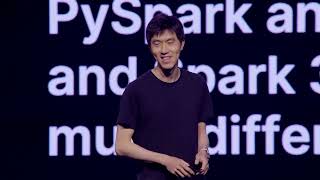
Reynold Xin, Co-founder and Chief Architect, Databricks shares the latest innovation coming out of the Apache Spark™ open source project including a preview of the anticipated release of Spark 4.0
Speakers: Reynold Xin, Co-founder and Chief Architect, Databricks Tareef Kawaf, President, Posit Sofware, PBC
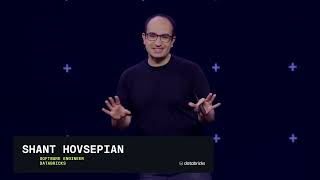
Shant Hovsepian, Chief Technology Officer of Data Warehousing at Databricks explains why Delta Lake is the most adopted open lakehouse format.
Includes: - Delta Lake UniForm GA (support for and compatibility with Hudi, Apache Iceberg, Delta) - Delta Lake Liquid Clustering - Delta Lake production-ready catalog (Iceberg REST API) - The growth and strength of the Delta ecosystem - Delta Kernel - DuckDB integration with Delta - Delta 4.0
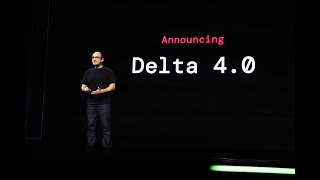
Shant Hovsepian, CTO of Data Warehousing at Databricks announced the biggest Delta Lake release to date, Delta 4.0, during the Data + AI Summit 2024 in San Francisco.
Speaker: Shant Hovsepian, Chief Technology Officer of Data Warehousing, Databricks

Speaker: Matei Zaharia, Original Creator of Apache Spark™ and MLflow; Chief Technologist, Databricks
Matei Zaharia, Original Creator of Apache Spark™ and MLflow and Chief Technologist at Databricks open sourced Unity Catalog live onstage at the Data + AI Summit 2024 in San Francisco.
Speaker: Bilal Aslam, Sr. Director of Product Management, Databricks
Bilal explains that everything starts with good data and outlines the three steps to good data including, ingesting, transforming and orchestrating your data. Then Bilal announces Databricks LakeFlow - a unified solution for data engineering. With LakeFlow you can ingest data from databases, enterprise apps and cloud sources, transform it in batch and real-time streaming, and confidently deploy and operate in production. Includes a live demo of Databricks LakeFlow.
To learn more about Databricks LakeFlow, see the announcement blog post: https://www.databricks.com/blog/introducing-databricks-lakeflow
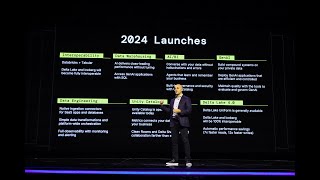
Ali Ghodsi, Co-founder and CEO of Databricks closes the 2024 Data + AI Summit with a recap of Databricks and open source innovation announced during the 4-day conference in San Francisco.
Speaker: Ali Ghodsi, Co-founder and CEO, Databricks @Databricks

Speakers: Matei Zaharia, Original Creator of Apache Spark™ and MLflow; Chief Technologist, Databricks Darshana Sivakumar, Staff Product Manager, Databricks
Organizations are looking for ways to securely exchange their data and collaborate with external partners to foster data-driven innovations. In the past, organizations had limited data sharing solutions, relinquishing control over how their sensitive data was shared with partners and little to no visibility into how their data was consumed. This created the risk for potential data misuse and data privacy breaches. Customers who tried using other clean room solutions have told us these solutions are limited and do not meet their needs, as they often require all parties to copy their data into the same platform, do not allow sophisticated analysis beyond basic SQL queries, and have limited visibility or control over their data.
Organizations need an open, flexible, and privacy-safe way to collaborate on data, and Databricks Clean Rooms meets these critical needs.
See a demo of Databricks Clean Rooms, now in Public Preview on AWS + Azure

Speaker: Matei Zaharia, Original Creator of Apache Spark™ and MLflow; Chief Technologist, Databricks
Summary: Data sharing and collaboration are important aspects of the data space. Matei Zaharia explains the evolution of the Databricks data platform to facilitate data sharing and collaboration for customers and their partners.
Delta Sharing allows you to share parts of your table with third parties authorized to view them. Over 16,000 data recipients use Delta Sharing, and 40% are not on Databricks—a testament to the open nature.
Databricks Marketplace has been growing rapidly and now has over 2,000 data listings, making it one of the largest data marketplaces available. New Marketplace partners include T-Mobile, Tableau, Atlassian, Epsilon, Shutterstock and more.
To learn more about Delta Sharing features and the expansion of partner sharing ecosystem, see the recent blog: https://www.databricks.com/blog/whats-new-data-sharing-and-collaboration
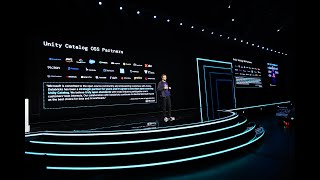
Speaker: Matei Zaharia, Original Creator of Apache Spark™ and MLflow; Chief Technologist, Databricks

Reynold Xin explains the evolution of Apache Spark™, outlining several historical challenges and how the Spark community worked to make improvements, including the addition of PySpark.
Speaker: Reynold Xin, Co-founder and Chief Architect at Databricks
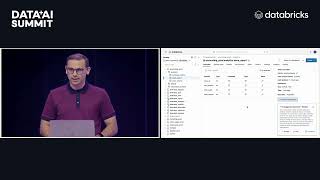
Get open access to your data no matter where it resides while applying unified governance - see the latest features of Unity Catalog.
Speaker: Zeashan Pappa, Staff Product Manager, Databricks
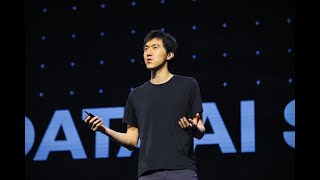
Databricks Co-founder and Chief Architect, Reynold Xin, on the evolution of Apache Spark™ and what's next, including Spark Connect and a preview of Apache Spark™ 4.0
Speaker: Reynold Xin, Co-founder and Chief Architect, Databricks

Shant Hovsepian, Chief Technology Officer of Data Warehousing at Databricks, discusses the UniForm data format and its interoperability with other data formats. Shant explains that Delta Lake is the most adopted open lakehouse format.
Speaker: Shant Hovsepian, Chief Technology Officer of Data Warehousing, Databricks

Speakers: Ali Ghodsi, Co-founder and CEO, Databricks Ryan Blue, Creator of Apache Iceberg and co-founder of Tabular
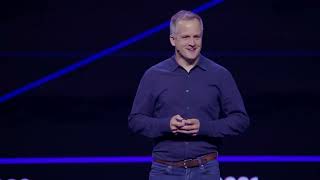
Speakers: Patrick Wendell, Co-founder and VP of Engineering, Databricks Kasey Uhlenhuth, Staff Product Manager, Databricks
At the Data and AI Summit, we announced several new capabilities that make Databricks Mosaic AI the best platform for building production-quality AI systems. These features are based on our experience working with thousands of companies to put AI-powered applications into production. Announcements include support for fine-tuning foundation models, an enterprise catalog for AI tools, a new SDK for building, deploying, and evaluating AI Agents, and a unified AI gateway for governing deployed AI services.
Sessions from Data + AI Summit are available on-demand at https://www.databricks.com/dataaisummit

Reynold Xin, Co-founder and Chief Architect at Databricks, presented during Data + AI Summit 2024 on Databricks SQL and its advancements and how to drive performance improvements with the Databricks Data Intelligence Platform.
Speakers: Reynold Xin, Co-founder and Chief Architect, Databricks Pearl Ubaru, Technical Product Engineer, Databricks
Main Points and Key Takeaways (AI-generated summary)
Introduction of Databricks SQL: - Databricks SQL was announced four years ago and has become the fastest-growing product in Databricks history. - Over 7,000 customers, including Shell, AT&T, and Adobe, use Databricks SQL for data warehousing.
Evolution from Data Warehouses to Lakehouses: - Traditional data architectures involved separate data warehouses (for business intelligence) and data lakes (for machine learning and AI). - The lakehouse concept combines the best aspects of data warehouses and data lakes into a single package, addressing issues of governance, storage formats, and data silos.
Technological Foundations: - To support the lakehouse, Databricks developed Delta Lake (storage layer) and Unity Catalog (governance layer). - Over time, lakehouses have been recognized as the future of data architecture.
Core Data Warehousing Capabilities: - Databricks SQL has evolved to support essential data warehousing functionalities like full SQL support, materialized views, and role-based access control. - Integration with major BI tools like Tableau, Power BI, and Looker is available out-of-the-box, reducing migration costs.
Price Performance: - Databricks SQL offers significant improvements in price performance, which is crucial given the high costs associated with data warehouses. - Databricks SQL scales more efficiently compared to traditional data warehouses, which struggle with larger data sets.
Incorporation of AI Systems: - Databricks has integrated AI systems at every layer of their engine, improving performance significantly. - AI systems automate data clustering, query optimization, and predictive indexing, enhancing efficiency and speed.
Benchmarks and Performance Improvements: - Databricks SQL has seen dramatic improvements, with some benchmarks showing a 60% increase in speed compared to 2022. - Real-world benchmarks indicate that Databricks SQL can handle high concurrency loads with consistent low latency.
User Experience Enhancements: - Significant efforts have been made to improve the user experience, making Databricks SQL more accessible to analysts and business users, not just data scientists and engineers. - New features include visual data lineage, simplified error messages, and AI-driven recommendations for error fixes.
AI and SQL Integration: - Databricks SQL now supports AI functions and vector searches, allowing users to perform advanced analysis and query optimizations with ease. - The platform enables seamless integration with AI models, which can be published and accessed through the Unity Catalog.
Conclusion: - Databricks SQL has transformed into a comprehensive data warehousing solution that is powerful, cost-effective, and user-friendly. - The lakehouse approach is presented as a superior alternative to traditional data warehouses, offering better performance and lower costs.
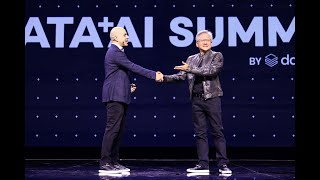
Nvidia and Databricks CEOs on the future of data processing and generative AI
Speakers: Jensen Huang, Founder and CEO of NVIDIA Ali Ghodsi, Co-founder and CEO of Databricks

Data + AI Summit Keynote 2024 - Summary of Product Announcements from Wednesday, June 12