talk-data.com talk-data.com

Topic

Linux

operating_system open_source unix_like

287

tagged

Activity Trend

20 peak/qtr
2020-Q1 2026-Q1

Activities

287 activities · Newest first

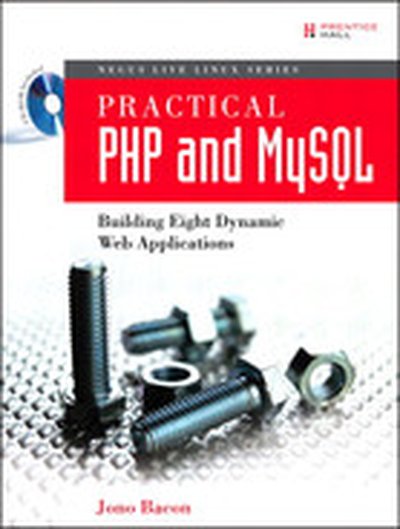
Negus Live Linux Series Practical PHP and MySQL

"Practical PHP and MySQL reflects Jono's commitment to the spirit of making open source subjects accessible to everyone. The book carefully walks you through the code for eight useful, dynamic Web applications. Projects are presented in a playful way, like the forum project that touts horror movies that make you 'hide behind the couch.'" -From the Foreword by Christopher Negus, Series Editor, Negus Live Linux Series Build Dynamic Web Sites Fast, with PHP and MySQL... Learn from Eight Ready-to-Run Applications! Suddenly, it’s easy to build commercial-quality Web applications using free and open source software. With this book, you’ll learn from eight ready-to-run, real-world applications—all backed by clear diagrams and screenshots, well-documented code, and simple, practical explanations. Leading open source author Jono Bacon teaches the core skills you’ll need to build virtually any application. You’ll discover how to connect with databases, upload content, perform cascading deletes, edit records, validate registrations, specify user security, create reusable components, use PEAR extensions, and even build Ajax applications. Working from complete examples on the CD-ROM, you’ll create Generic dynamic Web sites Blogs Discussion forums Shopping carts Auction sites Calendars FAQ systems Reusable components Content management systems News sites JONO BACON is Ubuntu community manager for Canonical, Ubuntu’s sponsor. He is an established speaker, author, and contributor to the open source community. Bacon co-authored Linux Desktop Hacks and The Official Ubuntu Book; has served as a columnist for Linux Format, Linux User & Developer, and PC Plus; and is an O’Reilly Networkweblog author. He is a lead developer onthe Jokosher (www.jokosher.org) project,and co-founder of LUGRadio—a podcastwith more than 15,000 listeners, andan annual event that attracts visitorsfrom around the world. CD-ROM Includes XAMPP for Linux: easy-to-install, preconfigured Apache distributions containing MySQL, PHP, Perl, and more Source code for all eight fully-working applications discussed in the book A remastered Ubuntu live CD, set to run all eight applications live System Requirements CPU: Pentium III, 650 MHz. RAM: 256MB (recommended 512MB). Hard disk: No space required to run live CD; 250MB of space needed to put XAMPP server and projects on installed system.
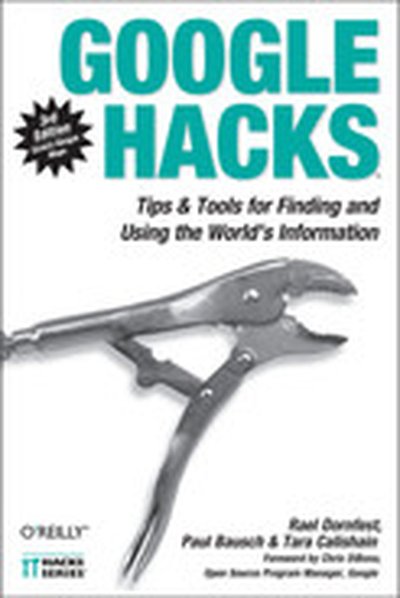
Google Hacks, 3rd Edition

Everyone knows that Google lets you search billions of web pages. But few people realize that Google also gives you hundreds of cool ways to organize and play with information. Since we released the last edition of this bestselling book, Google has added many new features and services to its expanding universe: Google Earth, Google Talk, Google Maps, Google Blog Search, Video Search, Music Search, Google Base, Google Reader, and Google Desktop among them. We've found ways to get these new services to do even more. The expanded third edition of Google Hacks is a brand-new and infinitely more useful book for this powerful search engine. You'll not only find dozens of hacks for the new Google services, but plenty of updated tips, tricks and scripts for hacking the old ones. Now you can make a Google Earth movie, visualize your web site traffic with Google Analytics, post pictures to your blog with Picasa, or access Gmail in your favorite email client. Industrial strength and real-world tested, this new collection enables you to mine a ton of information within Google's reach. And have a lot of fun while doing it: Search Google over IM with a Google Talk bot Build a customized Google Map and add it to your own web site Cover your searching tracks and take back your browsing privacy Turn any Google query into an RSS feed that you can monitor in Google Reader or the newsreader of your choice Keep tabs on blogs in new, useful ways Turn Gmail into an external hard drive for Windows, Mac, or Linux Beef up your web pages with search, ads, news feeds, and more Program Google with the Google API and language of your choice For those of you concerned about Google as an emerging Big Brother, this new edition also offers advice and concrete tips for protecting your privacy. Get into the world of Google and bend it to your will!

Deployment using Altiris on IBM System x and BladeCenter Servers

Altiris Deployment Solution is an industry leading management product which helps reduce the cost of deploying servers from bare metal and managing them all from a centralized location. Its user interface makes it easy to deploy operating systems and applications, apply custom configurations, and distribute software updates. Deployment Solution runs in either a virtual or physical server environment and supports deploying Linux, Windows, and ESX Server, as well as virtual machines to an ESX Server system. Deployment Solution also integrates with the IBM ServerGuide Scripting Toolkit to offer custom scripts for IBM hardware to further optimize the automation and standardization of complex server deployments on IBM hardware. Deployment Solution is a ServerProven application and is available directly from IBM. This IBM Redbooks publication describes the features of Altiris Deployment Solution and explains in detail how to implement features such as managing and deploying firmware updates and hardware configuration changes, image-based and script-based deployments, and integration with the IBM management tools. This book addresses the common issues and recommends best practices to overcome many of the challenges that arise during initial deployment setup. Update September 2006: Added 4.1.4, "Additional updates" on page 109 describing how to deploy updates such as server diagnostics using Altiris Deployment Solution and the ServerGuide Scripting Toolkit.

IBM Workplace Managed Client 2.6 on Linux

With IBM Workplace Managed Client Release 2.6 on Linux, IBM offers a strategic end-to-end Linux solution that provides both the benefits of Linux and IBM Workplace Collaboration Services. This IBM Redbooks publication provides a technical overview of IBM Workplace Managed Client and examines why it is a smart, strategic choice. In addition, we provide a detailed description and best practices for deploying, installing and configuring the product. We focus on the following topics: Please note that the additional material referenced in the text is not available from IBM.

MySQL Stored Procedure Programming

The implementation of stored procedures in MySQL 5.0 a hugemilestone -- one that is expected to lead to widespread enterprise adoption ofthe already extremely popular MySQL database. If you are serious aboutbuilding the web-based database applications of the future, you need toget up to speed quickly on how stored procedures work -- and how tobuild them the right way. This book, destined to be the bible of storedprocedure development, is a resource that no real MySQL programmer canafford to do without. In the decade since MySQL burst on the scene, it has become thedominant open source database, with capabilities and performancerivaling those of commercial RDBMS offerings like Oracle and SQLServer. Along with Linux and PHP, MySQL is at the heart of millions ofapplications. And now, with support for stored procedures, functions,and triggers in MySQL 5.0, MySQL offers the programming power neededfor true enterprise use. MySQL's new procedural language has a straightforward syntax, making iteasy to write simple programs. But it's not so easy to write secure,easily maintained, high-performance, and bug-free programs. Few in theMySQL world have substantial experience yet with stored procedures, butGuy Harrison and Steven Feuerstein have decades of combined expertise. In MySQL Stored Procedure Programming, they putthat hard-won experience to good use. Packed with code examples and coveringeverything from language basics to application building to advancedtuning and best practices, this highly readable book is the one-stopguide to MySQL development. It consists of four major sections: MySQL stored programming fundamentals -- tutorial, basicstatements, SQL in stored programs, and error handling Building MySQL stored programs -- transaction handling,built-in functions, stored functions, and triggers MySQL stored programs in applications -- using storedprograms with PHP, Java, Perl, Python, and .NET (C# and VB.NET) Optimizing MySQL stored programs -- security, basic andadvanced SQL tuning, optimizing stored program code, and programmingbest practices A companion web site contains many thousands of lines of code, that youcan put to use immediately. Guy Harrison is Chief Architect of Database Solutions at Quest Softwareand a frequent speaker and writer on MySQL topics. Steven Feuerstein isthe author of Oracle PL/SQL Programming, the classic reference for Oracle stored programming for more than ten years. Both have decades of experience as database developers, and between them they have authored a dozen books.

Running Linux on IBM System z9 and zSeries under z/VM

This IBM Redbooks publication discusses running Linux under z/VM on IBM System z9 and zSeries platforms. We describe enhancements available in z/VM Version 5.1. The intended audience for this book is IT administrators responsible for installing and configuring z/VM 5.1 systems running Linux guests. Using Fibre Channel Protocol (FCP), z/VM 5/1 can be installed on and operate from SCSI disks. Configured as emulated Fixed Block Architecture (FBA) disks, z/VM 5.1 can use FCP-attached disks for its system paging, spooling, directory, and minidisks. z/VM 5.1 adds new functions for Virtual Switches (VSWITCH). For increased network security, guests must have authorization before connecting to a VSWITCH. z/VM 5.1 introduces VSWITCH Layer 2 support. Operating at Layer 2, a VSWITCH delivers and receives network traffic in Ethernet frames. This provides the ability to handle non-IP protocols such as SNA, NetBIOS, and IPX. In addition, Layer 2 support reduces network latency and CPU overhead.

Linux for IBM System z9 and IBM zSeries

This IBM Redbooks publication discusses configuring and administering Linux systems running on IBM System z9 and zSeries. It is intended for system administrators and IT architects responsible for deploying Linux servers on System z9 and zSeries servers. We examine new features and enhancements of the Linux 2.6 kernel. We demonstrate Linux device configuration using sysfs and udev and discuss running Linux servers under z/VM. Networking options available for Linux on IBM System z9 and zSeries are examined in detail. Configuration of FCP-attached SCSI disks and traditional ECKD storage is demonstrated.

Planning and Installing the IBM eServer X3 Architecture Servers

The IBM eServer X3 Architecture servers are the new third-generation Enterprise X-Architecture servers from IBM. The xSeries 366 was announced in February 2005, the xSeries 460 was announced in May, and the xSeries 260 was announced in August. These X3 Architecture servers are ideal for random commercial workloads with high processor and memory bandwidth requirements. Although aimed at different client sets, they share common components and options. The x460 is targeted at clients who need to implement a large single image “scale-up” configuration of up to 32 processors and 512 GB of RAM. The x366 is targeted at the high-performance environment where rack space is a premium. The x260 is for clients who need high performance but also require large amounts of internal disk storage. This IBM Redbooks publication provides a detailed technical description of the three servers and explains how to plan, install, configure, and manage these high-performance servers running 32-bit and 64-bit versions of Windows Server 2003, Red Hat Enterprise Linux, SUSE Linux Enterprise Server, and VMware ESX Server.

End-to-end Automation with IBM Tivoli System Automation for Multiplatforms

IBM Tivoli System Automation for Multiplatforms monitors and automates applications distributed across Linux® , AIX® , and z/OS operating systems by introducing a new product structure with two major components: IBM Tivoli System Automation for Multiplatforms utilizes an adapter infrastructure to integrate with IBM Tivoli System Automation for z/OS, allowing for a more effective high-availability, automation, and management of multi-tier applications. This IBM Redbooks publication introduces the new versions of the IBM Tivoli Systems Automation product family and gives a broad understanding of the new architecture and components of both IBM Tivoli System Automation for Multiplatforms V2.1 and IBM Tivoli System Automation for z/OS V3.1 using a scenario based approach. This book is a valuable addition to the existing products documentation and should be read in conjunction with the official products documentation, which complements some of the concepts explained in this book. The instructions given in this book are very detailed and explicit. These instructions are not the only way to install the products and related prerequisites. They are meant to be followed by anyone to successfully install, configure, and set up end-to-end automation management using IBM Tivoli System Automation for Multiplatforms V2.1 and IBM Tivoli System Automation for z/OS V3.1 in environments of any size. Please note that the additional material referenced in the text is not available from IBM.

Professional LAMP: Linux®, Apache, MySQL®, and PHP5 Web Development

The combination of Linux, Apache, MySQL, and PHP is popular because of interaction, flexibility, customization, and-most importantly-the cost effectiveness of its components Helps LAMP professionals take their skills to the next level with in-depth discussions of OOP; extensions of PHP such as PEAR, GD, XML, and CURL; improving site security; and advanced tools available to the coder Those proficient in other languages such as Java, C++, Perl and ASP will find this guide invaluable when transitioning to the LAMP environment The Web site includes sample scripts created in the course of each chapter, and several applications that can be modified and reused

Oracle Database 10g Linux Administration

Install and configure Oracle Database 10g on a Linux enterprise platform. This book explains how to set up, administer, monitor, and tune Oracle Database 10g on Linux. You will also learn how to implement High Availability solutions as well as handle backup, recovery, and replication. This exclusive Oracle Press guide is the ideal resource for all Oracle DBAs working in a Linux environment.

IBM Workplace Collaboration Services: Release 2.5 Deployment Guide

IBM, a leader in collaboration, has created IBM Workplace Collaboration Services--a new completely, integrated collaborative environment based on open standards. IBM Workplace Collaboration Services provides a wide range of integrated, ready-to-use communication and collaboration capabilities as services for the IBM Workplace environment. This includes capabilities such e-mail, calendaring and scheduling, presence and awareness, instant messaging, learning, team spaces, Web conferencing, and document and Web content management. This IBM Redbooks publication is an installation and deployment guide for IBM Workplace Collaboration Services Release 2.5. We provide detailed installation procedures for Microsoft Windows and Novell SUSE Linux and highlight clustered deployment.

Deployment Guide Series: IBM Tivoli Configuration Manager

IBM Tivoli Configuration Manager controls software distribution and asset management inventory in a multiplatform environment. It is designed for configuration, distribution, change, version, and asset management in a distributed computing environment. Working on top of IBM Tivoli Management Framework, IBM Tivoli Configuration Manager provides an integrated solution for managing complex, distributed enterprise environments. This IBM Redbooks publication introduces the IBM Tivoli Configuration Manager logical and physical components and covers detailed planning and implementation steps to deploy IBM Tivoli Configuration Manager in small-to-medium and large-sized environments, including IBM AIX 5L, Microsoft Windows, Linux, and IBM OS/400 systems. In addition, we talk about best practices, advanced customization, and tuning topics for IBM Tivoli Configuration Manager. This book will be useful for IT specialists responsible for implementing IBM Tivoli Configuration Manager V4.2.x in customer environments. Please note that the additional material referenced in the text is not available from IBM.

Experiences with Oracle 10g Database for Linux on zSeries

Linux on zSeries offers many advantages to customers who rely upon IBM mainframe systems to run their businesses. Linux on zSeries takes advantage of the qualities of service in the zSeries hardware—making it a robust industrial strength Linux. This provides an excellent platform for consolidating Oracle databases that exist in your enterprise. This IBM Redbooks publication describes experiences gained while installing and testing Oracle10g for Linux on zSeries, such as: -Installing a single instance database of Oracle10g instances for Linux on zSeries Interested readers include database consultants, installers, administrators, and system programmers.

Implementing a Tivoli Solution for Central Management of Large Distributed Environments

Deploying and managing distributed systems in hundreds or thousands of branch banks and retail stores, called outlets, requires careful planning of the automation to cope with the sheer numbers of systems involved. This IBM Redbooks publication demonstrates how to architect, establish, and configure a Tivoli systems management environment that supports the central management of thousands of outlet systems based on the open United Linux platform. The main focus of this book is to provide step-by-step instructions, sample scripts, and code to install and deploy the core Tivoli products that enable the organization to: - Deploy and maintain distributed application solutions This book is intended for IT professionals with a basic understanding of the core Tivoli product set and who are responsible for deploying a Tivoli management infrastructure. Please note that the additional material referenced in the text is not available from IBM.

IBM Tivoli Storage Manager in a Clustered Environment

This IBM Redbooks publication is an easy-to-follow guide that describes how to implement IBM Tivoli Storage Manager Version 5.3 products in highly available clustered environments. The book is intended for those who want to plan, install, test, and manage the IBM Tivoli Storage Manager Version 5.3 in various environments by providing best practices and showing how to develop scripts for clustered environments. The book covers the following environments: IBM AIX HACMP, IBM Tivoli System Automation for Multiplatforms on Linux and AIX, MicrosoftCluster Server on Windows 2000 and Windows 2003, VERITAS Storage Foundation HA on AIX, and Windows Server 2003 Enterprise Edition. Please note that the additional material referenced in the text is not available from IBM.

Rexx Programmer's Reference

Originally developed for mainframes but highly portable across platforms-from servers to desktops to handhelds-Rexx is an easy yet powerful scripting language that's widely used for rapid application development. Covers Rexx interpreters for specialized functions-object-oriented, mainframe, and handheld. There are 8 different free Rexx interpreters optimized for different platforms and uses. This book shows how to use them all. Shows how to script for GUIs, databases, web servers, XML, and other interfaces. Details how to make the best use of Rexx tools and interfaces, with examples for both Linux and Windows. Includes a tutorial with lots of examples to help people get up and running.

Lotus Workplace 2.0.1 Products: Deployment Guide

IBM Lotus software has created IBM Lotus Workplace, an integrated family of products based on open standards. Lotus Workplace combines market-leading collaborative components that can be used with a variety of security-rich clients for simplified access and interaction with other people and a host of collaborative applications such as e-mail, calendaring and scheduling, instant messaging, Web conferencing, team spaces, document and Web content management, and e-learning. IBM Lotus Workplace products include: This IBM Redbooks publication is an installation and deployment guide for the Lotus Workplace 2.0.1 platform. We provide detailed installation procedures for installing the Lotus Workplace products on both a Microsoft Windows 2000 server and a Linux server running SUSE LINUX Enterprise Server 8.1. We also discuss important deployment and planning scenarios, as well as tips, best practices, and techniques for troubleshooting errors during installation.

Understanding DB2®: Learning Visually with Examples

The Easy, Visual Guide to IBM DB2 V8.2 IBM DB2 Universal Database™ V8.2 for Linux®, UNIX®, and Windows® is a flexible, scalable, cost-effective, and easy-to-use enterprise database. Now, one book makes DB2 even easier. teaches DB2 V8.2 visually, step by step, with dozens of examples and case studies drawn from the authors' unsurpassed experience as DB2 consultants at IBM. Understanding DB2 doesn't just present the big picture. It thoroughly introduces every DB2 concept, procedure, and tool you'll need to get results as an administrator, user, or developer. You'll find authoritative coverage of installation, configuration, objects, database instances, storage, connectivity, security, performance, backup and recovery, SQL fundamentals, and much more. Virtually every new concept is explained with screenshots, diagrams, or tables, all designed to help you learn faster and remember more. Understanding DB2 For those preparing for certification, this book also contains over a hundred sample questions crafted by the authors to reflect the content and format of the IBM DB2 UDB Database Administration Certification exams, with answers and detailed explanations. Coverage includes Understanding the DB2 product family, DB2 commands, and the DB2 environment Configuring client and server connectivity: walkthroughs of four typical scenarios Managing DB2 storage: partitions, tablespaces, buffer pools, and more Leveraging the power of SQL: queries, inserts, deletes, and updates Implementing security: encryption, authentication, and authorization Administering and maintaining data, from LOAD and EXPORT to backup/recovery Providing high availability with online split mirroring and suspended I/O DB2 architecture: process and memory models Managing database performance and troubleshooting

Migrating to Linux Using VERITAS Portable Data Containers on IBM eServer xSeries and BladeCenter

This IBM Redbooks publication discusses Portable Data Containers. Portable Data Containers are a tool that allows customers to migrate their applications from UNIX to Linux more seamlessly. They are a part of VERITAS Storage Foundations 4.0. With Portable Data Containers, a customer can migrate an application without moving that application's data. This book describes the concepts of storage management and the key features of VERITAS Storage Foundations 4.0 and . In addition, it discusses a number of considerations that you should review prior to a UNIX to Linux migration, and then takes you through a step-by-step migration from Solaris to Linux. It discusses the performance and scalability of Portable Data Containers and compares the throughput of Portable Data Containers with theoretical network throughput and disk transfer speeds. Finally, this book includes best practices for migrating applications to Linux using Portable Data Containers. In particular, it identifies the steps that are required to migrate an Oracle or DB2 database from a UNIX server to a Linux server. With this knowledge, customers can accelerate their migration plans to Linux to take advantage of the cost benefits provided by the open-source operating system. The audience for this book are IBM Clients and Business Partners as well as IT specialists and database administrators.