talk-data.com talk-data.com

Topic

Fabric

Microsoft Fabric

databricks data_plaform microsoft azure data_warehouse analytics data_analysis

323

tagged

Activity Trend

67 peak/qtr
2020-Q1 2026-Q1

Activities

323 activities · Newest first

Transforming Data Governance for Multimodal Data at Amgen With Databricks

Amgen is advancing its Enterprise Data Fabric to securely manage sensitive multimodal data, such as imaging and research data, across formats.Databricks is already the de facto standard for governance on structured data, and Amgen seeks to extend it for unstructured multi modal data too. This approach will also allow Amgen to standardize its GenAI projects on Databricks. Key priorities include: Centralized data access: establishing a unified, secure access control system Enhanced traceability: implementing detailed processes for transparency and accountability Consistent access standards: ensuring uniform data access privilege experience User support: providing flexible access for diverse stakeholders Comprehensive auditing: enabling thorough permission audits and data usage tracking Learn strategies for implementing a comprehensive multimodal data governance framework using Databricks, as we share our experience on standardizing data governance for GenAI use cases.

Accelerating Analytics: Integrating BI and Partner Tools to Databricks SQL

This session is repeated. Did you know that you can integrate with your favorite BI tools directly from Databricks SQL? You don’t even need to stand up an additional warehouse. This session shows the integrations with Microsoft Power Platform, Power BI, Tableau and dbt so you can have a seamless integration experience. Directly connect your Databricks workspace with Fabric and Power BI workspaces or Tableau to publish and sync data models, with defined primary and foreign keys, between the two platforms.

Data fabric and data mesh are not mutually exclusive. Join us in this two-speaker debate session that aims to put an end to a five-year long debate comparing fabric and mesh. D&A leaders can deploy them independently, or best-case together. You will find out how you can deploy the fabric design to unify data management and mesh operating model to distribute data management.

Urgent Investments in data, analytics and AI use cases has put the spotlight once more on strong data management foundations. Is our Data even Ready for upcoming AI, analytics and data sharing initiatives is now top of mindshare for heads of data, CDAOs and their counterparts. Data Fabrics have emerged as a long term, foundational data management architecture that you should now pursue for sustained D&A success. This session will:
1. Help understand what data Fabrics are and what they mean for your data strategy and architecture
2. Help decide how to build and where to buy
3. Navigate the vendor landscape to assist in tech procurement decisions to aid your fabric journey

Enterprises that possess high-quality data and governance and attest to the trust worthiness of their data among stakeholders have doubled the return on investment (ROI) from their AI. Learn how leading organizations today are implementing an open and trusted data foundation to secure and maximize the value of both their structured and unstructured data, accessing siloed data across hybrid cloud, cost-optimizing growing data workloads, and preparing and delivering high-quality, governed data for AI with a new approach to a data fabric architecture.

Data ecosystems, built on data fabric design and infused with AI, promise an integrated, cost effective, and operationally simple approach to varied data management challenges. However, they don't yet always deliver on that promise. This research explores the maturity of various ecosystem components and provides a guide for D&A leaders and others looking to invest in data foundations for competitive differentiation.

Let's kick this interaction off with some inputs from a Gartner expert and let the discussion evolve on its own. Join this session to offer your input to the data fabric and data mesh debate. Be prepared to challenge or reinforce positions from the market and discuss them with peers and a Gartner expert, who will cover these positions and their alternatives.

As AI rapidly moves from experimentation to deployment, one truth is becoming clear: AI is only as powerful as the data that fuels it. Traditional data architectures—rigid, siloed & hard to scale—are no longer fit for purpose in this new era. Enter the era of data products and data fabric—a bold shift in how organizations treat data not as a byproduct, but as a high-value asset engineered for consumption, agility, and impact. Join us as we unpack what this shift means & why CXOs need to rethink data strategies to accelerate AI adoption & enable real-time intelligence to unlock business value.

Come together for a discussion with peers to discuss data mesh and data fabric, and where you're having success. Peer Meetups are networking sessions that allow you to connect and share with a small group of your peers, without Gartner facilitation. Please make every effort to attend your Peer Meetup as other attendees will be looking forward to meeting with you.

Data fabric and data mesh are not mutually exclusive. Join this session to learn about how D&A leaders can put an end to a five-year long debate comparing fabric and mesh. You can deploy them independently, or best-case together. You will find out how you can deploy the fabric design to unify data management and mesh operating model to distribute data management in a sensible manner.

For over a decade, we have sought a holistic, unifying theory of data management. This presentation documents the quest, and touches on the data and analytics infrastructure model (DAIM), metadata, data fabric, data ecosystems, and FinOps. Each of these is required and together they address everything from infrastructure to AI to strategy communications.

AI initiatives often stall when data teams can’t keep up with business demand for fast, self-service data. Whether it’s AI agents, BI tools, or business users—everyone needs data, but the pipeline-centric modern data stack wasn’t built for this kind of agility. In this session, learn about how an Instant Data Fabric enables data teams for self-service at AI scale by instantly generating contextual Data Answers from distributed enterprise data for consumption by business teams. Discover how leading organizations are using this new data architecture to accelerate AI adoption without comprising governance and control.

Power BI and Microsoft Fabric have become the data hub for your organisation, providing everyone access to your critical and sensitive data. Whilst incredibly powerful, this also brings significant risk.
Including real world case studies, this session will look at how you can protect your organisation, your data, and yourself, through effective governance, auditing and disaster recovery within Power BI and Fabric.
This will cover effective planning, risk management, license reduction, FinOps, permissions monitoring, audit trails, and more.

Data ecosystems, built on data fabric design and infused with AI, promise an integrated, cost effective, and operationally simple approach to varied data management challenges. However, they don't yet always deliver on that promise. This research explores the maturity of various ecosystem components and provides a guide for D&A leaders and others looking to invest in data foundations for competitive differentiation.

Data teams face pressure to deliver real-time business insights across finance, supply chain, HR, and beyond. They need apps that are fueled with AI recommendations and insights available in business terms. The key lies in adopting a business data fabric architecture that interoperates across multi-cloud landscapes. SAP’s data and analytics solutions serve as the foundation for this data fabric, delivering an integrated, semantically-rich data layer that ensures seamless and scalable access to data without duplication. Join us to learn how to build this crucial foundation for your AI applications.

Urgent Investments in data, analytics and AI use cases has put the spotlight once more on strong data management foundations. Is our Data even Ready for upcoming AI, analytics and data sharing initiatives is now top of mindshare for heads of data, CDAOs and their counterparts. Data Fabrics have emerged as a long term, foundational data management architecture that you should now pursue for sustained D&A success. This session will:
1. Help understand what data Fabrics are and what they mean for your data strategy and architecture
2. Help decide how to build and where to buy
3. Navigate the vendor landscape to assist in tech procurement decisions to aid your fabric journey

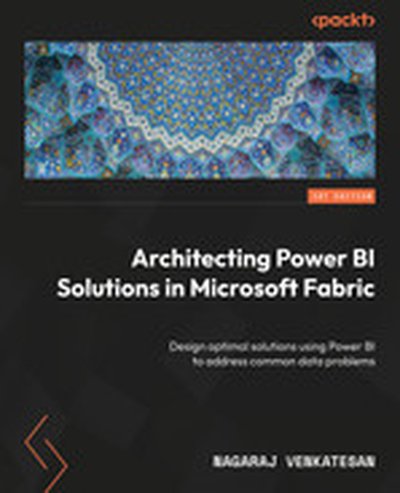
Architecting Power BI Solutions in Microsoft Fabric

This book is a comprehensive guide to building sophisticated and robust Power BI solutions that solve common data problems effectively. Written with hands-on professionals in mind, it provides essential insights and practical advice to help you choose the right tools and approaches for any BI task. Readers will learn to create performant, secure, and innovative business intelligence systems. What this Book will help me do Identify the scenarios where each Power BI component fits best. Apply secure and performance-conscious design principles when building BI solutions. Leverage Microsoft Fabric and other advanced integrations to maximize Power BI's capabilities. Implement AI-powered features such as Copilot and predictive modeling in Power BI. Facilitate collaboration and governance using Power BI's advanced features. Author(s) Nagaraj Venkatesan has over 17 years of professional expertise in data platform technologies and business intelligence tools. Through a rich career in data solution architecture, he has mastered the art of designing efficient and reliable Power BI implementations. This book reflects his passion for empowering professionals to make the most of Power BI. Who is it for? If you are a solution architect, data engineer, or Power BI report developer looking to elevate your skills in designing optimized Power BI solutions, this book is for you. Business analysts and data scientists can also benefit immensely from the book's coverage of self-service BI and data science integration. Some familiarity with Power BI will enhance your learning experience, but newcomers eager to learn will also find it invaluable.

Come and join Alcine and Shane as they visit with British Columbia educators John Harris and Denise Augustine. We begin in the realm of story as Denise describes being situated “between generations” in her renowned Coast Salish family of carvers, artists, and leaders and John shares his experiences of growing up on the land and watching his father negotiate treaties as the official liaison for their community. Drawing on her legacy as the Superintendent of Indigenous Education for British Columbia, Denise provides powerful historical context for the work of the Truth and Reconciliation Commission in Canada, which created space for residential school survivors to tell their stories and led to 94 distinct “calls to action” in 2015. She pulls this thread into the fabric of educational change, illuminating how BC is leading the way in reconciliation through a Tripartide Education Agreement and the more recent Declaration of the Right of Indigenous Peoples Act (DRIPA), which requires that school districts create Indigenous Education Councils that view First Nations as “governing bodies”, not just “special interest groups.” From this exploration of reconciliation in education, John takes us into his own family’s legacy of the “Sixties Scoop”, in which his father was taken from his grandparent’s home nearly a dozen times, all the way to his family’s recent visit to the Field Museum of Chicago, which holds over 4,000,000 cultural artifacts, many of which were purchased from Indigenous Nations in the Pacific Northwest. John describes the unsettling experience “as if someone went into your house and took everything.” They end their visit discussing the nuances of place-based versus land-based education and the ways that John has woven his upbringing and community cultural wealth into his pedagogy, which is depicted in the integrative case study which concludes Shane’s forthcoming book, Pedagogies of Voice: Street Data and the Path to Student Agency (Corwin, 2025). Speaking to student agency, John reminds us that “When we give youth opportunities to give back to their communities, they really shine.” Join us for this incredible and luminous conversation reinforcing relationality and reciprocity as core values from Indigenous knowledge systems that hold the potential to transform education everywhere.

For Further Learning:

Learn more about John and his family’s artwork and clothing line at www.aylelum.com Learn more about indigenous ways of knowing and being by reading

Indigenous Storywork: Educating the Heart, Mind, Body, and Spirit by Jo-Ann Archibald Land as teacher: understanding Indigenous land-based education - UNESCO Canadian Commission June 21, 2021

See land-based education in action by following Land-based Education K-12 Plains & Woodland Cree Tanya McCallum on Facebook Learn more about the work of the First Nations Education Steering Committee in British Columbia, Canada Read up on the The United Nations Declaration of the Rights of Indigenous People Act

Delivering data products across cloud and on-prem environments delivers critical competitive advantage. Ab Initio’s innovative architecture connects two of your most important assets - your people and your data. Discover a platform that delivers the fastest and most cost-effective solution for Data Product delivery by leveraging a unique combination of AI, semantic knowledge, and a metadata-driven compute fabric. By harnessing the elasticity of cloud compute, your organization will scale seamlessly, and securely, and meet growing data demands.

This Session is hosted by a Google Cloud Next Sponsor.
Visit your registration profile at g.co/cloudnext to opt out of sharing your contact information with the sponsor hosting this session.

Join Virgin Media O2 and Google for a technical discussion about lessons learned and best practices for building and scaling a data fabric on BigQuery. Find out how Virgin Media O2 eliminated silos and enabled secure and governed data sharing at scale to drive better decisions and get more value from their data.