talk-data.com talk-data.com

Topic

Fabric

Microsoft Fabric

databricks data_plaform microsoft azure data_warehouse analytics data_analysis

40

tagged

Activity Trend

67 peak/qtr
2020-Q1 2026-Q1

Activities

Showing filtered results

Filtering by: O'Reilly Data Engineering Books ×
The Data Engineer's Guide to Microsoft Fabric

Modern data engineering is evolving; and with Microsoft Fabric, the entire data platform experience is being redefined. This essential book offers a fresh, hands-on approach to navigating this shift. Rather than being an introduction to features, this guide explains how Fabric's key components—Lakehouse, Warehouse, and Real-Time Intelligence—work under the hood and how to put them to use in realistic workflows. Written by Christian Henrik Reich, a data engineering expert with experience that extends from Databricks to Fabric, this book is a blend of foundational theory and practical implementation of lakehouse solutions in Fabric. You'll explore how engines like Apache Spark and Fabric Warehouse collaborate with Fabric's Real-Time Intelligence solution in an integrated platform, and how to build ETL/ELT pipelines that deliver on speed, accuracy, and scale. Ideal for both new and practicing data engineers, this is your entry point into the fabric of the modern data platform. Acquire a working knowledge of lakehouses, warehouses, and streaming in Fabric Build resilient data pipelines across real-time and batch workloads Apply Python, Spark SQL, T-SQL, and KQL within a unified platform Gain insight into architectural decisions that scale with data needs Learn actionable best practices for engineering clean, efficient, governed solutions
Azure SQL Revealed: The Next-Generation Cloud Database with AI and Microsoft Fabric

Access detailed content and examples on Azure SQL, a set of cloud services that allows for SQL Server to be deployed in the cloud. This book teaches the fundamentals of deployment, configuration, security, performance, and availability of Azure SQL from the perspective of these same tasks and capabilities in SQL Server. This distinct approach makes this book an ideal learning platform for readers familiar with SQL Server on-premises who want to migrate their skills toward providing cloud solutions to an enterprise market that is increasingly cloud-focused. If you know SQL Server, you will love this book. You will be able to take your existing knowledge of SQL Server and translate that knowledge into the world of cloud services from the Microsoft Azure platform, and in particular into Azure SQL. This book provides information never seen before about the history and architecture of Azure SQL. Author Bob Ward is a leading expert with access to and support from the Microsoft engineering team that built Azure SQL and related database cloud services. He presents powerful, behind-the-scenes insights into the workings of one of the most popular database cloud services in the industry. This book also brings you the latest innovations for Azure SQL including Azure Arc, Hyperscale, generative AI applications, Microsoft Copilots, and integration with the Microsoft Fabric. What You Will Learn Know the history of Azure SQL Deploy, configure, and connect to Azure SQL Choose the correct way to deploy SQL Server in Azure Migrate existing SQL Server instances to Azure SQL Monitor and tune Azure SQL’s performance to meet your needs Ensure your data and application are highly available Secure your data from attack and theft Learn the latest innovations for Azure SQL including Hyperscale Learn how to harness the power of AI for generative data-driven applications and Microsoft Copilots for assistance Learn how to integrate Azure SQL with the unified data platform, the Microsoft Fabric Who This Book Is For This book is designed to teach SQL Server in the Azure cloud to the SQL Server professional. Anyone who operates, manages, or develops applications for SQL Server will benefit from this book. Readers will be able to translate their current knowledge of SQL Server—especially of SQL Server 2019 and 2022—directly to Azure. This book is ideal for database professionals looking to remain relevant as their customer base moves into the cloud.

Implementing Data Mesh

As data continues to grow and become more complex, organizations seek innovative solutions to manage their data effectively. Data mesh is one solution that provides a new approach to managing data in complex organizations. This practical guide offers step-by-step guidance on how to implement data mesh in your organization. In this book, Jean-Georges Perrin and Eric Broda focus on the key components of data mesh and provide practical advice supported by code. Data engineers, architects, and analysts will explore a simple and intuitive process for identifying key data mesh components and data products. You'll learn a consistent set of interfaces and access methods that make data products easy to consume. This approach ensures that your data products are easily accessible and the data mesh ecosystem is easy to navigate. This book helps you: Identify, define, and build data products that interoperate within an enterprise data mesh Build a data mesh fabric that binds data products together Build and deploy data products in a data mesh Establish the organizational structure to operate data products, data platforms, and data fabric Learn an innovative architecture that brings data products and data fabric together into the data mesh About the authors: Jean-Georges "JG" Perrin is a technology leader focusing on building innovative and modern data platforms. Eric Broda is a technology executive, practitioner, and founder of a boutique consulting firm that helps global enterprises realize value from data.

MuleSoft Platform Architect's Guide

The "MuleSoft Platform Architect's Guide" is your essential resource for mastering API-driven solutions using MuleSoft Anypoint Platform. This book enables you to design, deploy, and operate scalable, secure, and high-performance API architectures in enterprise settings while preparing for MuleSoft Platform Architect certification. What this Book will help me do Design robust API integration solutions using MuleSoft Anypoint Platform. Successfully deploy applications to CloudHub and Runtime Fabric environments. Monitor and operate APIs with advanced management tools. Implement scalable solutions aligned with business outcomes. Prepare confidently for the MuleSoft Platform Architect certification. Author(s) Jitendra Bafna is a Senior Solution Architect with years of experience optimizing MuleSoft implementations. Jim Andrews, a MuleSoft Evangelist, has dedicated his career to guiding others in achieving enterprise-ready API solutions. Together, they share practical knowledge, step-by-step guidance, and expertise in API and integration mastery. Who is it for? This book is perfect for IT architects and senior developers experienced in API development, especially those familiar with MuleSoft. It's tailored for professionals aiming to master Anypoint Platform or pursue MuleSoft Platform Architect certification. Readers should have basic experience with integration platforms and a willingness to explore advanced API design.

Azure Data Factory Cookbook - Second Edition

This comprehensive guide to Azure Data Factory shows you how to create robust data pipelines and workflows to handle both cloud and on-premises data solutions. Through practical recipes, you will learn to build, manage, and optimize ETL, hybrid ETL, and ELT processes. The book offers detailed explanations to help you integrate technologies like Azure Synapse, Data Lake, and Databricks into your projects. What this Book will help me do Master building and managing data pipelines using Azure Data Factory's latest versions and features. Leverage Azure Synapse and Azure Data Lake for streamlined data integration and analytics workflows. Enhance your ETL/ELT solutions with Microsoft Fabric, Databricks, and Delta tables. Employ debugging tools and workflows in Azure Data Factory to identify and solve data processing issues efficiently. Implement industry-grade best practices for reliable and efficient data orchestration and integration pipelines. Author(s) Dmitry Foshin, Tonya Chernyshova, Dmitry Anoshin, and Xenia Ireton collectively bring years of expertise in data engineering and cloud-based solutions. They are recognized professionals in the Azure ecosystem, dedicated to sharing their knowledge through detailed and actionable content. Their collaborative approach ensures that this book provides practical insights for technical audiences. Who is it for? This book is ideal for data engineers, ETL developers, and professional architects who work with cloud and hybrid environments. If you're looking to upskill in Azure Data Factory or expand your knowledge into related technologies like Synapse Analytics or Databricks, this is for you. Readers should have a foundational understanding of data warehousing concepts to fully benefit from the material.

Deciphering Data Architectures

Data fabric, data lakehouse, and data mesh have recently appeared as viable alternatives to the modern data warehouse. These new architectures have solid benefits, but they're also surrounded by a lot of hyperbole and confusion. This practical book provides a guided tour of these architectures to help data professionals understand the pros and cons of each. James Serra, big data and data warehousing solution architect at Microsoft, examines common data architecture concepts, including how data warehouses have had to evolve to work with data lake features. You'll learn what data lakehouses can help you achieve, as well as how to distinguish data mesh hype from reality. Best of all, you'll be able to determine the most appropriate data architecture for your needs. With this book, you'll: Gain a working understanding of several data architectures Learn the strengths and weaknesses of each approach Distinguish data architecture theory from reality Pick the best architecture for your use case Understand the differences between data warehouses and data lakes Learn common data architecture concepts to help you build better solutions Explore the historical evolution and characteristics of data architectures Learn essentials of running an architecture design session, team organization, and project success factors Free from product discussions, this book will serve as a timeless resource for years to come.

Data Fabric Architectures

The immense increase on the size and type of real time data generated across various edge computing platform results in unstructured databases and data silos. This edited book gathers together an international set of researchers to investigate the possibilities offered by data-fabric solutions; the volume focuses in particular on data architectures and on semantic changes in future data landscapes.

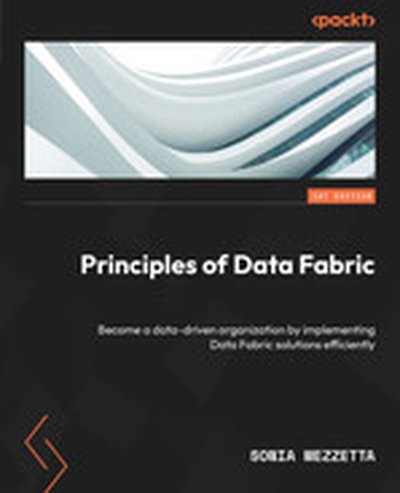
Principles of Data Fabric

In "Principles of Data Fabric," you will gain a comprehensive understanding of Data Fabric solutions and architectures. This book provides a clear picture of how to design, implement, and optimize Data Fabric solutions to tackle complex data challenges. By the end, you'll be equipped with the knowledge to unify and leverage your organizational data efficiently. What this Book will help me do Design and architect Data Fabric solutions tailored to specific organizational needs. Learn to integrate Data Fabric with DataOps and Data Mesh for holistic data management. Master the principles of Data Governance and Self-Service analytics within the Data Fabric. Implement best practices for distributed data management and regulatory compliance. Apply industry insights and frameworks to optimize Data Fabric deployment. Author(s) Sonia Mezzetta, the author of "Principles of Data Fabric," is an experienced data professional with a deep understanding of data management frameworks and architectures like Data Fabric, Data Mesh, and DataOps. With years of industry expertise, Sonia has helped organizations implement effective data strategies. Her writing combines technical know-how with an approachable style to enlighten and guide readers on their data journey. Who is it for? This book is ideal for data engineers, data architects, and business analysts who seek to understand and implement Data Fabric solutions. It will also appeal to senior data professionals like Chief Data Officers aiming to integrate Data Fabric into their enterprises. Novice to intermediate knowledge of data management would be beneficial for readers. The content provides clear pathways to achieve actionable results in data strategies.

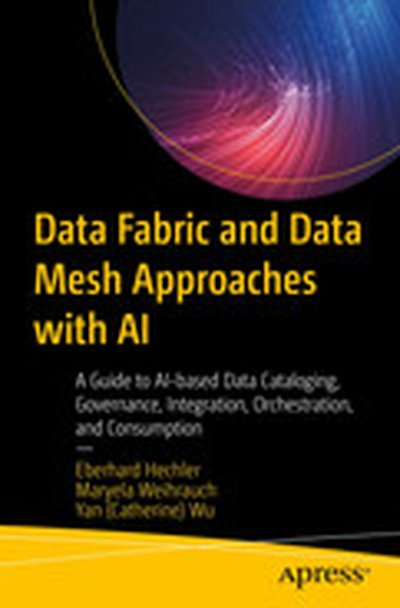
Data Fabric and Data Mesh Approaches with AI: A Guide to AI-based Data Cataloging, Governance, Integration, Orchestration, and Consumption

Understand modern data fabric and data mesh concepts using AI-based self-service data discovery and delivery capabilities, a range of intelligent data integration styles, and automated unified data governance—all designed to deliver "data as a product" within hybrid cloud landscapes. This book teaches you how to successfully deploy state-of-the-art data mesh solutions and gain a comprehensive overview on how a data fabric architecture uses artificial intelligence (AI) and machine learning (ML) for automated metadata management and self-service data discovery and consumption. You will learn how data fabric and data mesh relate to other concepts such as data DataOps, MLOps, AIDevOps, and more. Many examples are included to demonstrate how to modernize the consumption of data to enable a shopping-for-data (data as a product) experience. By the end of this book, you will understand the data fabric concept and architecture as it relates to themes such as automated unifieddata governance and compliance, enterprise information architecture, AI and hybrid cloud landscapes, and intelligent cataloging and metadata management. What You Will Learn Discover best practices and methods to successfully implement a data fabric architecture and data mesh solution Understand key data fabric capabilities, e.g., self-service data discovery, intelligent data integration techniques, intelligent cataloging and metadata management, and trustworthy AI Recognize the importance of data fabric to accelerate digital transformation and democratize data access Dive into important data fabric topics, addressing current data fabric challenges Conceive data fabric and data mesh concepts holistically within an enterprise context Become acquainted with the business benefits of data fabric and data mesh Who This Book Is For Anyone who is interested in deploying modern data fabric architectures and data mesh solutions within an enterprise, including IT and business leaders, data governance and data office professionals, data stewards and engineers, data scientists, and information and data architects. Readers should have a basic understanding of enterprise information architecture.

Using RDP with IBM FlashSystem to Debug Fibre Channel Optics Errors

The focus of this IBM® blueprint is to showcase the Read Diagnostic Parameters (RDP) feature of the Fibre Channel protocol (FCP). The data that is provided by RDP commands can simplify the process of managing and analyzing any issues on complex SAN fabrics. In this blueprint, we provide guidance to help users and administrators understand the meaning of RDP data and how to use it. The intent of this blueprint is to help a user understand what RDP is, what data RDP represents, and how to use that data to identify potential issues within the SAN fabric that is hosted by that Fibre Channel (FC) switch.

Cyber Resilient Infrastructure: Detect, Protect, and Mitigate Threats Against Brocade SAN FOS with IBM QRadar

Enterprise networks are large and rely on numerous connected endpoints to ensure smooth operational efficiency. However, they also present a challenge from a security perspective. The focus of this Blueprint is to demonstrate an early threat detection against the network fabric that is powered by Brocade that uses IBM® QRadar®. It also protects the same if a cyberattack or an internal threat by rouge user within the organization occurs. The publication also describes how to configure the syslog that is forwarding on Brocade SAN FOS. Finally, it explains how the forwarded audit events are used for detecting the threat and runs the custom action to mitigate the threat. The focus of this publication is to proactively start a cyber resilience workflow from IBM QRadar to block an IP address when multiple failed logins on Brocade switch are detected. As part of early threat detection, a sample rule that us used by IBM QRadar is shown. A Python script that also is used as a response to block the user's IP address in the switch is provided. Customers are encouraged to create control path or data path use cases, customized IBM QRadar rules, and custom response scripts that are best-suited to their environment. The use cases, QRadar rules, and Python script that are presented here are templates only and cannot be used as-is in an environment.

Data Privacy

Engineer privacy into your systems with these hands-on techniques for data governance, legal compliance, and surviving security audits. In Data Privacy you will learn how to: Classify data based on privacy risk Build technical tools to catalog and discover data in your systems Share data with technical privacy controls to measure reidentification risk Implement technical privacy architectures to delete data Set up technical capabilities for data export to meet legal requirements like Data Subject Asset Requests (DSAR) Establish a technical privacy review process to help accelerate the legal Privacy Impact Assessment (PIA) Design a Consent Management Platform (CMP) to capture user consent Implement security tooling to help optimize privacy Build a holistic program that will get support and funding from the C-Level and board Data Privacy teaches you to design, develop, and measure the effectiveness of privacy programs. You’ll learn from author Nishant Bhajaria, an industry-renowned expert who has overseen privacy at Google, Netflix, and Uber. The terminology and legal requirements of privacy are all explained in clear, jargon-free language. The book’s constant awareness of business requirements will help you balance trade-offs, and ensure your user’s privacy can be improved without spiraling time and resource costs. About the Technology Data privacy is essential for any business. Data breaches, vague policies, and poor communication all erode a user’s trust in your applications. You may also face substantial legal consequences for failing to protect user data. Fortunately, there are clear practices and guidelines to keep your data secure and your users happy. About the Book Data Privacy: A runbook for engineers teaches you how to navigate the trade-offs between strict data security and real world business needs. In this practical book, you’ll learn how to design and implement privacy programs that are easy to scale and automate. There’s no bureaucratic process—just workable solutions and smart repurposing of existing security tools to help set and achieve your privacy goals. What's Inside Classify data based on privacy risk Set up capabilities for data export that meet legal requirements Establish a review process to accelerate privacy impact assessment Design a consent management platform to capture user consent About the Reader For engineers and business leaders looking to deliver better privacy. About the Author Nishant Bhajaria leads the Technical Privacy and Strategy teams for Uber. His previous roles include head of privacy engineering at Netflix, and data security and privacy at Google. Quotes I wish I had had this text in 2015 or 2016 at Netflix, and it would have been very helpful in 2008–2012 in a time of significant architectural evolution of our technology. - From the Foreword by Neil Hunt, Former CPO, Netflix Your guide to building privacy into the fabric of your organization. - John Tyler, JPMorgan Chase The most comprehensive resource you can find about privacy. - Diego Casella, InvestSuite Offers some valuable insights and direction for enterprises looking to improve the privacy of their data. - Peter White, Charles Sturt University

SAN and Fabric Resiliency Best Practices for IBM b-type Products

This IBM® Redpaper® publication describes best practices for deploying and using advanced Broadcom Fabric Operating System (FOS) features to identify, monitor, and protect Fibre Channel (FC) SANs from problematic devices and media behavior. Note that this paper primarily focuses on the FOS command options and features that are available since version 8.2 with some coverage of new features that were introduced in 9.0. This paper covers the following recent changes: SANnav Fabric Performance Impact Notification

Fabric Resiliency and Best Practices for IBM c-type Products

This IBM Redpaper publication describes best practices for deploying and using advanced Cisco NX-OS features to identify, monitor, and protect Fibre Channel (FC) Storage Area Networks (SANs) from problematic devices and media behavior. The paper focuses on the IBM c-type SAN switches with firmware Cisco MDS NX-OS Release 8.4(2a).

Data Fabric as Modern Data Architecture

Data fabric is a hot concept in data management today. By encompassing the data ecosystem your company already has in place, this architectural design pattern provides your staff with one reliable place to go for data. In this report, author Alice LaPlante shows CIOs, CDOs, and CAOs how data fabric enables their users to spend more time analyzing than wrangling data. The best way to thrive during this intense period of digital transformation is through data. But after roaring through 2019, progress on getting the most out of data investments has lost steam. Only 38% of companies now say they've created a data-driven organization. This report describes how a data fabric can help you reach the all-important goal of data democratization. Learn how data fabric handles data prep, data delivery, and serves as a data catalog Use data fabric to handle data variety, a top challenge for many organizations Learn how data fabric spans any environment to support data for users and use cases from any source Examine data fabric's capabilities including data and metadata management, data quality, integration, analytics, visualization, and governance Get five pieces of advice for getting started with data fabric

The Rise of the Knowledge Graph

Businesses manage data to understand the connections between their customers, products or services, features, markets, and anything else that affects the business. With a knowledge graph, you can represent these connections directly to analyze and understand the compound relationships that drive business innovation. This report introduces knowledge graphs and examines their ability to weave business data and business knowledge into an architecture known as a data fabric . Authors Sean Martin, Ben Szekely, and Dean Allemang explain graph data and knowledge representation and demonstrate the value of combining these two things in a knowledge graph. You'll learn how knowledge graphs enable an enterprise-scale data fabric and discover what to expect in the near future as this technology evolves. This report also examines the evolution of databases, data integration, and data analysis to help you understand how the industry reached this point. Learn how graph technology enables you to represent knowledge and link it to data Understand how graph technology emphasizes the connected nature of data Use a data fabric to support other data-intensive tasks, including machine learning and data analysis Examine how a data fabric supports intense data-driven business initiatives more robustly than a simple database or data architecture

IBM Spectrum Virtualize HyperSwap SAN Implementation and Design Best Practices

In this paper, we outline some IBM® Spectrum Virtualize HyperSwap® SAN implementation and design best practices for optimum resiliency of the SAN Volume Controller cluster. It provides IBM Spectrum® Virtualize HyperSwap and Stretched Cluster configuration details. Note: In this book, for brevity, we use HyperSwap to refer to both HyperSwap and Stretched Cluster. The documentation there details the minimum requirements. However, it does not describe the design of the storage area network (SAN) in detail, nor does it describe the recommended way to implement those requirements on a SAN. In this IBM Redpaper publication, we outline some of the best practices for SAN design and implementation that leads to optimum resiliency of the SAN Volume Controller (SVC) cluster, and we explain why each recommendation is made. This paper is SAN vendor-neutral wherever possible. Any mention of a specific SAN switch vendor, or terms used by a specific switch vendor, is made only where relevant to a specific context, and does not imply an endorsement of a specific switch vendor. Note: Some of the figures in this document might not depict redundant fabrics or storage configurations. This was done for simplicity, and it should be assumed that any recommendations made for fabric design assume that there are two redundant fabrics.

Implementing VersaStack with Cisco ACI Multi-Pod and IBM HyperSwap for High Availability

The IBM HyperSwap® high availability (HA) function allows business continuity in a hardware failure, power failure, connectivity failure, or disasters, such as fire or flooding. It is available on the IBM SAN Volume Controller and IBM FlashSystem products. This IBM Redbooks publication covers the preferred practices for implementing Cisco VersaStack with IBM HyperSwap. The following are some of the topics covered in this book: Cisco Application Centric Infrastructure to showcase Cisco's ACI with Nexus 9Ks Cisco Fabric Interconnects and Unified Computing System (UCS) management capabilities Cisco Multilayer Director Switch (MDS) to showcase fabric channel connectivity Overall IBM HyperSwap solution architecture Differences between HyperSwap and Metro Mirroring, Volume Mirroring, and Stretch Cluster Multisite IBM SAN Volume Controller (SVC) deployment to showcase HyperSwap configuration and capabilities This book is intended for pre-sales and post-sales technical support professionals and storage administrators who are tasked with deploying a VersaStack solution with IBM HyperSwap.

IBM Storage Networking SAN768C-6 Product Guide

This IBM® Redbooks® Product Guide describes the IBM Storage Networking SAN768C-6. IBM Storage Networking SAN768C-6 has the industry's highest port density for a storage area network (SAN) director and features 768 line-rate 32 gigabits per second (Gbps) or 16 Gbps Fibre Channel ports. Designed to support multiprotocol workloads, IBM Storage Networking SAN768C-6 enables SAN consolidation and collapsed-core solutions for large enterprises, which reduces the number of managed switches and leads to easy-to-manage deployments. IBM Storage Networking SAN768C-6 supports the 48-Port 32 Gbps Fibre Channel Switching Module, the 48-Port 16 Gbps Fibre Channel Switching Module, the 48-port 10 Gbps FCoE Switching Module, the 24-port 40 Gbps FCoE switching module, and the 24/10-port SAN Extension Module. By reducing the number of front-panel ports that are used on inter-switch links (ISLs), it also offers room for future growth. IBM Storage Networking SAN768C-6 addresses the mounting storage requirements of today's large virtualized data centers. As a director-class SAN switch, IBM Storage Networking SAN768C-6 uses the same operating system and management interface as other IBM data center switches. It brings intelligent capabilities to a high-performance, protocol-independent switch fabric, and delivers uncompromising availability, security, scalability, simplified management, and the flexibility to integrate new technologies. You can use IBM Storage Networking SAN768C-6 to transparently deploy unified fabrics with Fibre Channel and Fibre Channel over Ethernet (FCoE) connectivity to achieve low total cost of ownership (TCO). For mission-critical enterprise storage networks that require secure, robust, cost-effective business-continuance services, the FCIP extension module is designed to deliver outstanding SAN extension performance, reducing latency for disk and tape operations with FCIP acceleration features, including FCIP write acceleration and FCIP tape write and read acceleration.

IBM Storage Networking SAN512B-6 and SAN256B-6 Directors

This IBM® Redbooks® product guide describes the IBM Storage Networking SAN512B-6 (8961-F08) and SAN256B-6 (8961-F04) directors and the IBM b-type Gen 6 Extension Blade (FC 3892, 3893). Digital transformation is pushing mission-critical storage environments to the limit, with users expecting data to be accessible from anywhere, at any time, on any device. Faced with exponential data growth, the network must evolve to enable businesses to thrive in this new era. A new approach to storage networking is needed to enable databases, virtual servers, desktops, and critical applications, and to unlock the full capabilities of flash. By treating the network as a strategic part of a storage environment, organizations can maximize their productivity and efficiency even as they rapidly scale their environments. IBM Storage Networking SAN512B-6 and SAN256B-6 directors with Fabric Vision technology are modular building blocks that combine innovative hardware, software, and built-in instrumentation to ensure high levels of operational stability and redefine application performance. Fabric Vision technology enhances visibility into the health of storage environments, delivering greater control and insight to quickly identify problems and achieve critical service level agreements (SLAs). Breakthrough 32 Gbps performance shatters application performance barriers and provides support for more than 1 billion input/output operations per second (IOPS) for flash-based storage workloads while 128 Gbps UltraScale inter-chassis links enable simplified, high-bandwidth scalability between directors.