talk-data.com talk-data.com

Topic

Fabric

Microsoft Fabric

databricks data_plaform microsoft azure data_warehouse analytics data_analysis

323

tagged

Activity Trend

67 peak/qtr
2020-Q1 2026-Q1

Activities

323 activities · Newest first

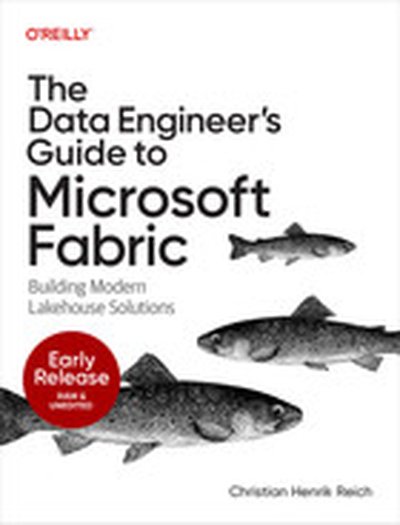
The Data Engineer's Guide to Microsoft Fabric

Modern data engineering is evolving; and with Microsoft Fabric, the entire data platform experience is being redefined. This essential book offers a fresh, hands-on approach to navigating this shift. Rather than being an introduction to features, this guide explains how Fabric's key components—Lakehouse, Warehouse, and Real-Time Intelligence—work under the hood and how to put them to use in realistic workflows. Written by Christian Henrik Reich, a data engineering expert with experience that extends from Databricks to Fabric, this book is a blend of foundational theory and practical implementation of lakehouse solutions in Fabric. You'll explore how engines like Apache Spark and Fabric Warehouse collaborate with Fabric's Real-Time Intelligence solution in an integrated platform, and how to build ETL/ELT pipelines that deliver on speed, accuracy, and scale. Ideal for both new and practicing data engineers, this is your entry point into the fabric of the modern data platform. Acquire a working knowledge of lakehouses, warehouses, and streaming in Fabric Build resilient data pipelines across real-time and batch workloads Apply Python, Spark SQL, T-SQL, and KQL within a unified platform Gain insight into architectural decisions that scale with data needs Learn actionable best practices for engineering clean, efficient, governed solutions
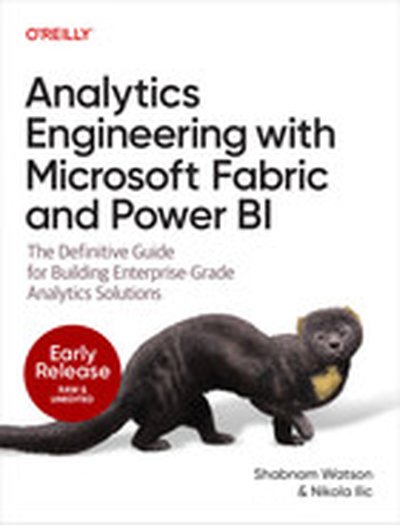
Analytics Engineering with Microsoft Fabric and Power BI

While Microsoft Power BI has dominated the business intelligence market for years and is a go-to tool for creating visually appealing, interactive reports and dashboards, it's now an integral part of Microsoft Fabric, the end-to-end analytics platform that offers unprecedented flexibility and scalability for building enterprise-grade data analytics solutions. This book covers everything analytics engineers need to know to design and implement robust and efficient analytics solutions using Microsoft Fabric and Power BI. You'll learn the core components of Fabric, such as lakehouses, warehouses, and eventhouses, and how to work with semantic models, ensuring that data is structured and ready for analysis. You'll also discover essential techniques in both Microsoft Fabric and Power BI that you can apply in your day-to-day work. Explore the core components of Microsoft Fabric Implement, manage, and optimize Power BI semantic models Discover numerous architectural solutions with Microsoft Fabric and Power BI Build Fabric items such as lakehouses, warehouses, semantic models, and more, and share them within your organization Identify when to use a particular Fabric item or implement a particular design pattern Implement the analytics development lifecycle Optimize and fine-tune existing analytics solutions

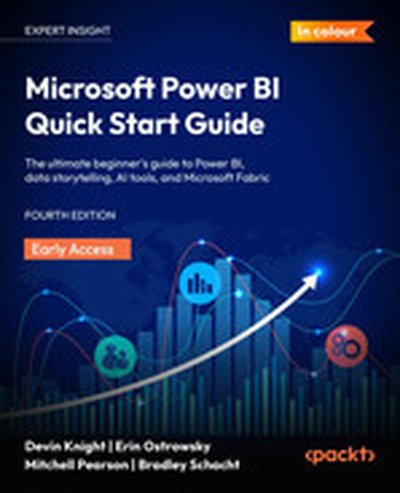
Microsoft Power BI Quick Start Guide - Fourth Edition

Bring your data to life with the ultimate beginner's guide to Power BI, now featuring Microsoft Fabric, Copilot, and full-color visuals to make learning data modeling, storytelling, and dashboards easier and faster than ever Key Features Build data literacy and gain confidence using Power BI through real-world, beginner-friendly examples Learn to shape, clean, and model data using Power BI Desktop and Power Query, with zero experience required Build vibrant, accurate reports and dashboards with real-world modeling examples Book Description Updated with the latest innovations in Power BI, including integration with Microsoft Fabric for seamless data unification and Copilot for AI-powered guidance. This comprehensive guide empowers you to build compelling reports and dashboards from the ground up. Whether you're new to Power BI or stepping into a data role, this book provides a friendly, approachable introduction to business intelligence and data storytelling You'll start with the Power BI Desktop interface and its core functionality, then move into shaping and cleaning your data using the Power Query Editor. From designing intuitive data models to writing your first DAX formulas, you’ll develop practical skills that apply directly to real-world scenarios. he book emphasizes how to use visualizations and narrative techniques to turn numbers into meaningful insights The chapters focus on hands-on, real-world examples—like analyzing sales trends, tracking KPIs, and cleaning messy data. You'll learn to build and refresh reports, scale your Power BI setup, and enhance your solutions using Microsoft Fabric and Copilot. Fabric unifies analytics across your organization, while Copilot speeds up your workflow with AI-driven insights and report suggestions By the end of the book, you’ll have the confidence and experience to turn raw data into insightful, impactful dashboards What you will learn Understand why data literacy matters in decision-making and careers Connect to data using import, DirectQuery, and live connection modes Clean and transform data using Power Query Editor and dataflows Design reports with visuals that support clear data storytelling Apply row-level security to enforce access and data protection Manage and monitor Power BI cloud for scalability and teamwork Use AI tools like Copilot to speed up prep and generate insights Learn Microsoft Fabric basics to enable unified data experiences Who this book is for This book is ideal for anyone looking to build a solid foundation in Power BI, regardless of prior experience. Whether you're just starting out or stepping into a new role that involves data, you'll find clear, approachable guidance throughout. The step-by-step tutorials and real-world examples make it easy to follow along—even if it’s your first time working with business intelligence tools

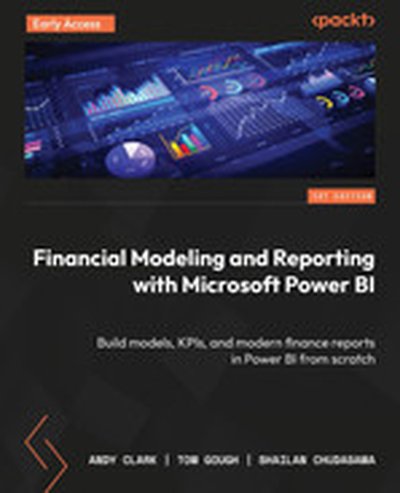
Financial Modeling and Reporting with Microsoft Power BI

Design powerful financial reports in Power BI by building models, measures, and dashboards tailored for real-world accounting and analytics Key Features Build a complete financial data model from ledgers, journals, and budgets Master DAX for income statements, KPIs, and performance analysis Learn Power BI Paginated and AI tools for printable and predictive reporting Purchase of the print or Kindle book includes a free PDF eBook Book Description Power BI for Financial Reporting is the definitive guide to designing high-performance, flexible, and insightful financial reports using Power BI. This book empowers finance and BI professionals to create everything from trial balances to enterprise-wide performance dashboards with ease and precision. The book starts by helping you define your reporting goals and data sources, mapping these needs to Power BI’s capabilities. You’ll then build a core financial data model—covering ledger transactions, charts of accounts, and multi-company support. As you proceed, you’ll integrate complex DAX measures, handle foreign exchange and journal entries, and extend your model with budgeting and inventory data. Each chapter builds toward a comprehensive suite of reports, complete with visual best practices and tested metrics. You’ll learn to streamline datasets using Power Query, test for data integrity, and generate printable reports via Power BI Paginated. The final chapters dive into using AI, predictive analytics, and Microsoft Fabric to future-proof your reporting. Whether you're consolidating data across systems or evolving your reports for changing business needs, this hands-on guide ensures you’re prepared to meet the demands of modern finance. What you will learn Build core financial models from ledgers and accounts Create Trial Balance and Income Statements using DAX Optimize Power BI with Power Query and data transformation Add budgets, targets, and KPIs to performance dashboards Integrate inventory data for nuanced stock reporting Produce printable reports using Power BI Paginated Apply AI for report generation and predictive analytics Test, tune, and evolve reports for secure, scalable use Who this book is for This book is for finance professionals, accountants, financial analysts, and BI developers who want to leverage Power BI to improve, automate, and future-proof their financial reporting. Whether consolidating data from ERPs, building reports across entities, or exploring advanced Power BI features, this book equips readers with practical skills and strategic insight.

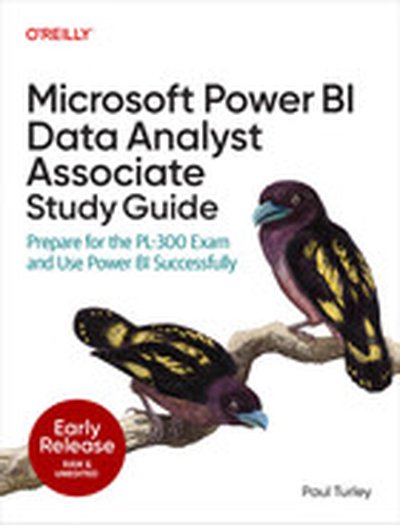
Microsoft Power BI Data Analyst Associate Study Guide

Passing the PL-300 exam with 2025 revisions isn't just about memorization—you need to thoroughly know the basic features of Power BI. However, data professionals must also apply best practices that make Power BI solutions scalable and future-proof. The first half of this go-to companion by Paul Turley provides complete coverage of the PL-300 exam objectives for desktop and self-service users, while the second half equips you with necessary best practices and practical skills for real-world success after the exam. Immerse yourself in exam prep, practice questions, and hands-on references for applying time-tested design patterns in Power BI. You'll learn how to transform raw data into actionable insights using Power Query, DAX, and dimensional modeling. Perfect for data analysts and business intelligence developers, this guide shows how Power BI fits into modern data platforms like Azure and Microsoft Fabric, preparing you for the exam and for the evolving world of data engineering. Understand PL-300 exam topics and key prep strategies Discover scalable, enterprise-grade Power BI solutions using best practices Learn how to correctly apply Power Query, DAX, and visualizations in real-world scenarios, with real business data Uncover how to build for scale See how Power BI fits into modern architectures like Azure and Microsoft Fabric

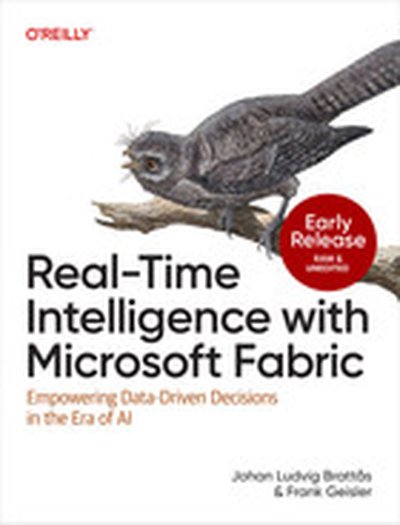
Real-Time Intelligence with Microsoft Fabric

In today's hyper-connected world, many organizations are overwhelmed by the volume of data generated every second. Making timely decisions using this information remains a challenge for many. Real-time intelligence has transformed from a luxury to a necessity for businesses striving to stay ahead in a rapidly evolving marketplace. Enter Microsoft Fabric's Real-Time Intelligence: a new tool that not only analyzes data but also acts upon the results. If you're ready to unlock the power of immediate insights, this comprehensive primer offers an exploration into the capabilities of Real-Time Intelligence with Microsoft Fabric. Authors Johan Ludvig Brattås and Frank Geisler explain AI-driven insights and how to use them to drive business success. Whether you're a seasoned professional or an enthusiast, this guide is the key to understanding an exciting new platform. You'll discover: The core concepts of Real-Time Intelligence within Microsoft Fabric Challenges that can be solved with Real-Time Intelligence, enhancing efficiency Techniques for using KQL queries, including SQL knowledge to optimize these queries Practical applications including data analytic solutions, event streams, and more How to automatically trigger actions based on data conditions

As Microsoft continues to promote and enhance their Microsoft Fabric offering, many clients are asking: How does Microsoft Fabric impact my current Power BI estate? What are some strategies for successful deployment of Microsoft Fabric? How do we scale analytics in Microsoft Fabric and leverage its native AI functionality? This session provides expert insights on Power BI to Microsoft Fabric migrations.

As Microsoft continues to promote and enhance their Microsoft Fabric offering, many clients are asking: How does Microsoft Fabric impact my current Power BI estate? What are some strategies for successful deployment of Microsoft Fabric? How do we scale analytics in Microsoft Fabric and leverage its native AI functionality? This session provides expert insights on Power BI to Microsoft Fabric migrations.

Organizations struggle to scale AI governance, mitigate risk, and effect compliance while delivering value in AI deployments. AI governance programs only check the box if they are not adaptive and embedded into the fabric of the AI lifecycle. In this session, you will learn how to define your role in AI governance, assess what technology capabilities are required to govern AI at scale, and make an investment decision in an AI Governance Platform or other technology tool.

Urgent investments in AI-ready data and operational use cases have put the spotlight on foundational data management. The Data Fabric has emerged as a long-term data management architecture that you should now pursue for sustained data, analytics, and AI success. This session will help participants understand what data fabrics are and their implications for your data architecture. It will also address how to build and where to buy data fabrics.

Organizations struggle to scale AI governance, mitigate risk, and effect compliance while delivering value in AI deployments. AI governance programs only check the box if they are not adaptive and embedded into the fabric of the AI lifecycle. In this session, you will learn how to define your role in AI governance, assess what technology capabilities are required to govern AI at scale, and make an investment decision in an AI Governance Platform or other technology tool.

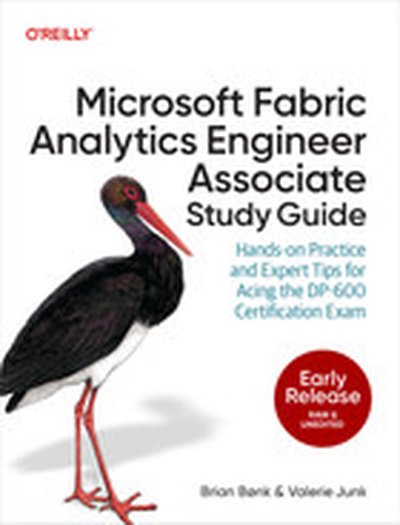
Microsoft Fabric Analytics Engineer Associate Study Guide

Data is the heartbeat of business. Microsoft's Fabric Analytics Engineer Associate (DP-600) certification proves you understand the tools and technologies to make use of it. This comprehensive guide covers everything you need to know to design and implement enterprise-grade analytics solutions—and ace your certification exam. Drawing on their extensive experience working with Microsoft Fabric and Power BI, Brian Bønk and Valerie Junk take you through preparing and transforming data, securing and managing analytics assets, and building and optimizing semantic models. You'll learn to work with data warehouses and lakehouses, ensuring data is structured and ready for analysis. You will also discover how to query and analyze data using SQL, KQL, and DAX, which are essential skills for anyone working with Fabric. Whether you're preparing for the exam or just looking to expand your Fabric expertise, this book gives you the foundation to succeed. Prepare and enrich data for analysis Work with, secure, and maintain analytics assets Implement and manage semantic models Utilize data warehouses and lakehouses Handle workspace access control and item-level access control Optimize enterprise-scale semantic models

Real-Time Intelligence session: A hands-on look at end-to-end data round-trip from creation to insights. The presenter demonstrates building a weather-prediction solution using Real-Time Intelligence within Microsoft Fabric. Topics include collecting weather data on a Raspberry Pi, sending it to Fabric via Azure IoT Hub, and connecting to the data in Microsoft Fabric to transform, predict, and alert in real time about whether to go outside today.

With the new Fabric IQ, Microsoft is taking a big leap forward: rather than IT specialists, it is the business users who define and describe how the business works using an ontology, via entities with properties and relationships between them. They then explain to Microsoft Fabric where the relevant data can be found, and a data agent can then be used to query all aspects of the business and analyze them. And because it knows the entire business with its rules and not just one department, it can automatically make decisions that are almost as good as those made by its human colleagues. Not quite clear? No matter, this presentation has some good examples.

With the new Fabric IQ, Microsoft is taking a big leap forward: rather than IT specialists, it is the business users who define and describe how the business works using an ontology, via entities with properties and relationships between them. They then explain to Microsoft Fabric where the relevant data can be found, and a data agent can then be used to query all aspects of the business and analyze them. And because it knows the entire business with its rules and not just one department, it can automatically make decisions that are almost as good as those made by its human colleagues. Not quite clear? No matter, this presentation has some good examples.

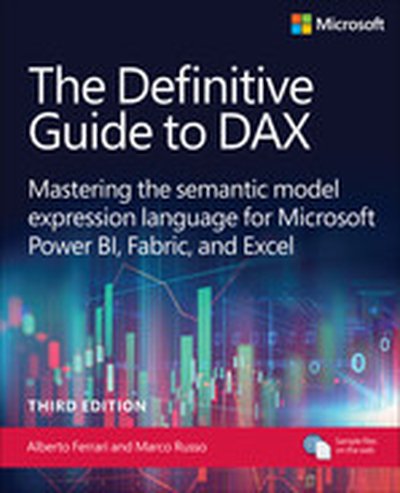
The Definitive Guide to DAX: Mastering the semantic model expression language for Microsoft Power BI, Fabric, and Excel, 3rd Edition

Seasoned Experts Alberto Ferrari and Marco Russo Help You Master DAX for Superior Business Intelligence Solutions The Definitive Guide to DAX is an authoritative resource for mastering the DAX language, which is pivotal for creating measures for semantic models in Microsoft Power BI, Fabric, Analysis Services, and Excel. With years of experience since the inception of Power Pivot, the authors offer a comprehensive reference that navigates through the unique and complex concepts of DAX, making it an essential tool for BI professionals. This third edition updates you with the latest features and provides a framework for writing efficient DAX code, enhancing your ability to customize calculations in data models. You will gain the skills necessary to understand and apply advanced DAX concepts, structure code in user-defined functions, and leverage new calendars for time intelligence calculations. By reading this book, you will: Understand the foundational concepts of DAX and its unique language structure Master the use of evaluation contexts to enhance data analysis Utilize CALCULATE and CALCULATETABLE functions effectively Implement variables to simplify complex DAX expressions Leverage classic and new calendar based time intelligence functions Work with iterators to perform advanced calculations Apply visual calculations to improve report interactivity Create and manage calculation groups for dynamic reporting Handle complex hierarchies and relationships in data models Author DAX queries for testing and troubleshooting About This Book For BI professionals and Excel power users eager to deepen their understanding of DAX and enhance their data modeling capabilities with advanced techniques For data analysts and IT specialists seeking to optimize their use of Microsoft Power BI, Fabric, Analysis Services, and Excel for more efficient and insightful data analysis

Session interactive dédiée aux capacités conversationnelles de Power BI et de Microsoft Fabric, avec activation de Copilot, grounding des données et création d’agents pour les utilisateurs métiers. Bonnes pratiques pour sécuriser et contextualiser les réponses générées par l’IA, éviter hallucinations et fuites de données.

AWS re:Invent 2025 - AWS Trn3 UltraServers: Power next-generation enterprise AI performance(AIM3335)

Enterprise AI workloads demand infrastructure that can scale efficiently while delivering breakthrough performance. This session introduces Tranium3 UltraServers, the next generation of AI infrastructure built on Trainium3 chips with advanced NeuronSwitch-v1 fabric architecture, and gives a glimpse into how Anthropic is optimizing Claude models on Trainium. Discover how this purpose-built infrastructure accelerates the most demanding enterprise applications, from large-scale reasoning models to multimodal intelligence and agentic AI workloads. We'll explore the complete silicon-to-server innovation stack, demonstrate significant generation-over-generation performance improvements, and show how organizations can leverage these advances to unlock new levels of AI-driven productivity in real-world deployments.

Learn more: More AWS events: https://go.aws/3kss9CP

Subscribe: More AWS videos: http://bit.ly/2O3zS75 More AWS events videos: http://bit.ly/316g9t4

ABOUT AWS: Amazon Web Services (AWS) hosts events, both online and in-person, bringing the cloud computing community together to connect, collaborate, and learn from AWS experts. AWS is the world's most comprehensive and broadly adopted cloud platform, offering over 200 fully featured services from data centers globally. Millions of customers—including the fastest-growing startups, largest enterprises, and leading government agencies—are using AWS to lower costs, become more agile, and innovate faster.

AWSreInvent #AWSreInvent2025 #AWS