This volume will take you from novice to master, covering not only how to use SQL but also the Oracle extensions to SQL. The examples feature the sample schemas available with Oracle Database 10 g, and free code will be available for download.
 talk-data.com
Topic
541
tagged
This volume will take you from novice to master, covering not only how to use SQL but also the Oracle extensions to SQL. The examples feature the sample schemas available with Oracle Database 10 g, and free code will be available for download.
An enormous system comprising myriad technologies, options, and releases, Oracle's complexities have spawned numerous areas of specialization. For each area of specialization there are equally specialized how-to books and manuals. O'Reilly's Oracle Essentials claims a unique place among these books. Rather than focusing on one area, the book explains the foundational concepts of the Oracle technology and the core technical and business aspects of using it.The new edition of this classic book, Oracle Essentials, 3rd Edition: Oracle Database 10g, distills a vast amount of knowledge into an easy-to-read volume covering every aspect of the Oracle database. Readers of all levels will learn about Oracle's features and technologies, including the product line, architecture, data structures, networking, concurrency, tuning, and much more.Featuring focused text, abundant illustrations, and helpful hints, the new edition offers a valuable overview of Oracle's Database 10 g--the industry's first database to support grid computing. Recent releases such as Oracle 9 i and 8 i are also covered. The book contains chapters on: Oracle products, options, and overall architecture for Oracle 10 g and prior recent releases Installing and running Oracle: how to configure, start up, and shut down the database, and various networking issues Oracle data structures, datatypes, and ways of extending datatypes, with an introduction to Oracle objects (e.g., tables, views, indexes) Managing Oracle: security, the Oracle Enterprise Manager, fragmentation and reorganization, and backup and recovery Oracle performance: characteristics of disk, memory, and CPU tuning Multi-user concurrency, online transaction processing (OLTP), and high availability Hardware architectures (e.g., SMP, MPP, NUMA) and their impact on Oracle Data warehousing and distributed databases Network deployment: using Oracle as an Internet computing platform and for grid computing What's new in Oracle 10 g: a summary of the database changes described in the book Oracle Essentials, 3rd Edition: Oracle Database 10g was written for anyone whose job involves managing or building systems using Oracle DBMS technology or working with staff that uses Oracle technology. This book is the perfect all-in-one source for understanding the complexities and capabilities of Oracle.
Complete tutorial for database developers! Thorough coverage of PL/SQL Practical "cookbook" techniques Effectively create and manage complex databases with Oracle! Systems and database expert Kevin Owens explores PL/SQL, Oracle's answer to the Structured Query Language (SQL), and teaches you what you need to know to build robust and complex databases for your business. Using easy-to-follow instructions and examples, this book presents techniques to take advantage of Oracle features such as triggers and stored procedures-features that allow your databases to incorporate business rules which are easy to manage and modify as the business evolves. Topics covered include: Viewing constraints in the data dictionary Complex rule enforcement PL/SQL program units and language features Data types and composite structure Error handling and exceptions Inter-process communications Declarative constraints, including primary key, unique, foreign key, check, and much more Programming Oracle Triggers and Stored Procedures, Third Edition, is an invaluable resource for database developers, designers, and project leaders looking to build and maintain truly intelligent, complex databases
Oracle system performance inefficiencies often go undetected for months or even years--even under intense scrutiny--because traditional Oracle performance analysis methods and tools are fundamentally flawed. They're unreliable and inefficient.Oracle DBAs and developers are all too familiar with the outlay of time and resources, blown budgets, missed deadlines, and marginally effective performance fiddling that is commonplace with traditional methods of Oracle performance tuning. In this crucial book, Cary Millsap, former VP of Oracle's System Performance Group, clearly and concisely explains how to use Oracle's response time statistics to diagnose and repair performance problems. Cary also shows how "queueing theory" can be applied to response time statistics to predict the impact of upgrades and other system changes. Optimizing Oracle Performance eliminates the time-consuming, trial-and-error guesswork inherent in most conventional approaches to tuning. You can determine exactly where a system's performance problem is, and with equal importance, where it is not, in just a few minutes--even if the problem is several years old. Optimizing Oracle Performance cuts a path through the complexity of current tuning methods, and streamlines an approach that focuses on optimization techniques that any DBA can use quickly and successfully to make noticeable--even dramatic--improvements.For example, the one thing database users care most about is response time. Naturally, DBAs focus much of their time and effort towards improving response time. But it is entirely too easy to spend hundreds of hours to improve important system metrics such as hit ratios, average latencies, and wait times, only to find users are unable to perceive the difference. And an expensive hardware upgrade may not help either.It doesn't have to be that way. Technological advances have added impact, efficiency, measurability, predictive capacity, reliability, speed, and practicality to the science of Oracle performance optimization. Optimizing Oracle Performance shows you how to slash the frustration and expense associated with unraveling the true root cause of any type of performance problem, and reliably predict future performance.The price of this essential book will be paid back in hours saved the first time its methods are used.
Tom Kyte of Oracle Magazine’s “Ask Tom” column has written the definitive guide to designing and building high-performance, scalable Oracle applications. The book covers schema design, SQL and PL/SQL, tables and indexes, and much more. From the exclusive publisher of Oracle Press books, this is a must-have resource for all Oracle developers and DBAs.
The Oracle SQL every DBA needs—fast and easy! Covers all the core day-to-day tasks DBAs are responsible for Quick access to SQL commands, operators, functions, data dictionary views, and more Includes dozens of easy-to-understand syntax diagrams The fast, practical Oracle SQL reference for every Oracle DBA! If you're a working Oracle DBA, here's the Oracle SQL reference you've been searching for—simple, straightforward, and incredibly easy to use! There's no faster way to discover the exact syntax you need...refresh your memory about that option you haven't used lately...find the name of that view you know exists...start using that new Oracle 9 i feature you haven't tried yet. Keep it by your desk, near your server...wherever you need fast, reliable answers right this minute! Covers Oracle SQL through Oracle9 i Release 2 Clear, well-organized tables of operators, functions, format models, privileges, and reserved words Complete command reference: syntax and options for every Oracle SQL command Standard "railroad" syntax diagrams make it easy to write correct syntax Handy listings of data dictionary views and dynamic performance tables
The definitive, real-world guide to Oracle data warehousing Maximizing performance, flexibility, and manageability in production environments Hardware/software architectures, star schema design, partitioning, and more Industrial strength data loading and query optimization techniques By the world-renowned architect of 7-Eleven's multi-terabyte datawarehouse Maximize Oracle data warehouse performance, flexibility, and manageability Oracle DBAs finally have a definitive guide to every aspect of designing, constructing, tuning, and maintaining star schema data warehouses with Oracle 8i and 9i. Bert Scalzo, one of the world's leading Oracle data warehousing experts, offers practical, hard-won lessons and breakthrough techniques for maximizing performance, flexibility, and manageability in any production environment. Coverage includes: Data warehousing fundamentals for DBAs--including what a data warehouse isn't Planning software architecture: business intelligence, user interfaces, Oracle versions, OS platforms, and more Planning hardware architecture: CPUs, memory, disk space, and configuration Radically different star schema design for radically improved performance Tuning ad-hoc queries for lightning speed Industrial-strength data loading techniques Aggregate tables: maximizing performance benefits, minimizing complexity tradeoffs Improving manageability: The right ways to partition Data warehouse administration: Backup/recovery, space and extent management, updates, patches, and more
If you work with Oracle, then you don't need to be told that the data dictionary is large and complex, and grows larger with each new Oracle release. It's one of the basic elements of the Oracle database you interact with regularly, but the sheer number of tables and views makes it difficult to remember which view you need, much less the name of the specific column. Want to make it simpler? The Oracle Data Dictionary Pocket Reference puts all the information you need right at your fingertips. Its handy and compact format lets you locate the table and view you need effortlessly without stopping to interrupt your work Oracle Data Dictionary Pocket Reference gives DBAs and developers at any level quick and easy access to the data dictionary in Oracle's latest database, Oracle9i. This pocket-sized book provides a complete list of the most commonly used tables and views in the Oracle9i data dictionary, intelligently arranged for quick reference. It also includes column names and descriptions for each of the tables and views, as well as helpful tips, warnings, and usage examples.O'Reilly's Pocket References have become a favorite among developers and database administrators everywhere. By providing a wealth of important details in a concise, well-organized format, these handy books deliver just what you need to complete the task at hand. When you've reached a sticking point in your work and want to check your facts quickly, the Oracle Data Dictionary Pocket Reference is the book to have close by.
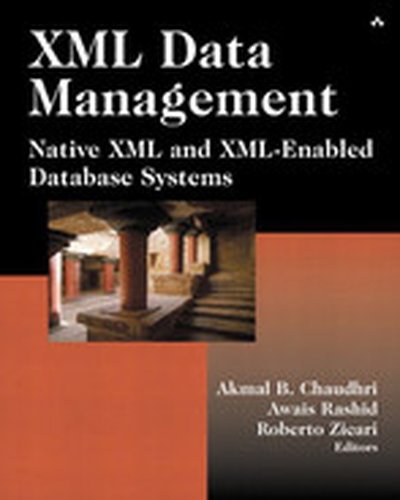
"This is an excellent book that combines a practical and analytical look at the subject." —Leo Korman, Principal Software Engineer, KANA Software As organizations begin to employ XML within their information-management and exchange strategies, data management issues pertaining to storage, retrieval, querying, indexing, and manipulation increasingly arise. Moreover, new information-modeling challenges also appear. —with its contributions from experts at the forefront of the XML field—addresses these key issues and challenges, offering insights into the advantages and drawbacks of various XML solutions, best practices for modeling information with XML, and developing custom, in-house solutions. XML Data Management In this book, you will find discussions on the newest native XML databases, along with information on working with XML-enabled relational database systems. In addition, thoroughly examines benchmarks and analysis techniques for performance of XML databases. XML Data Management Topics covered include: The power of good grammar and style in modeling information to alleviate the need for redundant domain knowledge Tamino's XML storage, indexing, querying, and data access features The features and APIs of open source eXist Berkeley DB XML's ability to store XML documents natively IBM's DB2 Universal Database and its support for XML applications Xperanto's method of addressing information integration requirements Oracle's XMLType for managing document centric XML documents Microsoft SQL Server 2000's support for exporting and importing XML data A generic architecture for storing XML documents in a relational database X007, XMach-1, XMark, and other benchmarks for evaluating XML database performance Numerous case studies demonstrate real-world problems, industry-tested solutions, and creative applications of XML data management solutions. Written for both XML and relational database professionals, provides a promising new approach to data management, one that is sure to positively impact the way organizations manage and exchange information. XML Data Management 0201844524B01302003
TOAD Handbook is a guide for developing Oracle applications and administering Oracle databases with TOAD. Starting with installation and configuration, the book covers the TOAD SQL editors in depth, including dozens of helpful, undocumented features. Later chapters discuss reporting and exporting data and using several add-on tools designed to enhance TOAD development. Along the way, the authors provide critical insights into the workings of TOAD and how developers can use it to make the most of their applications. Includes a foreword by Jim McDaniel, the inventor of TOAD.
Like most PL/SQL programmers, you've found Oracle PL/SQL Programming to be a reference book you can't do without. Packed with examples and recommendations, it's a book that has helped everyone, from Oracle Forms developers to database administrators, make the most of PL/SQL. But you can't always carry it with you, and even at your desk there are times when you just need a reminder, a quick answer to a problem you're up against. For times like those, PL/SQL experts Stephen Feuerstein, Bill Pribyl, and Chip Dawes have written a new edition of Oracle PL/SQL Language Pocket Reference. Updated for Oracle9i, this little book is easy to take with you and use anywhere for quick problem solving. The second edition of the Oracle PL/SQL Language Pocket Reference boils down the most vital information from Oracle PL/SQL Programming into a convenient quick reference to PL/SQL basics. This compact book will be indispensable for new and seasoned Oracle database developers alike. It summarizes features available in Oracle9i and provides essential information on PL/SQL block structure, fundamental language elements, control statements, and use of procedures, functions, packages, triggers, Oracle objects, external procedures, and methods of calling Java classes from PL/SQL. O'Reilly's Pocket References have become a favorite among developers and database administrators everywhere. By providing a wealth of important details in a concise, well-organized format, these handy books deliver just what you need to complete the task at hand. When you've reached a sticking point in your work and need to get to a solution quickly, the new edition of Oracle PL/SQL Language Pocket Reference is the book you'll want to have.
Introduced a quarter-century ago, the Oracle database remains the leading enterprise relational database management system (RDBMS) in the world. Oracle is a complex system, offering a myriad of products, languages, and tools. Frequent updates, releases, and editions complicate the ability of Oracle users to keep up with the huge amounts of frequently changing information about the database and its capabilities.The goal of Oracle in a Nutshell is to pull together the most essential information on Oracle architecture, syntax, and user interfaces. The content and format of this book, an admirable addition to O'Reilly's respected In-a-Nutshell line, combine to boil down vital Oracle commands, language constructs, parameters, and file formats in a succinct and highly accessible desktop reference. Oracle in a Nutshell covers the information that database administrators PL/SQL and Java developers, and system, network, and security administrators need as they manage Oracle databases and write code for these databases. It includes: Oracle Foundations--Overview of the Oracle architecture (memory structures and fundamental concepts), Oracle's various editions and packaging options, summary of the initialization file parameters and data dictionary views, and fundamentals of Oracle's concurrency scheme, security mechanisms (privileges, profiles, roles), and networking files (TNSNAMES.ORA, SQLNET.ORA, LISTENER.ORA, DAP.ORA, NAMES.ORA, CMAN.ORA) and options. Oracle Languages--Syntax summary for SQL language statements, SQL function calls PL/SQL language statements and characteristics, PL/SQL built-in package headers, and Java (JDBC and SQLJ) interfaces to the Oracle database. Oracle Tools--Commands provided with SQLPlus, SQLLoader, Import and Export, Oracle Recovery Manager (RMAN) and other backup/recovery methods, Oracle Enterprise Manager, and various performance tuning tools (Explain Plan, TKPROF, AUTOTRACE, UTLBSTAT, UTLESTAT, Statspack). Appendixes--Summary of Oracle datatypes, operators, expressions, conditions, numeric and date formats, and resources for additional reading.
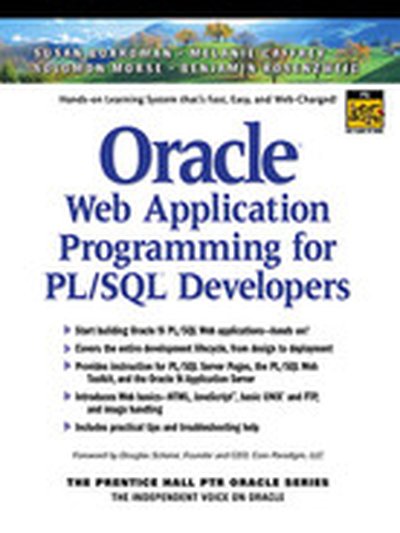
The hands-on, rapid-mastery guide to Oracle PL/SQL Web development. Start building Oracle 9i PL/SQL Web applications—hands on Covers the entire development lifecycle, from design to deployment Provides instruction for PL/SQL Server Pages, the PL/SQL Web Toolkit, and the Oracle 9i Application Server Introduces Web basics—HTML, JavaScript, basic UNIX and FTP, and image handling Reviews PL/SQL and SQL concepts Includes practical tips and troubleshooting help Leverage your SQL and PL/SQL experience to build powerful data-driven Web and e-business applications—starting right now! In this book, a team of Columbia University PL/SQL instructors cover the core pieces of what you need to know, from preliminary configuration to deployment of dynamic, data-driven applications. You'll find practical examples, hands-on exercises, and dozens of practical tips and solutions designed to save you time, effort, and frustration. One step at a time, discover how to: Configure Oracle's Internet Application Server Control Web applications and servers remotely Build Oracle Web applications with PL/SQL Create dynamic, data-driven pages Test, debug, troubleshoot, and deploy your applications Maintain and optimize running Web applications Whether you've been writing simple queries or complex PL/SQL code, this book takes your database development skills onto the Web—and into the future!
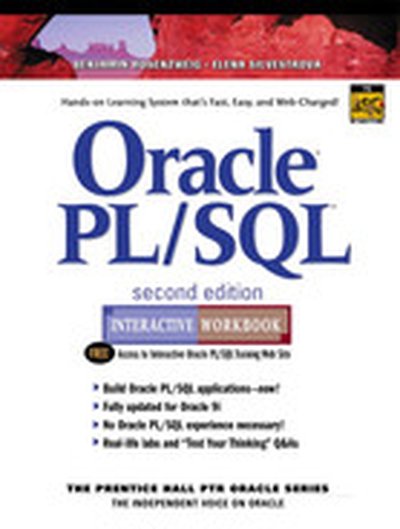
Build Oracle PL/SQL applications—now. Fully updated for Oracle 9i No Oracle PL/SQL experience necessary. Real-life labs and "Test Your Thinking" Q&As Start developing applications with Oracle PL/SQL—fast. This integrated book-and-Web learning solution teaches all the Oracle PL/SQL skills you need, hands on, through real-world labs, exercises, projects, and a complete Web-based training site. Completely updated for Oracle 9i, it covers all the fundamentals—and a whole lot more. Master PL/SQL syntax, iterative and conditional control, scoping, anchored datatypes, cursors, triggers, security, tables, and packaging—plus powerful new techniques for working with exceptions, cursors, collections, and records. Your free Web-based training module includes a Virtual Study Lounge where you can interact with other learners, work on new projects, and get updates. Totally integrated with a FREE, state-of-the-art Oracle 9i learning Web site. Every Prentice Hall Oracle Interactive Workbook is fully integrated with its own exclusive Web site, giving you all this and more: "Test Your Thinking" project solutions and detailed explanations Additional self-review exercises with instant feedback and explanations An exclusive Virtual Study Lounge where you can interact with other students. Just the facts. No endless, boring discussions here. You'll learn hands on through practical exercises, self-review questions, and real-world answers. Exclusive "Test Your Thinking" projects guarantee you'll go beyond rote knowledge to really master the subject. It's an integrated learning system that's proven to work. Dozens of exercises cover the real-world tasks that matter most. Hundreds of self-review questions and answers make sure you understand.
XML is the de-facto standard for manipulating and sharing data among applications. It is supported by every major programming tool and language, including Java, Microsoft .NET, Oracle, SQL Server, etc. All professional developers and administrators - even those who don't intend to build XML applications - need a basic understanding of it just to read and maintain data they receive and process. Many of them don't have the time for a thick reference book or detailed tutorial. Sams Teach Yourself XML in 10 Minutes quickly covers the basics of XML and its family of related concepts, including basic syntax, DTDs, XML Schema, DOM, SAX, XSL, and XPath. Each topic is illustrated with an example to ensure readers' understanding.
Sams Teach Yourself SQL in 21 Days, Fourth Edition provides a sold foundation in understanding the fundamentals of SQL (Structured Query Language). SQL is the query language used by relational databases such a Oracle, Microsoft Access, and Microsoft SQL Server. The new edition covers object-oriented programming with SQL, ODBC, JDBC, embedded SQL, accessing remote databases, and constructs. All new examples based on an open source database such as MySQL enhance this new edition by making the examples readily useable for readers.
SQLPlus is available at every Oracle site--from the largest data warehouse to the smallest single-user system--and it's a critical tool for virtually every Oracle user. Despite its wide use, few developers and DBAs know how powerful a tool SQLPlus can be. This pocket reference provides quick reference information that will help you use SQLPlus, Oracle's interactive query tool. It summarizes all of the SQLPlus syntax, including the syntax for the Oracle9i release. This book boils down the most vital information from Gennick's best-selling book, "Oracle SQL8Plus: The Definitive Guide", into an accessible summary and works as a vital companion to the larger book. It concisely describes interacting with SQLPlus, selecting data, formatting reports with SQLPlus, and tuning SQL queries. It also contains quick references to the SQLPlus commands and format elements. The new 2nd edition of our Oracle SQLPlus Pocket Reference includes many new features for Oracle9i (e.g., COALESCE function, searched CASE expressions, new table join syntax, partition operations, MERGE statement, and syntax changes in existing SQLPlus statements such as ACCEPT, DESRIBE, HELP, and SET) It also adds sections on basic SQL (a much-requested feature): INSERT, DELETE, UPDATE, SELECT, and transaction management. The pocket reference size is especially appropriate for this particular subject, since Oracle SQLPlus is used on every possible platform, it's particularly convenient to be able to carry a small book around from office computer to home computer to laptop.
With the successful implementation of XML Schema, developers are learning how to increase productivity, improve software reliability, minimize development time, and decrease time to market. This in-depth reference is an all-in-one resource designed to help developers leverage the power and potential of XML schemas by offering a complete roadmap to their creation, design, and use. This authoritative reference and tutorial is filled with practical insights and detailed examples. The book begins by providing a conceptual introduction to XML Schema. From there, coverage shifts to the W3C Schema Recommendation and how to apply schemas to specific business goals. The authors provide insight and instruction throughout on integrating XML schemas into existing technologies such as .NET, Java, Visual Basic, Oracle, and more. The book concludes with a complete case study designed to reinforce and illustrate material covered. Additional topics include: Applications for schemas Simple and complex types XML schema processing and validation Namespaces in XML Using schemas with DOM and SAX XML schema document syntax XML Information Sets XML Schema applications of XPath Whether designing a schema from scratch or integrating schemas into contemporary technologies, is the most complete and definitive sourcebook available for the XML Schema environment. The XML Schema Complete Reference 0672323745B08162002
Nearly a quarter-million PL/SQL programmers--novices and experienced developers alike--have found the first and second editions of Oracle PL/SQL Programming to be indispensable references to this powerful language. Packed with examples and recommendations, this book has helped everyone, from Oracle Forms developers to database administrators, make the most of PL/SQL. This new edition is a comprehensive update of the original book, covering all versions of PL/SQL through Oracle9i Release 2. It adds much-requested new chapters on how to create and run PL/SQL programs, call Java methods from within PL/SQL, and define and use database triggers. An extensive new chapter--designed especially for experienced PL/SQL developers--describes PL/SQL's runtime architecture and how to use knowledge of Oracle internals to get the best performance from PL/SQL. The book contains information about the latest Oracle9i PL/SQL features, including: Record-based DML: You can now use records in INSERT and DELETE statements. Table functions: These are functions that return a result set (in the form of a PL/SQL collection). Such functions existed in Oracle8i but they are now much expanded. New and improved datatypes: Oracle now offers dramatically improved support for timestamps, time zone management, and interval calculations. In addition, the XMLType datatype has now been implemented. Inheritance for object types: You can now define a hierarchy of object types (which were first introduced in Oracle8). Enhancements to PL/SQL collections. PL/SQL now supports multiple-level collections (nesting collections within collections), as well as associative arrays (previously called index-by tables), which allow you to index by PLS_INTEGER and VARCHAR2. Native compilation of PL/SQL code: PL/SQL source code can now optionally be compiled into native object code that is linked into Oracle. Part I, Programming in PL/SQL Part II, PL/SQL Program Structure Part III, PL/SQL Program Data Part IV, SQL in PL/SQL Part V, PL/SQL Application Construction Part VI, Advanced PL/SQL Topics The book is divided into six parts: Even if you've been a PL/SQL developer for years, you'll find an enormous amount of new and revised information in this third edition and on its companion web site. If you're new to PL/SQL, you'll find Oracle PL/SQL Programming an invaluable companion on the road to mastery.
is a handbook of practical solutions for busy database professionals charged with managing an organization's critically important data. Covering today's most popular and widely installed database environments, this book is an indispensable resource for managing and tuning SQL across multiple platforms. SQL Performance Tuning Packed with tips, techniques, and best practices, this hands-on guide covers SQL commands and queries over a wide range of conditions and environments. Every facet of the SQL environment is covered, from concurrency control to optimization—and every issue in between. The book includes an overview of each of the most widely used database management systems (DBMS) and provides tuning tips for common day-to-day situations. Topics covered include: General and specific tuning General sort considerations and options Joins and subqueries Columns and tables Indexes, including B-trees and bitmaps Constraints and stored procedures ODBC and JDBC Data changes and concurrency control (locking) Clients, servers, and middleware Whether you are a programmer, consultant, or user, you will find SQL Performance Tuning an indispensable guide to optimizing SQL performance across today's popular database environments. Throughout , ideas and techniques are tested on a variety of popular SQL environments, including IBM DB2, Informix, Ingres, InterBase, Microsoft SQL Server, MySQL, Oracle, and Sybase ASE. The book's practical examples are written in ANSI/ISO Standard SQL: 1999. SQL Performance Tuning