talk-data.com talk-data.com

Topic

relational-databases

507

tagged

Activity Trend

1 peak/qtr
2020-Q1 2026-Q1

Activities

507 activities · Newest first

IBM DB2 12 for z/OS Technical Overview

IBM® DB2® 12 for z/OS® delivers key innovations that increase availability, reliability, scalability, and security for your business-critical information. In addition, DB2 12 for z/OS offers performance and functional improvements for both transactional and analytical workloads and makes installation and migration simpler and faster. DB2 12 for z/OS also allows you to develop applications for the cloud and mobile devices by providing self-provisioning, multitenancy, and self-managing capabilities in an agile development environment. DB2 12 for z/OS is also the first version of DB2 built for continuous delivery. This IBM Redbooks® publication introduces the enhancements made available with DB2 12 for z/OS. The contents help database administrators to understand the new functions and performance enhancements, to plan for ways to use the key new capabilities, and to justify the investment in installing or migrating to DB2 12.
MDX with Microsoft SQL Server 2016 Analysis Services Cookbook - Third Edition

Dive into the world of multidimensional data analysis with "MDX with Microsoft SQL Server 2016 Analysis Services Cookbook." This book provides over 70 practical recipes to help you understand and utilize MDX queries and calculations effectively. What this Book will help me do Master the fundamentals of MDX concepts and their applications. Learn to create time-aware calculations using the Time dimension. Develop skills to write efficient and flexible MDX queries. Gain insights into creating compact and efficient analytical reports. Understand advanced techniques for capturing MDX queries and metadata-driven calculations. Author(s) None Li and Tomislav Piasevoli are accomplished experts in multidimensional data analysis and business intelligence. Drawing from extensive experience, they offer readers a well-structured and comprehensive approach to mastering MDX. Their pedagogy emphasizes practical, real-world examples promoting clear understanding. Who is it for? This volume is designed for database administrators, multidimensional cube developers, and report writers looking to enhance their strengths in MDX. Readers with intermediate exposure to multidimensional databases will particularly benefit. It also serves as a valuable resource for business analysts and power users aiming to boost data analysis capabilities.

Delivering Business Intelligence with Microsoft SQL Server 2016, Fourth Edition, 4th Edition

Distribute Actionable, Timely BI with Microsoft® SQL Server® 2016 and Power BI Drive better, faster, more informed decision making across your organization using the expert tips and best practices featured in this hands-on guide. Delivering Business Intelligence with Microsoft SQL Server 2016, Fourth Edition, shows, step-by-step, how to distribute high-performance, custom analytics to users enterprise-wide. Discover how to build BI Semantic Models, create data marts and OLAP cubes, write MDX and DAX scripts, and share insights using Microsoft client tools. The book includes coverage of self-service business intelligence with Power BI. • Understand the goals and components of successful BI • Build data marts, OLAP cubes, and Tabular models • Load and cleanse data with SQL Server Integration Services • Manipulate and analyze data using MDX and DAX scripts and queries • Work with SQL Server Analysis Services and the BI Semantic Model • Author interactive reports using SQL Server Data Tools • Create KPIs and digital dashboards • Implement time-based analytics • Embed data model content in custom applications using ADOMD.NET • Use Power BI to gather, model, and visualize data in a self-service environment

In-Place Analytics with Live Enterprise Data with IBM DB2 Query Management Facility

IBM® DB2® Query Management Facility™ for z/OS® provides a zero-footprint, mobile-enabled, highly secure business analytics solution. IBM QMF™ V11.2.1 offers many significant new features and functions in keeping with the ongoing effort to broaden its usage and value to a wider set of users and business areas. In this IBM Redbooks® publication, we explore several of the new features and options that are available within this new release. This publication introduces TSO enhancements for QMF Analytics for TSO and QMF Enhanced Editor. A chapter describes how the QMF Data Service component connects to multiple mainframe data sources to accomplish the consolidation and delivery of data. This publication describes how self-service business intelligence can be achieved by using QMF Vision to enable self-service dashboards and data exploration. A chapter is dedicated to JavaScript support, demonstrating how application developers can use JavaScript to extend the capabilities of QMF. Additionally, this book describes methods to take advantage of caching for reduced CPU consumption, wider access to information, and faster performance. This publication is of interest to anyone who wants to better understand how QMF can enable in-place analytics with live enterprise data.

Securing SQL Server: DBAs Defending the Database

Protect your data from attack by using SQL Server technologies to implement a defense-in-depth strategy, performing threat analysis, and encrypting sensitive data as a last line of defense against compromise. The multi-layered approach in this book helps ensure that a single breach doesn't lead to loss or compromise of your data that is confidential and important to the business. Database professionals in today's world deal increasingly often with repeated data attacks against high-profile organizations and sensitive data. It is more important than ever to keep your company's data secure. demonstrates how administrators and developers can both play their part in the protection of a SQL Server environment. Securing SQL Server This book provides a comprehensive technical guide to the security model, and to encryption within SQL Server, including coverage of the latest security technologies such as Always Encrypted, Dynamic Data Masking, and Row Level Security. Most importantly, the book gives practical advice and engaging examples on how to defend your data -- and ultimately your job! -- against attack and compromise. Covers the latest security technologies, including Always Encrypted, Dynamic Data Masking, and Row Level Security Promotes security best-practice and strategies for defense-in-depth of business-critical database assets Gives advice on performing threat analysis and reducing the attack surface that your database presents to the outside world What You Will Learn Perform threat analysis Implement access level control and data encryption Avoid non-reputability by implementing comprehensive auditing Use security metadata to ensure your security policies are enforced Apply the latest SQL Server technologies to increase data security Mitigate the risk of credentials being stolen Who This Book Is For SQL Server database administrators who need to understand and counteract the threat of attacks against their company's data. The book is also of interest to database administrators of other platforms, as several of the attack techniques are easily generalized beyond SQL Server and to other database brands.

Microsoft SQL Server 2016: A Beginner's Guide, Sixth Edition, 6th Edition

Up-to-date Microsoft SQL Server 2016 skills made easy! Get up and running on Microsoft SQL Server 2016 in no time with help from this thoroughly revised, practical resource. The book offers thorough coverage of SQL management and development and features full details on the newest business intelligence, reporting, and security features. Filled with new real-world examples and hands-on exercises, Microsoft SQL Server 2016: A Beginner's Guide, Sixth Edition , starts by explaining fundamental relational database system concepts. From there, you will learn how to write Transact-SQL statements, execute simple and complex database queries, handle system administration and security, and use the powerful analysis and BI tools. XML, spatial data, and full-text search are also covered in this step-by-step tutorial. · Revised from the ground up to cover the latest version of SQL Server · Ideal both as a self-study guide and a classroom textbook · Written by a prominent professor and best-selling author

PostgreSQL Development Essentials

Dive into the advanced features of PostgreSQL and master database development with 'PostgreSQL Development Essentials'. This book guides you step-by-step through topics like advanced SQL queries, database design, query optimization, and using PostgreSQL with programming languages like Java and PHP. By the end, you'll have the skills to build secure, efficient, and enterprise-ready database applications. What this Book will help me do Write powerful and complex SQL queries to harness the full potential of PostgreSQL. Create and optimize robust database designs tailored to application needs. Enhance database performance through indexing, partitioning, and query optimization. Integrate PostgreSQL seamlessly with Java and PHP for advanced application development. Utilize PostgreSQL extensions and features to expand functionality and ensure scalability. Author(s) Baji Shaik, the author of 'PostgreSQL Development Essentials', has extensive experience in database development and optimization with a focus on PostgreSQL. With his practical approach, Baji simplifies advanced concepts and provides actionable insights to empower developers. His teaching style bridges technical depth with accessibility, making this book an essential for professionals aiming to excel in PostgreSQL. Who is it for? This book is designed for software developers and database professionals who have a foundational understanding of PostgreSQL and are eager to deepen their expertise. It is ideal for those looking to enrich their skills in advanced SQL, optimizing database performance, and integrating PostgreSQL with application frameworks like Java and PHP. If you're aiming to elevate your database applications to enterprise-grade quality while ensuring both efficiency and scalability, this book is tailored for you.

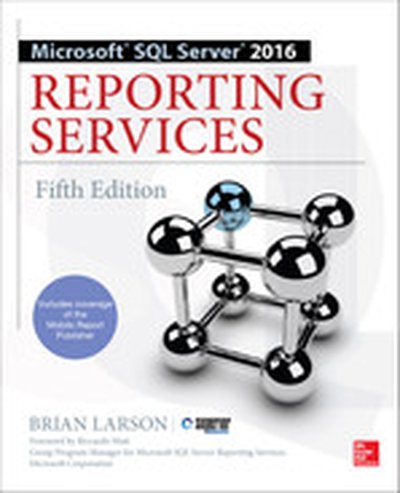
Microsoft SQL Server 2016 Reporting Services, Fifth Edition, 5th Edition

Up-to-Date Coverage of Microsoft® SQL Server® 2016 Reporting Services, Including the Mobile Report Publisher Build, publish, and maintain paginated and mobile reports using the expert tips and best practices contained in this hands-on guide. Written by a member of the original Reporting Services development team, Microsoft SQL Server 2016 Reporting Services, Fifth Edition, fully explains the process of creating and distributing reports and shows how to maximize all of the powerful, integrated SSRS capabilities, including the new and enhanced features. A detailed case study and sample reports are featured in this practical resource. • Plan for, install, configure, and customize SQL Server 2016 Reporting Services • Design and generate feature-rich reports using the Report Wizard • Work with Report Designer in Visual Studio, Report Builder, and the Mobile Report Publisher • Incorporate charts, images, gauges, and maps • Enhance your reports through summarizing, totaling, and interactivity • Build reusable report templates • Embed Visual Basic .NET functions and subreports • Enable end-user access via the Report Server and its web portal interface • Integrate SSRS reports with your own websites and custom applications • Follow along with sample reports from the book’s case study

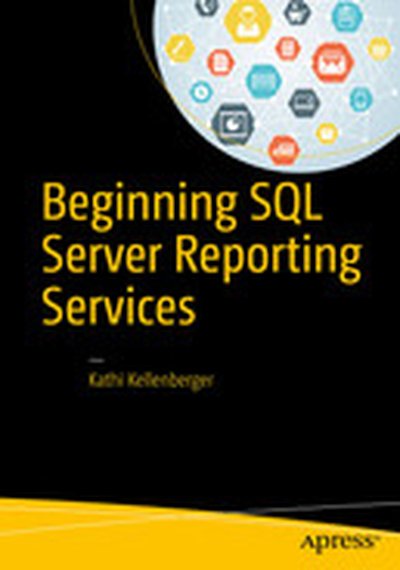
Beginning SQL Server Reporting Services

Learn SQL Server Reporting Services and become current with the 2016 edition. Develop interactive, dynamic reports that combine graphs, charts, and tabular data into attractive dashboards and reports to delight business analysts and other users of corporate data. Deliver mobile reports to anywhere and any device. Build vital knowledge of Reporting Services at a time when Microsoft's dominance in business intelligence is on the rise. turns novices into skilled report developers. The book begins by explaining how to set up the development environment. It then walks you through creating your first reports using the built-in wizard. After showing what is possible, the book breaks down and explains the skills needed to create reports from scratch. And not just reports! But also dashboards with charts, graphs, and maps. Each chapter builds on knowledge gained in the previous chapters with step-by-step tutorials. Beginning SQL Server Reporting Services boosts your skills and provides you additional career options. Don't be without those options. Grab and read this book today. Beginning SQL Server Reporting Services Build reports with and without the built-in wizard. Build interactive features such as drill-through reports. Build dashboards full of charts, graphs, and maps. Build mobile reports. What You Will Learn Set up your development environment. Organized projects and share components among reports. Create report using a wizard. Create reports from scratch, including grouping levels, parameters, and drill through features. Build interactive dashboard with graphs, charts, and maps. Deploy and manage reports for use by others in the business. Who This Book Is For Database professionals of all experience levels who have some experience in databases and want to make the leap into business intelligence reporting. The book is an excellent choice for those needing to add Reporting Services to their current list of skills, or who are looking for a skill set that is in demand for in order to break into IT.

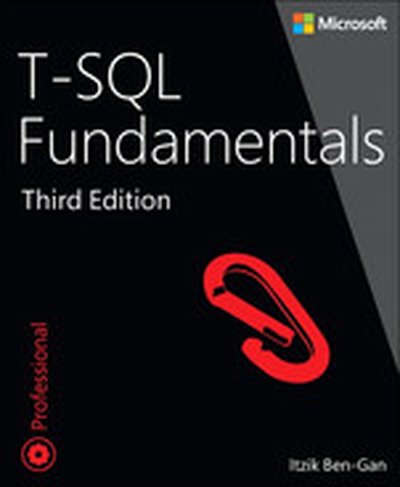
T-SQL Fundamentals, Third Edition

Effectively query and modify data using Transact-SQL Master T-SQL fundamentals and write robust code for Microsoft SQL Server and Azure SQL Database. Itzik Ben-Gan explains key T-SQL concepts and helps you apply your knowledge with hands-on exercises. The book first introduces T-SQL’s roots and underlying logic. Next, it walks you through core topics such as single-table queries, joins, subqueries, table expressions, and set operators. Then the book covers more-advanced data-query topics such as window functions, pivoting, and grouping sets. The book also explains how to modify data, work with temporal tables, and handle transactions, and provides an overview of programmable objects. Related Content Book: T-SQL Fundamentals, 4th Edition Microsoft Data Platform MVP Itzik Ben-Gan shows you how to: Review core SQL concepts and its mathematical roots Create tables and enforce data integrity Perform effective single-table queries by using the SELECT statement Query multiple tables by using joins, subqueries, table expressions, and set operators Use advanced query techniques such as window functions, pivoting, and grouping sets Insert, update, delete, and merge data Use transactions in a concurrent environment Get started with programmable objects–from variables and batches to user-defined functions, stored procedures, triggers, and dynamic SQL

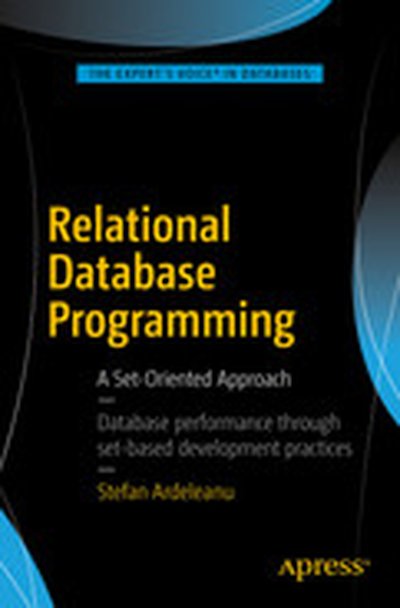
Relational Database Programming: A Set-Oriented Approach

Learn the best way of writing code to run inside a relational database. This book shows how a holistic and set-oriented approach to database programming can far exceed the performance of the row-by-row model that is too often used by developers who haven't been shown a better way. Two styles of programming are encountered in the database world. Classical programming as taught in many universities leads to an atomic, row-oriented, and procedural style inspired by the structured models of programming. In short, many application developers write in the relational database exactly like in the user interface. The other style of programming is holistic, data set oriented, and coded mainly in SQL. This is the style of the database developer. The set based and holistic style of development is not promoted enough in universities, and many application developers are not fully aware of it. There are many performance issues all over the world in relational databases due to the use of the atomic and inappropriate style of programming. This book compares the two styles, and promotes the holistic style of development as the most suitable one. Examples are given to demonstrate the superiority of a set-based and holistic approach. Compares the two styles of development Shows the performance advantages of set-based development Solves example problems using both approaches Who This Book Is For is aimed at application developers willing to adapt their programming styles in return for better-performing applications. It's for students and new developers wanting to position themselves as having database expertise and build a reputation for developing highly-performant database applications. Two Styles of Database Development

Introducing Microsoft SQL Server 2016: Mission-Critical Applications, Deeper Insights, Hyperscale Cloud

With Microsoft SQL Server 2016, a variety of new features and enhancements to the data platform deliver breakthrough performance, advanced security, and richer, integrated reporting and analytics capabilities. In this ebook, we introduce new security features: Always Encrypted, Row-Level Security, and dynamic data masking; discuss enhancements that enable you to better manage performance and storage: TemDB configuration, query store, and Stretch Database; review several improvements to Reporting Services; and also describe AlwaysOn Availability Groups, tabular enhancements, and R integration.

Dynamic SQL: Applications, Performance, and Security

This book is an introduction and deep-dive into the many uses of dynamic SQL in Microsoft SQL Server. Dynamic SQL is key to large-scale searching based upon user-entered criteria. It's also useful in generating value-lists, in dynamic pivoting of data for business intelligence reporting, and for customizing database objects and querying their structure. Executing dynamic SQL is at the heart of applications such as business intelligence dashboards that need to be fluid and respond instantly to changing user needs as those users explore their data and view the results. Yet dynamic SQL is feared by many due to concerns over SQL injection attacks. Reading Dynamic SQL: Applications, Performance, and Security is your opportunity to learn and master an often misunderstood feature, including security and SQL injection. All aspects of security relevant to dynamic SQL are discussed in this book. You will learn many ways to save time and develop code more efficiently, and you will practice directly with security scenarios that threaten companies around the world every day. Dynamic SQL: Applications, Performance, and Security helps you bring the productivity and user-satisfaction of flexible and responsive applications to your organization safely and securely. Your organization's increased ability to respond to rapidly changing business scenarios will build competitive advantage in an increasingly crowded and competitive global marketplace. Discusses many applications of dynamic SQL, both simple and complex. Explains each example with demos that can be run at home and on your laptop. Helps you to identify when dynamic SQL can offer superior performance. Pays attention to security and best practices to ensure safety of your data. What You Will Learn Build flexible applications that respond fast to changing business needs. Take advantage of unconventional but productive uses of dynamic SQL. Protect your data from attack through best-practices in your implementations. Know about SQL Injection and be confident in your defenses against it Run at high performance by optimizing dynamic SQL in your applications. Troubleshoot and debug dynamic SQL to ensure correct results. Who This Book is For Dynamic SQL: Applications, Performance, and Security is for developers and database administrators looking to hone and build their T-SQL coding skills. The book is ideal for advanced users wanting to plumb the depths of application flexibility and troubleshoot performance issues involving dynamic SQL. The book is also ideal for beginners wanting to learn what dynamic SQL is about and how it can help them deliver competitive advantage to their organizations.

External Procedures, Triggers, and User-Defined Functions on IBM DB2 for i

Procedures, triggers, and user-defined functions (UDFs) are the key database software features for developing robust and distributed applications. IBM Universal Database™ for i (IBM DB2® for i) supported these features for many years, and they were enhanced in V5R1, V5R2, and V5R3 of IBM® OS/400® and V5R4 of IBM i5/OS™. This IBM Redbooks® publication includes several of the announced features for procedures, triggers, and UDFs in V5R1, V5R2, V5R3, and V5R4. This book includes suggestions, guidelines, and practical examples to help you effectively develop IBM DB2 for i procedures, triggers, and UDFs. The following topics are covered in this book: External stored procedures and triggers Java procedures (both Java Database Connectivity (JDBC) and Structured Query Language for Java (SQLJ)) External triggers External UDFs This publication also offers examples that were developed in several programming languages, including RPG, COBOL, C, Java, and Visual Basic, by using native and SQL data access interfaces. This book is part of the original IBM Redbooks publication, Stored Procedures, Triggers, and User-Defined Functions on DB2 Universal Database for iSeries, SG24-6503-02, that covered external procedures, triggers, and functions, and also SQL procedures, triggers, and functions. All of the information that relates to external routines was left in this publication. All of the information that relates to SQL routines was rewritten and updated. This information is in the new IBM Redbooks publication, SQL Procedures, Triggers, and Functions on IBM DB2 for i, SG24-8326. This book is intended for anyone who wants to develop IBM DB2 for i procedures, triggers, and UDFs. Before you read this book, you need to know about relational database technology and the application development environment on the IBM i server.

SQL Procedures, Triggers, and Functions on IBM DB2 for i

Structured Query Language (SQL) procedures, triggers, and functions, which are also known as user-defined functions (UDFs), are the key database features for developing robust and distributed applications. IBM® DB2® for i supported these features for many years, and they are enhanced in IBM i versions 6.1, 7.1, and 7.2. DB2 for i refers to the IBM DB2 family member and relational database management system that is integrated within the IBM Power operating system that is known as IBM i. This IBM Redbooks® publication includes several of the announced features for SQL procedures, triggers, and functions in IBM i versions 6.1, 7.1, and 7.2. This book includes suggestions, guidelines, and practical examples to develop DB2 for i SQL procedures, triggers, and functions effectively. This book covers the following topics: Introduction to the SQL/Persistent Stored Modules (PSM) language, which is used in SQL procedures, triggers, and functions SQL procedures SQL triggers SQL functions This book is for IBM i database engineers and data-centric developers who strive to provide flexible, extensible, agile, and scalable database solutions that meet business requirements in a timely manner. Before you read this book, you need to know about relational database technology and the application development environment on the IBM Power Systems™ with the IBM i operating system.

Relational Database Design and Implementation, 4th Edition

Relational Database Design and Implementation: Clearly Explained, Fourth Edition, provides the conceptual and practical information necessary to develop a database design and management scheme that ensures data accuracy and user satisfaction while optimizing performance. Database systems underlie the large majority of business information systems. Most of those in use today are based on the relational data model, a way of representing data and data relationships using only two-dimensional tables. This book covers relational database theory as well as providing a solid introduction to SQL, the international standard for the relational database data manipulation language. The book begins by reviewing basic concepts of databases and database design, then turns to creating, populating, and retrieving data using SQL. Topics such as the relational data model, normalization, data entities, and Codd's Rules (and why they are important) are covered clearly and concisely. In addition, the book looks at the impact of big data on relational databases and the option of using NoSQL databases for that purpose. Features updated and expanded coverage of SQL and new material on big data, cloud computing, and object-relational databases Presents design approaches that ensure data accuracy and consistency and help boost performance Includes three case studies, each illustrating a different database design challenge Reviews the basic concepts of databases and database design, then turns to creating, populating, and retrieving data using SQL

MySQL for the Internet of Things

This book introduces the problems facing Internet of Things developers and explores current technologies and techniques to help you manage, mine, and make sense of the data being collected through the use of the world’s most popular database on the Internet - MySQL. The IoT is poised to change how we interact with and perceive the world around us, and the possibilities are nearly boundless. As more and more connected devices generate data, we will need to solve the problem of how to collect, store, and make sense of IoT data by leveraging the power of database systems. The book begins with an introduction of the MySQL database system and storage of sensor data. Detailed instructions and examples are provided to show how to add database nodes to IoT solutions including how to leverage MySQL high availability, including examples of how to protect data from node outages using advanced features of MySQL. The book closes with a comparison of raw and transformed data showing how transformed data can improve understandability and help you cut through a clutter of superfluous data toward the goal of mining nuggets of useful knowledge.

VersaStack Solution by Cisco and IBM with IBM DB2, IBM Spectrum Control, and IBM Spectrum Protect

Dynamic organizations want to accelerate growth while reducing costs. To do so, they must speed the deployment of business applications and adapt quickly to any changes in priorities. Organizations require an IT infrastructure to be easy, efficient, and versatile. The VersaStack solution by Cisco and IBM® can help you accelerate the deployment of your datacenters. It reduces costs by more efficiently managing information and resources while maintaining your ability to adapt to business change. The VersaStack solution combines the innovation of Cisco Unified Computing System (Cisco UCS) Integrated Infrastructure with the efficiency of the IBM Storwize® storage system. The Cisco UCS Integrated Infrastructure includes the Cisco UCS, Cisco Nexus and Cisco MDS switches, and Cisco UCS Director. The IBM Storwize V7000 storage system enhances virtual environments with its Data Virtualization, IBM Real-time Compression™, and IBM Easy Tier® features. These features deliver extraordinary levels of performance and efficiency. The VersaStack solution is Cisco Application Centric Infrastructure (ACI) ready. Your IT team can build, deploy, secure, and maintain applications through a more agile framework. Cisco Intercloud Fabric capabilities help enable the creation of open and highly secure solutions for the hybrid cloud. These solutions accelerate your IT transformation while delivering dramatic improvements in operational efficiency and simplicity. Cisco and IBM are global leaders in the IT industry. The VersaStack solution gives you the opportunity to take advantage of integrated infrastructure solutions that are targeted at enterprise applications, analytics, and cloud solutions. The VersaStack solution is backed by Cisco Validated Designs (CVDs) to provide faster delivery of applications, greater IT efficiency, and less risk. This IBM Redbooks® publication is aimed at experienced storage administrators that are tasked with deploying a VersaStack solution with IBM DB2® High Availability (DB2 HA), IBM Spectrum™ Protect, and IBM Spectrum Control™.

What Is Database Design, Anyway?

Since databases are at the center of the IT world, their proper design would seem to be paramount. And yet, some of the popular references on database design theory and design best practice show a curious lack of understanding by the IT industry at large. In this O’Reilly report, C.J. Date—a prominent researcher and consultant specializing in relational database theory—clarifies exactly what database design is, or ought to be. After providing concise definitions of physical and logical database design, Date dives deeper into the subject of logical design. Specifically, he covers concepts such as table predicate, business rule, uncontrolled redundancy, and consistency. Once you digest this report, you can find more detailed information in Date’s book Database Design and Relational Theory: Normal Forms and All That Jazz (O’Reilly, 2012). C.J. Date has a stature that is unique within the database industry. He is a prolific writer, and is well known for his best-selling textbook An Introduction to Database Systems (Addison Wesley).

Introducing SQLite for Mobile Developers

This brief book is a basic introduction to SQLite for iOS and Android developers. The book includes a simple introduction to SQL, a discussion of when to use SQLite, and chapters devoted to using SQLite with the most likely programming languages: Java, PHP, Swift and Objective-C. It then goes through adding simple database functionality to an Android or iOS app and finally a chapter on managing the app’s life cycle.