talk-data.com talk-data.com

Topic

SAS

statistical_software analytics data_management

245

tagged

Activity Trend

8 peak/qtr
2020-Q1 2026-Q1

Activities

Showing filtered results

Filtering by: O'Reilly Data Science Books ×
SAS Certification Prep Guide, 4th Edition
Businesses rely on career professionals with strong SAS knowledge and skills. Set yourself apart from the competition by earning the only globally recognized credential endorsed by SAS.

The SAS Certification Prep Guide: Advanced Programming for SAS 9, Fourth Edition, prepares you to take the Advanced Programming for SAS 9 exam. Major topics include SQL processing with SAS, the SAS macro language, advanced SAS programming techniques, and optimizing SAS programs, as well as a new chapter on creating functions with PROC FCMP. You will also become familiar with the enhancements and new functionality that are available in SAS 9.

New or experienced SAS users will find this guide to be an invaluable resource that covers the objectives tested on the exam. The text contains quizzes that enable you to test your understanding of material in each chapter. Quiz solutions are included at the end of the book. Candidates must earn the SAS Certified Base Programmer for SAS 9 Credential before taking the SAS Advanced Programming for SAS 9 exam.

You’ll find instructions on how to obtain sample data when accessing SAS through SAS Enterprise Guide, SAS Studio, SAS University Edition, and the SAS windowing environment. This edition provides significant improvements to numerous examples, making the code even more efficient.

Experience is a critical component to becoming a SAS Certified Professional. This comprehensive guide along with training in SAS SQL1, SAS Macro Language 1, and SAS Programming 3 are valuable resources designed to help you prepare for the Advanced SAS Certification exam.
Test Scoring and Analysis Using SAS

Develop your own multiple-choice tests, score students, produce student rosters (in print form or Excel), and explore item response theory (IRT).

Aimed at nonstatisticians working in education or training, Test Scoring and Analysis Using SAS describes item analysis and test reliability in easy-to-understand terms, and teaches you SAS programming to score tests, perform item analysis, and estimate reliability. Maximizing flexibility, the scoring and analysis programs enable you to analyze tests with multiple versions, define alternate correct responses for selected items, and repeat the scoring with selected items deleted.

You will be guided step-by-step on how to design multiple-choice items, use analysis to improve your tests, and even detect cheating on students’ submitted multiple-choice tests. Other subjects addressed include reading in data from a variety of sources (text files and Excel workbooks, for example), detecting errors in the input data, and producing class rosters in printed form or Excel workbooks. Also included is a chapter on IRT—widely used in education to calibrate and evaluate items in tests in education such as the SAT and GRE—with instructions for running the new SAS procedure PROC IRT.

This book is part of the SAS Press program.

The Essential Guide to SAS Dates and Times, Second Edition, 2nd Edition

Why does SAS use January 1, 1960 as its arbitrary reference date? How do you convert a value such as 27 January 2003 into a SAS date? How do you put a date into a filename, or label an Excel worksheet with the date?

You'll find the answers to these questions and much more in Derek Morgan's Essential Guide to SAS Dates and Times, Second Edition, which makes it easy to understand how to use and manipulate dates, times, and datetimes in SAS. Updated for SAS 9.4, with additional functions, formats, and capabilities, the Second Edition has a new chapter dedicated to the ISO 8601 standard and the formats and functions that are new to SAS, including how SAS works with Universal Coordinated Time (UTC).

Novice users will appreciate the new "Troubleshooting" appendix, which discusses questions common to newer SAS users in a conversational way and provides clear examples of simple solutions to these questions. Both novice and intermediate users will find the clear, task-based examples on how to accomplish date-related tasks and the detailed explanations of standard formats and functions invaluable. Users working with intervals will appreciate the expanded discussion of the topic, which details the new custom interval capability, among other enhancements to intervals.

Users working with international dates and times will benefit from the detailed discussion of the NLS facility as it relates to dates and times. Included are bonus "Quick Reference Guides" that list both the standard date and time formats and the NLS date and time formats with examples. These guides illustrate how each format displays the same date, time, or datetime, so you can find the format you want to use at a glance.

The Essential Guide to SAS Dates and Times, Second Edition is the most complete and up-to-date collection of examples on how to write complex programs involving dates, times, or datetime values.

This book is part of the SAS Press Program.

Statistical Graphics Procedures by Example

Sanjay Matange and Dan Heath's Statistical Graphics Procedures by Example: Effective Graphs Using SAS shows the innumerable capabilities of SAS Statistical Graphics (SG) procedures. The authors begin with a general discussion of the principles of effective graphics, ODS Graphics, and the SG procedures. They then move on to show examples of the procedures' many features. The book is designed so that you can easily flip through it, find the graph you need, and view the code right next to the example. Among the topics included are how to combine plot statements to create custom graphs; customizing graph axes, legends, and insets; advanced features, such as annotation and attribute maps; tips and tricks for creating the optimal graph for the intended usage; real-world examples from the health and life sciences domain; and ODS styles. The procedures in Statistical Graphics Procedures by Example are specifically designed for the creation of analytical graphs. That makes this book a must-read for analysts and statisticians in the health care, clinical trials, financial, and insurance industries. However, you will find that the examples here apply to all fields. This book is part of the SAS Press program.

Text Mining and Analysis

Big data: It's unstructured, it's coming at you fast, and there's lots of it. In fact, the majority of big data is text-oriented, thanks to the proliferation of online sources such as blogs, emails, and social media.

However, having big data means little if you can't leverage it with analytics. Now you can explore the large volumes of unstructured text data that your organization has collected with Text Mining and Analysis: Practical Methods, Examples, and Case Studies Using SAS.

This hands-on guide to text analytics using SAS provides detailed, step-by-step instructions and explanations on how to mine your text data for valuable insight. Through its comprehensive approach, you'll learn not just how to analyze your data, but how to collect, cleanse, organize, categorize, explore, and interpret it as well. Text Mining and Analysis also features an extensive set of case studies, so you can see examples of how the applications work with real-world data from a variety of industries.

Text analytics enables you to gain insights about your customers' behaviors and sentiments. Leverage your organization's text data, and use those insights for making better business decisions with Text Mining and Analysis.

This book is part of the SAS Press program.

Introduction to Mixed Modelling: Beyond Regression and Analysis of Variance, 2nd Edition

Mixed modelling is very useful, and easier than you think! Mixed modelling is now well established as a powerful approach to statistical data analysis. It is based on the recognition of random-effect terms in statistical models, leading to inferences and estimates that have much wider applicability and are more realistic than those otherwise obtained. Introduction to Mixed Modelling leads the reader into mixed modelling as a natural extension of two more familiar methods, regression analysis and analysis of variance. It provides practical guidance combined with a clear explanation of the underlying concepts. Like the first edition, this new edition shows diverse applications of mixed models, provides guidance on the identification of random-effect terms, and explains how to obtain and interpret best linear unbiased predictors (BLUPs). It also introduces several important new topics, including the following: Use of the software SAS, in addition to GenStat and R. Meta-analysis and the multiple testing problem. The Bayesian interpretation of mixed models. Including numerous practical exercises with solutions, this book provides an ideal introduction to mixed modelling for final year undergraduate students, postgraduate students and professional researchers. It will appeal to readers from a wide range of scientific disciplines including statistics, biology, bioinformatics, medicine, agriculture, engineering, economics, archaeology and geography. Praise for the first edition: "One of the main strengths of the text is the bridge it provides between traditional analysis of variance and regression models and the more recently developed class of mixed models...Each chapter is well-motivated by at least one carefully chosen example...demonstrating the broad applicability of mixed models in many different disciplines...most readers will likely learn something new, and those previously unfamiliar with mixed models will obtain a solid foundation on this topic."— Kerrie Nelson University of South Carolina, in American Statistician, 2007

Design and Analysis of Experiments by Douglas Montgomery: A Supplement for Using JMP

With a growing number of scientists and engineers using JMP software for design of experiments, there is a need for an example-driven book that supports the most widely used textbook on the subject, Design and Analysis of Experiments by Douglas C. Montgomery. Design and Analysis of Experiments by Douglas Montgomery: A Supplement for Using JMP meets this need and demonstrates all of the examples from the Montgomery text using JMP. In addition to scientists and engineers, undergraduate and graduate students will benefit greatly from this book.
While users need to learn the theory, they also need to learn how to implement this theory efficiently on their academic projects and industry problems. In this first book of its kind using JMP software, Rushing, Karl and Wisnowski demonstrate how to design and analyze experiments for improving the quality, efficiency, and performance of working systems using JMP. Topics include JMP software, two-sample t-test, ANOVA, regression, design of experiments, blocking, factorial designs, fractional-factorial designs, central composite designs, Box-Behnken designs, split-plot designs, optimal designs, mixture designs, and 2 k factorial designs. JMP platforms used include Custom Design, Screening Design, Response Surface Design, Mixture Design, Distribution, Fit Y by X, Matched Pairs, Fit Model, and Profiler.
With JMP software, Montgomery’s textbook, and Design and Analysis of Experiments by Douglas Montgomery: A Supplement for Using JMP, users will be able to fit the design to the problem, instead of fitting the problem to the design. This book is part of the SAS Press program.

Fixed Effects Regression Methods for Longitudinal Data Using SAS

Fixed Effects Regression Methods for Longitudinal Data Using SAS, written by Paul Allison, is an invaluable resource for all researchers interested in adding fixed effects regression methods to their tool kit of statistical techniques. First introduced by economists, fixed effects methods are gaining widespread use throughout the social sciences. Designed to eliminate major biases from regression models with multiple observations (usually longitudinal) for each subject (usually a person), fixed effects methods essentially offer control for all stable characteristics of the subjects, even characteristics that are difficult or impossible to measure. This straightforward and thorough text shows you how to estimate fixed effects models with several SAS procedures that are appropriate for different kinds of outcome variables. The theoretical background of each model is explained, and the models are then illustrated with detailed examples using real data. The book contains thorough discussions of the following uses of SAS procedures: PROC GLM for estimating fixed effects linear models for quantitative outcomes, PROC LOGISTIC for estimating fixed effects logistic regression models, PROC PHREG for estimating fixed effects Cox regression models for repeated event data, PROC GENMOD for estimating fixed effects Poisson regression models for count data, and PROC CALIS for estimating fixed effects structural equation models. To gain the most benefit from this book, readers should be familiar with multiple linear regression, have practical experience using multiple regression on real data, and be comfortable interpreting the output from a regression analysis. An understanding of logistic regression and Poisson regression is a plus. Some experience with SAS is helpful, but not required. This book is part of the SAS Press program.

Analysis of Observational Health Care Data Using SAS

This book guides researchers in performing and presenting high-quality analyses of all kinds of non-randomized studies, including analyses of observational studies, claims database analyses, assessment of registry data, survey data, pharmaco-economic data, and many more applications. The text is sufficiently detailed to provide not only general guidance, but to help the researcher through all of the standard issues that arise in such analyses. Just enough theory is included to allow the reader to understand the pros and cons of alternative approaches and when to use each method. The numerous contributors to this book illustrate, via real-world numerical examples and SAS code, appropriate implementations of alternative methods. The end result is that researchers will learn how to present high-quality and transparent analyses that will lead to fair and objective decisions from observational data.

This book is part of the SAS Press program.

Business Analytics Principles, Concepts, and Applications with SAS: What, Why, and How

Learn everything you need to know to start using business analytics and integrating it throughout your organization. brings together a complete, integrated package of knowledge for newcomers to the subject. The authors present an up-to-date view of what business analytics is, why it is so valuable, and most importantly, how it is used. They combine essential conceptual content with clear explanations of the tools, techniques, and methodologies actually used to implement modern business analytics initiatives. Business Analytics Principles, Concepts, and Applications with SAS They offer a proven step-wise approach to designing an analytics program, and successfully integrating it into your organization, so it effectively provides intelligence for competitive advantage in decision making. Using step-by-step examples, the authors identify common challenges that can be addressed by business analytics, illustrate each type of analytics (descriptive, prescriptive, and predictive), and guide users in undertaking their own projects. Illustrating the real-world use of statistical, information systems, and management science methodologies, these examples help readers successfully apply the methods they are learning. Unlike most competitive guides, this text demonstrates the use of SAS software, permitting instructors to spend less time teaching software and more time focusing on business analytics itself. will be a valuable resource for all beginning-to-intermediate level business analysts and business analytics managers; for MBA/Masters' degree students in the field; and for advanced undergraduates majoring in statistics, applied mathematics, or engineering/operations research. Business Analytics Principles, Concepts, and Applications with SAS

Business Analytics Using SAS Enterprise Guide and SAS Enterprise Miner

This tutorial for data analysts new to SAS Enterprise Guide and SAS Enterprise Miner provides valuable experience using powerful statistical software to complete the kinds of business analytics common to most industries.

Today’s businesses increasingly use data to drive decisions that keep them competitive. Especially with the influx of big data, the importance of data analysis to improve every dimension of business cannot be overstated. Data analysts are therefore in demand; however, many hires and prospective hires, although talented with respect to business and statistics, lack the know-how to perform business analytics with advanced statistical software.

Business Analytics Using SAS Enterprise Guide and SAS Enterprise Miner is a beginner’s guide with clear, illustrated, step-by-step instructions that will lead you through examples based on business case studies. You will formulate the business objective, manage the data, and perform analyses that you can use to optimize marketing, risk, and customer relationship management, as well as business processes and human resources. Topics include descriptive analysis, predictive modeling and analytics, customer segmentation, market analysis, share-of-wallet analysis, penetration analysis, and business intelligence.

This book is part of the SAS Press program.

SAS 9.4 Graph Template Language, 3rd Edition

Provides usage information and examples for the Graph Template Language (GTL). The GTL is the underlying language for the default templates that are provided by SAS for procedures that use ODS Graphics. You can use the GTL either to modify these templates or to create your own highly customized charts and plots. Information covered includes how to combine language elements to build a custom graph, creating panels that contain multiple graphs, managing plot axes, using legends, modifying style elements to control appearance characteristics, and using functions, expressions, and conditional processing.

Big Data Analytics Strategies for the Smart Grid

By implementing a comprehensive data analytics program, utility companies can meet the continually evolving challenges of modern grids that are operationally efficient, while reconciling the demands of greenhouse gas legislation and establishing a meaningful return on investment from smart grid deployments. Readable and accessible, Big Data Analytics Strategies for the Smart Grid addresses the needs of applying big data technologies and approaches, including Big Data cybersecurity, to the critical infrastructure that makes up the electrical utility grid. It supplies industry stakeholders with an in-depth understanding of the engineering, business, and customer domains within the power delivery market. The book explores the unique needs of electrical utility grids, including operational technology, IT, storage, processing, and how to transform grid assets for the benefit of both the utility business and energy consumers. It not only provides specific examples that illustrate how analytics work and how they are best applied, but also describes how to avoid potential problems and pitfalls. Discussing security and data privacy, it explores the role of the utility in protecting their customers’ right to privacy while still engaging in forward-looking business practices. The book includes discussions of: SAS for asset management tools The AutoGrid approach to commercial analytics Space-Time Insight’s work at the California ISO (CAISO) This book is an ideal resource for mid- to upper-level utility executives who need to understand the business value of smart grid data analytics. It explains critical concepts in a manner that will better position executives to make the right decisions about building their analytics programs. At the same time, the book provides sufficient technical depth that it is useful for data analytics professionals who need to better understand the nuances of the engineering and business challenges unique to the utilities industry.

Big Data, Big Innovation: Enabling Competitive Differentiation through Business Analytics

A practical guide to leveraging your data to spur innovation and growth Your business generates reams of data, but what do you do with it? Reporting is only the beginning. Your data holds the key to innovation and growth - you just need the proper analytics. In Big Data, Big Innovation: Enabling Competitive Differentiation Through Business Analytics, author Evan Stubbs explores the potential gold hiding in your un-mined data. As Chief Analytics Officer for SAS Australia/New Zealand, Stubbs brings an industry insider's perspective to guide you through pattern recognition, analysis, and implementation. Big Data, Big Innovation: Enabling Competitive Differentiation Through Business Analytics details a groundbreaking approach to ensuring your company's upward trajectory. Use this guide to leverage your customer information, financial reports, performance metrics, and more to build a rock-solid foundation for future growth. Build an effective analytics team, and empower them with the right tools Learn how big data drives both evolutionary and revolutionary innovation, and who should be responsible Identify data collection and analysis opportunities and implement action plans Design the platform that suits your company's current and future needs Quantify performance with statistics, programming, and research for a more complete picture of operations Effective management means combining data, people, and analytics to create a synergistic force for innovation and growth. If you want your company to move forward with confidence, Big Data, Big Innovation: Enabling Competitive Differentiation Through Business Analytics can show you how to use what you already have and acquire what you need to succeed.

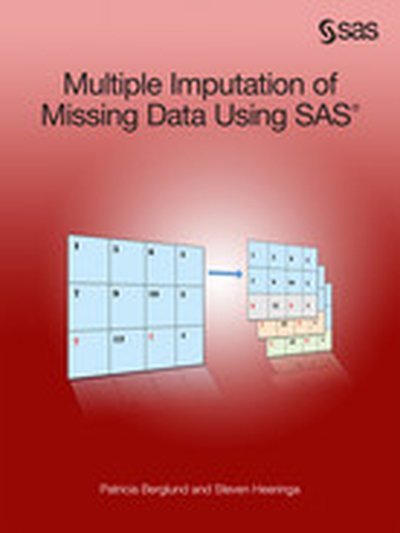
Multiple Imputation of Missing Data Using SAS

Find guidance on using SAS for multiple imputation and solving common missing data issues.

Multiple Imputation of Missing Data Using SAS provides both theoretical background and constructive solutions for those working with incomplete data sets in an engaging example-driven format. It offers practical instruction on the use of SAS for multiple imputation and provides numerous examples that use a variety of public release data sets with applications to survey data.

Written for users with an intermediate background in SAS programming and statistics, this book is an excellent resource for anyone seeking guidance on multiple imputation. The authors cover the MI and MIANALYZE procedures in detail, along with other procedures used for analysis of complete data sets. They guide analysts through the multiple imputation process, including evaluation of missing data patterns, choice of an imputation method, execution of the process, and interpretation of results.

Topics discussed include how to deal with missing data problems in a statistically appropriate manner, how to intelligently select an imputation method, how to incorporate the uncertainty introduced by the imputation process, and how to incorporate the complex sample design (if appropriate) through use of the SAS SURVEY procedures.

Discover the theoretical background and see extensive applications of the multiple imputation process in action.

This book is part of the SAS Press program.