talk-data.com talk-data.com

Topic

statistics

512

tagged

Activity Trend

1 peak/qtr
2020-Q1 2026-Q1

Activities

512 activities · Newest first

Elementary Statistics Using SAS

Bridging the gap between statistics texts and SAS documentation, Elementary Statistics Using SAS is written for those who want to perform analyses to solve problems. The first section of the book explains the basics of SAS data sets and shows how to use SAS for descriptive statistics and graphs. The second section discusses fundamental statistical concepts, including normality and hypothesis testing. The remaining sections of the book show analyses for comparing two groups, comparing multiple groups, fitting regression equations, and exploring contingency tables. For each analysis, author Sandra Schlotzhauer explains assumptions, statistical approach, and SAS methods and syntax, and makes conclusions from the results. Statistical methods covered include two-sample t-tests, paired-difference t-tests, analysis of variance, multiple comparison techniques, regression, regression diagnostics, and chi-square tests. Elementary Statistics Using SAS is a thoroughly revised and updated edition of Ramon Littell and Sandra Schlotzhauer's SAS System for Elementary Statistical Analysis. This book is part of the SAS Press program.
Beyond Basic Statistics: Tips, Tricks, and Techniques Every Data Analyst Should Know

Features basic statistical concepts as a tool for thinking critically, wading through large quantities of information, and answering practical, everyday questions Written in an engaging and inviting manner, Beyond Basic Statistics: Tips, Tricks, and Techniques Every Data Analyst Should Know presents the more subjective side of statistics—the art of data analytics. Each chapter explores a different question using fun, common sense examples that illustrate the concepts, methods, and applications of statistical techniques. Without going into the specifics of theorems, propositions, or formulas, the book effectively demonstrates statistics as a useful problem-solving tool. In addition, the author demonstrates how statistics is a tool for thinking critically, wading through large volumes of information, and answering life's important questions. Beyond Basic Statistics: Tips, Tricks, and Techniques Every Data Analyst Should Know also features: Plentiful examples throughout aimed to strengthen readers' understanding of the statistical concepts and methods A step-by-step approach to elementary statistical topics such as sampling, hypothesis tests, outlier detection, normality tests, robust statistics, and multiple regression A case study in each chapter that illustrates the use of the presented techniques Highlights of well-known shortcomings that can lead to false conclusions An introduction to advanced techniques such as validation and bootstrapping Featuring examples that are engaging and non-application specific, the book appeals to a broad audience of students and professionals alike, specifically students of undergraduate statistics, managers, medical professionals, and anyone who has to make decisions based on raw data or compiled results.

Statistical Programming in SAS

In Statistical Programming in SAS, author A. John Bailer integrates SAS tools with interesting statistical applications and uses SAS 9.2 as a platform to introduce programming ideas for statistical analysis, data management, and data display and simulation. Written using a reader-friendly and narrative style, the book includes extensive examples and case studies to present a well-structured introduction to programming issues.

Probability and Statistics
This book is designed for engineering students studying for the core paper on probability and statistics. The topics have been dealt in a coherent manner, supported by illustrations for better compre¬hension. Each chapter is replete with examples and exercises. The book also has numerous Multiple Choice Questions at the end of each chapter, thus providing the student with an abundant repository of exam specific problems.
Seeing the Future

This book guides you through an enjoyable journey, step by step, into the future. A team of fictional characters is introduced to share their learning and working experiences with the readers. In the beginning of the book, you will take the first step by learning the most basic models for one-period forecasts based on past performance of a market. You will also learn how to evaluate your newly built models. Next, you will progress further into intermediate-level models, including multi-period forecasts based on past performance of a market or based on an external factor. It also introduces interval forecasting, which allows you to obtain a range of forecast values instead of a single value in the future. In the second half, you will familiarize yourself with advanced models that provide multi-period forecasts based on multiple internal or external factors. Toward the end, you will learn several applied models in business and economics that will facilitate you with practical applications related to real life situations. The  last chapter summarizes all models introduced in this book and provides a table of references for finding the most important concepts, tables, and figures in the book so that you can recall every step of your adventure.

Bayesian Inference for Partially Identified Models

This book shows how the Bayesian approach to inference is applicable to partially identified models (PIMs) and examines the performance of Bayesian procedures in partially identified contexts. Drawing on his many years of research in this area, the author presents a thorough overview of the statistical theory, properties, and applications of PIMs. He covers a range of PIMs, including models for misclassified data and models involving instrumental variables. He also includes real data applications of PIMs that have recently appeared in the literature.

Financial Forecasting, Analysis and Modelling: A Framework for Long-Term Forecasting

Risk analysis has become critical to modern financial planning Financial Forecasting, Analysis and Modelling provides a complete framework of long-term financial forecasts in a practical and accessible way, helping finance professionals include uncertainty in their planning and budgeting process. With thorough coverage of financial statement simulation models and clear, concise implementation instruction, this book guides readers step-by-step through the entire projection plan development process. Readers learn the tools, techniques, and special considerations that increase accuracy and smooth the workflow, and develop a more robust analysis process that improves financial strategy. The companion website provides a complete operational model that can be customised to develop financial projections or a range of other key financial measures, giving readers an immediately-applicable tool to facilitate effective decision-making. In the aftermath of the recent financial crisis, the need for experienced financial modelling professionals has steadily increased as organisations rush to adjust to economic volatility and uncertainty. This book provides the deeper level of understanding needed to develop stronger financial planning, with techniques tailored to real-life situations. Develop long-term projection plans using Excel Use appropriate models to develop a more proactive strategy Apply risk and uncertainty projections more accurately Master the Excel Scenario Manager, Sensitivity Analysis, Monte Carlo Simulation, and more Risk plays a larger role in financial planning than ever before, and possible outcomes must be measured before decisions are made. Uncertainty has become a critical component in financial planning, and accuracy demands it be used appropriately. With special focus on uncertainty in modelling and planning, Financial Forecasting, Analysis and Modelling is a comprehensive guide to the mechanics of modern finance.

Probabilities: The Little Numbers That Rule Our Lives, 2nd Edition

Praise for the First Edition "If there is anything you want to know, or remind yourself, about probabilities, then look no further than this comprehensive, yet wittily written and enjoyable, compendium of how to apply probability calculations in real-world situations." - Keith Devlin, Stanford University, National Public Radio's "Math Guy" and author of The Math Gene and The Unfinished Game From probable improbabilities to regular irregularities, Probabilities: The Little Numbers That Rule Our Lives, Second Edition investigates the often surprising effects of risk and chance in our lives. Featuring a timely update, the Second Edition continues to be the go-to guidebook for an entertaining presentation on the mathematics of chance and uncertainty. The new edition develops the fundamental mathematics of probability in a unique, clear, and informal way so readers with various levels of experience with probability can understand the little numbers found in everyday life. Illustrating the concepts of probability through relevant and engaging real-world applications, the Second Edition features numerous examples on weather forecasts, DNA evidence, games and gambling, and medical testing. The revised edition also includes: The application of probability in finance, such as option pricing The introduction of branching processes and the extinction of family names An extended discussion on opinion polls and Nate Silver's election predictions Probabilities: The Little Numbers That Rule Our Lives, Second Edition is an ideal reference for anyone who would like to obtain a better understanding of the mathematics of chance, as well as a useful supplementary textbook for students in any course dealing with probability.

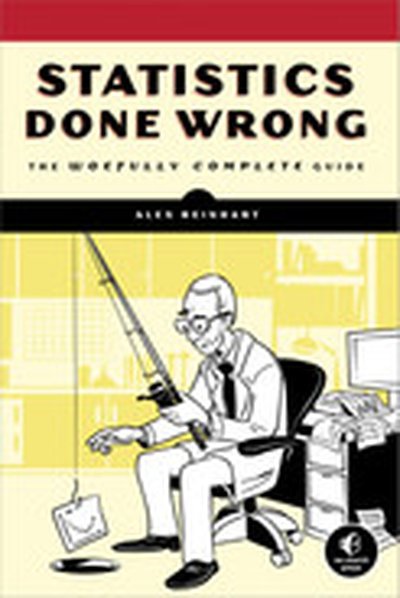
Statistics Done Wrong

Scientific progress depends on good research, and good research needs good statistics. But statistical analysis is tricky to get right, even for the best and brightest of us. You'd be surprised how many scientists are doing it wrong. Statistics Done Wrong is a pithy, essential guide to statistical blunders in modern science that will show you how to keep your research blunder-free. You'll examine embarrassing errors and omissions in recent research, learn about the misconceptions and scientific politics that allow these mistakes to happen, and begin your quest to reform the way you and your peers do statistics. You'll find advice on: Asking the right question, designing the right experiment, choosing the right statistical analysis, and sticking to the plan How to think about p values, significance, insignificance, confidence intervals, and regression Choosing the right sample size and avoiding false positives Reporting your analysis and publishing your data and source code Procedures to follow, precautions to take, and analytical software that can help Scientists: Read this concise, powerful guide to help you produce statistically sound research. Statisticians: Give this book to everyone you know. The first step toward statistics done right is Statistics Done Wrong.

American-Type Options

The book gives a systematical presentation of stochastic approximation methods for discrete time Markov price processes. Advanced methods combining backward recurrence algorithms for computing of option rewards and general results on convergence of stochastic space skeleton and tree approximations for option rewards are applied to a variety of models of multivariate modulated Markov price processes. The principal novelty of presented results is based on consideration of multivariate modulated Markov price processes and general pay-off functions, which can depend not only on price but also an additional stochastic modulating index component, and use of minimal conditions of smoothness for transition probabilities and pay-off functions, compactness conditions for log-price processes and rate of growth conditions for pay-off functions. The volume presents results on structural studies of optimal stopping domains, Monte Carlo based approximation reward algorithms, and convergence of American-type options for autoregressive and continuous time models, as well as results of the corresponding experimental studies.

Semi-Markov Models

Featuring previously unpublished results, Semi-Markov Models: Control of Restorable Systems with Latent Failures describes valuable methodology which can be used by readers to build mathematical models of a wide class of systems for various applications. In particular, this information can be applied to build models of reliability, queuing systems, and technical control. Beginning with a brief introduction to the area, the book covers semi-Markov models for different control strategies in one-component systems, defining their stationary characteristics of reliability and efficiency, and utilizing the method of asymptotic phase enlargement developed by V.S. Korolyuk and A.F. Turbin. The work then explores semi-Markov models of latent failures control in two-component systems. Building on these results, solutions are provided for the problems of optimal periodicity of control execution. Finally, the book presents a comparative analysis of analytical and imitational modeling of some one- and two-component systems, before discussing practical applications of the results Reflects the possibility and effectiveness of this method of modeling systems, such as phase merging algorithms developed by V.S. Korolyuk, A.F. Turbin, A.V. Swishchuk, little covered elsewhere Focuses on possible applications to engineering control systems

Bit-Interleaved Coded Modulation: Fundamentals, Analysis and Design

Presenting a thorough overview of bit-interleaved coded modulation (BICM), this book introduces the tools for the analysis and design of BICM transceivers. It explains in details the functioning principles of BICM and proposes a refined probabilistic modeling of the reliability metrics-the so-called L-values-which are at the core of the BICM receivers. Alternatives for transceiver design based on these models are then studied. Providing new insights into the analysis of BICM, this book is unique in its approach, providing a general framework for analysis and design, focusing on communication theoretic aspects of BICM transceivers. It adopts a tutorial approach, explains the problems in simple terms with the aid of multiple examples and case studies, and provides solutions using accessible mathematical tools. The book will be an excellent resource for researchers in academia and industry: graduate students, academics, development engineers, and R & D managers. Key Features: Presents an introduction to BICM, placing it in the context of other coded modulation schemes Offers explanations of the functioning principles and design alternatives Provides a unique approach, focusing on communication theory aspects Shows examples and case studies to illustrate analysis and design of BICM Adopts a tutorial approach, explaining the problems in simple terms and presenting solutions using accessible mathematical tools

Business Applications of Multiple Regression, Second Edition

This second edition of Business Applications of Multiple Regression describes the use of the statistical procedure called multiple regression in business situations, including forecasting and understanding the relationships between variables. The book assumes a basic understanding of statistics but reviews correlation analysis and simple regression to prepare the reader to understand and use multiple regression. The techniques described in the book are illustrated using both Microsoft Excel and a professional statistical program. Along the way, several real-world data sets are analyzed in detail to better prepare the reader for working with actual data in a business environment. This book will be a useful guide to managers at all levels who need to understand and make decisions based on data analysis performed using multiple regression. It also provides the beginning analyst with the detailed understanding required to use multiple regression to analyze data sets.

Inside the Crystal Ball: How to Make and Use Forecasts

A practical guide to understanding economic forecasts In Inside the Crystal Ball: How to Make and Use Forecasts, UBS Chief U.S. Economist Maury Harris helps readers improve their own forecasting abilities by examining the elements and processes that characterize successful and failed forecasts. The book: , named among Bloomberg's 50 Most Influential People in Global Finance. Provides insights from Maury Harris Harris walks readers through the real-life steps he and other successful forecasters take in preparing their projections. These valuable procedures can help forecast users evaluate forecasts and forecasters as inputs for making their own specific business and investment decisions. Demonstrates "best practices" in the assembly and evaluation of forecasts. . Harris explores the prerequisites for sound forecasting judgment—a good sense of history and an understanding of contemporary theoretical frameworks—in readable and illuminating detail. Emphasizes the critical role of judgment in improving projections derived from purely statistical methodologies Harris also offers procedural guidelines for special circumstances, such as natural disasters, terrorist threats, gyrating oil and stock prices, and international economic crises. Addresses everyday forecasting issues, including the credibility of government statistics and analyses, fickle consumers, and volatile business spirits. —including the now commonplace hypothesis of sustained economic sluggishness, possible inflation outcomes in an environment of falling unemployment, and projecting interest rates when central banks implement unprecedented low interest rate and quantitative easing (QE) policies. Evaluates major contemporary forecasting issues and those of other leading economists in his almost four-decade career as a professional economist and forecaster. Dr. Harris presents his personal recipes for long-term credibility and commercial success to anyone offering advice about the future. Brings to life Harris's own experiences

Introductory Statistics and Analytics: A Resampling Perspective

Concise, thoroughly class-tested primer that features basic statistical concepts in the concepts in the context of analytics, resampling, and the bootstrap A uniquely developed presentation of key statistical topics, Introductory Statistics and Analytics: A Resampling Perspective provides an accessible approach to statistical analytics, resampling, and the bootstrap for readers with various levels of exposure to basic probability and statistics. Originally class-tested at one of the first online learning companies in the discipline, www.statistics.com, the book primarily focuses on applications of statistical concepts developed via resampling, with a background discussion of mathematical theory. This feature stresses statistical literacy and understanding, which demonstrates the fundamental basis for statistical inference and demystifies traditional formulas. The book begins with illustrations that have the essential statistical topics interwoven throughout before moving on to demonstrate the proper design of studies. Meeting all of the Guidelines for Assessment and Instruction in Statistics Education (GAISE) requirements for an introductory statistics course, Introductory Statistics and Analytics: A Resampling Perspective also includes: Over 300 "Try It Yourself" exercises and intermittent practice questions, which challenge readers at multiple levels to investigate and explore key statistical concepts Numerous interactive links designed to provide solutions to exercises and further information on crucial concepts Linkages that connect statistics to the rapidly growing field of data science Multiple discussions of various software systems, such as Microsoft Office Excel®, StatCrunch, and R, to develop and analyze data Areas of concern and/or contrasting points-of-view indicated through the use of "Caution" icons Introductory Statistics and Analytics: A Resampling Perspective is an excellent primary textbook for courses in preliminary statistics as well as a supplement for courses in upper-level statistics and related fields, such as biostatistics and econometrics. The book is also a general reference for readers interested in revisiting the value of statistics.

Principles of System Identification

Master Techniques and Successfully Build Models Using a Single Resource Vital to all data-driven or measurement-based process operations, system identification is an interface that is based on observational science, and centers on developing mathematical models from observed data. Principles of System Identification: Theory and Practice is an introductory-level book that presents the basic foundations and underlying methods relevant to system identification. The overall scope of the book focuses on system identification with an emphasis on practice, and concentrates most specifically on discrete-time linear system identification. Useful for Both Theory and Practice The book presents the foundational pillars of identification, namely, the theory of discrete-time LTI systems, the basics of signal processing, the theory of random processes, and estimation theory. It explains the core theoretical concepts of building (linear) dynamic models from experimental data, as well as the experimental and practical aspects of identification. The author offers glimpses of modern developments in this area, and provides numerical and simulation-based examples, case studies, end-of-chapter problems, and other ample references to code for illustration and training. Comprising 26 chapters, and ideal for coursework and self-study, this extensive text: Provides the essential concepts of identification Lays down the foundations of mathematical descriptions of systems, random processes, and estimation in the context of identification Discusses the theory pertaining to non-parametric and parametric models for deterministic-plus-stochastic LTI systems in detail Demonstrates the concepts and methods of identification on different case-studies Presents a gradual development of state-space identification and grey-box modeling Offers an overview of advanced topics of identification namely the linear time-varying (LTV), non-linear, and closed-loop identification Discusses a multivariable approach to identification using the iterative principal component analysis Embeds MATLAB® codes for illustrated examples in the text at the respective points presents a formal base in LTI deterministic and stochastic systems modeling and estimation theory; it is a one-stop reference for introductory to moderately advanced courses on system identification, as well as introductory courses on stochastic signal processing or time-series analysis.The MATLAB scripts and SIMULINK models used as examples and case studies in the book are also available on the author's website: http://arunkt.wix.com/homepage#!textbook/c397 Principles of System Identification: Theory and Practice

Introduction to High-Dimensional Statistics

Ever-greater computing technologies have given rise to an exponentially growing volume of data. Today massive data sets (with potentially thousands of variables) play an important role in almost every branch of modern human activity, including networks, finance, and genetics. However, analyzing such data has presented a challenge for statisticians and data analysts and has required the development of new statistical methods capable of separating the signal from the noise. Introduction to High-Dimensional Statistics is a concise guide to state-of-the-art models, techniques, and approaches for handling high-dimensional data. The book is intended to expose the reader to the key concepts and ideas in the most simple settings possible while avoiding unnecessary technicalities. Offering a succinct presentation of the mathematical foundations of high-dimensional statistics, this highly accessible text: Describes the challenges related to the analysis of high-dimensional data Covers cutting-edge statistical methods including model selection, sparsity and the lasso, aggregation, and learning theory Provides detailed exercises at the end of every chapter with collaborative solutions on a wikisite Illustrates concepts with simple but clear practical examples Introduction to High-Dimensional Statistics is suitable for graduate students and researchers interested in discovering modern statistics for massive data. It can be used as a graduate text or for self-study.

Statistical Computing in Nuclear Imaging

Statistical Computing in Nuclear Imaging introduces aspects of Bayesian computing in nuclear imaging. The book provides an introduction to Bayesian statistics and concepts and is highly focused on the computational aspects of Bayesian data analysis of photon-limited data acquired in tomographic measurements. Basic statistical concepts, elements of decision theory, and counting statistics, including models of photon-limited data and Poisson approximations, are discussed in the first chapters. Monte Carlo methods and Markov chains in posterior analysis are discussed next along with an introduction to nuclear imaging and applications such as PET and SPECT. The final chapter includes illustrative examples of statistical computing, based on Poisson-multinomial statistics. Examples include calculation of Bayes factors and risks as well as Bayesian decision making and hypothesis testing. Appendices cover probability distributions, elements of set theory, multinomial distribution of single-voxel imaging, and derivations of sampling distribution ratios. C++ code used in the final chapter is also provided. The text can be used as a textbook that provides an introduction to Bayesian statistics and advanced computing in medical imaging for physicists, mathematicians, engineers, and computer scientists. It is also a valuable resource for a wide spectrum of practitioners of nuclear imaging data analysis, including seasoned scientists and researchers who have not been exposed to Bayesian paradigms.

Sample Size Calculations for Clustered and Longitudinal Outcomes in Clinical Research

This book explains how to determine sample size for studies with correlated outcomes, which are widely implemented in medical, epidemiological, and behavioral studies. For clustered studies, the authors provide sample size formulas that account for variable cluster sizes and within-cluster correlation. For longitudinal studies, they present sample size formulas that account for within-subject correlation among repeated measurements and various missing data patterns. For multiple levels of clustering, the authors describe how randomization impacts trial administration, analysis, and sample size requirement.

Probability: An Introduction with Statistical Applications, 2nd Edition

Praise for the First Edition "This is a well-written and impressively presented introduction to probability and statistics. The text throughout is highly readable, and the author makes liberal use of graphs and diagrams to clarify the theory." - The Statistician Thoroughly updated, Probability: An Introduction with Statistical Applications, Second Edition features a comprehensive exploration of statistical data analysis as an application of probability. The new edition provides an introduction to statistics with accessible coverage of reliability, acceptance sampling, confidence intervals, hypothesis testing, and simple linear regression. Encouraging readers to develop a deeper intuitive understanding of probability, the author presents illustrative geometrical presentations and arguments without the need for rigorous mathematical proofs. The Second Edition features interesting and practical examples from a variety of engineering and scientific fields, as well as: Over 880 problems at varying degrees of difficulty allowing readers to take on more challenging problems as their skill levels increase Chapter-by-chapter projects that aid in the visualization of probability distributions New coverage of statistical quality control and quality production An appendix dedicated to the use of Mathematica® and a companion website containing the referenced data sets Featuring a practical and real-world approach, this textbook is ideal for a first course in probability for students majoring in statistics, engineering, business, psychology, operations research, and mathematics. Probability: An Introduction with Statistical Applications, Second Edition is also an excellent reference for researchers and professionals in any discipline who need to make decisions based on data as well as readers interested in learning how to accomplish effective decision making from data.