

talk-data.com talk-data.com

Topic

TensorFlow

machine_learning deep_learning neural_networks

4

tagged

Activity Trend

10 peak/qtr
2020-Q1 2026-Q1

Activities

Showing filtered results

Filtering by: Databricks DATA + AI Summit 2023 ×
US Army Corp of Engineers Enhanced Commerce & National Sec Through Data-Driven Geospatial Insight

The US Army Corps of Engineers (USACE) is responsible for maintaining and improving nearly 12,000 miles of shallow-draft (9'-14') inland and intracoastal waterways, 13,000 miles of deep-draft (14' and greater) coastal channels, and 400 ports, harbors, and turning basins throughout the United States. Because these components of the national waterway network are considered assets to both US commerce and national security, they must be carefully managed to keep marine traffic operating safely and efficiently.

The National DQM Program is tasked with providing USACE a nationally standardized remote monitoring and documentation system across multiple vessel types with timely data access, reporting, dredge certifications, data quality control, and data management. Government systems have often lagged commercial systems in modernization efforts, and the emergence of the cloud and Data Lakehouse Architectures have empowered USACE to successfully move into the modern data era.

This session incorporates aspects of these topics: Data Lakehouse Architecture: Delta Lake, platform security and privacy, serverless, administration, data warehouse, Data Lake, Apache Iceberg, Data Mesh GIS: H3, MOSAIC, spatial analysis data engineering: data pipelines, orchestration, CDC, medallion architecture, Databricks Workflows, data munging, ETL/ELT, lakehouses, data lakes, Parquet, Data Mesh, Apache Spark™ internals. Data Streaming: Apache Spark Structured Streaming, real-time ingestion, real-time ETL, real-time ML, real-time analytics, and real-time applications, Delta Live Tables. ML: PyTorch, TensorFlow, Keras, scikit-learn, Python and R ecosystems data governance: security, compliance, RMF, NIST data sharing: sharing and collaboration, delta sharing, data cleanliness, APIs.

Talk by: Jeff Mroz

Connect with us: Website: https://databricks.com Twitter: https://twitter.com/databricks LinkedIn: https://www.linkedin.com/company/databricks Instagram: https://www.instagram.com/databricksinc Facebook: https://www.facebook.com/databricksinc
Writing Data-Sharing Apps Using Node.js and Delta Sharing

JavaScript remains the top programming language today with most code repositories written using JavaScript on GitHub. However, JavaScript is evolving beyond just a language for web application development into a language built for tomorrow. Everyday tasks like data wrangling, data analysis, and predictive analytics are possible today directly from a web browser. For example, many popular data analytics libraries, like Tensorflow.js, now support JavaScript SDKs.

Another popular library, Danfo.js, makes it possible to wrangle data using familiar pandas-like operations, shortening the learning curve and arming the typical data engineer or data scientist with another data tool in their toolbox. In this presentation, we’ll explore using the Node.js connector for Delta Sharing to build a data analytics app that summarizes a Twitter dataset.

Talk by: Will Girten

Connect with us: Website: https://databricks.com Twitter: https://twitter.com/databricks LinkedIn: https://www.linkedin.com/company/databricks Instagram: https://www.instagram.com/databricksinc Facebook: https://www.facebook.com/databricksinc
Predicting Repeat Admissions to Substance Abuse Treatment with Machine Learning

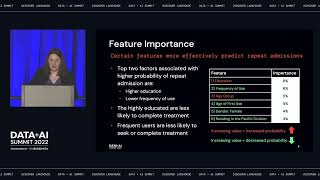
In our presentation, we will walk through a model created to predict repeat admissions to substance abuse treatment centers. The goal is to predict early who will be at high risk for relapse so care can be tailored to put additional focus on these patients. We used the Treatment Episode Data Set (TEDS) Admissions data set, which includes every publicly funded substance abuse treatment admission in the US.

While longitudinal data is not available in the data set, we were able to predict with 88% accuracy and an f-score of 0.85 which admissions were first or repeat admissions. Our solution used a scikit-learn Random Forest model and leveraged MLFlow to track model metrics to choose the most effective model. Our pipeline tested over 100 models of different types ranging from Gradient Boosted Trees to Deep Neural Networks in Tensorflow.

To improve model interpretability, we used Shapley values to measure which variables were most important for predicting readmission. These model metrics along with other valuable data are visualized in an interactive Power BI dashboard designed to help practitioners understand who to focus on during treatment. We are in discussions with companies and researchers who may be able to leverage this model in substance abuse treatment centers in the field.

Connect with us: Website: https://databricks.com Facebook: https://www.facebook.com/databricksinc Twitter: https://twitter.com/databricks LinkedIn: https://www.linkedin.com/company/data... Instagram: https://www.instagram.com/databricksinc/

Quick to Production with the Best of Both Apache Spark and Tensorflow on Databricks

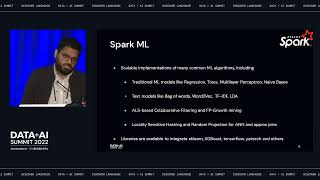
Using Tensorflow with big datasets has been an impediment for building deep learning models due to the added complexities of running it in a distributed setting and complicated MLOps code, recent advancements in tensorflow 2, and some extension libraries for Spark has now simplified a lot of this. This talk focuses on how we can leverage the best of both Spark and tensorflow to build machine learning and deep learning models using minimal MLOps code letting Spark handle the grunt of work, enabling us to focus more on feature engineering and building the model itself. This design also enables us to use any of the libraries in the tensorflow ecosystem (like tensorflow recommenders) with the same boilerplate code. For businesses like ours, fast prototyping and quick experimentations are key to building completely new experiences in an efficient and iterative way. It is always preferable to have tangible results before putting more resources into a certain project. This design provides us with that capability and lets us spend more time on research, building models, testing quickly, and rapidly iterating. It also provides us with the flexibility to use our choice of framework at any stage of the machine learning lifecycle. In this talk, we will go through some of the best and new features of both spark and tensorflow, how to go from single node training to distributed training with very few extra lines of code, how to leverage MLFlow as a central model store, and finally, using these models for batch and real-time inference.

Connect with us: Website: https://databricks.com Facebook: https://www.facebook.com/databricksinc Twitter: https://twitter.com/databricks LinkedIn: https://www.linkedin.com/company/data... Instagram: https://www.instagram.com/databricksinc/