talk-data.com talk-data.com

Event

O'Reilly Data Engineering Books

2001-10-19 – 2027-05-25 Oreilly Visit website ↗

Activities tracked

243

Collection of O'Reilly books on Data Engineering.

Filtering by: Java ×

Sessions & talks

Showing 176–200 of 243 · Newest first

Search within this event →
Professional XML

As XML gains popularity, developers are looking to implement XML technologies in their line-of-business applications This book offers readers real-world insight into XML so that they can build the best possible applications Offers an in-depth look at XML and discusses XML tools, services (RSS, SOAP, REST, WSDL), programming (DOM, SAX, Ajax), and languages (.NET, Java, PHP)

Informix Dynamic Server V10 . . . Extended Functionality for Modern Business

This IBM Redbooks publication provides an overview of the Informix Dynamic Server (IDS), Version 10. IDS provides the reliability, flexibility, and ease of maintenance that can enable you to adapt to new customer requirements. It is well known for its blazing online transaction processing (OLTP) performance, legendary reliability, and nearly hands-free administration for businesses of all sizes--all while simplifying and automating enterprise database deployment. Version 10 offers significant improvements in performance, availability, security, and manageability, including patent-pending technology that virtually eliminates downtime and automates many of the tasks that are associated with deploying mission-critical enterprise systems. New features speed application development, enable more robust enterprise data replication, and enable improved programmer productivity through support of IBM Rational development tools, JDBC 3.0, and Microsoft .NET as examples. Version 10 provides a robust foundation for e-business infrastructures with optimized Java support, IBM WebSphere certification, and XML and Web services support. Ready for service-oriented architecture (SOA)? This book also includes descriptions and demonstrations of support that are specific to IDS for an SOA.

Java and XML, 3rd Edition

Java and XML, 3rd Edition, shows you how to cut through all the hype about XML and put it to work. It teaches you how to use the APIs, tools, and tricks of XML to build real-world applications. The result is a new approach to managing information that touches everything from configuration files to web sites. After two chapters on XML basics, including XPath, XSL, DTDs, and XML Schema, the rest of the book focuses on using XML from your Java applications. This third edition of Java and XML covers all major Java XML processing libraries, including full coverage of the SAX, DOM, StAX, JDOM, and dom4j APIs as well as the latest version of the Java API for XML Processing (JAXP) and Java Architecture for XML Binding (JAXB). The chapters on web technology have been entirely rewritten to focus on the today's most relevant topics: syndicating content with RSS and creating Web 2.0 applications. You'll learn how to create, read, and modify RSS feeds for syndicated content and use XML to power the next generation of websites with Ajax and Adobe Flash. Topics include: The basics of XML, including DTDs, namespaces, XML Schema, XPath, and Transformations The SAX API, including all handlers, filters, and writers The DOM API, including DOM Level 2, Level 3, and the DOM HTML module The JDOM API, including the core and a look at XPath support The StAX API, including StAX factories, producing documents and XMLPull Data Binding with JAXB, using the new JAXB 2.0 annotations Web syndication and podcasting with RSS XML on the Presentation Layer, paying attention to Ajax and Flash applications If you are developing with Java and need to use XML, or think that you will be in the future; if you're involved in the new peer-to-peer movement, messaging, or web services; or if you're developing software for electronic commerce, Java and XML will be an indispensable companion.

Linux Integration with IBM i5/OS

IBM System i platform offers many points of integration that support Linux applications leveraging IBM i5/OS applications and data, such as IBM eServer iSeries Access for Linux, IBM i5/OS NetServer with Samba support, and IBM Java Virtual Machine and JTOpen support. Please note that the additional material referenced in the text is not available from IBM.

MySQL Cookbook, 2nd Edition

Along with MySQL's popularity has come a flood of questions about solving specific problems, and that's where this Cookbook is essential. Designed as a handy resource when you need quick solutions or techniques, the book offers dozens of short, focused pieces of code and hundreds of worked-out examples for programmers of all levels who don't have the time (or expertise) to solve MySQL problems from scratch. The new edition covers MySQL 5.0 and its powerful new features, as well as the older but still widespread MySQL 4.1. One major emphasis of this book is how to use SQL to formulate queries for particular kinds of questions, using the mysql client program included in MySQL distributions. The other major emphasis is how to write programs that interact with the MySQL server through an API. You'll find plenty of examples using several language APIs in multiple scenarios and situations, including the use of Ruby to retrieve and format data. There are also many new examples for using Perl, PHP, Python, and Java as well. Other recipes in the book teach you to: Access data from multiple tables at the same time Use SQL to select, sort, and summarize rows Find matches or mismatches between rows in two tables Determine intervals between dates or times, including age calculations Store images into MySQL and retrieve them for display in web pages Get LOAD DATA to read your data files properly or find which values in the file are invalid Use strict mode to prevent entry of bad data into your database Copy a table or a database to another server Generate sequence numbers to use as unique row identifiers Create database events that execute according to a schedule And a lot more MySQL Cookbook doesn't attempt to develop full-fledged, complex applications. Instead, it's intended to assist you in developing applications yourself by helping you get past problems that have you stumped.

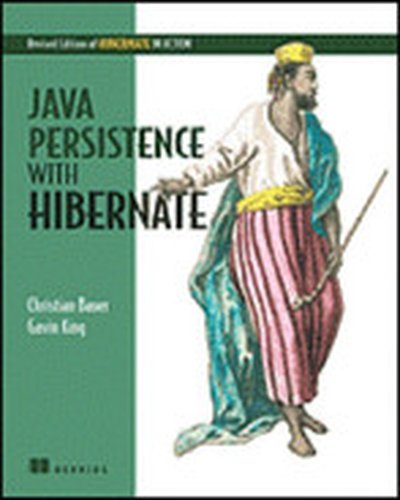
Java Persistence with Hibernate

Java Persistence with Hibernate explores Hibernate by developing an application that ties together hundreds of individual examples. You'll immediately dig into the rich programming model of Hibernate 3.2 and Java Persistence, working through queries, fetching strategies, caching, transactions, conversations, and more. You'll also appreciate the well-illustrated discussion of best practices in database design, object/relational mapping, and optimization techniques. In this revised edition of Manning's bestselling Hibernate in Action, authors Christian Bauer and Gavin King—the founder of the Hibernate project—cover Hibernate 3.2 in detail along with the EJB 3.0 and Java Persistence 1.0 standards. The book ends with detailed coverage of JBoss Seam, a revolutionary web application framework for Java EE that builds on EJB 3.0, JavaServer Faces, and Hibernate concepts. About the Technology Persistence—the ability of data to outlive an instance of a program—is central to modern applications. Hibernate, the most popular Java persistence tool, provides automatic and transparent object/relational mapping so it's a snap to work with SQL databases in Java applications. Hibernate conforms to the new EJB 3.0 and Java Persistence 1.0 standards. About the Book What's Inside O/R mapping concepts Get started with Hibernate and Java Persistence Efficient database application design Comprehensive Hibernate and Java Persistence reference Unmatched breadth and depth About the Reader About the Authors Christian Bauer is a member of the Hibernate developer team and a trainer, consultant, and product manager for Hibernate, EJB 3.0, and JBoss Seam at JBoss. Gavin King, a lead developer at JBoss, is the founder of the Hibernate project, and a member of the EJB 3.0 (JSR 220) expert group. He also leads the Web Beans JSR 299, a standardization effort involving Hibernate concepts, JSF, and EJB 3.0. Quotes ...this book is the ultimate solution. If you are going to use Hibernate in your application, you have no other choice, go rush to the store and get this book. - Meera Subbarao, JavaLobby "Java Persistence with Hibernate" is the most comprehensive, authoritative and definitive guide, tutorial, and reference to OR-mapped Java persistence. - Will Wagers, C#online.net A definitive source on Hibernate. Great for any developer. - Patrick Peak, CTO, BrowserMedia, Author of Hibernate Quickly I wholeheartedly recommend this book! - Stuart Caborn, Thoughtworks Great topic, great content, and there is a great need for this book! - Ryan Daigle, RTP Region, ALTERthought ...very thorough, very complete. I highly recommend it. - Patrick Dennis, Java Developer Management Dynamics Inc. A must-read for developers using Hibernate. - Dan Dobrin, BEA Systems It's the best book out there about Hibernate (and there are quite a few on the market right now), maybe even the best book about ORM in Java, in general. - Adrian Spinei, Real Life, beta version

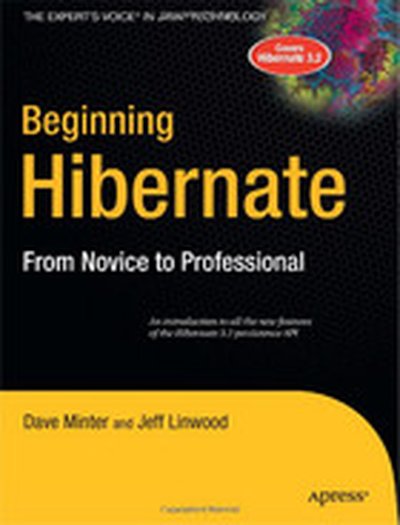
Beginning Hibernate: From Novice to Professional

Beginning Hibernate is ideal if you're experienced in Java with databases (the traditional, or connected, approach), but are new to open source lightweight Hibernate—the most popular de facto object-relational mapping and database-oriented application development framework. This book packs in information about the release of the Hibernate 3.2.x persistence layer and provides a clear introduction to the current standard for object-relational persistence in Java. Experienced author Dave Minter and contributor Jeff Linwood provide more in-depth examples than any other books for Hibernate beginners. The authors also present material in a lively, example-based mannernot in a dry, theoretical, hard-to-read fashion. And since the book keeps its focus on Hibernate without wasting time on nonessential third-party tools, you'll be able to immediately start building transaction-based engines and applications.

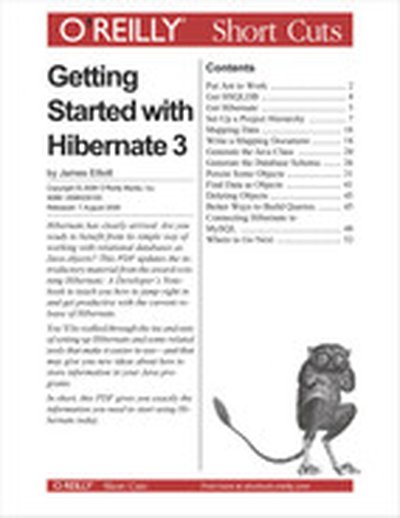
Getting Started with Hibernate 3

Hibernate has clearly arrived. Are you ready to benefit from its simple way of working with relational databases as Java objects? This PDF updates the introductory material from the award-winning Hibernate: A Developer's Notebook to teach you how to jump right in and get productive with the current release of Hibernate. You'll be walked through the ins and outs of setting up Hibernate and some related tools that make it easier to use--and that may give you new ideas about how to store information in your Java programs. In short, this PDF gives you exactly the information you need to start using Hibernate today.

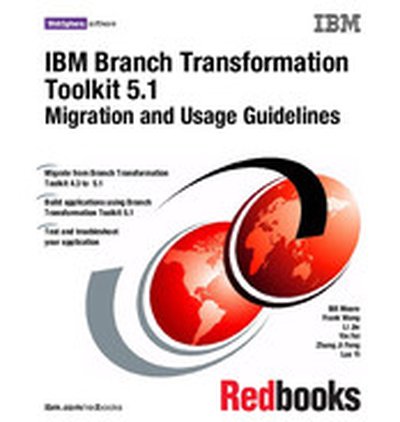
IBM Branch Transformation Toolkit 5.1 Migration and Usage Guidelines

This IBM Redbooks publication shows in detail IBM Branch Transformation Toolkit for WebSphere Studio Version 5.1 and explains how to migrate from Branch Transformation Toolkit Version 4.3 to Branch Transformation Toolkit 5.1. We provide guidelines for the architecture of the target solution, the correct use of migration tools, and migration-sizing. This book also describes how to build new applications in Branch Transformation Toolkit V5.1. We explain both top-down and bottom-up development, and discuss how to use WebSphere Studio and Branch Transformation Toolkit development plug-ins. We also describe rich Java client development using the Branch Transformation Toolkit. This book is intended for the following audiences: - Solution architects who require a description of IBM Branch Transformation Toolkit for WebSphere Studio and how to build a solution - IT professionals and executives who require a broad understanding of the architecture of the Branch Transformation Toolkit and its implementation - Readers who are familiar with object-oriented software and related development techniques, and have a general knowledge of Java 2 Platform, Enterprise Edition (J2EE) and related technologies Please note that the additional material referenced in the text is not available from IBM.

MySQL, Second Edition: Visual Quickstart Guide

Even if you've never used MySQL before, this Visual QuickStart Guide will have you up and running with the world’s most popular open source database application in no time. In this completely updated edition of our best-selling guide to MySQL, leading technology author Larry Ullman uses his trademark crystal-clear instructions and friendly prose to introduce you to everything that’s new in MySQL. Filled with step-by-step, task-based instructions and loads of visual aids, this book explains how to interact with MySQL using SQL, the language common to all databases. The interface examples show how to use MySQL’s own tools and how to use three popular programming languages (PHP, Perl, and Java). The book covers MySQL versions 3 and 4, as well as everything new in the eagerly anticipated version 5. Along the way, you'll find extensive coverage of MySQL installation, administration, database design, as well as its use with various programming languages, database programming techniques, utilities, advanced MySQL and SQL, and more! • Takes an easy, visual approach to teaching MySQL, using pictures to guide you through the software and show you what to do. • Works like a reference book—you look up what you need and then get straight to work. • No long-winded passages—concise, straightforward commentary explains what you need to know. • Affordably priced, because buying a computer book shouldn’t be an investment in itself. • Companion Web site at www.DMCInsights.com/mysql2 contains complete source code for examples in the book, online resources, extra scripts and tutorials, updates, a reader forum, and more.

Agile Java Development with Spring, Hibernate and Eclipse

is a book about robust technologies and effective methods which help bring simplicity back into the world of enterprise Java development. The three key technologies covered in this book, the Spring Framework, Hibernate and Eclipse, help reduce the complexity of enterprise Java development significantly. Furthermore, these technologies enable plain old Java objects (POJOs) to be deployed in light-weight containers versus heavy-handed remote objects that require heavy EJB containers. This book also extensively covers technologies such as Ant, JUnit, JSP tag libraries and touches upon other areas such as such logging, GUI based debugging, monitoring using JMX, job scheduling, emailing, and more. Also, Extreme Programming (XP), Agile Model Driven Development (AMDD) and refactoring are methods that can expedite the software development projects by reducing the amount of up front requirements and design; hence these methods are embedded throughout the book but with just enough details and examples to not sidetrack the focus of this book. In addition, this book contains well separated, subjective material (opinion sidebars), comic illustrations, tips and tricks, all of which provide real-world and practical perspectives on relevant topics. Last but not least, this book demonstrates the complete lifecycle by building and following a sample application, chapter-by-chapter, starting from conceptualization to production using the technology and processes covered in this book. In summary, by using the technologies and methods covered in this book, the reader will be able to effectively develop enterprise-class Java applications, in an agile manner! Agile Java™ Development With Spring, Hibernate and Eclipse

MySQL Stored Procedure Programming

The implementation of stored procedures in MySQL 5.0 a hugemilestone -- one that is expected to lead to widespread enterprise adoption ofthe already extremely popular MySQL database. If you are serious aboutbuilding the web-based database applications of the future, you need toget up to speed quickly on how stored procedures work -- and how tobuild them the right way. This book, destined to be the bible of storedprocedure development, is a resource that no real MySQL programmer canafford to do without. In the decade since MySQL burst on the scene, it has become thedominant open source database, with capabilities and performancerivaling those of commercial RDBMS offerings like Oracle and SQLServer. Along with Linux and PHP, MySQL is at the heart of millions ofapplications. And now, with support for stored procedures, functions,and triggers in MySQL 5.0, MySQL offers the programming power neededfor true enterprise use. MySQL's new procedural language has a straightforward syntax, making iteasy to write simple programs. But it's not so easy to write secure,easily maintained, high-performance, and bug-free programs. Few in theMySQL world have substantial experience yet with stored procedures, butGuy Harrison and Steven Feuerstein have decades of combined expertise. In MySQL Stored Procedure Programming, they putthat hard-won experience to good use. Packed with code examples and coveringeverything from language basics to application building to advancedtuning and best practices, this highly readable book is the one-stopguide to MySQL development. It consists of four major sections: MySQL stored programming fundamentals -- tutorial, basicstatements, SQL in stored programs, and error handling Building MySQL stored programs -- transaction handling,built-in functions, stored functions, and triggers MySQL stored programs in applications -- using storedprograms with PHP, Java, Perl, Python, and .NET (C# and VB.NET) Optimizing MySQL stored programs -- security, basic andadvanced SQL tuning, optimizing stored program code, and programmingbest practices A companion web site contains many thousands of lines of code, that youcan put to use immediately. Guy Harrison is Chief Architect of Database Solutions at Quest Softwareand a frequent speaker and writer on MySQL topics. Steven Feuerstein isthe author of Oracle PL/SQL Programming, the classic reference for Oracle stored programming for more than ten years. Both have decades of experience as database developers, and between them they have authored a dozen books.

DB2 UDB for z/OS: Design Guidelines for High Performance and Availability

Conducting business via the Web and remaining open for business 24 hours a day, seven days a week is now commonplace. Customers come in with unexpected workloads through the Web and operate in a self-service fashion with mostly context-sensitive metadata to guide them. The strong requirement is availability. However, even with new Web applications, most of the core business systems considerations still apply, and performance is critical. Technology has been accelerating for mainframe systems. They had become adept at providing business resiliency accommodating strategic software that has been around for the last several decades such as IMS™ , DB2® , and CICS® , and they have also become a host for developing and running Web applications built in Java™ accommodating the latest business requirements. Businesses need to leverage, extend and integrate the strategic assets which represent multi-year investments to support leading edge technology. DB2 for z/OS® has come a long way and provides facilities to exploit the latest hardware and software technologies, accommodating a majority of user requirements. However, special considerations are required to build high performance applications. If you want to achieve high performance or high availability, you must use the design, programming, and operational techniques applicable to DB2. Please note that the additional material referenced in the text is not available from IBM.

Business Process Execution Language for Web Services - Second Edition

Key Features Architecture, syntax, development and composition of Business Processes and Services using BPEL Advanced BPEL features such as compensation, concurrency, links, scopes, events, dynamic partner links, and correlations Oracle BPEL Process Manager and BPEL Designer Microsoft BizTalk Server as a BPEL server Book Description Web services provide the basic technical platform required for application interoperability. They do not, however, provide higher level control, such as which web services need to be invoked, which operations should be called and in what sequence. Nor do they provide ways to describe the semantics of interfaces, the workflows, or e-business processes. BPEL is the missing link to assemble and integrate web services into a real business process BPEL4WS standardizes process automation between web services. This applies both within the enterprise, where BPEL4WS is used to integrate previously isolated systems, and between enterprises, where BPEL4WS enables easier and more effective integration with business partners. In providing a standard descriptive structure BPEL4WS enables enterprises to define their business processes during the design phase. Wider business benefits can flow from this through business process optimization, reengineering, and the selection of most appropriate processes . Supported by major vendors - including BEA, Hewlett-Packard, IBM, Microsoft, Novell, Oracle, SAP, Sun, and others - BPEL4WS is becoming the accepted standard for business process management. This book provides detailed coverage of BPEL4WS, its syntax, and where, and how, it is used. It begins with an overview of web services, showing both the foundation of, and need for, BPEL. The web services orchestration stack is explained, including standards such as WS-Security, WS-Coordination, WS-Transaction, WS-Addressing, and others. The BPEL language itself is explained in detail, with Code snippets and complete examples illustrating both its syntax and typical construction. Having covered BPEL itself, the book then goes on to show BPEL is used in context. by providing an overview of major BPEL4WS servers. It covers the Oracle BPEL Process Manager and Microsoft BizTalk Server 2004 in detail, and shows how to write BPEL4WS solutions using these servers. What you will learn Chapter 1 provides a detailed introduction to BPEL and Service Oriented Architecture (SOA). It discusses business processes and their automation, explains the role of BPEL, web services, and Enterprise Service Buses (ESB) in SOA, provides insight into business process composition with BPEL, explains the most important features, compares BPEL to other specifications, provides an overview of BPEL servers, and discusses the future of BPEL. Chapter 2 provides a detailed introduction to the Web Services Technology Stack. It discusses the important standards and specifications for using BPEL and implementing SOA with web services, such as WS-Security, WS-Addressing, WS-Coordination, WS-AtomicTransaction, WS-BusinessActivity, WS-Reliable Messaging, etc. Chapter 3 discusses the composition of web services with BPEL. The chapter introduces the core concepts of BPEL and explains how to define synchronous and asynchronous business processes with BPEL. The reader gets familiar with BPEL process structure, partner links, sequential and parallel service invocation, variables, conditions, etc. Chapter 4 goes deeper into the BPEL specification and covers advanced features for modeling complex business processes. Advanced activities, scopes, serialization, fault handing, compensations, event handling, correlation sets, concurrent activities and links, process lifecycle, and dynamic partner links are covered in detail. Chapter 5 explains how to use the Oracle BPEL Process Manager for deploying and executing business processes defined in BPEL. It describes the server architecture, tools, features, and common approaches for managing and debugging BPEL processes. The chapter also looks at graphical development of BPEL processes using Oracle BPEL Designer for JDeveloper and for Eclipse. Chapter 6 takes a detailed look at the advanced features of the Oracle BPEL Process Manager including extension functions, dynamic parallel flows, Web Services Invocation Framework, Java embedding, Notification service, Workflow service, Identity service, and Oracle BPEL Server APIs. Chapter 7 discusses MS BizTalk Server 2004 and its support for BPEL. It explains how to develop business processes in BizTalk and export them to BPEL. It also explains how to import BPEL processes into BizTalk and how to use the Orchestration Designer tool to define processes graphically, and compares BizTalk and BPEL constructs. Appendix A provides a syntax reference for BPEL version 1.1. The appendix covers standard BPEL activities and elements, functions, attributes, and faults. Who this book is for This book is aimed at architects and developers in the design, implementation, and integration phases of advanced information systems and e-business solutions, developing business processes and dealing with the issues of composition, orchestration, transactions, coordination, and security. The book presumes knowledge of XML and web services, web services development (either on J2EE or .NET), and multi-tier architecture

Professional LAMP: Linux®, Apache, MySQL®, and PHP5 Web Development

The combination of Linux, Apache, MySQL, and PHP is popular because of interaction, flexibility, customization, and-most importantly-the cost effectiveness of its components Helps LAMP professionals take their skills to the next level with in-depth discussions of OOP; extensions of PHP such as PEAR, GD, XML, and CURL; improving site security; and advanced tools available to the coder Those proficient in other languages such as Java, C++, Perl and ASP will find this guide invaluable when transitioning to the LAMP environment The Web site includes sample scripts created in the course of each chapter, and several applications that can be modified and reused

Pro Apache Log4j, Second Edition

In development scenarios where things can't be run in a debugger, or when you run the risk of masking the problem, logs are the greatest source of information about running a program. Pro Apache Log4j, Second Edition provides best practices guidelines and comprehensive coverage of the most recent release. Step by step, the book explains core concepts, from basic to advanced. Code samples are in Java and include guidelines for different application-specific needs. You’ll also learn how to extend the API to write custom components and best practices for using the feature-rich log4j API. This book concludes with enterprise Java applications using log4j with JSP and J2EE.

IMS Version 9 Implementation Guide: A Technical Overview

This IBM Redbooks publication provides an overview of the new functions and enhancements in IBM Information Management System (IMS) Version 9. IMS Version 9 contains over 50 enhancements, in all areas of the product. that address availability, scalability, capacity, usability, manageability, operations, on demand business, and application development requirements from its huge customer base. All of the enhancements in this new version resulted from specific customer requirements. The major enhancements include: Improved database availability for HALDB databases is provided by the long-awaited online reorganization (OLR) enhancement. The functionality of the IMS Connect product is included as an integrated function of IMS. DBRC provides a new API that allows assembler programs to query the RECON. IMS Java users will have new JDBC SQL calls and DLI Model Utility support for retrieving existing IMS data in XML format as well as storing, indexing, searching, and retrieving valid XML documents into new or existing IMS databases. We describe these enhancements and all other major changes in IMS Version 9. This book gives you the essential information that you need when you are migrating your IMS systems to IMS Version 9.

Hibernate: A J2EE™ Developer's Guide

Build fast, high-performance Java database applications with Hibernate. Hibernate makes it far easier to build robust, high-performance database applications with Java. Now there's a practical, hands-on guide to using Hibernate's flexible, fast object/relational persistence and query services. Will Iverson covers every facet of development with Hibernate, from its mapping system toits advanced query mechanisms and transaction support. Iverson shows you how to build Hibernate solutions that can integrate with Swing, with JSP, and even with EJBs utilizing bean-managed persistence. Using realistic examples, he demonstrates how to work with persistent objects, manage schema, and optimize database application performance. After you've mastered Hibernate's core techniques, Iverson presents best practices, tips, tricks, and style guidance for even more effective development. Coverage includes Case study applications: starting from object/relational mapping files, Java code, and existing schema Writing Hibernate queries using HQL—Hibernate's object-oriented SQL extension Using Hibernate with Java-based Criteria and Example or native SQL The Hibernate mapping file format in detail: a complete reference How Hibernate handles class and database relationships Managing session and database transactions with Hibernate Tracking and optimizing performance with p6spy and IronTrack SQL Automatically generating DDL scripts that create, update, and drop tables Even if your Java database experience is limited to basic JDBC, this book will help you leverage Hibernate's remarkable power. You'll spend far less time writing code to bridge databases with Java applications—so you can get to market faster, with more features. © Copyright Pearson Education. All rights reserved.

Oracle Utilities Pocket Reference

The Oracle Utilities Pocket Reference is a handy, quick-reference guide to the multitude of Oracle utilities that database administrators (DBAs) use every hour of every day.As the undisputed leader among database products, Oracle is grasped conceptually by most DBAs. However, they understandably may not recall the specific utility to use for a given task, and, more commonly, won't in many cases remember the syntax to use. And that's exactly what the Oracle Utilities Pocket Reference supplies--the syntax and options for whatever utility a DBA needs to perform a given task.Some of the utilities documented in this guide include: Packed with information in an easy-to-read format, this valuable resource is ideal for any experienced DBA. Even database programmers who deal with Oracle will truly appreciate having the SQL*Loader, for loading data expdp and exp for exporting data to another database oradebug for use in troubleshooting loadjava and dropjava for loading and unloading Java programs Oracle Utilities Pocket Reference close at hand.Authored by Sanjay Mishra, a foremost authority on Oracle systems, this convenient and compact guide is focused and to-the-point, eliminating any potential guesswork or difficult memorization. The Oracle Utilities Pocket Reference is part of the strong-selling collection of O'Reilly "pocket reference" books.

DB2 UDB V8.2 on the Windows Environment

IBM DB2 Universal Database Version 8.2 is another significant jump in DBRM technology. It delivers new features to address the ever-increasing demands and requirements of information management customers. This IBM Redbooks publication is an update of DB2 UDB Exploitation of the Windows Environment (SG24-6893), with a focus on DB2 UDB Version 8.2 functions and features. We illustrate, step-by-step, the installation and migration processes. The new autonomic computing technology that makes the DBA’s job easier is described in detail. The new security features and their integration with the Windows environment are discussed intensively. This book covers the new performance and monitoring enhancements of Version 8.2. New, exciting high availability functions are described in detail. Further, we discuss aspects of DB2 application development with .NET 2003 and Java and provide programming details using ADO.NET, CLR, and Java.

Oracle Database 10g The Complete Reference

Get a thorough understanding of Oracle Database 10 g from the most comprehensive Oracle database reference on the market, published by Oracle Press. From critical architecture concepts to advanced object-oriented concepts, this powerhouse contains nearly 50 chapters designed to enlighten you. Upgrade from earlier versions, use SQL, SQL Plus, and PL/SQL. Get code examples and access popular documentation PDFs--plus a full electronic copy of the book on the included CD-ROM. Go beyond the basics and learn security, text searches, external tables, using Java in Oracle, and a great deal more.

Oracle Database 10g XML & SQL: Design, Build, & Manage XML Applications in Java, C, C++, & PL/SQL

Written by members of the Oracle XML group, this is a must-have reference for all IT managers, DBAs, and developers who want to learn the best practices for using XML with Oracle’s XML-enabled products. Includes real-world case studies based on the authors’ experience managing Oracle’s XML Discussion Forum--a community of 20,000+ XML component users.

Designing Web Services with the J2EE™ 1.4 Platform JAX-RPC, SOAP, and XML Technologies

Written by Sun Microsystems' Java™ BluePrints team, is the authoritative guide to the best practices for designing and integrating enterprise-level Web services using the Java 2 Platform, Enterprise Edition (J2EE) 1.4. This book provides the guidelines, patterns, and real-world examples architects and developers need in order to shorten the learning curve and start building robust, scalable, and portable solutions. Designing Web Services with the J2EE™ 1.4 Platform The authors use the Java Adventure Builder application to bring the design process to life and help illustrate the use of Java APIs for XML Processing (JAXP), Java APIs for XML-Based RPC (JAX-RPC), and other Web service and Java-XML technologies. Key topic coverage includes: Web service requirements and design issues Support for Web services provided by the J2EE 1.4 platform Designing and implementing Web service end points Writing efficient Web service client applications Designing and developing XML-based applications Integrating applications and data using Web services The J2EE platform security model as it applies to Web services A coherent programming model for designing and developing Web service endpoints and clients provides the insight, advice, and detail that make it easier to create effective Web service applications using the J2EE 1.4 platform. Designing Web Services with the J2EE™ 1.4 Platform

IBM eServer zSeries 890 Technical Introduction

This IBM Redbooks publication introduces the IBM eServer zSeries 890, which represents the continuation of the scalable servers featured with the IBM eServer zSeries 990. The z890 is based on z/Architecture, the zSeries building blocks of the z990, and the virtualization technology of passed sever families. It is designed to be resilient in the unpredictable on demand world. The z890 is a single model server with a wide range of capacity settings, delivering significantly improved granularity and enriched functions over its predecessor. At the same time, the z890 is also introducing the new eServer zSeries Application Assist Processor (zAAP), which provides a Java execution environment. This publication provides information on the hardware and software features available with the z890. It also includes planning and migration considerations. This technical introduction is intended for hardware planners, system engineers, and consultants who need to understand the capabilities of the z890.

Hibernate: A Developer's Notebook

Do you enjoy writing software, except for the database code? Hibernate:A Developer's Notebook is for you. Database experts may enjoy fiddling with SQL, but you don't have to--the rest of the application is the fun part. And even database experts dread the tedious plumbing and typographical spaghetti needed to put their SQL into a Java program. Hibernate: A Developers Notebook shows you how to use Hibernate to automate persistence: you write natural Java objects and some simple configuration files, and Hibernate automates all the interaction between your objects and the database. You don't even need to know the database is there, and you can change from one database to another simply by changing a few statements in a configuration file. Hibernate: A Developer's Notebook walks you through the ins and outs of using Hibernate, from installation and configuration, to complex associations and composite types. Two chapters explore ways to write sophisticated queries, which you can express either through a pure Java API, or with an SQL-inspired, but object-oriented, query language. Don't let that intimidate you though: one of the biggest surprises in working with Hibernate is that for many of the common real-world application scenarios, you don't need an explicit query at all. If you've needed to add a database backend to your application, don't put it off. It's much more fun than it used to be, and Hibernate: A Developer's Notebook shows you why. Here's what a few reviewers had to say: "I'm sitting on an airplane after finishing Hibernate: A Developer's Notebook. It's rare to find a book on a new Java technology that you can get through on a domestic flight. That this notebook effectively and succinctly tackles object-relational mapping makes it, and Hibernate, even more impressive. Many books in this category would need to be checked luggage. With this book, you travel first class." --Mike Clark "A simple persistence framework deserves a simple book, and this one delivers. The examples are well described and easy to understand, yet sophisticated enough to demonstrate Hibernate in a real-world context. Jim, I'm a new fan." --Bruce Tate About the new Developer's Notebook Series from O'Reilly: Developer's Notebooks are a new book series covering important new tools for software developers. Developer's Notebooks stress example over explanation and practice over theory. They are about learning by doing; by experimenting with tools and discovering what works. "All lab, no lecture," with a thoughtful lab partner to guide the way.