talk-data.com talk-data.com

Event

O'Reilly Data Science Books

2013-08-09 – 2026-02-25 Oreilly Visit website ↗

Activities tracked

326

Collection of O'Reilly books on Data Science.

Filtering by: data-science-tools ×

Sessions & talks

Showing 26–50 of 326 · Newest first

Search within this event →
Programming in MATLAB ®: A Problem-Solving Approach by Pearson

MATLAB provides an interactive programming interface for numerical computation and data visualization making it the default framework used for analysis, design and research in many domains of science and industry. Programming in MATLAB is intended as an aid to engineers and scientists with no prior programming expertise. The book focuses on the systematic development of practical programming skills through MATLAB language constructs, backed by several well-designed examples and exercises. Designed to be as much a MATLAB reference tool for researchers in varied fields as it is a guide for undergraduate readers, the book builds on the concepts sequentially as it progresses through the chapters. Each chapter is complete, independent of the book's remaining contents. Thus, for teaching purposes, one can suitably the relevant portions.

About The Authors –

Ramnarayan Patel did his Ph.D. in the area of power systems from Indian Institute of Technology Delhi, in 2003. He received his M.Tech. from IIT Delhi and a graduate degree in electrical engineering from SGSITS, Indore. His manifold fields of interest include power system stability, optimization in electric power systems, application of artificial intelligence techniques, design of intelligent controllers and renewable energy systems. He has over 14 years of hands-on experience working with MATLAB and Simulink, as an instructor, researcher and trainer.

Dr Patel has served as faculty in the electrical engineering department at IIT Roorkee and at the Birla Institute of Technology and Science, Pilani. Currently, he is Professorin the Department of Electrical and Electronics Engineering, Shri Shankaracharya Technical Campus (SSGI), Bhilai, and has many publications to his credit in various international journals of repute. He has presented his research at various international conferences and organized many workshops and conferences within the country. He is a recipient of the prestigious ‘Career Award for Young Teachers’ from All India Council for Technical Education (AICTE), New Delhi. Dr Patel has successfully handled many research projects funded by AICTE, New Delhi, and Department of Science and Technology, Government of India, New Delhi.

Ankush Mittal received his B.Tech. in computer science and engineering from Indian Institute of Technology Delhi in 1996, and later, his Master’s degree in 1998 from the same institute. He received his Ph.D. degree in electrical and computer engineering from the National University of Singapore in 2001 and was a faculty member in the Department of Computer Science, National University of Singapore, for two years. He has also served as Associate Professor at IIT Roorkee. Currently, he is Director (Research) at Graphic Era University, Dehradun.

Dr Mittal has contributed more than 250 research papers in journals and conferences of high repute with significant impact in academic circles. A dedicated teacher and active researcher, he is a recipient of the IIT Roorkee Outstanding Teacher Award and the IBM Faculty Award. He has taught more than 20 courses and worked on MATLAB extensively since his Ph.D.

Book Contents –

  1. Introduction to MATLAB® Desktop
  2. Matrix Operations and Applications
  3. MATLAB® Graphics and Plotting
  4. Control Structures, Loops, and File Handling
  5. Scripts and Functions
  6. Numerical Methods, Calculus, and Statistics
  7. Using Memory Efficiently
  8. Using the MATLAB® Debugger and Profiler
  9. Efficient Coding Using Vectorization Technique
  10. Precision and Errors
  11. Advanced Concepts in MATLAB®
  12. Modeling with Simulink®
  13. Digital Image Processing Index
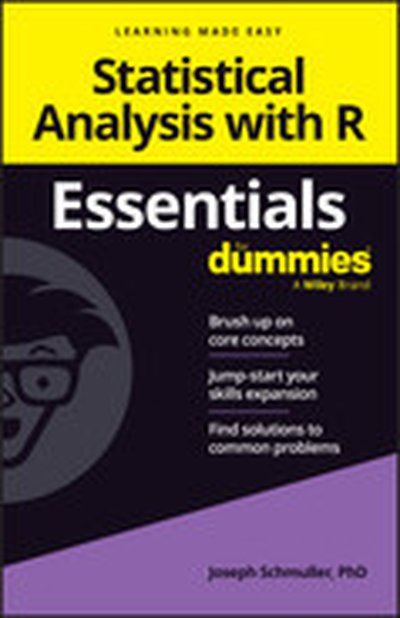
Statistical Analysis with R Essentials For Dummies

The easy way to get started coding and analyzing data in the R programming language Statistical Analysis with R Essentials For Dummies is your reference to all the core concepts about R—the widely used, open-source programming language and data analysis tool. This no-nonsense book gets right to the point, eliminating review material, wordy explanations, and fluff. Understand all you need to know about the foundations of R, swiftly and clearly. Perfect for a brush-up on the basics or as an everyday desk reference on the job, this is the reliable little book you can always turn to for answers. Get a quick and thorough intro to the basic concepts of coding for data analysis in R Review what you've already learned or pick up essential new skills Perform statistical analysis for school, business, and beyond with R programming Keep this concise reference book handy for jogging your memory as you work This book is to the point, focusing on the key topics readers need to know about this popular programming language. Great for supplementing classroom learning, reviewing for a certification, or staying knowledgeable on the job.

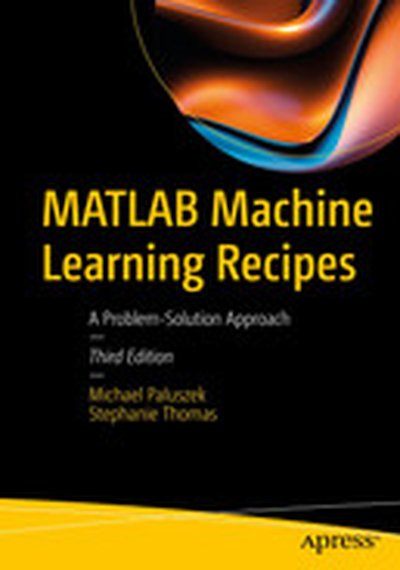
MATLAB Machine Learning Recipes: A Problem-Solution Approach

Harness the power of MATLAB to resolve a wide range of machine learning challenges. This new and updated third edition provides examples of technologies critical to machine learning. Each example solves a real-world problem, and all code provided is executable. You can easily look up a particular problem and follow the steps in the solution. This book has something for everyone interested in machine learning. It also has material that will allow those with an interest in other technology areas to see how machine learning and MATLAB can help them solve problems in their areas of expertise. The chapter on data representation and MATLAB graphics includes new data types and additional graphics. Chapters on fuzzy logic, simple neural nets, and autonomous driving have new examples added. And there is a new chapter on spacecraft attitude determination using neural nets. Authors Michael Paluszek and Stephanie Thomas show how all of these technologies allow you to build sophisticated applications to solve problems with pattern recognition, autonomous driving, expert systems, and much more. What You Will Learn Write code for machine learning, adaptive control, and estimation using MATLAB Use MATLAB graphics and visualization tools for machine learning Become familiar with neural nets Build expert systems Understand adaptive control Gain knowledge of Kalman Filters Who This Book Is For Software engineers, control engineers, university faculty, undergraduate and graduate students, hobbyists.

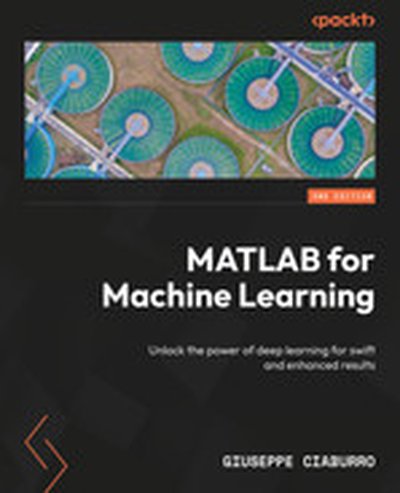
MATLAB for Machine Learning - Second Edition

"MATLAB for Machine Learning" is your comprehensive guide to leveraging MATLAB's powerful tools and toolbox for machine learning and deep learning tasks. Through this book, you will explore practical applications and processes that streamline the development of machine learning models while tackling real-world problems effectively. What this Book will help me do Gain proficiency in utilizing MATLAB's Machine Learning Toolbox for developing machine learning algorithms. Learn how to handle data preprocessing, from data cleansing to visualization, within MATLAB. Explore and implement foundational to advanced machine learning techniques, such as classification and regression models. Comprehend and apply the principles of neural networks for pattern recognition and cluster analysis. Dive into advanced concepts of deep learning, including convolutional networks, natural language processing, and time series analysis, using MATLAB's inbuilt functionality. Author(s) Giuseppe Ciaburro is an expert in the field of machine learning and MATLAB programming. With a robust academic background in data science and years of experience in applying these principles across domains, Giuseppe provides a clear and approachable pathway for learners in his writing. Who is it for? This book is ideal for machine learning professionals, data scientists, and engineers specializing in fields such as deep learning, computer vision, and natural language processing. It is suitable for those with a fundamental understanding of programming concepts who seek to apply MATLAB in solving complex learning problems. A prior familiarity with MATLAB basics will be advantageous.

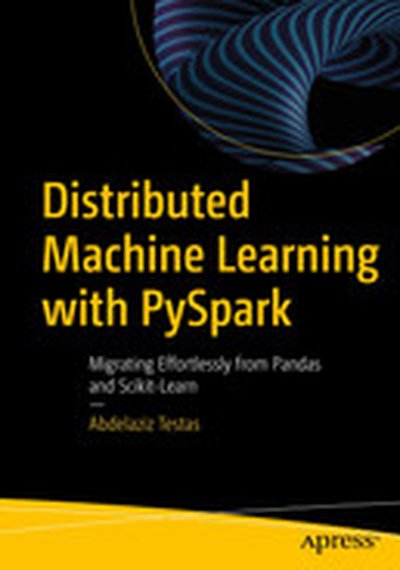
Distributed Machine Learning with PySpark: Migrating Effortlessly from Pandas and Scikit-Learn

Migrate from pandas and scikit-learn to PySpark to handle vast amounts of data and achieve faster data processing time. This book will show you how to make this transition by adapting your skills and leveraging the similarities in syntax, functionality, and interoperability between these tools. Distributed Machine Learning with PySpark offers a roadmap to data scientists considering transitioning from small data libraries (pandas/scikit-learn) to big data processing and machine learning with PySpark. You will learn to translate Python code from pandas/scikit-learn to PySpark to preprocess large volumes of data and build, train, test, and evaluate popular machine learning algorithms such as linear and logistic regression, decision trees, random forests, support vector machines, Naïve Bayes, and neural networks. After completing this book, you will understand the foundational concepts of data preparation and machine learning and will have the skills necessary toapply these methods using PySpark, the industry standard for building scalable ML data pipelines. What You Will Learn Master the fundamentals of supervised learning, unsupervised learning, NLP, and recommender systems Understand the differences between PySpark, scikit-learn, and pandas Perform linear regression, logistic regression, and decision tree regression with pandas, scikit-learn, and PySpark Distinguish between the pipelines of PySpark and scikit-learn Who This Book Is For Data scientists, data engineers, and machine learning practitioners who have some familiarity with Python, but who are new to distributed machine learning and the PySpark framework.

Near Extensions and Alignment of Data in R(superscript)n

Near Extensions and Alignment of Data in Rn Comprehensive resource illustrating the mathematical richness of Whitney Extension Problems, enabling readers to develop new insights, tools, and mathematical techniques Near Extensions and Alignment of Data in Rn demonstrates a range of hitherto unknown connections between current research problems in engineering, mathematics, and data science, exploring the mathematical richness of near Whitney Extension Problems, and presenting a new nexus of applied, pure and computational harmonic analysis, approximation theory, data science, and real algebraic geometry. For example, the book uncovers connections between near Whitney Extension Problems and the problem of alignment of data in Euclidean space, an area of considerable interest in computer vision. Written by a highly qualified author, Near Extensions and Alignment of Data in Rn includes information on: Areas of mathematics and statistics, such as harmonic analysis, functional analysis, and approximation theory, that have driven significant advances in the field Development of algorithms to enable the processing and analysis of huge amounts of data and data sets Why and how the mathematical underpinning of many current data science tools needs to be better developed to be useful New insights, potential tools, and mathematical techniques to solve problems in Whitney extensions, signal processing, shortest paths, clustering, computer vision, optimal transport, manifold learning, minimal energy, and equidistribution Providing comprehensive coverage of several subjects, Near Extensions and Alignment of Data in Rn is an essential resource for mathematicians, applied mathematicians, and engineers working on problems related to data science, signal processing, computer vision, manifold learning, and optimal transport.

The Statistics and Machine Learning with R Workshop

This book guides readers through the essentials of applied statistics and machine learning using the R programming language. By delving into robust data processing techniques, visualization, and statistical modeling with R, you will develop skills to effectively analyze data and design predictive models. Each chapter includes hands-on exercises to reinforce the concepts in a practical, intuitive way. What this Book will help me do Understand and apply key statistical concepts such as probability distributions and hypothesis testing to analyze data. Master foundational mathematical principles like linear algebra and calculus relevant to data science and machine learning. Develop proficiency in data manipulation and visualization using robust R libraries such as dplyr and ggplot2. Build predictive models through practical exercises and learn advanced concepts like Bayesian statistics and linear regression. Gain the practical knowledge needed to apply statistical and machine learning methodologies in real-world scenarios. Author(s) Liu Peng is an accomplished author with a strong academic and practical background in statistics and data science. Armed with extensive experience in applying R to real-world problems, he brings a blend of technical mastery and teaching expertise. His commitment is to transform complex concepts into accessible, enriching learning experiences for readers. Who is it for? This book is ideal for data scientists and analysts ranging from beginners to those at an intermediate level. It caters especially to those interested in practicing statistical modeling and learning R in depth. If you have basic familiarity with statistics and are looking to expand your data science capabilities using R, this book is well-suited for you.

Machine and Deep Learning Using MATLAB

MACHINE AND DEEP LEARNING In-depth resource covering machine and deep learning methods using MATLAB tools and algorithms, providing insights and algorithmic decision-making processes Machine and Deep Learning Using MATLAB introduces early career professionals to the power of MATLAB to explore machine and deep learning applications by explaining the relevant MATLAB tool or app and how it is used for a given method or a collection of methods. Its properties, in terms of input and output arguments, are explained, the limitations or applicability is indicated via an accompanied text or a table, and a complete running example is shown with all needed MATLAB command prompt code. The text also presents the results, in the form of figures or tables, in parallel with the given MATLAB code, and the MATLAB written code can be later used as a template for trying to solve new cases or datasets. Throughout, the text features worked examples in each chapter for self-study with an accompanying website providing solutions and coding samples. Highlighted notes draw the attention of the user to critical points or issues. Readers will also find information on: Numeric data acquisition and analysis in the form of applying computational algorithms to predict the numeric data patterns (clustering or unsupervised learning) Relationships between predictors and response variable (supervised), categorically sub-divided into classification (discrete response) and regression (continuous response) Image acquisition and analysis in the form of applying one of neural networks, and estimating net accuracy, net loss, and/or RMSE for the successive training, validation, and testing steps Retraining and creation for image labeling, object identification, regression classification, and text recognition Machine and Deep Learning Using MATLAB is a useful and highly comprehensive resource on the subject for professionals, advanced students, and researchers who have some familiarity with MATLAB and are situated in engineering and scientific fields, who wish to gain mastery over the software and its numerous applications.

Python Data Analytics: With Pandas, NumPy, and Matplotlib

Explore the latest Python tools and techniques to help you tackle the world of data acquisition and analysis. You'll review scientific computing with NumPy, visualization with matplotlib, and machine learning with scikit-learn. This third edition is fully updated for the latest version of Python and its related libraries, and includes coverage of social media data analysis, image analysis with OpenCV, and deep learning libraries. Each chapter includes multiple examples demonstrating how to work with each library. At its heart lies the coverage of pandas, for high-performance, easy-to-use data structures and tools for data manipulation Author Fabio Nelli expertly demonstrates using Python for data processing, management, and information retrieval. Later chapters apply what you've learned to handwriting recognition and extending graphical capabilities with the JavaScript D3 library. Whether you are dealing with sales data, investment data, medical data, web page usage, or other data sets, Python Data Analytics, Third Edition is an invaluable reference with its examples of storing, accessing, and analyzing data. What You'll Learn Understand the core concepts of data analysis and the Python ecosystem Go in depth with pandas for reading, writing, and processing data Use tools and techniques for data visualization and image analysis Examine popular deep learning libraries Keras, Theano,TensorFlow, and PyTorch Who This Book Is For Experienced Python developers who need to learn about Pythonic tools for data analysis

Scaling Python with Dask

Modern systems contain multi-core CPUs and GPUs that have the potential for parallel computing. But many scientific Python tools were not designed to leverage this parallelism. With this short but thorough resource, data scientists and Python programmers will learn how the Dask open source library for parallel computing provides APIs that make it easy to parallelize PyData libraries including NumPy, pandas, and scikit-learn. Authors Holden Karau and Mika Kimmins show you how to use Dask computations in local systems and then scale to the cloud for heavier workloads. This practical book explains why Dask is popular among industry experts and academics and is used by organizations that include Walmart, Capital One, Harvard Medical School, and NASA. With this book, you'll learn: What Dask is, where you can use it, and how it compares with other tools How to use Dask for batch data parallel processing Key distributed system concepts for working with Dask Methods for using Dask with higher-level APIs and building blocks How to work with integrated libraries such as scikit-learn, pandas, and PyTorch How to use Dask with GPUs

R Packages, 2nd Edition

Turn your R code into packages that others can easily install and use. With this fully updated edition, developers and data scientists will learn how to bundle reusable R functions, sample data, and documentation together by applying the package development philosophy used by the team that maintains the "tidyverse" suite of packages. In the process, you'll learn how to automate common development tasks using a set of R packages, including devtools, usethis, testthat, and roxygen2. Authors Hadley Wickham and Jennifer Bryan from Posit (formerly known as RStudio) help you create packages quickly, then teach you how to get better over time. You'll be able to focus on what you want your package to do as you progressively develop greater mastery of the structure of a package. With this book, you will: Learn the key components of an R package, including code, documentation, and tests Streamline your development process with devtools and the RStudio IDE Get tips on effective habits such as organizing functions into files Get caught up on important new features in the devtools ecosystem Learn about the art and science of unit testing, using features in the third edition of testthat Turn your existing documentation into a beautiful and user friendly website with pkgdown Gain an appreciation of the benefits of modern code hosting platforms, such as GitHub

R for Data Science, 2nd Edition

Use R to turn data into insight, knowledge, and understanding. With this practical book, aspiring data scientists will learn how to do data science with R and RStudio, along with the tidyverse—a collection of R packages designed to work together to make data science fast, fluent, and fun. Even if you have no programming experience, this updated edition will have you doing data science quickly. You'll learn how to import, transform, and visualize your data and communicate the results. And you'll get a complete, big-picture understanding of the data science cycle and the basic tools you need to manage the details. Updated for the latest tidyverse features and best practices, new chapters show you how to get data from spreadsheets, databases, and websites. Exercises help you practice what you've learned along the way. You'll understand how to: Visualize: Create plots for data exploration and communication of results Transform: Discover variable types and the tools to work with them Import: Get data into R and in a form convenient for analysis Program: Learn R tools for solving data problems with greater clarity and ease Communicate: Integrate prose, code, and results with Quarto

Two-Dimensional (2D) NMR Methods

TWO-DIMENSIONAL (2D) NMR METHODS Practical guide explaining the fundamentals of 2D-NMR for experienced scientists as well as relevant for advanced students Two-Dimensional (2D) NMR Methods is a focused work presenting an overview of 2D-NMR concepts and techniques, including basic principles, practical applications, and how NMR pulse sequences work. Contributed to by global experts with extensive experience in the field, Two-Dimensional (2D) NMR Methods provides in-depth coverage of sample topics such as: Basics of 2D-NMR, data processing methods (Fourier and beyond), product operator formalism, basics of spin relaxation, and coherence transfer pathways Multidimensional methods (single- and multiple-quantum spectroscopy), NOESY (principles and applications), and DOSY methods Multiple acquisition strategies, anisotropic NMR in molecular analysis, ultrafast 2D methods, and multidimensional methods in bio-NMR TROSY (principles and applications), field-cycling and 2D NMR, multidimensional methods and paramagnetic NMR, and relaxation dispersion experiments This text is a highly useful resource for NMR specialists and advanced students studying NMR, along with users in research, academic and commercial laboratories that study or conduct experiments in NMR.

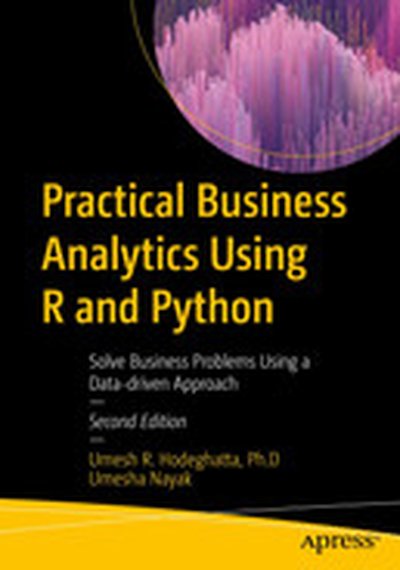
Practical Business Analytics Using R and Python: Solve Business Problems Using a Data-driven Approach

This book illustrates how data can be useful in solving business problems. It explores various analytics techniques for using data to discover hidden patterns and relationships, predict future outcomes, optimize efficiency and improve the performance of organizations. You’ll learn how to analyze data by applying concepts of statistics, probability theory, and linear algebra. In this new edition, both R and Python are used to demonstrate these analyses. Practical Business Analytics Using R and Python also features new chapters covering databases, SQL, Neural networks, Text Analytics, and Natural Language Processing.Part one begins with an introduction to analytics, the foundations required to perform data analytics, and explains different analytics terms and concepts such as databases and SQL, basic statistics, probability theory, and data exploration. Part two introduces predictive models using statistical machine learning and discusses concepts like regression, classification, and neural networks. Part three covers two of the most popular unsupervised learning techniques, clustering and association mining, as well as text mining and natural language processing (NLP). The book concludes with an overview of big data analytics, R and Python essentials for analytics including libraries such as pandas and NumPy. Upon completing this book, you will understand how to improve business outcomes by leveraging R and Python for data analytics. What You Will Learn Master the mathematical foundations required for business analytics Understand various analytics models and data mining techniques such as regression, supervised machine learning algorithms for modeling, unsupervised modeling techniques, and how to choose the correct algorithm for analysis in any given task Use R and Python to develop descriptive models, predictive models, and optimize models Interpret and recommend actions based on analytical model outcomes Who This Book Is For Software professionals and developers, managers, and executives who want to understand and learn the fundamentals of analytics using R and Python.

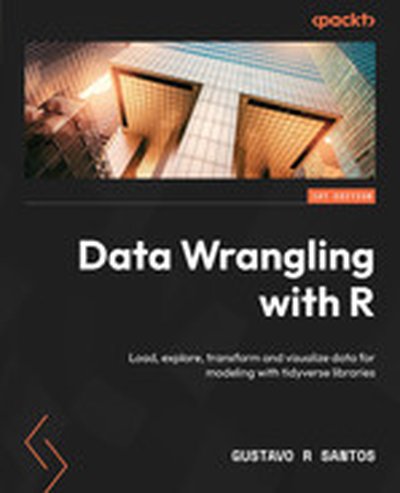
Data Wrangling with R

Data Wrangling with R guides you through mastering data preparation in the R programming language using tidyverse libraries. You will learn techniques to load, explore, transform, and visualize data effectively, gaining the skills needed for data modeling and insights extraction. What this Book will help me do Understand how to use R and tidyverse libraries to handle data wrangling tasks. Learn methods to work with diverse data types like numbers, strings, and dates. Gain proficiency in building visual representations of data using ggplot2. Build and validate your first predictive model for useful insights. Create an interactive web application with Shiny in R. Author(s) Gustavo Santos is an experienced data scientist specializing in R programming and data visualization. With a background in statistics and several years of professional experience in industry and academia, Gustavo excels at translating complex data analytics concepts into practical skills. His approach to teaching is hands-on and example-driven, aiming to empower readers to excel in real-world applications. Who is it for? If you are a data scientist, data analyst, or even a beginner programmer who wants to enhance their data manipulation and visualization skills, this book is perfect for you. Familiarity with R or a general understanding of programming concepts is suggested but not mandatory. It caters to professionals looking to refine their data wrangling workflow and to students aspiring to break into data-centered fields. By the end, you'll be ready to apply data wrangling and visualization tools in your projects.

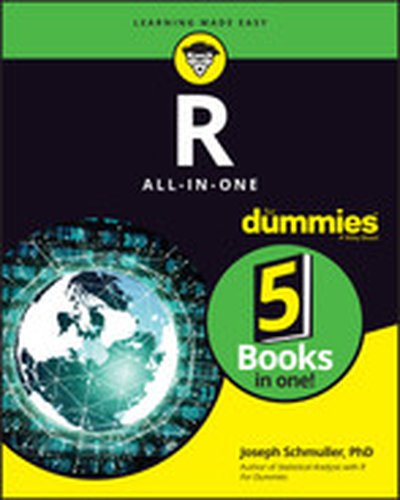
R All-in-One For Dummies

A deep dive into the programming language of choice for statistics and data With R All-in-One For Dummies, you get five mini-books in one, offering a complete and thorough resource on the R programming language and a road map for making sense of the sea of data we're all swimming in. Maybe you're pursuing a career in data science, maybe you're looking to infuse a little statistics know-how into your existing career, or maybe you're just R-curious. This book has your back. Along with providing an overview of coding in R and how to work with the language, this book delves into the types of projects and applications R programmers tend to tackle the most. You'll find coverage of statistical analysis, machine learning, and data management with R. Grasp the basics of the R programming language and write your first lines of code Understand how R programmers use code to analyze data and perform statistical analysis Use R to create data visualizations and machine learning programs Work through sample projects to hone your R coding skill This is an excellent all-in-one resource for beginning coders who'd like to move into the data space by knowing more about R.

Introduction to System Science with MATLAB, 2nd Edition

Introduction to SYSTEM SCIENCE with MATLAB Explores the mathematical basis for developing and evaluating continuous and discrete systems In this revised Second Edition of Introduction to System Science with MATLAB®, the authors Gary Sandquist and Zakary Wilde provide a comprehensive exploration of essential concepts, mathematical framework, analytical resources, and productive skills required to address any rational system confidently and adequately for quantitative evaluation. This Second Edition is supplemented with new updates to the mathematical and technical materials from the first edition. A new chapter to assist readers to generalize and execute algorithms for systems development and analysis, as well as an expansion of the chapter covering specific system science applications, is included. The book provides the mathematical basis for developing and evaluating single and multiple input/output systems that are continuous or discrete. It offers the mathematical basis for the recognition, definition, quantitative modeling, analysis, and evaluation in system science. The book also provides: A comprehensive introduction to system science and the principles of causality and cause and effect operations, including their historical and scientific background A complete exploration of fundamental systems concepts and basic system equations, including definitions and classifications Practical applications and discussions of single-input systems, multiple-input systems, and system modeling and evaluation An in-depth examination of generalized system analysis methods and specific system science applications Perfect for upper-level undergraduate and graduate students in engineering, mathematics, and physical sciences, Introduction to System Science with MATLAB® will also earn a prominent place in libraries of researchers in the life and social sciences.

Pandas for Everyone: Python Data Analysis, 2nd Edition

Manage and Automate Data Analysis with Pandas in Python Today, analysts must manage data characterized by extraordinary variety, velocity, and volume. Using the open source Pandas library, you can use Python to rapidly automate and perform virtually any data analysis task, no matter how large or complex. Pandas can help you ensure the veracity of your data, visualize it for effective decision-making, and reliably reproduce analyses across multiple data sets. Pandas for Everyone, 2nd Edition, brings together practical knowledge and insight for solving real problems with Pandas, even if youre new to Python data analysis. Daniel Y. Chen introduces key concepts through simple but practical examples, incrementally building on them to solve more difficult, real-world data science problems such as using regularization to prevent data overfitting, or when to use unsupervised machine learning methods to find the underlying structure in a data set. New features to the second edition include: Extended coverage of plotting and the seaborn data visualization library Expanded examples and resources Updated Python 3.9 code and packages coverage, including statsmodels and scikit-learn libraries Online bonus material on geopandas, Dask, and creating interactive graphics with Altair Chen gives you a jumpstart on using Pandas with a realistic data set and covers combining data sets, handling missing data, and structuring data sets for easier analysis and visualization. He demonstrates powerful data cleaning techniques, from basic string manipulation to applying functions simultaneously across dataframes. Once your data is ready, Chen guides you through fitting models for prediction, clustering, inference, and exploration. He provides tips on performance and scalability and introduces you to the wider Python data analysis ecosystem. Work with DataFrames and Series, and import or export data Create plots with matplotlib, seaborn, and pandas Combine data sets and handle missing data Reshape, tidy, and clean data sets so theyre easier to work with Convert data types and manipulate text strings Apply functions to scale data manipulations Aggregate, transform, and filter large data sets with groupby Leverage Pandas advanced date and time capabilities Fit linear models using statsmodels and scikit-learn libraries Use generalized linear modeling to fit models with different response variables Compare multiple models to select the best one Regularize to overcome overfitting and improve performance Use clustering in unsupervised machine learning ...

The Art of Data-Driven Business

Learn how to integrate data-driven methodologies and machine learning into your business decision-making processes with 'The Art of Data-Driven Business.' This comprehensive guide shows you how to apply Python-based machine learning techniques to real-world challenges, transforming your organization into an innovative and well-informed enterprise. What this Book will help me do Create professional-quality data visualizations using Python's seaborn library to derive business insights. Analyze customer behavior, including predicting churn, with machine learning techniques. Apply clustering algorithms to segment customers for targeted marketing campaigns. Utilize pandas effectively for pricing and sales analytics to optimize your pricing strategies. Forecast outcomes of promotional strategies to determine costs and benefits and maximize performance. Author(s) None Palacio is an experienced data scientist and educator who specializes in the application of machine learning to solve business problems. With extensive real-world industry experience, Palacio brings practical insights and methodologies to learners. Their teaching connects technical knowledge to actionable business strategies. Who is it for? This book is ideal for business professionals aiming to incorporate data science into their strategies and technical experts seeking to leverage machine learning for business scenarios. Beginners to Python can find foundational help, while data scientists will appreciate the focused practical applications. It's perfect for individuals seeking a strong data-driven perspective in marketing, sales, and customer management.

Beginning MATLAB and Simulink: From Beginner to Pro

Employ essential tools and functions of the MATLAB and Simulink packages, which are explained and demonstrated via interactive examples and case studies. This revised edition covers features from the latest MATLAB 2022b release, as well as other features that have been released since the first edition published. This book contains dozens of simulation models and solved problems via m-files/scripts and Simulink models which will help you to learn programming and modelling essentials. You’ll become efficient with many of the built-in tools and functions of MATLAB/Simulink while solving engineering and scientific computing problems. Beginning MATLAB and Simulink, Second Edition explains various practical issues of programming and modelling in parallel by comparing MATLAB and Simulink. After studying and using this book, you'll be proficient at using MATLAB and Simulink and applying the source code and models from the book's examples as templates for your own projects in data science or engineering. What You Will Learn Master the programming and modelling essentials of MATLAB and Simulink Carry out data visualization with MATLAB Build a GUI and develop App with MATLAB Work with integration and numerical root finding methods Apply MATLAB to differential equations-based models and simulations Use MATLAB and Simulink for data science projects Who This Book Is For Engineers, programmers, data scientists, and students majoring in engineering and scientific computing who are new to MATLAB and Simulink.

R 4 Data Science Quick Reference: A Pocket Guide to APIs, Libraries, and Packages

In this handy, quick reference book you'll be introduced to several R data science packages, with examples of how to use each of them. All concepts will be covered concisely, with many illustrative examples using the following APIs: readr, dibble, forecasts, lubridate, stringr, tidyr, magnittr, dplyr, purrr, ggplot2, modelr, and more. With R 4 Data Science Quick Reference, you'll have the code, APIs, and insights to write data science-based applications in the R programming language. You'll also be able to carry out data analysis. All source code used in the book is freely available on GitHub.. What You'll Learn Implement applicable R 4 programming language specification features Import data with readr Work with categories using forcats, time and dates with lubridate, and strings with stringr Format data using tidyr and then transform that data using magrittr and dplyr Write functions with R for data science, data mining, and analytics-based applications Visualize data with ggplot2 and fit data to models using modelr Who This Book Is For Programmers new to R's data science, data mining, and analytics packages. Some prior coding experience with R in general is recommended.

Mathematical Foundations of Data Science Using R, 2nd Edition

The aim of the book is to help students become data scientists. Since this requires a series of courses over a considerable period of time, the book intends to accompany students from the beginning to an advanced understanding of the knowledge and skills that define a modern data scientist. The book presents a comprehensive overview of the mathematical foundations of the programming language R and of its applications to data science.