talk-data.com talk-data.com

Event

Databricks DATA + AI Summit 2023

2026-01-11 YouTube Visit website ↗

Activities tracked

48

Filtering by: Cyber Security ×

Sessions & talks

Showing 1–25 of 48 · Newest first

Search within this event →
Distributing Data Governance: How Unity Catalog Allows for a Collaborative Approach

Distributing Data Governance: How Unity Catalog Allows for a Collaborative Approach

2023-08-01 Watch
video

As one of the world’s largest providers of content delivery network (CDN) and security solutions, Akamai owns thousands of data assets of various shapes and sizes, some even go up to multiple PBs. Several departments within the company leverage Databricks for their data and AI workloads, which means we have over a hundred Databricks workspaces within a single Databricks account, where some of the assets are shared across products, and some are product-specific.

In this presentation, we will describe how to use the capabilities of Unity Catalog to distribute the administration burden between departments, while still maintaining a unified governance model.

We will also share the benefits we’ve found in using Unity Catalog, beyond just access management, such as:

  • Visibility into which data assets we have in the organization
  • Ability to identify and potentially eliminate duplicate data workloads between departments
  • Removing boilerplate code for accessing external sources
  • Increasing innovation of product teams by exposing the data assets in a better, more efficient way

Talk by: Gilad Asulin and Pulkit Chadha

Connect with us: Website: https://databricks.com Twitter: https://twitter.com/databricks LinkedIn: https://www.linkedin.com/company/databricks Instagram: https://www.instagram.com/databricksinc Facebook: https://www.facebook.com/databricksinc
Internet-Scale Analytics: Migrating a Mission Critical Product to the Cloud

Internet-Scale Analytics: Migrating a Mission Critical Product to the Cloud

2023-07-28 Watch
video

While we may not all agree on a “If it ain’t broke, don’t fix it” approach, we can all agree that “If it shows any crack, migrate it to the cloud and completely re-architect it.” Akamai’s CSI (Cloud Security Intelligence) group is responsible for processing massive amounts of security events arriving from our edge network, which is estimated to process 30% of internet traffic, making it accessible by various internal consumers powering customer-facing products.

In this session, we will visit the reasons for migrating one of our mission critical security products and its 10GB ingest pipeline to the cloud, examine our new architecture and its benefits and touch on the challenges we faced during the process (and still do). While our requirements are unique and our solution contains a few proprietary components, this session will provide you with several concepts involving popular off-the-shelf products you can easily use in your own cloud environment.

Talk by: Yaniv Kunda

Here’s more to explore: Why the Data Lakehouse Is Your next Data Warehouse: https://dbricks.co/3Pt5unq Lakehouse Fundamentals Training: https://dbricks.co/44ancQs

Connect with us: Website: https://databricks.com Twitter: https://twitter.com/databricks LinkedIn: https://www.linkedin.com/company/databricks Instagram: https://www.instagram.com/databricksinc Facebook: https://www.facebook.com/databricksinc
Democratize AI & ML in a Large Company: The Importance of User Enablement & Technical Training

Democratize AI & ML in a Large Company: The Importance of User Enablement & Technical Training

2023-07-27 Watch
video

The biggest critical factor to success in a cloud transformation is people. As such, having a change management process in place to manage the impact of the transformation and user enablement is foundational to any large program. In this session, we will dive into how TD bank democratizes data, mobilizes a community of over 2000 analytics users and the tactics we used to successfully enable new use cases on Cloud. The session will focus on the following:

To democratize data: - Centralize a data platform that is accessible to all employees and allow for easy data sharing - Implement privacy and security to protect data and use data ethically - Compliance and governance for using data in responsible and compliant way - Simplification of processes and procedures to reduce redundancy and faster adoption

To mobilize end users: - Increase data literacy: provide training and resources for employees to increase their abilities and skills - Foster a culture of collaboration and openness: cross-functional teams to collaborate and share ideas - Encourage exploration of innovative ideas that impact the organization's values and customers technical enablement and adoption tactics we've used at TD Bank:

  1. Hands-on training for over 1300+ analytics users with emphasis on learn by doing, to relate to real-life situations
  2. Online tutorials and documentations to be used as self-paced study
  3. Workshops and office hours on specific topics to empower business users
  4. Coaching to work with teams on a specific use case/complex issue and provide recommendations for a faster, cost effective solutions
  5. Offer certification and encourage continuous education for employees to keep up to date with latest
  6. Feedback loop: get user feedback on training and user experience to improve future trainings

Talk by: Ellie Hajarian

Here’s more to explore: State of Data + AI Report: https://dbricks.co/44i2HBp The Data Team's Guide to the Databricks Lakehouse Platform: https://dbricks.co/46nuDpI

Connect with us: Website: https://databricks.com Twitter: https://twitter.com/databricks LinkedIn: https://www.linkedin.com/company/databricks Instagram: https://www.instagram.com/databricksinc Facebook: https://www.facebook.com/databricksinc
Labcorp Data Platform Journey: From Selection to Go-Live in Six Months

Labcorp Data Platform Journey: From Selection to Go-Live in Six Months

2023-07-27 Watch
video

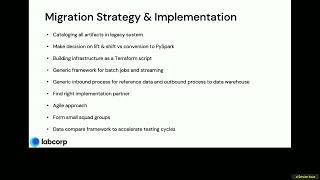
Join this session to learn about the Labcorp data platform transformation from on-premises Hadoop to AWS Databricks Lakehouse. We will share best practices and lessons learned from cloud-native data platform selection, implementation, and migration from Hadoop (within six months) with Unity Catalog.

We will share steps taken to retire several legacy on-premises technologies and leverage Databricks native features like Spark streaming, workflows, job pools, cluster policies and Spark JDBC within Databricks platform. Lessons learned in Implementing Unity Catalog and building a security and governance model that scales across applications. We will show demos that walk you through batch frameworks, streaming frameworks, data compare tools used across several applications to improve data quality and speed of delivery.

Discover how we have improved operational efficiency, resiliency and reduced TCO, and how we scaled building workspaces and associated cloud infrastructure using Terraform provider.

Talk by: Mohan Kolli and Sreekanth Ratakonda

Connect with us: Website: https://databricks.com Twitter: https://twitter.com/databricks LinkedIn: https://www.linkedin.com/company/databricks Instagram: https://www.instagram.com/databricksinc Facebook: https://www.facebook.com/databricksinc
Managing Data Encryption in Apache Spark™

Managing Data Encryption in Apache Spark™

2023-07-27 Watch
video

Sensitive data sets can be encrypted directly by new Apache Spark™ versions (3.2 and higher). Setting several configuration parameters and DataFrame options will trigger the Apache Parquet modular encryption mechanism that protects select columns with column-specific keys. The upcoming Spark 3.4 version will also support uniform encryption, where all DataFrame columns are encrypted with the same key.

Spark data encryption is already leveraged by a number of companies to protect personal or business confidential data in their production environments. The main integration effort is focused on key access control and on building a Spark/Parquet plug-in code that can interact with company’s key management service (KMS).

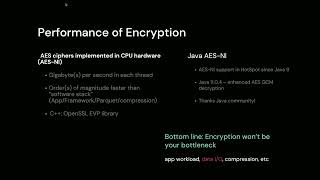
In this session, we will briefly cover the basics of Spark/Parquet encryption usage, and dive into the details of encryption key management that will help in integrating this Spark data protection mechanism in your deployment. You will learn how to run a HelloWorld encryption sample, and how to extend it into a real world production code integrated with your organization’s KMS and access control policies. We will talk about the standard envelope encryption approach to big data protection, the performance-vs-security trade-offs between single and double envelope wrapping, internal and external key metadata storage. We will see a demo, and discuss the new features such as uniform encryption and two-tier management of encryption keys.

Talk by: Gidon Gershinsky

Here’s more to explore: Data, Analytics, and AI Governance: https://dbricks.co/44gu3YU

Connect with us: Website: https://databricks.com Twitter: https://twitter.com/databricks LinkedIn: https://www.linkedin.com/company/databricks Instagram: https://www.instagram.com/databricksinc Facebook: https://www.facebook.com/databricksinc
Map Your Lakehouse Content with DiscoverX

Map Your Lakehouse Content with DiscoverX

2023-07-26 Watch
video

An enterprise lakehouse contains many different datasets which are related to different sources and might belong to different business units. These datasets can span across hundreds of tables, and each table has a different schema, and those schemas evolve over time. The cyber security domain is a good example where datasets come from many different source systems and land in the lakehouse. With such a complex dataset ecosystem, answers to simple questions like “Have we ever detected this IP address?” or “Which columns contain IP addresses?” can become impractical and expensive.

DiscoverX can automate the discovery of all columns that might contain specific patterns, (e.g., IP addresses, MAC addresses, fully qualified domain names, etc.) and automatically generate search and indexing queries that span across multiple tables and columns.

Talk by: Erni Durdevic and David Tempelmann

Connect with us: Website: https://databricks.com Twitter: https://twitter.com/databricks LinkedIn: https://www.linkedin.com/company/databricks Instagram: https://www.instagram.com/databricksinc Facebook: https://www.facebook.com/databricksinc
Enabling Data Governance at Enterprise Scale Using Unity Catalog

Enabling Data Governance at Enterprise Scale Using Unity Catalog

2023-07-26 Watch
video

Amgen has invested in building modern, cloud-native enterprise data and analytics platforms over the past few years with a focus on tech rationalization, data democratization, overall user experience, increase reusability, and cost-effectiveness. One of these platforms is our Enterprise Data Fabric which focuses on pulling in data across functions and providing capabilities to integrate and connect the data and govern access. For a while, we have been trying to set up robust data governance capabilities which are simple, yet easy to manage through Databricks. There were a few tools in the market that solved a few immediate needs, but none solved the problem holistically. For use cases like maintaining governance on highly restricted data domains like Finance and HR, a long-term solution native to Databricks and addressing the below limitations was deemed important:

The way these tools were set up, allowed the overriding of a few security policies

  • Tools were not UpToDate with the latest DBR runtime
  • Complexity of implementing fine-grained security
  • Policy management – AWS IAM + In tool policies

To address these challenges, and for large-scale enterprise adoption of our governance capability, we started working on UC integration with our governance processes. With an aim to realize the following tech benefits:

  • Independent of Databricks runtime
  • Easy fine-grained access control
  • Eliminated management of IAM roles
  • Dynamic access control using UC and dynamic views

Today, using UC, we have to implement fine-grained access control & governance for the restricted data of Amgen. We are in the process of devising a realistic migration & change management strategy across the enterprise.

Talk by: Lakhan Prajapati and Jaison Dominic

Connect with us: Website: https://databricks.com Twitter: https://twitter.com/databricks LinkedIn: https://www.linkedin.com/company/databricks Instagram: https://www.instagram.com/databricksinc Facebook: https://www.facebook.com/databricksinc
Instacart on Why Engineers Shouldn't Write Data Governance Policies

Instacart on Why Engineers Shouldn't Write Data Governance Policies

2023-07-26 Watch
video

Controlling permissions for accessing data assets can be messy, time consuming, and usually a combination of both. The teams responsible for creating the business rules that govern who should have access to what data are usually different from the teams responsible for administering the grants to achieve that access. On the other side of the equation, the end user who needs access to a data asset may be left waiting for grants to be made as the decision is passed between teams. That is, if they even know the correct path to getting access in the first place.

Separating the concerns of managing data governance at a business level and implementing data governance at an engineering level is the best way to clarify data access permissions. In practice, this involves building systems to enable data governance enforcement based on business rules, with little to no understanding of the individual system where the data lives.

In practice, with a concrete business rule, such as “only users from the finance team should have access to critical financial data,” we want a system that deals only with those constituent concepts. For example, “the data is marked as critical financial” and “the user is a part of the finance team.” By abstracting away any source system components, such as “the tables in the finance schema” and “someone who’s a member of the finance Databricks group,” the access policies applied will then model the business rules as closely as possible.

This session will focus on how to establish and align the processes, policies, and stakeholders involved in making this type of system work seamlessly. Sharing the experience and learnings of our team at Instacart, we will aim to help attendees streamline and simplify their data security and access strategies.

Talk by: Kieran Taylor and Andria Fuquen

Connect with us: Website: https://databricks.com Twitter: https://twitter.com/databricks LinkedIn: https://www.linkedin.com/company/databricks Instagram: https://www.instagram.com/databricksinc Facebook: https://www.facebook.com/databricksinc
Self-Service Data Analytics and Governance at Enterprise Scale with Unity Catalog

Self-Service Data Analytics and Governance at Enterprise Scale with Unity Catalog

2023-07-26 Watch
video

This session focuses on one of the first Unity Catalog implementations for a large-scale enterprise. In this scenario, a cloud scale analytics platform with 7500 active users based on the lakehouse approach is used. In addition, there is potential for 1500 further users who are subject to special governance rules. They are consuming more than 600 TB of data stored in Delta Lake - continuously growing at more than 1TB per day. This might grow due to local country data. Therefore, the existing data platform must be extended to enable users to combine global and local data from their countries. A new data management was required, which reflects the strict information security rules at a need to know base. Core requirements are: read only from global data, write into local and share the results.

Due to a very pronounced information security awareness and a lack of the technological possibilities it was not possible to interdisciplinary analyze and exchange data so easy or at all so far. Therefore, a lot of business potential and gains could not be identified and realized.

With the new developments in the technology used and the basis of the lakehouse approach, thanks to Unity Catalog, we were able to develop a solution that could meet high requirements for security and process. And enables globally secured interdisciplinary data exchange and analysis at scale. This solution enables the democratization of the data. This results not only in the ability to gain better insights for business management, but also to generate entirely new business cases or products that require a higher degree of data integration and encourage the culture to change. We highlight technical challenges and solutions, present best practices and point out benefits of implementing Unity catalog for enterprises.

Talk by: Artem Meshcheryakov and Pascal van Bellen

Here’s more to explore: Data, Analytics, and AI Governance: https://dbricks.co/44gu3YU

Connect with us: Website: https://databricks.com Twitter: https://twitter.com/databricks LinkedIn: https://www.linkedin.com/company/databricks Instagram: https://www.instagram.com/databricksinc Facebook: https://www.facebook.com/databricksinc
Why a Major Japanese Financial Institution Chose Databricks To Accelerate its Data AI-Driven Journey

Why a Major Japanese Financial Institution Chose Databricks To Accelerate its Data AI-Driven Journey

2023-07-26 Watch
video
Yuki Saito (NTT DATA)

In this session, NTT DATA presents a case study involving of one of the largest and most prominent financial institutions in Japan. The project involved migration from the largest data analysis platform to Databricks, a project that required careful navigation of very strict security requirements while accommodating the needs of evolving technical solutions so they could support a wide variety of company structures. This session is for those who want to accelerate their business by effectively utilizing AI as well as BI.

NTT DATA is one of the largest system integrators in Japan, providing data analytics infrastructure to leading companies to help them effectively drive the democratization of data and AI as many in the Japanese market are now adding AI into their BI offering.

Talk by: Yuki Saito

Connect with us: Website: https://databricks.com Twitter: https://twitter.com/databricks LinkedIn: https://www.linkedin.com/company/databricks Instagram: https://www.instagram.com/databricksinc Facebook: https://www.facebook.com/databricksinc
Databricks and Delta Lake: Lessons Learned from Building Akamai's Web Security Analytics Product

Databricks and Delta Lake: Lessons Learned from Building Akamai's Web Security Analytics Product

2023-07-26 Watch
video
Tomer Patel , Itai Yaffe (Nielsen Identity Engine)

Akamai is a leading content delivery network (CDN) and cybersecurity company operating hundreds of thousands of servers in more than 135 countries worldwide. In this session, we will share our experiences and lessons learned from building and maintaining the Web Security Analytics (WSA) product, an interactive analytics platform powered by Databricks and Delta Lake that enables customers to efficiently analyze and take informed action on a high volume of streaming security events.

The WSA platform must be able to serve hundreds of queries per minute, scanning hundreds of terabytes of data from a six petabyte data lake, with most queries returning results within ten seconds; for both aggregation queries and needle in a haystack queries. This session will cover how to use Databricks SQL warehouses and job clusters cost-effectively, and how to improve query performance using tools and techniques such as Delta Lake, Databricks Photon, and partitioning. This talk will be valuable for anyone looking to build and operate a high-performance analytics platform.

Talk by: Tomer Patel and Itai Yaffe

Connect with us: Website: https://databricks.com Twitter: https://twitter.com/databricks LinkedIn: https://www.linkedin.com/company/databricks Instagram: https://www.instagram.com/databricksinc Facebook: https://www.facebook.com/databricksinc
Data Globalization at Conde Nast Using Delta Sharing

Data Globalization at Conde Nast Using Delta Sharing

2023-07-26 Watch
video

Databricks has been an essential part of the Conde Nast architecture for the last few years. Prior to building our centralized data platform, “evergreen,” we had similar challenges as many other organizations; siloed data, duplicated efforts for engineers, and a lack of collaboration between data teams. These problems led to mistrust in data sets and made it difficult to scale to meet the strategic globalization plan we had for Conde Nast.

Over the last few years we have been extremely successful in building a centralized data platform on Databricks in AWS, fully embracing the lakehouse vision from end-to-end. Now, our analysts and marketers can derive the same insights from one dataset and data scientists can use the same datasets for use cases such as personalization, subscriber propensity models, churn models and on-site recommendations for our iconic brands.

In this session, we’ll discuss how we plan to incorporate Unity Catalog and Delta Sharing as the next phase of our globalization mission. The evergreen platform has become the global standard for data processing and analytics at Conde. In order to manage the worldwide data and comply with GDPR requirements, we need to make sure data is processed in the appropriate region and PII data is handled appropriately. At the same time, we need to have a global view of the data to allow us to make business decisions at the global level. We’ll talk about how delta sharing allows us a simple, secure way to share de-identified datasets across regions in order to make these strategic business decisions, while complying with security requirements. Additionally, we’ll discuss how Unity Catalog allows us to secure, govern and audit these datasets in an easy and scalable manner.

Talk by: Zachary Bannor

Connect with us: Website: https://databricks.com Twitter: https://twitter.com/databricks LinkedIn: https://www.linkedin.com/company/databricks Instagram: https://www.instagram.com/databricksinc Facebook: https://www.facebook.com/databricksinc
Essential Data Security Strategies for the Modern Enterprise Data Architecture

Essential Data Security Strategies for the Modern Enterprise Data Architecture

2023-07-26 Watch
video

Balancing critical data requirements is a 24-7 task for enterprise-level organizations that must straddle the need to open specific gates to enable self-service data access while closing other access points to maintain internal and external compliance. Data breaches can cost U.S. businesses an average of $9.4 million per occurrence; ignoring this leaves organizations vulnerable to severe losses and crippling costs.

The 2022 Gartner Hype Cycle for Data Security reports that more and more enterprises are modernizing their data architecture with cloud and technology partners to help them collect, store and manage business data; a trend that does not appear to be letting up. According to Gartner®, “by 2025, 30% of enterprises will have adopted the Broad Data Security Platform (bDSP), up from less than 10% in 2021, due to the pent-up demand for higher levels of data security and the rapid increase in product capabilities."

Moving to both a modern data architecture and data-driven culture sets enterprises on the right trajectory for growth, but it’s important to keep in mind individual public cloud platforms are not guaranteed to protect and secure data. To solve this, Privacera pioneered the industry’s first open-standards-based data security platform that integrates privacy and compliance across multiple cloud services.

During this presentation, we will discuss: - Why today’s modern data architecture needs a DSP that works across the entire data ecosystem; Essential DSP prescriptive measures and adoption strategies. - Why faster and more responsible access to data insights helps reduce cost, increases productivity, expedites decision making, and leads to exponential growth.

Talk by: Piet Loubser

Here’s more to explore: Data, Analytics, and AI Governance: https://dbricks.co/44gu3YU

Connect with us: Website: https://databricks.com Twitter: https://twitter.com/databricks LinkedIn: https://www.linkedin.com/company/databricks Instagram: https://www.instagram.com/databricksinc Facebook: https://www.facebook.com/databricksinc
Testing Generative AI Models: What You Need to Know

Testing Generative AI Models: What You Need to Know

2023-07-26 Watch
video

Generative AI shows incredible promise for enterprise applications. The explosion of generative AI can be attributed to the convergence of several factors. Most significant is that the barrier to entry has dropped for AI application developers through customizable prompts (few-shot learning), enabling laypeople to generate high-quality content. The flexibility of models like ChatGPT and DALLE-2 have sparked curiosity and creativity about new applications that they can support. The number of tools will continue to grow in a manner similar to how AWS fueled app development. But excitement must be tampered by concerns about new risks imposed to business and society. Increased capability and adoption also increase risk exposure. As organizations explore creative boundaries of generative models, measures to reduce risk must be put in place. However, the enormous size of the input space and inherent complexity make this task more challenging than traditional ML models.

In this session, we summarize the new risks introduced by the new class of generative foundation models through several examples, and compare how these risks relate to the risks of mainstream discriminative models. Steps can be taken to reduce the operational risk, bias and fairness issues, and privacy and security of systems that leverage LLM for automation. We’ll explore model hallucinations, output evaluation, output bias, prompt injection, data leakage, stochasticity, and more. We’ll discuss some of the larger issues common to LLMs and show how to test for them. A comprehensive, test-based approach to generative AI development will help instill model integrity by proactively mitigating failure and the associated business risk.

Talk by: Yaron Singer

Here’s more to explore: LLM Compact Guide: https://dbricks.co/43WuQyb Big Book of MLOps: https://dbricks.co/3r0Pqiz

Connect with us: Website: https://databricks.com Twitter: https://twitter.com/databricks LinkedIn: https://www.linkedin.com/company/databricks Instagram: https://www.instagram.com/databricksinc Facebook: https://www.facebook.com/databricksinc

Activate Your Lakehouse with Unity Catalog

Activate Your Lakehouse with Unity Catalog

2023-07-26 Watch
video

Building a lakehouse is straightforward today thanks to many open source technologies and Databricks. However, it can be taxing to extract value from lakehouses as they grow without robust data operations. Join us to learn how YipitData uses the Unity Catalog to streamline data operations and discover best practices to scale your own Lakehouse. At YipitData, our 15+ petabyte Lakehouse is a self-service data platform built with Databricks and AWS, supporting analytics for a data team of over 250. We will share how leveraging Unity Catalog accelerates our mission to help financial institutions and corporations leverage alternative data by:

  • Enabling clients to universally access our data through a spectrum of channels, including Sigma, Delta Sharing, and multiple clouds
  • Fostering collaboration across internal teams using a data mesh paradigm that yields rich insights
  • Strengthening the integrity and security of data assets through ACLs, data lineage, audit logs, and further isolation of AWS resources
  • Reducing the cost of large tables without downtime through automated data expiration and ETL optimizations on managed delta tables

Through our migration to Unity Catalog, we have gained tactics and philosophies to seamlessly flow our data assets internally and externally. Data platforms need to be value-generating, secure, and cost-effective in today's world. We are excited to share how Unity Catalog delivers on this and helps you get the most out of your lakehouse.

Talk by: Anup Segu

Connect with us: Website: https://databricks.com Twitter: https://twitter.com/databricks LinkedIn: https://www.linkedin.com/company/databricks Instagram: https://www.instagram.com/databricksinc Facebook: https://www.facebook.com/databricksinc
US Army Corp of Engineers Enhanced Commerce & National Sec Through Data-Driven Geospatial Insight

US Army Corp of Engineers Enhanced Commerce & National Sec Through Data-Driven Geospatial Insight

2023-07-26 Watch
video

The US Army Corps of Engineers (USACE) is responsible for maintaining and improving nearly 12,000 miles of shallow-draft (9'-14') inland and intracoastal waterways, 13,000 miles of deep-draft (14' and greater) coastal channels, and 400 ports, harbors, and turning basins throughout the United States. Because these components of the national waterway network are considered assets to both US commerce and national security, they must be carefully managed to keep marine traffic operating safely and efficiently.

The National DQM Program is tasked with providing USACE a nationally standardized remote monitoring and documentation system across multiple vessel types with timely data access, reporting, dredge certifications, data quality control, and data management. Government systems have often lagged commercial systems in modernization efforts, and the emergence of the cloud and Data Lakehouse Architectures have empowered USACE to successfully move into the modern data era.

This session incorporates aspects of these topics: Data Lakehouse Architecture: Delta Lake, platform security and privacy, serverless, administration, data warehouse, Data Lake, Apache Iceberg, Data Mesh GIS: H3, MOSAIC, spatial analysis data engineering: data pipelines, orchestration, CDC, medallion architecture, Databricks Workflows, data munging, ETL/ELT, lakehouses, data lakes, Parquet, Data Mesh, Apache Spark™ internals. Data Streaming: Apache Spark Structured Streaming, real-time ingestion, real-time ETL, real-time ML, real-time analytics, and real-time applications, Delta Live Tables. ML: PyTorch, TensorFlow, Keras, scikit-learn, Python and R ecosystems data governance: security, compliance, RMF, NIST data sharing: sharing and collaboration, delta sharing, data cleanliness, APIs.

Talk by: Jeff Mroz

Connect with us: Website: https://databricks.com Twitter: https://twitter.com/databricks LinkedIn: https://www.linkedin.com/company/databricks Instagram: https://www.instagram.com/databricksinc Facebook: https://www.facebook.com/databricksinc
Advanced Governance with Collibra on Databricks

Advanced Governance with Collibra on Databricks

2023-07-26 Watch
video

A data lake is only as good as its governance. Understanding what data you have, performing classification, defining/applying security policies and auding how it's used is the data governance lifecycle. Unity Catalog with its rich ecosystem of supported tools simplifies all stages of the data governance lifecycle. Learn how metadata can be hydrated, into Collibra directly from Unity Catalog. Once the metadata is available in Collibra we will demonstrate classification, defining security policies on the data and pushing those policies into Databricks. All access and usage of data is automatically audited with real time lineage provided in the data explorer as well as system tables.

Talk by: Leon Eller and Antonio Castelo

Connect with us: Website: https://databricks.com Twitter: https://twitter.com/databricks LinkedIn: https://www.linkedin.com/company/databricks Instagram: https://www.instagram.com/databricksinc Facebook: https://www.facebook.com/databricksin

Best Practices for Setting Up Databricks SQL at Enterprise Scale

Best Practices for Setting Up Databricks SQL at Enterprise Scale

2023-07-26 Watch
video
Paul Roome (Databricks) , Jeremy Lewallen (Databricks) , Siddharth Bhai (Databricks) , Samrat Ray (Databricks)

To learn more, visit the Databricks Security and Trust Center: https://www.databricks.com/trust

In this session, we will talk about the best practices for setting up Databricks to run at large enterprise scale with thousands of users, departmental security and governance, and end-to-end lineage from ingestion to BI tools. We’ll showcase the power of Unity Catalog and Databricks SQL as the core of your modern data stack and how to achieve both data, environment, and financial governance while empowering your users to quickly find and access the data they need.

Talk by: Siddharth Bhai, Paul Roome, Jeremy Lewallen, and Samrat Ray

Connect with us: Website: https://databricks.com Twitter: https://twitter.com/databricks LinkedIn: https://www.linkedin.com/company/databricks Instagram: https://www.instagram.com/databricksinc Facebook: https://www.facebook.com/databricksin

Sponsored by: Immuta | Building an End-to-End MLOps Workflow with Automated Data Access Controls

Sponsored by: Immuta | Building an End-to-End MLOps Workflow with Automated Data Access Controls

2023-07-26 Watch
video

WorldQuant Predictive’s customers rely on our predictions to understand how changing world and market conditions will impact decisions to be made. Speed is critical, and so are accuracy and resilience. To that end, our data team built a modern, automated MLOps data flow using Databricks as a key part of our data science tooling, and integrated with Immuta to provide automated data security and access control.

In this session, we will share details of how we used policy-as-code to support our globally distributed data science team with secure data sharing, testing, validation and other model quality requirements. We will also discuss our data science workflow that uses Databricks-hosted MLflow together with an Immuta-backed custom feature store to maximize speed and quality of model development through automation. Finally, we will discuss how we deploy the models into our customized serverless inference environment, and how that powers our industry solutions.

Talk by: Tyler Ditto

Connect with us: Website: https://databricks.com Twitter: https://twitter.com/databricks LinkedIn: https://www.linkedin.com/company/databricks Instagram: https://www.instagram.com/databricksinc Facebook: https://www.facebook.com/databricksinc
What’s New With Platform Security and Compliance in the Databricks Lakehouse Platform

What’s New With Platform Security and Compliance in the Databricks Lakehouse Platform

2023-07-26 Watch
video
David Veuve (Databricks) , Samrat Ray (Databricks)

At Databricks, we know that data is one of your most valuable assets and alwasys must be protected, that’s why security is built into every layer of the Databricks Lakehouse Platform. Databricks provides comprehensive security to protect your data and workloads, such as encryption, network controls, data governance and auditing.

In this session, you will hear from Databricks product leaders on the platform security and compliance progress made over the past year, with demos on how administrators can start protecting workloads fast. You will also learn more about the roadmap that delivers on the Databricks commitment to you as the most trusted, compliant, and secure data and AI platform with the Databricks Lakehouse.

Talk by: Samrat Ray and David Veuve

Connect with us: Website: https://databricks.com Twitter: https://twitter.com/databricks LinkedIn: https://www.linkedin.com/company/databricks Instagram: https://www.instagram.com/databricksinc Facebook: https://www.facebook.com/databricksin

Sponsored by: Privacera | Applying Advanced Data Security Governance with Databricks Unity Catalog

Sponsored by: Privacera | Applying Advanced Data Security Governance with Databricks Unity Catalog

2023-07-26 Watch
video

This talk explores the application of advanced data security and access control integrated with Databricks Unity Catalog through Privacera. Learn about Databricks with Unity Catalog and Privacera capabilities and real-world use cases demonstrating data security and access control best practices and how to successfully plan for and implement enterprise data security governance at scale across your entire Databricks Lakehouse.

Talk by: Don Bosco Durai

Connect with us: Website: https://databricks.com Twitter: https://twitter.com/databricks LinkedIn: https://www.linkedin.com/company/databricks Instagram: https://www.instagram.com/databricksinc Facebook: https://www.facebook.com/databricksinc
Lakehouse Architecture to Advance Security Analytics at the Department of State

Lakehouse Architecture to Advance Security Analytics at the Department of State

2023-07-26 Watch
video

In 2023, the Department of State surged forward on implementing a lakehouse architecture to get faster, smarter, and more effective on cybersecurity log monitoring and incident response. In addition to getting us ahead of federal mandates, this approach promises to enable advanced analytics and machine learning across our highly federated global IT environment while minimizing costs associated with data retention and aggregation.

This talk will include a high-level overview of the technical and policy challenge and a technical deeper dive on the tactical implementation choices made. We’ll share lessons learned related to governance and securing organizational support, connecting between multiple cloud environments, and standardizing data to make it useful for analytics. And finally, we’ll discuss how the lakehouse leverages Databricks in multicloud environments to promote decentralized ownership of data while enabling strong, centralized data governance practices.

Talk by: Timothy Ahrens and Edward Moe

Connect with us: Website: https://databricks.com Twitter: https://twitter.com/databricks LinkedIn: https://www.linkedin.com/company/databricks Instagram: https://www.instagram.com/databricksinc Facebook: https://www.facebook.com/databricksinc
Security Best Practices and Tools to Build a Secure Lakehouse

Security Best Practices and Tools to Build a Secure Lakehouse

2023-07-26 Watch
video
Arun Pamulapati (Databricks) , Anindita Mahapatra (Databricks)

To learn more, visit the Databricks Security and Trust Center: https://www.databricks.com/trust

As you embark on a lakehouse project or evolve your existing data lake, you may want to improve your security posture and take advantage of new security features—there may even be a security team at your company that demands it. Databricks has worked with thousands of customers to securely deploy the Databricks Platform to meet their architecture and security requirements. While many organizations deploy security differently, we have found a common set of guidelines and features among organizations that require a high level of security. In this session, we will detail the security features and architectural choices frequently used by these organizations and walk through a series of threat models for the risks that most concern security teams. While this session is great for people who already know Databricks—don’t worry—that knowledge isn’t required. You will walk away with a full handbook detailing all the concepts, configurations, check lists, security analysis tool (SAT), and security reference architecture (SRA) automation scripts from the session so that you can make immediate progress when you get back to the office. Security can be hard, but we’ve collected the hard work already done by some of the best in the industry, and built tools, to make it easier. Come learn how. See how good looks like via a demo.

Talk by: Arun Pamulapati and Anindita Mahapatra

Connect with us: Website: https://databricks.com Twitter: https://twitter.com/databricks LinkedIn: https://www.linkedin.com/company/databricks Instagram: https://www.instagram.com/databricksinc Facebook: https://www.facebook.com/databricksinc
Cutting the Edge in Fighting Cybercrime: Reverse-Engineering a Search Language to Cross-Compile

Cutting the Edge in Fighting Cybercrime: Reverse-Engineering a Search Language to Cross-Compile

2022-07-22 Watch
video

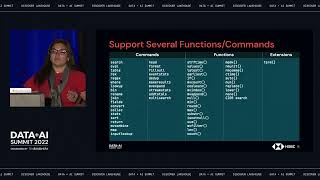
Traditional cybersecurity Security Information and Event Management (SIEM) ways do not scale well for data sources with 30TiB per day, leading HSBC to create a Cybersecurity Lakehouse with Delta and Spark. Creating a platform to overcome several conventional technical constraints, the limitation in the amount of data for long-term analytics available in traditional platforms and query languages is difficult to scale and time-consuming to run. In this talk, we’ll learn how to implement (or actually reverse-engineer) a language with Scala and translate it into what Apache Spark understands, the Catalyst engine. We’ll guide you through the technical journey of building equivalents of a query language into Spark. We’ll learn how HSBC business benefited from this cutting-edge innovation, like decreasing time and resources for Cyber data processing migration, improving Cyber threat Incident Response, and fast onboarding of HSBC Cyber Analysts on Spark with Cybersecurity Lakehouse platform.

Connect with us: Website: https://databricks.com Facebook: https://www.facebook.com/databricksinc Twitter: https://twitter.com/databricks LinkedIn: https://www.linkedin.com/company/data... Instagram: https://www.instagram.com/databricksinc/
Scaling Privacy: Practical Architectures and Experiences

Scaling Privacy: Practical Architectures and Experiences

2022-07-19 Watch
video

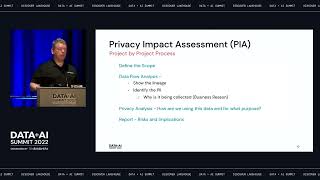
At Spark Data & AI 2021, We presented the use case around Privacy in an Insurance Landscape using Privacera. Scaling Privacy in a Spark Ecosystem (https://www.youtube.com/watch?v=cjJEMlNcg5k). In one year, the concept of privacy and security have taken off as a major need to solve and the ability to embed this into business process to empower data democratization has become mandatory. The concept that data is a product is now commonplace and that ability to rapidly innovate those products hinges on the ability to balance a dual mandate. One mandate: Move Fast. Second Mandate: Manage Privacy and Security. How do we make this happen? Let's dig into the real details and experiences and show the blueprint for success.

Connect with us: Website: https://databricks.com Facebook: https://www.facebook.com/databricksinc Twitter: https://twitter.com/databricks LinkedIn: https://www.linkedin.com/company/data... Instagram: https://www.instagram.com/databricksinc/