Hear how Mercy Corps leveraged Cloudera’s AI to transform data into actionable insights, enabling agile responses in crisis situations. The session will provide some principles on how to setup a scalable AI capability in your organisation and explore the Mercy Corps connection between data systems and organisational goals, which has allowed them to convert complex data into immediate, actionable insights. This approach can offer valuable guidance for other industries looking to expand their decision-making capabilities through AI.
 talk-data.com
Topic
Agile/Scrum
project_management
software_development
methodology
561
tagged
Activity Trend
163
peak/qtr
2020-Q1
2026-Q2
Top Events
AWS re:Invent 2024
341
O'Reilly Data Engineering Books
56
O'Reilly Data Science Books
22
Data Engineering Podcast
11
DataTalks.Club
10
Databricks DATA + AI Summit 2023
8
Big Data & AI Paris 2025
8
Data + AI Summit 2025
7
Big Data LDN 2025
6
Secrets of Data Analytics Leaders
6
gartner-data-analytics-apac-2025
5
Experiencing Data w/ Brian T. O’Neill (AI & data product management leadership—powered by UX design)
5
Hear the latest best practices for harnessing Appian’s low-code, process automation platform including key technologies such as data fabric and Process HQ. Discover the power of real time, business generated data insights, dashboards and process insights that can transform the way business owners make agile, data-based decisions.
In this episode of Hub & Spoken, Jason Foster, CEO & Founder of Cynozure, speaks with Lisa Allen, Director of Data at The Pensions Regulator (TPR), about the role of data in protecting savers and shaping a more resilient pensions industry. Lisa shares the story behind TPR's new data strategy and how it's helping to modernise an ecosystem that oversees more than £2 trillion in savings across 38 million members. Drawing on her experience at organisations including the Ordnance Survey and the Open Data Institute, she explains why strong data foundations, industry collaboration, and adaptive thinking are essential to success. The conversation explores how the regulator is building a data marketplace, adopting open standards, and applying AI to enable risk-based regulation, while reducing unnecessary burdens on the industry. Lisa also discusses the value of working transparently, co-designing with stakeholders, and staying agile in the face of rapid change. This episode is a must-listen for business leaders, regulators, and data professionals thinking about strategy, innovation, and sector-wide impact. **** Cynozure is a leading data, analytics and AI company that helps organisations to reach their data potential. It works with clients on data and AI strategy, data management, data architecture and engineering, analytics and AI, data culture and literacy, and data leadership. The company was named one of The Sunday Times' fastest-growing private companies in both 2022 and 2023 and recognised as The Best Place to Work in Data by DataIQ in 2023 and 2024. Cynozure is a certified B Corporation.
Seismic shift Large Language Models are unleashing on data engineering, challenging traditional workflows. LLMs obliterate inefficiencies and redefine productivity. AI powerhouses automate complex tasks like documentation, code translation, and data model development with unprecedented speed and precision. Integrating LLMs into tools promises to reduce offshore dependency, fostering agile onshore innovation. Harnessing LLMs' full potential involves challenges, requiring deep dives into domain-specific data and strategic business alignment. Session will addresses deploying LLMs effectively, overcoming data management hurdles, and fostering collaboration between engineers and stakeholders. Join us to explore a future where LLMs redefine possibilities, inviting you to embrace AI-driven innovation and position your organization as a leader in data engineering.
Supported by Our Partners • Sonar — Code quality and code security for ALL code. • Statsig — The unified platform for flags, analytics, experiments, and more. • Augment Code — AI coding assistant that pro engineering teams love. — Kent Beck is one of the most influential figures in modern software development. Creator of Extreme Programming (XP), co-author of The Agile Manifesto, and a pioneer of Test-Driven Development (TDD), he’s shaped how teams write, test, and think about code. Now, with over five decades of programming experience, Kent is still pushing boundaries—this time with AI coding tools. In this episode of Pragmatic Engineer, I sit down with him to talk about what’s changed, what hasn’t, and why he’s more excited than ever to code. In our conversation, we cover: • Why Kent calls AI tools an “unpredictable genie”—and how he’s using them • Why Kent no longer has an emotional attachment to any specific programming language • The backstory of The Agile Manifesto—and why Kent resisted the word “agile” • An overview of XP (Extreme Programming) and how Grady Booch played a role in the name • Tape-to-tape experiments in Kent’s childhood that laid the groundwork for TDD • Kent’s time at Facebook and how he adapted to its culture and use of feature flags • And much more! — Timestamps (00:00) Intro (02:27) What Kent has been up to since writing Tidy First (06:05) Why AI tools are making coding more fun for Kent and why he compares it to a genie (13:41) Why Kent says languages don’t matter anymore (16:56) Kent’s current project building a small talk server (17:51) How Kent got involved with The Agile Manifesto (23:46) Gergely’s time at JP Morgan, and why Kent didn’t like the word ‘agile’ (26:25) An overview of “extreme programming” (XP) (35:41) Kent’s childhood tape-to-tape experiments that inspired TDD (42:11) Kent’s response to Ousterhout’s criticism of TDD (50:05) Why Kent still uses TDD with his AI stack (54:26) How Facebook operated in 2011 (1:04:10) Facebook in 2011 vs. 2017 (1:12:24) Rapid fire round — The Pragmatic Engineer deepdives relevant for this episode: • — See the transcript and other references from the episode at https://newsletter.pragmaticengineer.com/podcast — Production and marketing by https://penname.co/. For inquiries about sponsoring the podcast, email [email protected].
Get full access to The Pragmatic Engineer at newsletter.pragmaticengineer.com/subscribe
![Dusting off the Cobwebs — Moving off a 26-year-old Heritage Platform to Databricks [Teradata]](https://img.youtube.com/vi/bG8pdYFxVIw/mqdefault.jpg)
Join us to hear about how National Australia Bank (NAB) successfully completed a significant milestone in its data strategy by decommissioning its 26-year-old Teradata environment and migrating to a new strategic data platform called 'Ada'. This transition marks a pivotal shift from legacy systems to a modern, cloud-based data and AI platform powered by Databricks. The migration process, which spanned two years, involved ingesting 16 data sources, transferring 456 use cases, and collaborating with hundreds of users across 12 business units. This strategic move positions NAB to leverage the full potential of cloud-native data analytics, enabling more agile and data-driven decision-making across the organization. The successful migration to Ada represents a significant step forward in NAB's ongoing efforts to modernize its data infrastructure and capitalize on emerging technologies in the rapidly evolving financial services landscape
The role of data teams and data engineers is evolving. No longer just pipeline builders or dashboard creators, today’s data teams must evolve to drive business strategy, enable automation, and scale with growing demands. Best practices seen in the software engineering world (Agile development, CI/CD, and Infrastructure-as-code) from the DevOps movement are gradually making their way into data engineering. We believe these changes have led to the rise of DataOps and a new wave of best practices that will transform the discipline of data engineering. But how do you transform a reactive team into a proactive force for innovation? We’ll explore the key principles for building a resilient, high-impact data team—from structuring for collaboration, testing, automation, to leveraging modern orchestration tools. Whether you’re leading a team or looking to future-proof your career, you’ll walk away with actionable insights on how to stay ahead in the rapidly changing data landscape.
Atlassian is rebuilding its central lakehouse from the ground up to deliver a more secure, flexible and scalable data environment. In this session, we’ll share how we leverage Unity Catalog for fine-grained governance and supplement it with Immuta for dynamic policy management, enabling row and column level security at scale. By shifting away from broad, monolithic access controls toward a modern, agile solution, we’re empowering teams to securely collaborate on sensitive data without sacrificing performance or usability. Join us for an inside look at our end-to-end policy architecture, from how data owners declare metadata and author policies to the seamless application of access rules across the platform. We’ll also discuss lessons learned on streamlining data governance, ensuring compliance, and improving user adoption. Whether you’re a data architect, engineer or leader, walk away with actionable strategies to simplify and strengthen your own governance and access practices.
Modern insurers require agile, integrated data systems to harness AI. This framework for a global insurer uses Azure Databricks to unify legacy systems into a governed lakehouse medallion architecture (bronze/silver/gold layers), eliminating silos and enabling real-time analytics. The solution employs: Medallion architecture for incremental data quality improvement. Unity Catalog for centralized governance, row/column security, and audit compliance. Azure encryption/confidential computing for data mesh security. Automated ingestion/semantic/DevOps pipelines for scalability. By combining Databricks’ distributed infrastructure with Azure’s security, the insurer achieves regulatory compliance while enabling AI-driven innovation (e.g., underwriting, claims). The framework establishes a future-proof foundation for mergers/acquisitions (M&A) and cross-functional data products, balancing governance with agility.
In today's rapidly evolving digital landscape, organizations must prioritize robust data architectures and AI strategies to remain competitive. In this session, we will explore how Procter & Gamble (P&G) has embarked on a transformative journey to digitize its operations via scalable data, analytics and AI platforms, establishing a strong foundation for data-driven decision-making and the emergence of agentic AI.Join us as we delve into the comprehensive architecture and platform initiatives undertaken at P&G to create scalable and agile data platforms unleashing BI/AI value. We will discuss our approach to implementing data governance and semantics, ensuring data integrity and accessibility across the organization. By leveraging advanced analytics and Business Intelligence (BI) tools, we will illustrate how P&G harnesses data to generate actionable insights at scale, all while maintaining security and speed.
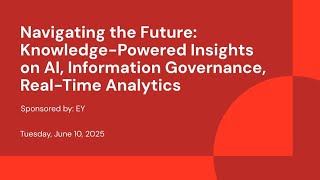
In an era where data drives strategic decision-making, organizations must adapt to the evolving landscape of business analytics. This session will focus on three pivotal themes shaping the future of data management and analytics in 2025. Join our panel of experts, including a Business Analytics Leader, Head of Information Governance, and Data Science Leader, as they explore: - Knowledge-Powered AI: Discover trends in Knowledge-Powered AI and how these initiatives can revolutionize business analytics, with real-world examples of successful implementations. - Information Governance: Explore the role of information governance in ensuring data integrity and compliance. Our experts will discuss strategies for establishing robust frameworks that protect organizational assets. - Real-Time Analytics: Understand the importance of real-time analytics in today’s fast-paced environment. The panel will highlight how organizations can leverage real-time data for agile decision-making.
In today’s data-driven world, organizations are challenged to extract meaningful insights from complex, distributed information. A modern data intelligence platform brings together data management, AI/ML, and analytics to turn raw data into strategic advantage. This session explores how unified data architectures, augmented analytics, and intelligent applications are enabling smarter decisions and better business outcomes across industries. Real-world use cases—from demand forecasting to regulatory compliance—highlight the transformative impact of data intelligence. Powered by Oracle, this approach helps enterprises stay agile, informed, and competitive.
In today’s disrupted markets, CXOs face mounting pressure to translate bold strategies into tangible results. This session will reveal how to bridge the gap between strategic vision and agile execution leveraging AI-powered Copilot. We will explore how integrating AI and data-driven intelligence transforms fragmented data into a unified "digital blueprint," enabling enterprise agility and delivering measurable ROI. Join us to learn how connected workflows—from strategy to frontline execution—are reshaping the future of work and driving success.
With new pressures coming from AI, CDAOs must be agile in implementing and enabling business innovation. But, with quick adaptation, inevitably comes stress on traditional D&A delivery processes and practices. Join this interactive session to lean how to: clarify strategies to support business innovation, design adaptable and scalable delivery models and collaborate with business units to ensure value of D&A capabilities and services.

Ganesh Kumar Suresh: Agile Meets Data Science: Agile Strategies for High-Impact Data Science & Machine Learning Projects
Data and analytics leaders can use the concept of a “franchise” as a metaphor to communicate the optimal organizational model, data architecture and governance framework that large enterprises require to scale self-service analytics programs.
With new pressures coming from AI, CDAOs must be agile in implementing and enabling business innovation. But, with quick adaptation, inevitably comes stress on traditional D&A delivery processes and practices. Join this interactive session to lean how to: clarify strategies to support business innovation, design adaptable and scalable delivery models and collaborate with business units to ensure value of D&A capabilities and services.
The days of running a business on Excel and static reports are long gone. Organizations need to be more agile than ever before, and AI can help transform not only what you do but take you to the next level and drive adoption and value. Join Pyramid Analytics and their premier customer East of England Co-op, and learn how they reinvented their data and analytics strategy. They'll share the tangible steps they took to conquer their challenges, the benefits they are seeing today, and their exciting path forward with AI and analytics!
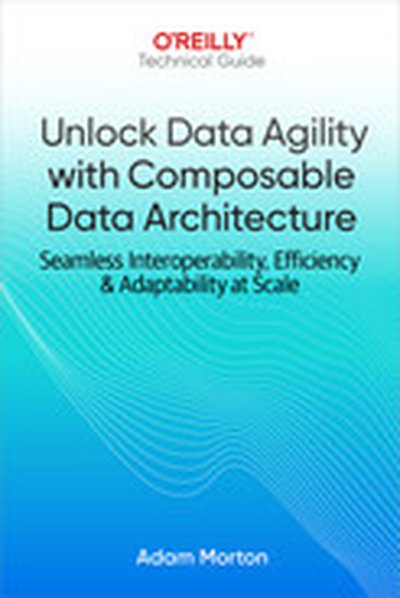
Are your data systems slowing down your AI initiatives? The potential of AI to revolutionize business is undeniable, but many organizations struggle to bridge the gap between ambitious ideas and real-world results. The cause? Traditional data architectures remain too rigid and siloed to support today's dynamic, data-intensive demands. If you're a data leader searching for a solution, composable data architecture is the answer. This essential guide provides a clear, actionable framework for you to discover how this modular, adaptable approach empowers data teams, streamlines pipelines, and fuels continuous innovation. So, you'll not only keep pace with your most agile competitors—you'll surpass them. Understand the fundamental concepts that make composable architecture a game-changer Design pipelines that optimize performance and adapt to your organization's unique data needs See how composable architecture breaks down silos, enabling faster, more collaborative data processes Discover tools to streamline data management of high-volume streams or multicloud environments Leverage flexible architecture that simplifies data sharing, enabling easier access to insights
Discover how a neuroinclusive approach to Agile methodology can transform your team's innovation effectiveness. This session explores the benefits of integrating diverse knowledge systems and cognitive perspectives to drive impactful results.