 talk-data.com
Topic
AWS
Amazon Web Services (AWS)
837
tagged
Activity Trend
Top Events
Date: 2023-10-17. Elevate your AWS expertise with an instructor-led virtual Master Class focused on AWS security. Gain insight into security design principles and AWS services to bolster your security posture in the AWS Cloud. This session will cover: - Understanding security benefits and responsibilities of using the AWS Cloud. - Explore different design principles for security in the cloud. - Explore different AWS services to improve security posture.
Banque à Distance : Quelle valeur tire-t-on d’une migration dans le Cloud d’une application Internet grand public en minimisant les impacts applicatifs ?
GTS Institute : Découvrez la formidable aventure migratoire de "GTS Institute", le Learning Management System interne de l'infrastructure du groupe Société Générale, à partir d'on-premises vers le cloud AWS.
SG APIM - La plateforme d'API Management de Société Générale dans AWS : en passant par les services utilisés pour garantir le fonctionnement de la plateforme jusqu'à l'application réelle sur un cas business, nous expliquerons comment SG APIM est déployée sur AWS.
Nouveautés du Cloud - AWS et Azure
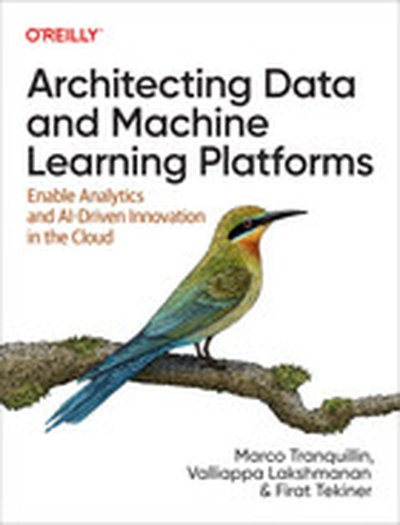
All cloud architects need to know how to build data platforms that enable businesses to make data-driven decisions and deliver enterprise-wide intelligence in a fast and efficient way. This handbook shows you how to design, build, and modernize cloud native data and machine learning platforms using AWS, Azure, Google Cloud, and multicloud tools like Snowflake and Databricks. Authors Marco Tranquillin, Valliappa Lakshmanan, and Firat Tekiner cover the entire data lifecycle from ingestion to activation in a cloud environment using real-world enterprise architectures. You'll learn how to transform, secure, and modernize familiar solutions like data warehouses and data lakes, and you'll be able to leverage recent AI/ML patterns to get accurate and quicker insights to drive competitive advantage. You'll learn how to: Design a modern and secure cloud native or hybrid data analytics and machine learning platform Accelerate data-led innovation by consolidating enterprise data in a governed, scalable, and resilient data platform Democratize access to enterprise data and govern how business teams extract insights and build AI/ML capabilities Enable your business to make decisions in real time using streaming pipelines Build an MLOps platform to move to a predictive and prescriptive analytics approach
Testing is often the foremost challenge that newcomers face when venturing into serverless technologies. A common narrative suggests we have to choose between slow remote tests or grappling with the near-impossible task of simulating an entire AWS environment locally. But what if this narrative isn't the whole story? Imagine having a fast feedback loop and the capability to debug your code locally without leaning on local simulators. The good news? You can have the best of both worlds! Join this session to discover a straightforward approach that's applicable across any framework (be it Serverless, CDK, SAM, or others) and any programming language.
Yan is an experienced engineer who has run production workload at scale on AWS since 2010. He has been an architect and principal engineer in a variety of industries ranging from banking, e-commerce, sports streaming to mobile gaming. He has worked extensively with AWS Lambda in production since 2015. Nowadays, he splits his time between advancing the state of serverless observability as a Developer Advocate at lumigo.io and helping companies around the world adopt serverless as an independent consultant. Yan is also an AWS Serverless Hero and a regular speaker at user groups and conferences internationally. He is the author of Production-Ready Serverless and co-author of Serverless Architectures on AWS, 2nd Edition. And he keeps an active blog at theburningmonk.com and hosts a serverless-focused podcast at realworldserverless.com.
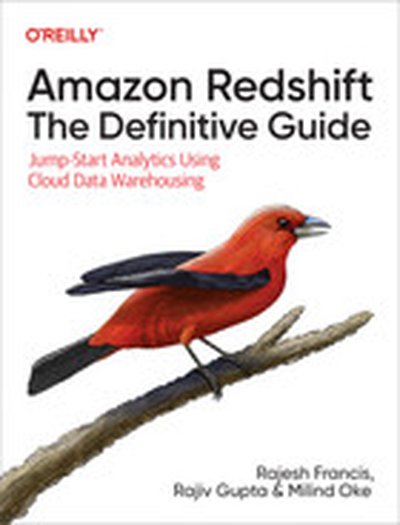
Amazon Redshift powers analytic cloud data warehouses worldwide, from startups to some of the largest enterprise data warehouses available today. This practical guide thoroughly examines this managed service and demonstrates how you can use it to extract value from your data immediately, rather than go through the heavy lifting required to run a typical data warehouse. Analytic specialists Rajesh Francis, Rajiv Gupta, and Milind Oke detail Amazon Redshift's underlying mechanisms and options to help you explore out-of-the box automation. Whether you're a data engineer who wants to learn the art of the possible or a DBA looking to take advantage of machine learning-based auto-tuning, this book helps you get the most value from Amazon Redshift. By understanding Amazon Redshift features, you'll achieve excellent analytic performance at the best price, with the least effort. This book helps you: Build a cloud data strategy around Amazon Redshift as foundational data warehouse Get started with Amazon Redshift with simple-to-use data models and design best practices Understand how and when to use Redshift Serverless and Redshift provisioned clusters Take advantage of auto-tuning options inherent in Amazon Redshift and understand manual tuning options Transform your data platform for predictive analytics using Redshift ML and break silos using data sharing Learn best practices for security, monitoring, resilience, and disaster recovery Leverage Amazon Redshift integration with other AWS services to unlock additional value
Meet the AWS Women‘s User Group Organization Team and learn more about their vision and goals.
Agenda item: Explore AWS tools and services that can accelerate the migration process.
Agenda item: Explore the primary drivers for moving to the AWS Cloud.
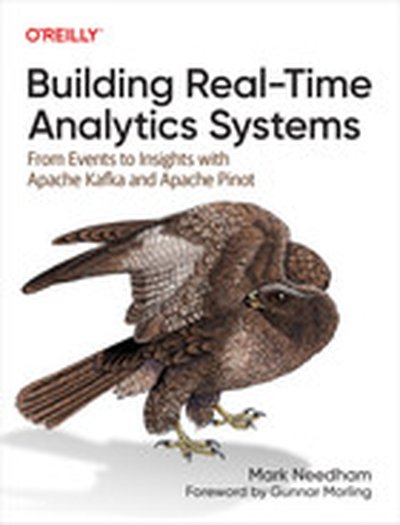
Gain deep insight into real-time analytics, including the features of these systems and the problems they solve. With this practical book, data engineers at organizations that use event-processing systems such as Kafka, Google Pub/Sub, and AWS Kinesis will learn how to analyze data streams in real time. The faster you derive insights, the quicker you can spot changes in your business and act accordingly. Author Mark Needham from StarTree provides an overview of the real-time analytics space and an understanding of what goes into building real-time applications. The book's second part offers a series of hands-on tutorials that show you how to combine multiple software products to build real-time analytics applications for an imaginary pizza delivery service. You will: Learn common architectures for real-time analytics Discover how event processing differs from real-time analytics Ingest event data from Apache Kafka into Apache Pinot Combine event streams with OLTP data using Debezium and Kafka Streams Write real-time queries against event data stored in Apache Pinot Build a real-time dashboard and order tracking app Learn how Uber, Stripe, and Just Eat use real-time analytics
From the printing press to the robotic assembly line, each advancement in automation has improved our quality of life and freed up employees to do higher value work. The current generation of automation leverages AI to perform activities that can’t be performed at human scale, such as helping customer service calculate in real time the probability of customer churn or recommending a way to optimize AWS resources for performance and cost. The new generation of AI-driven automation will empower business teams to better engage customers and employees, as well as to optimize cost across the entire hybrid cloud environment. Join Madhu Kochar, VP of Product Development, to learn how breakthrough automation technologies leverage conversational AI, Kafka event streams, and AI-driven optimization to meet these challenges and empower the next generation of business and IT.
It's been a year since ChatGPT burst onto the scene. It has given many of us a sense of the power and potential that LLMs hold in revolutionizing the global economy. But the power that generative AI brings also comes with inherent risks that need to be mitigated. For those working in AI, the task at hand is monumental: to chart a safe and ethical course for the deployment and use of artificial intelligence. This isn't just a challenge; it's potentially one of the most important collective efforts of this decade. The stakes are high, involving not just technical and business considerations, but ethical and societal ones as well. How do we ensure that AI systems are designed responsibly? How do we mitigate risks such as bias, privacy violations, and the potential for misuse? How do we assemble the right multidisciplinary mindset and expertise for addressing AI safety? Reid Blackman, Ph.D., is the author of “Ethical Machines” (Harvard Business Review Press), creator and host of the podcast “Ethical Machines,” and Founder and CEO of Virtue, a digital ethical risk consultancy. He is also an advisor to the Canadian government on their federal AI regulations, was a founding member of EY’s AI Advisory Board, and a Senior Advisor to the Deloitte AI Institute. His work, which includes advising and speaking to organizations including AWS, US Bank, the FBI, NASA, and the World Economic Forum, has been profiled by The Wall Street Journal, the BBC, and Forbes. His written work appears in The Harvard Business Review and The New York Times. Prior to founding Virtue, Reid was a professor of philosophy at Colgate University and UNC-Chapel Hill. In the episode, Reid and Richie discuss the dominant concerns in AI ethics, from biased AI and privacy violations to the challenges introduced by generative AI, such as manipulative agents and IP issues. They delve into the existential threats posed by AI, including shifts in the job market and disinformation. Reid also shares examples where unethical AI has led to AI projects being scrapped, the difficulty in mitigating bias, preemptive measures for ethical AI and much more. Links mentioned in the show: Ethical Machines by Reid BlackmanVirtue Ethics ConsultancyAmazon’s Scrapped AI Recruiting ToolNIST AI Risk Management FrameworkCourse: AI EthicsDataCamp Radar: Data & AI Literacy
Workshop introducing infrastructure as code fundamentals using Pulumi to provision AWS resources, including basics of the Pulumi Programming Model, how to provision, update, and destroy AWS resources, and features of aws-classic v6 and AWSX.
Did you miss The Spatial Data Science Conference in London 2023? No worries, you can see the highlights here. If you want to see more of the presentations from KFC, CARTO, Databricks, AWS, BT, Choreograph and Mott Macdonald - see our full content hub: https://spatial-data-science-conference.com/2023/london/
This master class is designed to teach business leaders and IT technical professionals the benefits of computing in the AWS Cloud. You will learn how to use AWS services to improve business processes and gain an understanding of how to benefit from AWS security and compliance services.
As companies scale and become more successful, new horizons open, but with them come unexpected challenges. The influx of revenue and expansion of operations often reveal hidden complexities that can hinder efficiency and inflate costs. In this tricky situation, data teams can find themselves entangled in a web of obstacles that slow down their ability to innovate and respond to ever-changing business needs. Enter cloud analytics—a transformative solution that promises to break down barriers and unleash potential. By migrating analytics to the cloud, organizations can navigate the growing pains of success, cutting costs, enhancing flexibility, and empowering data teams to work with agility and precision. John Knieriemen is the Regional Business Lead for North America at Exasol, the market-leading high-performance analytics database. Prior to joining Exasol, he served as Vice President and General Manager at Teradata during an 11-year tenure with the company. John is responsible for strategically scaling Exasol’s North America business presence across industries and expanding the organization’s partner network. Solongo Erdenekhuyag is the former Customer Success and Data Strategy Leader at Exasol. Solongo is skilled in strategy, business development, program management, leadership, strategic partnerships, and management. In the episode, Richie, Solongo, and John cover the motivation for moving analytics to the cloud, economic triggers for migration, success stories from organizations who have migrated to the cloud, the challenges and potential roadblocks in migration, the importance of flexibility and open-mindedness and much more. Links from the Show ExasolAmazon S3Azure Blob StorageGoogle Cloud StorageBigQueryAmazon RedshiftSnowflake[Course] Understanding Cloud Computing[Course] AWS Cloud Concepts