talk-data.com talk-data.com

Topic

AWS

Amazon Web Services (AWS)

cloud cloud provider infrastructure services

32

tagged

Activity Trend

190 peak/qtr
2020-Q1 2026-Q1

Activities

Showing filtered results

Filtering by: Databricks DATA + AI Summit 2023 ×
Announcing Databricks Clean Rooms with Live Demo. Presented by Matei Zaharia and Darshana Sivakumar

Speakers: Matei Zaharia, Original Creator of Apache Spark™ and MLflow; Chief Technologist, Databricks Darshana Sivakumar, Staff Product Manager, Databricks

Organizations are looking for ways to securely exchange their data and collaborate with external partners to foster data-driven innovations. In the past, organizations had limited data sharing solutions, relinquishing control over how their sensitive data was shared with partners and little to no visibility into how their data was consumed. This created the risk for potential data misuse and data privacy breaches. Customers who tried using other clean room solutions have told us these solutions are limited and do not meet their needs, as they often require all parties to copy their data into the same platform, do not allow sophisticated analysis beyond basic SQL queries, and have limited visibility or control over their data.

Organizations need an open, flexible, and privacy-safe way to collaborate on data, and Databricks Clean Rooms meets these critical needs.

See a demo of Databricks Clean Rooms, now in Public Preview on AWS + Azure

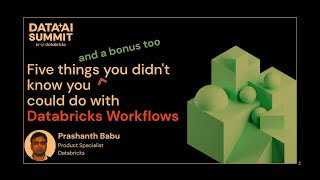
Five Things You Didn't Know You Could Do with Databricks Workflows

Databricks workflows has come a long way since the initial days of orchestrating simple notebooks and jar/wheel files. Now we can orchestrate multi-task jobs and create a chain of tasks with lineage and DAG with either fan-in or fan-out among multiple other patterns or even run another Databricks job directly inside another job.

Databricks workflows takes its tag: “orchestrate anything anywhere” pretty seriously and is a truly fully-managed, cloud-native orchestrator to orchestrate diverse workloads like Delta Live Tables, SQL, Notebooks, Jars, Python Wheels, dbt, SQL, Apache Spark™, ML pipelines with excellent monitoring, alerting and observability capabilities as well. Basically, it is a one-stop product for all orchestration needs for an efficient lakehouse. And what is even better is, it gives full flexibility of running your jobs in a cloud-agnostic and cloud-independent way and is available across AWS, Azure and GCP.

In this session, we will discuss and deep dive on some of the very interesting features and will showcase end-to-end demos of the features which will allow you to take full advantage of Databricks workflows for orchestrating the lakehouse.

Talk by: Prashanth Babu

Connect with us: Website: https://databricks.com Twitter: https://twitter.com/databricks LinkedIn: https://www.linkedin.com/company/databricks Instagram: https://www.instagram.com/databricksinc Facebook: https://www.facebook.com/databricksinc

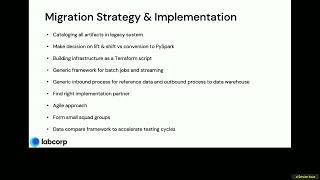
Labcorp Data Platform Journey: From Selection to Go-Live in Six Months

Join this session to learn about the Labcorp data platform transformation from on-premises Hadoop to AWS Databricks Lakehouse. We will share best practices and lessons learned from cloud-native data platform selection, implementation, and migration from Hadoop (within six months) with Unity Catalog.

We will share steps taken to retire several legacy on-premises technologies and leverage Databricks native features like Spark streaming, workflows, job pools, cluster policies and Spark JDBC within Databricks platform. Lessons learned in Implementing Unity Catalog and building a security and governance model that scales across applications. We will show demos that walk you through batch frameworks, streaming frameworks, data compare tools used across several applications to improve data quality and speed of delivery.

Discover how we have improved operational efficiency, resiliency and reduced TCO, and how we scaled building workspaces and associated cloud infrastructure using Terraform provider.

Talk by: Mohan Kolli and Sreekanth Ratakonda

Connect with us: Website: https://databricks.com Twitter: https://twitter.com/databricks LinkedIn: https://www.linkedin.com/company/databricks Instagram: https://www.instagram.com/databricksinc Facebook: https://www.facebook.com/databricksinc

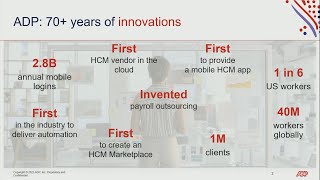
Sponsored: Impetus | Accelerating ADP’s Business Transformation w/ a Modern Enterprise Data Platform

Learn How ADP’s Enterprise Data Platform Is used to drive direct monetization opportunities, differentiate its solutions, and improve operations. ADP is continuously searching for ways to increase innovation velocity, time-to-market, and improve the overall enterprise efficiency. Making data and tools available to teams across the enterprise while reducing data governance risk is the key to making progress on all fronts. Learn about ADP’s enterprise data platform that created a single source of truth with centralized tools, data assets, and services. It allowed teams to innovate and gain insights by leveraging cross-enterprise data and central machine learning operations.

Explore how ADP accelerated creation of the data platform on Databricks and AWS, achieve faster business outcomes, and improve overall business operations. The session will also cover how ADP significantly reduced its data governance risk, elevated the brand by amplifying data and insights as a differentiator, increased data monetization, and leveraged data to drive human capital management differentiation.

Talk by: Chetan Kalanki and Zaf Babin

Here’s more to explore: State of Data + AI Report: https://dbricks.co/44i2HBp The Data Team's Guide to the Databricks Lakehouse Platform: https://dbricks.co/46nuDpI

Connect with us: Website: https://databricks.com Twitter: https://twitter.com/databricks LinkedIn: https://www.linkedin.com/company/databricks Instagram: https://www.instagram.com/databricksinc Facebook: https://www.facebook.com/databricksinc

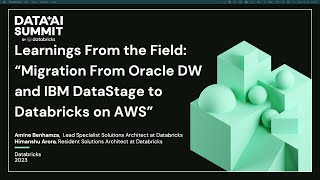
Learnings From the Field: Migration From Oracle DW and IBM DataStage to Databricks on AWS

Legacy data warehouses are costly to maintain, unscalable and cannot deliver on data science, ML and real-time analytics use cases. Migrating from your enterprise data warehouse to Databricks lets you scale as your business needs grow and accelerate innovation by running all your data, analytics and AI workloads on a single unified data platform.

In the first part of this session we will guide you through the well-designed process and tools that will help you from the assessment phase to the actual implementation of an EDW migration project. Also, we will address ways to convert PL/SQL proprietary code to an open standard python code and take advantage of PySpark for ETL workloads and Databricks SQL’s data analytics workload power.

The second part of this session will be based on an EDW migration project of SNCF (French national railways); one of the major enterprise customers of Databricks in France. Databricks partnered with SNCF to migrate its real estate entity from Oracle DW and IBM DataStage to Databricks on AWS. We will walk you through the customer context, urgency to migration, challenges, target architecture, nitty-gritty details of implementation, best practices, recommendations, and learnings in order to execute a successful migration project in a very accelerated time frame.

Talk by: Himanshu Arora and Amine Benhamza

Connect with us: Website: https://databricks.com Twitter: https://twitter.com/databricks LinkedIn: https://www.linkedin.com/company/databricks Instagram: https://www.instagram.com/databricksinc Facebook: https://www.facebook.com/databricksinc

Enabling Data Governance at Enterprise Scale Using Unity Catalog

Amgen has invested in building modern, cloud-native enterprise data and analytics platforms over the past few years with a focus on tech rationalization, data democratization, overall user experience, increase reusability, and cost-effectiveness. One of these platforms is our Enterprise Data Fabric which focuses on pulling in data across functions and providing capabilities to integrate and connect the data and govern access. For a while, we have been trying to set up robust data governance capabilities which are simple, yet easy to manage through Databricks. There were a few tools in the market that solved a few immediate needs, but none solved the problem holistically. For use cases like maintaining governance on highly restricted data domains like Finance and HR, a long-term solution native to Databricks and addressing the below limitations was deemed important:

The way these tools were set up, allowed the overriding of a few security policies

  • Tools were not UpToDate with the latest DBR runtime
  • Complexity of implementing fine-grained security
  • Policy management – AWS IAM + In tool policies

To address these challenges, and for large-scale enterprise adoption of our governance capability, we started working on UC integration with our governance processes. With an aim to realize the following tech benefits:

  • Independent of Databricks runtime
  • Easy fine-grained access control
  • Eliminated management of IAM roles
  • Dynamic access control using UC and dynamic views

Today, using UC, we have to implement fine-grained access control & governance for the restricted data of Amgen. We are in the process of devising a realistic migration & change management strategy across the enterprise.

Talk by: Lakhan Prajapati and Jaison Dominic

Connect with us: Website: https://databricks.com Twitter: https://twitter.com/databricks LinkedIn: https://www.linkedin.com/company/databricks Instagram: https://www.instagram.com/databricksinc Facebook: https://www.facebook.com/databricksinc

Data Globalization at Conde Nast Using Delta Sharing

Databricks has been an essential part of the Conde Nast architecture for the last few years. Prior to building our centralized data platform, “evergreen,” we had similar challenges as many other organizations; siloed data, duplicated efforts for engineers, and a lack of collaboration between data teams. These problems led to mistrust in data sets and made it difficult to scale to meet the strategic globalization plan we had for Conde Nast.

Over the last few years we have been extremely successful in building a centralized data platform on Databricks in AWS, fully embracing the lakehouse vision from end-to-end. Now, our analysts and marketers can derive the same insights from one dataset and data scientists can use the same datasets for use cases such as personalization, subscriber propensity models, churn models and on-site recommendations for our iconic brands.

In this session, we’ll discuss how we plan to incorporate Unity Catalog and Delta Sharing as the next phase of our globalization mission. The evergreen platform has become the global standard for data processing and analytics at Conde. In order to manage the worldwide data and comply with GDPR requirements, we need to make sure data is processed in the appropriate region and PII data is handled appropriately. At the same time, we need to have a global view of the data to allow us to make business decisions at the global level. We’ll talk about how delta sharing allows us a simple, secure way to share de-identified datasets across regions in order to make these strategic business decisions, while complying with security requirements. Additionally, we’ll discuss how Unity Catalog allows us to secure, govern and audit these datasets in an easy and scalable manner.

Talk by: Zachary Bannor

Connect with us: Website: https://databricks.com Twitter: https://twitter.com/databricks LinkedIn: https://www.linkedin.com/company/databricks Instagram: https://www.instagram.com/databricksinc Facebook: https://www.facebook.com/databricksinc

Embracing the Future of Data Engineering: The Serverless, Real-Time Lakehouse in Action

As we venture into the future of data engineering, streaming and serverless technologies take center stage. In this fun, hands-on, in-depth and interactive session you can learn about the essence of future data engineering today.

We will tackle the challenge of processing streaming events continuously created by hundreds of sensors in the conference room from a serverless web app (bring your phone and be a part of the demo). The focus is on the system architecture, the involved products and the solution they provide. Which Databricks product, capability and settings will be most useful for our scenario? What does streaming really mean and why does it make our life easier? What are the exact benefits of serverless and how "serverless" is a particular solution?

Leveraging the power of the Databricks Lakehouse Platform, I will demonstrate how to create a streaming data pipeline with Delta Live Tables ingesting data from AWS Kinesis. Further, I’ll utilize advanced Databricks workflows triggers for efficient orchestration and real-time alerts feeding into a real-time dashboard. And since I don’t want you to leave with empty hands - I will use Delta Sharing to share the results of the demo we built with every participant in the room. Join me in this hands-on exploration of cutting-edge data engineering techniques and witness the future in action.

Talk by: Frank Munz

Connect with us: Website: https://databricks.com Twitter: https://twitter.com/databricks LinkedIn: https://www.linkedin.com/company/databricks Instagram: https://www.instagram.com/databricksinc Facebook: https://www.facebook.com/databricksinc

Sponsored: AWS-Real Time Stream Data & Vis Using Databricks DLT, Amazon Kinesis, & Amazon QuickSight

Amazon Kinesis Data Analytics is a managed service that can capture streaming data from IoT devices. Databricks Lakehouse platform provides ease of processing streaming and batch data using Delta Live Tables. Amazon Quicksight with powerful visualization capabilities can provides various advanced visualization capabilities with direct integration with Databricks. Combining these services, customers can capture, process, and visualize data from hundreds and thousands of IoT sensors with ease.

Talk by: Venkat Viswanathan

Here’s more to explore: Big Book of Data Engineering: 2nd Edition: https://dbricks.co/3XpPgNV The Data Team's Guide to the Databricks Lakehouse Platform: https://dbricks.co/46nuDpI

Connect with us: Website: https://databricks.com Twitter: https://twitter.com/databricks LinkedIn: https://www.linkedin.com/company/databricks Instagram: https://www.instagram.com/databricksinc Facebook: https://www.facebook.com/databricksinc

Testing Generative AI Models: What You Need to Know

Generative AI shows incredible promise for enterprise applications. The explosion of generative AI can be attributed to the convergence of several factors. Most significant is that the barrier to entry has dropped for AI application developers through customizable prompts (few-shot learning), enabling laypeople to generate high-quality content. The flexibility of models like ChatGPT and DALLE-2 have sparked curiosity and creativity about new applications that they can support. The number of tools will continue to grow in a manner similar to how AWS fueled app development. But excitement must be tampered by concerns about new risks imposed to business and society. Increased capability and adoption also increase risk exposure. As organizations explore creative boundaries of generative models, measures to reduce risk must be put in place. However, the enormous size of the input space and inherent complexity make this task more challenging than traditional ML models.

In this session, we summarize the new risks introduced by the new class of generative foundation models through several examples, and compare how these risks relate to the risks of mainstream discriminative models. Steps can be taken to reduce the operational risk, bias and fairness issues, and privacy and security of systems that leverage LLM for automation. We’ll explore model hallucinations, output evaluation, output bias, prompt injection, data leakage, stochasticity, and more. We’ll discuss some of the larger issues common to LLMs and show how to test for them. A comprehensive, test-based approach to generative AI development will help instill model integrity by proactively mitigating failure and the associated business risk.

Talk by: Yaron Singer

Here’s more to explore: LLM Compact Guide: https://dbricks.co/43WuQyb Big Book of MLOps: https://dbricks.co/3r0Pqiz

Connect with us: Website: https://databricks.com Twitter: https://twitter.com/databricks LinkedIn: https://www.linkedin.com/company/databricks Instagram: https://www.instagram.com/databricksinc Facebook: https://www.facebook.com/databricksinc

Activate Your Lakehouse with Unity Catalog

Building a lakehouse is straightforward today thanks to many open source technologies and Databricks. However, it can be taxing to extract value from lakehouses as they grow without robust data operations. Join us to learn how YipitData uses the Unity Catalog to streamline data operations and discover best practices to scale your own Lakehouse. At YipitData, our 15+ petabyte Lakehouse is a self-service data platform built with Databricks and AWS, supporting analytics for a data team of over 250. We will share how leveraging Unity Catalog accelerates our mission to help financial institutions and corporations leverage alternative data by:

  • Enabling clients to universally access our data through a spectrum of channels, including Sigma, Delta Sharing, and multiple clouds
  • Fostering collaboration across internal teams using a data mesh paradigm that yields rich insights
  • Strengthening the integrity and security of data assets through ACLs, data lineage, audit logs, and further isolation of AWS resources
  • Reducing the cost of large tables without downtime through automated data expiration and ETL optimizations on managed delta tables

Through our migration to Unity Catalog, we have gained tactics and philosophies to seamlessly flow our data assets internally and externally. Data platforms need to be value-generating, secure, and cost-effective in today's world. We are excited to share how Unity Catalog delivers on this and helps you get the most out of your lakehouse.

Talk by: Anup Segu

Connect with us: Website: https://databricks.com Twitter: https://twitter.com/databricks LinkedIn: https://www.linkedin.com/company/databricks Instagram: https://www.instagram.com/databricksinc Facebook: https://www.facebook.com/databricksinc

From Insights to Recommendations:How SkyWatch Predicts Demand for Satellite Imagery Using Databricks

SkyWatch is on a mission to democratize earth observation data and make it simple for anyone to use.

In this session, you will learn about how SkyWatch aggregates demand signals for the EO market and turns them into monetizable recommendations for satellite operators. Skywatch’s Data & Platform Engineer, Aayush will share how the team built a serverless architecture that synthesizes customer requests for satellite images and identifies geographic locations with high demand, helping satellite operators maximize revenue and satisfying a broad range of EO data hungry consumers.

This session will cover:

  • Challenges with Fulfillment in Earth Observation ecosystem
  • Processing large scale GeoSpatial Data with Databricks
  • Databricks in-built H3 functions
  • Delta Lake to efficiently store data leveraging optimization techniques like Z-Ordering
  • Data LakeHouse Architecture with Serverless SQL Endpoints and AWS Step Functions
  • Building Tasking Recommendations for Satellite Operators

Talk by: Aayush Patel

Connect with us: Website: https://databricks.com Twitter: https://twitter.com/databricks LinkedIn: https://www.linkedin.com/company/databricks Instagram: https://www.instagram.com/databricksinc Facebook: https://www.facebook.com/databricksinc

Processing Delta Lake Tables on AWS Using AWS Glue, Amazon Athena, and Amazon Redshift

Delta Lake is an open source project that helps implement modern data lake architectures commonly built on cloud storages. With Delta Lake, you can achieve ACID transactions, time travel queries, CDC, and other common use cases on the cloud.

There are a lot of use cases of Delta tables on AWS. AWS has invested a lot in this technology, and now Delta Lake is available with multiple AWS services, such as AWS Glue Spark jobs, Amazon EMR, Amazon Athena, and Amazon Redshift Spectrum. AWS Glue is a serverless, scalable data integration service that makes it easier to discover, prepare, move, and integrate data from multiple sources. With AWS Glue, you can easily ingest data from multiple data sources such as on-prem databases, Amazon RDS, DynamoDB, MongoDB into Delta Lake on Amazon S3 even without expertise in coding.

This session will demonstrate how to get started with processing Delta Lake tables on Amazon S3 using AWS Glue, and querying from Amazon Athena, and Amazon Redshift. The session also covers recent AWS service updates related to Delta Lake.

Talk by: Noritaka Sekiyama and Akira Ajisaka

Here’s more to explore: Why the Data Lakehouse Is Your next Data Warehouse: https://dbricks.co/3Pt5unq Lakehouse Fundamentals Training: https://dbricks.co/44ancQs

Connect with us: Website: https://databricks.com Twitter: https://twitter.com/databricks LinkedIn: https://www.linkedin.com/company/databricks Instagram: https://www.instagram.com/databricksinc Facebook: https://www.facebook.com/databricksinc

Sponsored: AWS|Build Generative AI Solution on Open Source Databricks Dolly 2.0 on Amazon SageMaker

Create a custom chat-based solution to query and summarize your data within your VPC using Dolly 2.0 and Amazon SageMaker. In this talk, you will learn about Dolly 2.0, Databricks, state-of-the-art, open source, LLM, available for commercial and Amazon SageMaker, AWS’s premiere toolkit for ML builders. You will learn how to deploy and customize models to reference your data using retrieval augmented generation (RAG) and additional fine tuning techniques…all using open-source components available today.

Talk by: Venkat Viswanathan and Karl Albertsen

Here’s more to explore: LLM Compact Guide: https://dbricks.co/43WuQyb Big Book of MLOps: https://dbricks.co/3r0Pqiz

Connect with us: Website: https://databricks.com Twitter: https://twitter.com/databricks LinkedIn: https://www.linkedin.com/company/databricks Instagram: https://www.instagram.com/databricksinc Facebook: https://www.facebook.com/databricksinc

How Comcast Effectv Drives Data Observability with Databricks and Monte Carlo

Comcast Effectv, the 2,000-employee advertising wing of Comcast, America’s largest telecommunications company, provides custom video ad solutions powered by aggregated viewership data. As a global technology and media company connecting millions of customers to personalized experiences and processing billions of transactions, Comcast Effectv was challenged with handling massive loads of data, monitoring hundreds of data pipelines, and managing timely coordination across data teams.

In this session, we will discuss Comcast Effectv’s journey to building a more scalable, reliable lakehouse and driving data observability at scale with Monte Carlo. This has enabled Effectv to have a single pane of glass view of their entire data environment to ensure consumer data trust across their entire AWS, Databricks, and Looker environment.

Talk by: Scott Lerner and Robinson Creighton

Connect with us: Website: https://databricks.com Twitter: https://twitter.com/databricks LinkedIn: https://www.linkedin.com/company/databricks Instagram: https://www.instagram.com/databricksinc Facebook: https://www.facebook.com/databricksinc

Deep Dive Into Grammarly's Data Platform

Grammarly helps 30 million people and 50,000 teams to communicate more effectively. Using the Databricks Lakehouse Platform, we can rapidly ingest, transform, aggregate, and query complex data sets from an ecosystem of sources, all governed by Unity Catalog. This session will overview Grammarly’s data platform and the decisions that shaped the implementation. We will dive deep into some architectural challenges the Grammarly Data Platform team overcame as we developed a self-service framework for incremental event processing.

Our investment in the lakehouse and Unity Catalog has dramatically improved the speed of our data value chain: making 5 billion events (ingested, aggregated, de-identified, and governed) available to stakeholders (data scientists, business analysts, sales, marketing) and downstream services (feature store, reporting/dashboards, customer support, operations) available within 15. As a result, we have improved our query cost performance (110% faster at 10% the cost) compared to our legacy system on AWS EMR.

I will share architecture diagrams, their implications at scale, code samples, and problems solved and to be solved in a technology-focused discussion about Grammarly’s iterative lakehouse data platform.

Talk by: Faraz Yasrobi and Christopher Locklin

Connect with us: Website: https://databricks.com Twitter: https://twitter.com/databricks LinkedIn: https://www.linkedin.com/company/databricks Instagram: https://www.instagram.com/databricksinc Facebook: https://www.facebook.com/databricksinc

Using DMS and DLT for Change Data Capture

Bringing in Relational Data Store (RDS) data into your data lake is a critical and important process to facilitate use cases. By leveraging AWS Database Migration Services (DMS) and Databricks Delta Live Tables (DLT) we can simplify change data capture from your RDS. In this talk, we will be breaking down this complex process by discussing the fundamentals and best practices. There will also be a demo where we bring this all together.

Talk by: Neil Patel and Ganesh Chand

Connect with us: Website: https://databricks.com Twitter: https://twitter.com/databricks LinkedIn: https://www.linkedin.com/company/databricks Instagram: https://www.instagram.com/databricksinc Facebook: https://www.facebook.com/databricksinc

Secure Data Distribution and Insights with Databricks on AWS

Every industry must comply with some form of compliance or data security in order to operate. As data becomes more mission critical to the organization, so does the need to protect and secure it.

Public Sector organizations are responsible for securing sensitive data sets and complying with regulatory programs such as HIPAA, FedRAMP, and StateRAMP.

This does not come as a surprise given the many different attacks targeted at the industry and the extremely sensitive nature of the large volumes of data stored and analyzed. For a product owner or DBA, this can be extremely overwhelming with a security team issuing more restrictions and data access becoming more of a common request among business users. It can be difficult finding an effective governance model to democratize data while also managing compliance across your hybrid estate.

In this session, we will discuss challenges faced in the public sector when expanding to AWS cloud. We will review best practices for managing access and data integrity for a cloud-based data lakehouse with Databricks, and discuss recommended approaches for securing your AWS Cloud environment. We will highlight ways to enable compliance by developing a continuous monitoring strategy and providing tips for implementation of defense in depth. This guide will provide critical questions to ask, an overall strategy, and specific recommendations to serve all security leaders and data engineers in the Public Sector.

This talk is intended to educate on security design considerations when extending your data warehouse to the cloud. This guidance is expected to grow and evolve as new standards and offerings emerge for local, state, and federal government.

Connect with us: Website: https://databricks.com Facebook: https://www.facebook.com/databricksinc Twitter: https://twitter.com/databricks LinkedIn: https://www.linkedin.com/company/data... Instagram: https://www.instagram.com/databricksinc/

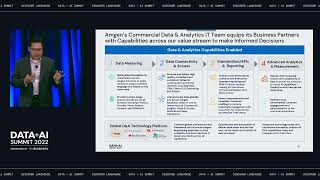
Amgen’s Journey To Building a Global 360 View of its Customers with the Lakehouse

Serving patients in over 100 countries, Amgen is a leading global biotech company focused on developing therapies that have the power to save lives. Delivering on this mission requires our commercial teams to regularly meet with healthcare providers to discuss new treatments that can help patients in need. With the onset of the pandemic, where face-to-face interactions with doctors and other Healthcare Providers (HCPs) were severely impacted, Amgen had to rethink these interactions. With that in mind, the Amgen Commercial Data and Analytics team leveraged a modern data and AI architecture built on the Databricks Lakehouse to help accelerate its digital and data insights capabilities. This foundation enabled Amgen’s teams to develop a comprehensive, customer-centric view to support flexible go-to-market models and provide personalized experiences to our customers. In this presentation, we will share our recent journey of how we took an agile approach to bringing together over 2.2 petabytes of internally generated and externally sourced vendor data , and onboard into our AWS Cloud and Databricks environments to enable a standardized, scalable and robust capabilities to meet the business requirements in our fast-changing life sciences environment. We will share use cases of how we harmonized and managed our diverse sets of data to deliver efficiency, simplification, and performance outcomes for the business. We will cover the following aspects of our journey along with best practices we learned over time: • Our architecture to support Amgen’s Commercial Data & Analytics constant processing around the globe • Engineering best practices for building large scale Data Lakes and Analytics platforms such as Team organization, Data Ingestion and Data Quality Frameworks, DevOps Toolkit and Maturity Frameworks, and more • Databricks capabilities adopted such as Delta Lake, Workspace policies, SQL workspace endpoints, and MLflow for model registry and deployment. Also, various tools were built for Databricks workspace administration • Databricks capabilities being explored for future, such as Multi-task Orchestration, Container-based Apache Spark Processing, Feature Store, Repos for Git integration, etc. • The types of commercial analytics use cases we are building on the Databricks Lakehouse platform Attendees building global and Enterprise scale data engineering solutions to meet diverse sets of business requirements will benefit from learning about our journey. Technologists will learn how we addressed specific Business problems via reusable capabilities built to maximize value.

Connect with us: Website: https://databricks.com Facebook: https://www.facebook.com/databricksinc Twitter: https://twitter.com/databricks LinkedIn: https://www.linkedin.com/company/data... Instagram: https://www.instagram.com/databricksinc/

Near Real-Time Analytics with Event Streaming, Live Tables, and Delta Sharing

Microservices is an increasingly popular architecture much loved by application teams, for it allows services to be developed and scaled independently. Data teams, though, often need a centralized repository where all data from different services come together to join and aggregate. The data platform can serve as a single source of company facts, enable near real time analytics, and secure sharing of massive data sets across clouds.

A viable microservices ingestion pattern is Change Data Capture, using AWS Database Migration Services or Debezium. CDC proves to be a scalable solution ideal for stable platforms, but it has several challenges for evolving services: Frequent schema changes, complex, unsupported DDL during migration, and automated deployments are but a few. An event streaming architecture can address these challenges.

Confluent, for example, provides a schema registry service where all services can register their event schemas. Schema registration helps with verifying that the events are being published based on the agreed contracts between data producers and consumers. It also provides a separation between internal service logic and the data consumed downstream. The services write their events to Kafka using the registered schemas with a specific topic based on the type of the event.

Data teams can leverage Spark jobs to ingest Kafka topics into Bronze tables in the Delta Lake. On ingestion, the registered schema from schema registry is used to validate the schema based on the provided version. A merge operation is sometimes called to translate events into final states of the records per business requirements.

Data teams can take advantage of Delta Live Tables on streaming datasets to produce Silver and Gold tables in near real time. Each input data source also has a set of expectations to ensure data quality and business rules. The pipeline allows Engineering and Analytics to collaborate by mixing Python and SQL. The refined data sets are then fed into Auto ML for discovery and baseline modeling.

To expose Gold tables to more consumers, especially non spark users across clouds, data teams can implement Delta Sharing. Recipients can accesses Silver tables from a different cloud and build their own analytics data sets. Analytics teams can also access Gold tables via pandas Delta Sharing client and BI tools.

Connect with us: Website: https://databricks.com Facebook: https://www.facebook.com/databricksinc Twitter: https://twitter.com/databricks LinkedIn: https://www.linkedin.com/company/data... Instagram: https://www.instagram.com/databricksinc/