talk-data.com talk-data.com

Topic

bayesian-statistics

26

tagged

Activity Trend

1 peak/qtr
2020-Q1 2026-Q1

Activities

Showing filtered results

Filtering by: O'Reilly Data Science Books ×
Causal Inference with Bayesian Networks

Leverage the power of graphical models for probabilistic and causal inference to build knowledge-based system applications and to address causal effect queries with observational data for decision aiding and policy making. Key Features Gain a firm understanding of Bayesian networks and structured algorithms for probabilistic inference Acquire a comprehensive understanding of graphical models and their applications in causal inference Gain insights into real-world applications of causal models in multiple domains Enhance your coding skills in R and Python through hands-on examples of causal inference Book Description This is a practical guide that explores the theory and application of Bayesian networks (BN) for probabilistic and causal inference. The book provides step-by-step explanations of graphical models of BN and their structural properties; the causal interpretations of BN and the notion of conditioning by intervention; and the mathematical model of structural equations and the representation in structured causal models (SCM). For probabilistic inference in Bayesian networks, you will learn methods of variable elimination and tree clustering. For causal inference you will learn the computational framework of Pearl's do-calculus for the identification and estimation of causal effects with causal models. In the context of causal inference with observational data, you will be introduced to the potential outcomes framework and explore various classes of meta-learning algorithms that are used to estimate the conditional average treatment effect in causal inference. The book includes practical exercises using R and Python for you to engage in and solidify your understanding of different approaches to probabilistic and causal inference. By the end of this book, you will be able to build and deploy your own causal inference application. You will learn from causal inference sample use cases for diagnosis, epidemiology, social sciences, economics, and finance. What you will learn Representation of knowledge with Bayesian networks Interpretation of conditional independence assumptions Interpretation of causality assumptions in graphical models Probabilistic inference with Bayesian networks Causal effect identification and estimation Machine learning methods for causal inference Coding in R and Python for probabilistic and causal inference Who this book is for This book will serve as a valuable resource for a wide range of professionals including data scientists, software engineers, policy analysts, decision-makers, information technology professionals involved in developing expert systems or knowledge-based applications that deal with uncertainty, as well as researchers across diverse disciplines seeking insights into causal analysis and estimating treatment effects in randomized studies. The book will enable readers to leverage libraries in R and Python and build software prototypes for their own applications.
Bayesian Statistics and Marketing, 2nd Edition

Fine-tune your marketing research with this cutting-edge statistical toolkit Bayesian Statistics and Marketing illustrates the potential for applying a Bayesian approach to some of the most challenging and important problems in marketing. Analyzing household and consumer data, predicting product performance, and custom-targeting campaigns are only a few of the areas in which Bayesian approaches promise revolutionary results. This book provides a comprehensive, accessible overview of this subject essential for any statistically informed marketing researcher or practitioner. Economists and other social scientists will find a comprehensive treatment of many Bayesian methods that are central to the problems in social science more generally. This includes a practical approach to computationally challenging problems in random coefficient models, non-parametrics, and the problems of endogeneity. Readers of the second edition of Bayesian Statistics and Marketing will also find: Discussion of Bayesian methods in text analysis and Machine Learning Updates throughout reflecting the latest research and applications Discussion of modern statistical software, including an introduction to the R package bayesm, which implements all models incorporated here Extensive case studies throughout to link theory and practice Bayesian Statistics and Marketing is ideal for advanced students and researchers in marketing, business, and economics departments, as well as for any statistically savvy marketing practitioner.

Bayesian Optimization in Action

Bayesian optimization helps pinpoint the best configuration for your machine learning models with speed and accuracy. Put its advanced techniques into practice with this hands-on guide. In Bayesian Optimization in Action you will learn how to: Train Gaussian processes on both sparse and large data sets Combine Gaussian processes with deep neural networks to make them flexible and expressive Find the most successful strategies for hyperparameter tuning Navigate a search space and identify high-performing regions Apply Bayesian optimization to cost-constrained, multi-objective, and preference optimization Implement Bayesian optimization with PyTorch, GPyTorch, and BoTorch Bayesian Optimization in Action shows you how to optimize hyperparameter tuning, A/B testing, and other aspects of the machine learning process by applying cutting-edge Bayesian techniques. Using clear language, illustrations, and concrete examples, this book proves that Bayesian optimization doesn’t have to be difficult! You’ll get in-depth insights into how Bayesian optimization works and learn how to implement it with cutting-edge Python libraries. The book’s easy-to-reuse code samples let you hit the ground running by plugging them straight into your own projects. About the Technology In machine learning, optimization is about achieving the best predictions—shortest delivery routes, perfect price points, most accurate recommendations—in the fewest number of steps. Bayesian optimization uses the mathematics of probability to fine-tune ML functions, algorithms, and hyperparameters efficiently when traditional methods are too slow or expensive. About the Book Bayesian Optimization in Action teaches you how to create efficient machine learning processes using a Bayesian approach. In it, you’ll explore practical techniques for training large datasets, hyperparameter tuning, and navigating complex search spaces. This interesting book includes engaging illustrations and fun examples like perfecting coffee sweetness, predicting weather, and even debunking psychic claims. You’ll learn how to navigate multi-objective scenarios, account for decision costs, and tackle pairwise comparisons. What's Inside Gaussian processes for sparse and large datasets Strategies for hyperparameter tuning Identify high-performing regions Examples in PyTorch, GPyTorch, and BoTorch About the Reader For machine learning practitioners who are confident in math and statistics. About the Author Quan Nguyen is a research assistant at Washington University in St. Louis. He writes for the Python Software Foundation and has authored several books on Python programming. Quotes Using a hands-on approach, clear diagrams, and real-world examples, Quan lifts the veil off the complexities of Bayesian optimization. - From the Foreword by Luis Serrano, Author of Grokking Machine Learning This book teaches Bayesian optimization, starting from its most basic components. You’ll find enough depth to make you comfortable with the tools and methods and enough code to do real work very quickly. - From the Foreword by David Sweet, Author of Experimentation for Engineers Combines modern computational frameworks with visualizations and infographics you won’t find anywhere else. It gives readers the confidence to apply Bayesian optimization to real world problems! - Ravin Kumar, Google

Experimentation for Engineers

Optimize the performance of your systems with practical experiments used by engineers in the world’s most competitive industries. In Experimentation for Engineers: From A/B testing to Bayesian optimization you will learn how to: Design, run, and analyze an A/B test Break the "feedback loops" caused by periodic retraining of ML models Increase experimentation rate with multi-armed bandits Tune multiple parameters experimentally with Bayesian optimization Clearly define business metrics used for decision-making Identify and avoid the common pitfalls of experimentation Experimentation for Engineers: From A/B testing to Bayesian optimization is a toolbox of techniques for evaluating new features and fine-tuning parameters. You’ll start with a deep dive into methods like A/B testing, and then graduate to advanced techniques used to measure performance in industries such as finance and social media. Learn how to evaluate the changes you make to your system and ensure that your testing doesn’t undermine revenue or other business metrics. By the time you’re done, you’ll be able to seamlessly deploy experiments in production while avoiding common pitfalls. About the Technology Does my software really work? Did my changes make things better or worse? Should I trade features for performance? Experimentation is the only way to answer questions like these. This unique book reveals sophisticated experimentation practices developed and proven in the world’s most competitive industries that will help you enhance machine learning systems, software applications, and quantitative trading solutions. About the Book Experimentation for Engineers: From A/B testing to Bayesian optimization delivers a toolbox of processes for optimizing software systems. You’ll start by learning the limits of A/B testing, and then graduate to advanced experimentation strategies that take advantage of machine learning and probabilistic methods. The skills you’ll master in this practical guide will help you minimize the costs of experimentation and quickly reveal which approaches and features deliver the best business results. What's Inside Design, run, and analyze an A/B test Break the “feedback loops” caused by periodic retraining of ML models Increase experimentation rate with multi-armed bandits Tune multiple parameters experimentally with Bayesian optimization About the Reader For ML and software engineers looking to extract the most value from their systems. Examples in Python and NumPy. About the Author David Sweet has worked as a quantitative trader at GETCO and a machine learning engineer at Instagram. He teaches in the AI and Data Science master's programs at Yeshiva University. Quotes Putting an ‘improved’ version of a system into production can be really risky. This book focuses you on what is important! - Simone Sguazza, University of Applied Sciences and Arts of Southern Switzerland A must-have for anyone setting up experiments, from A/B tests to contextual bandits and Bayesian optimization. - Maxim Volgin, KLM Shows a non-mathematical programmer exactly what they need to write powerful mathematically-based testing algorithms. - Patrick Goetz, The University of Texas at Austin Gives you the tools you need to get the most out of your experiments. - Marc-Anthony Taylor, Raiffeisen Bank International

Bayesian Analysis with Excel and R

Leverage the full power of Bayesian analysis for competitive advantage Bayesian methods can solve problems you can't reliably handle any other way. Building on your existing Excel analytics skills and experience, Microsoft Excel MVP Conrad Carlberg helps you make the most of Excel's Bayesian capabilities and move toward R to do even more. Step by step, with real-world examples, Carlberg shows you how to use Bayesian analytics to solve a wide array of real problems. Carlberg clarifies terminology that often bewilders analysts, provides downloadable Excel workbooks you can easily adapt to your own needs, and offers sample R code to take advantage of the rethinking package in R and its gateway to Stan. As you incorporate these Bayesian approaches into your analytical toolbox, you'll build a powerful competitive advantage for your organization---and yourself. Explore key ideas and strategies that underlie Bayesian analysis Distinguish prior, likelihood, and posterior distributions, and compare algorithms for driving sampling inputs Use grid approximation to solve simple univariate problems, and understand its limits as parameters increase Perform complex simulations and regressions with quadratic approximation and Richard McElreath's quap function Manage text values as if they were numeric Learn today's gold-standard Bayesian sampling technique: Markov Chain Monte Carlo (MCMC) Use MCMC to optimize execution speed in high-complexity problems Discover when frequentist methods fail and Bayesian methods are essential---and when to use both in tandem ...

Think Bayes, 2nd Edition

If you know how to program, you're ready to tackle Bayesian statistics. With this book, you'll learn how to solve statistical problems with Python code instead of mathematical formulas, using discrete probability distributions rather than continuous mathematics. Once you get the math out of the way, the Bayesian fundamentals will become clearer and you'll begin to apply these techniques to real-world problems. Bayesian statistical methods are becoming more common and more important, but there aren't many resources available to help beginners. Based on undergraduate classes taught by author Allen B. Downey, this book's computational approach helps you get a solid start. Use your programming skills to learn and understand Bayesian statistics Work with problems involving estimation, prediction, decision analysis, evidence, and Bayesian hypothesis testing Get started with simple examples, using coins, dice, and a bowl of cookies Learn computational methods for solving real-world problems

Probably Not, 2nd Edition

A revised edition that explores random numbers, probability, and statistical inference at an introductory mathematical level Written in an engaging and entertaining manner, the revised and updated second edition of Probably Not continues to offer an informative guide to probability and prediction. The expanded second edition contains problem and solution sets. In addition, the book’s illustrative examples reveal how we are living in a statistical world, what we can expect, what we really know based upon the information at hand and explains when we only think we know something. The author introduces the principles of probability and explains probability distribution functions. The book covers combined and conditional probabilities and contains a new section on Bayes Theorem and Bayesian Statistics, which features some simple examples including the Presecutor’s Paradox, and Bayesian vs. Frequentist thinking about statistics. New to this edition is a chapter on Benford’s Law that explores measuring the compliance and financial fraud detection using Benford’s Law. This book: Contains relevant mathematics and examples that demonstrate how to use the concepts presented Features a new chapter on Benford’s Law that explains why we find Benford’s law upheld in so many, but not all, natural situations Presents updated Life insurance tables Contains updates on the Gantt Chart example that further develops the discussion of random events Offers a companion site featuring solutions to the problem sets within the book Written for mathematics and statistics students and professionals, the updated edition of Probably Not: Future Prediction Using Probability and Statistical Inference, Second Edition combines the mathematics of probability with real-world examples. LAWRENCE N. DWORSKY, PhD, is a retired Vice President of the Technical Staff and Director of Motorola’s Components Research Laboratory in Schaumburg, Illinois, USA. He is the author of Introduction to Numerical Electrostatics Using MATLAB from Wiley.

Bayesian Statistics the Fun Way

Probability and statistics are increasingly important in a huge range of professions. But many people use data in ways they don’t even understand, meaning they aren’t getting the most from it. Bayesian Statistics the Fun Way will change that. This book will give you a complete understanding of Bayesian statistics through simple explanations and un-boring examples. Find out the probability of UFOs landing in your garden, how likely Han Solo is to survive a flight through an asteroid belt, how to win an argument about conspiracy theories, and whether a burglary really was a burglary, to name a few examples. By using these off-the-beaten-track examples, the author actually makes learning statistics fun. And you’ll learn real skills, like how to: •How to measure your own level of uncertainty in a conclusion or belief •Calculate Bayes theorem and understand what it’s useful for •Find the posterior, likelihood, and prior to check the accuracy of your conclusions •Calculate distributions to see the range of your data •Compare hypotheses and draw reliable conclusions from them Next time you find yourself with a sheaf of survey results and no idea what to do with them, turn to Bayesian Statistics the Fun Way to get the most value from your data.

Practical Applications of Bayesian Reliability

Demonstrates how to solve reliability problems using practical applications of Bayesian models This self-contained reference provides fundamental knowledge of Bayesian reliability and utilizes numerous examples to show how Bayesian models can solve real life reliability problems. It teaches engineers and scientists exactly what Bayesian analysis is, what its benefits are, and how they can apply the methods to solve their own problems. To help readers get started quickly, the book presents many Bayesian models that use JAGS and which require fewer than 10 lines of command. It also offers a number of short R scripts consisting of simple functions to help them become familiar with R coding. Practical Applications of Bayesian Reliability starts by introducing basic concepts of reliability engineering, including random variables, discrete and continuous probability distributions, hazard function, and censored data. Basic concepts of Bayesian statistics, models, reasons, and theory are presented in the following chapter. Coverage of Bayesian computation, Metropolis-Hastings algorithm, and Gibbs Sampling comes next. The book then goes on to teach the concepts of design capability and design for reliability; introduce Bayesian models for estimating system reliability; discuss Bayesian Hierarchical Models and their applications; present linear and logistic regression models in Bayesian Perspective; and more. Provides a step-by-step approach for developing advanced reliability models to solve complex problems, and does not require in-depth understanding of statistical methodology Educates managers on the potential of Bayesian reliability models and associated impact Introduces commonly used predictive reliability models and advanced Bayesian models based on real life applications Includes practical guidelines to construct Bayesian reliability models along with computer codes for all of the case studies JAGS and R codes are provided on an accompanying website to enable practitioners to easily copy them and tailor them to their own applications Practical Applications of Bayesian Reliability is a helpful book for industry practitioners such as reliability engineers, mechanical engineers, electrical engineers, product engineers, system engineers, and materials scientists whose work includes predicting design or product performance.

Bayesian Psychometric Modeling

This book presents a unified Bayesian approach across traditionally separate families of psychometric models. It shows that Bayesian techniques, as alternatives to conventional approaches, offer distinct and profound advantages in achieving many goals of psychometrics. The book covers foundational principles and statistical models as well as popular psychometric models. Throughout the text, procedures are illustrated using examples primarily from educational assessments. A supplementary website provides the datasets, WinBUGS code, R code, and Netica files used in the examples.

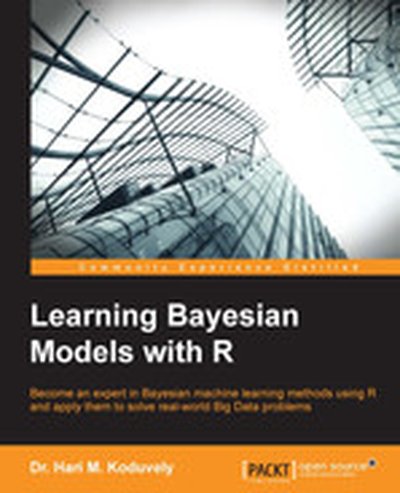
Learning Bayesian Models with R

Dive into the world of Bayesian Machine Learning with "Learning Bayesian Models with R." This comprehensive guide introduces the foundations of probability theory and Bayesian inference, teaches you how to implement these concepts with the R programming language, and progresses to practical techniques for supervised and unsupervised problems in data science. What this Book will help me do Understand and set up an R environment for Bayesian modeling Build Bayesian models including linear regression and classification for predictive analysis Learn to apply Bayesian inference to real-world machine learning problems Work with big data and high-performance computation frameworks like Hadoop and Spark Master advanced Bayesian techniques and apply them to deep learning and AI challenges Author(s) Hari Manassery Koduvely is a proficient data scientist with extensive experience in leveraging Bayesian frameworks for real-world applications. His passion for Bayesian Machine Learning is evident in his approachable and detailed teaching methodology, aimed at making these complex topics accessible for practitioners. Who is it for? This book is best suited for data scientists, analysts, and statisticians familiar with R and basic probability theory who aim to enhance their expertise in Bayesian approaches. It's ideal for professionals tackling machine learning challenges in applied data contexts. If you're looking to incorporate advanced probabilistic methods into your projects, this guide will show you how.

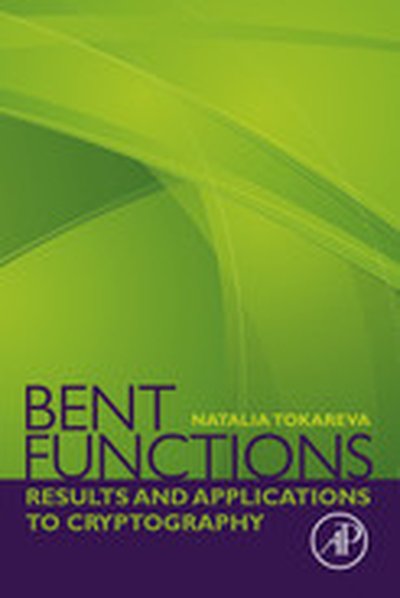
Bent Functions

Bent Functions: Results and Applications to Cryptography offers a unique survey of the objects of discrete mathematics known as Boolean bent functions. As these maximal, nonlinear Boolean functions and their generalizations have many theoretical and practical applications in combinatorics, coding theory, and cryptography, the text provides a detailed survey of their main results, presenting a systematic overview of their generalizations and applications, and considering open problems in classification and systematization of bent functions. The text is appropriate for novices and advanced researchers, discussing proofs of several results, including the automorphism group of bent functions, the lower bound for the number of bent functions, and more. Provides a detailed survey of bent functions and their main results, presenting a systematic overview of their generalizations and applications Presents a systematic and detailed survey of hundreds of results in the area of highly nonlinear Boolean functions in cryptography Appropriate coverage for students from advanced specialists in cryptography, mathematics, and creators of ciphers

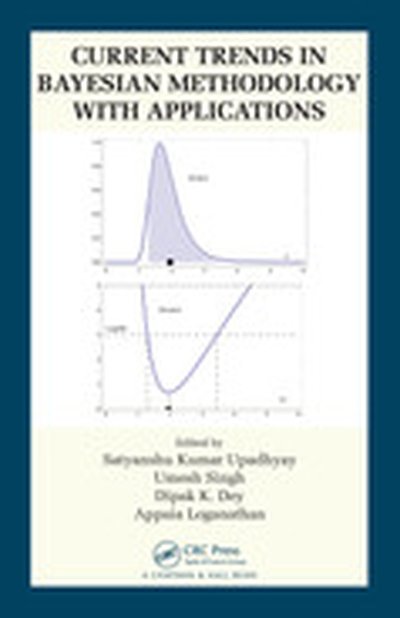
Current Trends in Bayesian Methodology with Applications

Collecting Bayesian material scattered throughout the literature, this volume examines the latest methodological and applied aspects of Bayesian statistics. The book covers biostatistics, econometrics, reliability and risk analysis, spatial statistics, image analysis, shape analysis, Bayesian computation, clustering, uncertainty assessment, high-energy astrophysics, neural networking, fuzzy information, objective Bayesian methodologies, empirical Bayes methods, small area estimation, and many more topics. Each chapter is self-contained, gives an overview of the area, presents theoretical insights, and emphasizes applications through motivating examples.

Bit-Interleaved Coded Modulation: Fundamentals, Analysis and Design

Presenting a thorough overview of bit-interleaved coded modulation (BICM), this book introduces the tools for the analysis and design of BICM transceivers. It explains in details the functioning principles of BICM and proposes a refined probabilistic modeling of the reliability metrics-the so-called L-values-which are at the core of the BICM receivers. Alternatives for transceiver design based on these models are then studied. Providing new insights into the analysis of BICM, this book is unique in its approach, providing a general framework for analysis and design, focusing on communication theoretic aspects of BICM transceivers. It adopts a tutorial approach, explains the problems in simple terms with the aid of multiple examples and case studies, and provides solutions using accessible mathematical tools. The book will be an excellent resource for researchers in academia and industry: graduate students, academics, development engineers, and R & D managers. Key Features: Presents an introduction to BICM, placing it in the context of other coded modulation schemes Offers explanations of the functioning principles and design alternatives Provides a unique approach, focusing on communication theory aspects Shows examples and case studies to illustrate analysis and design of BICM Adopts a tutorial approach, explaining the problems in simple terms and presenting solutions using accessible mathematical tools

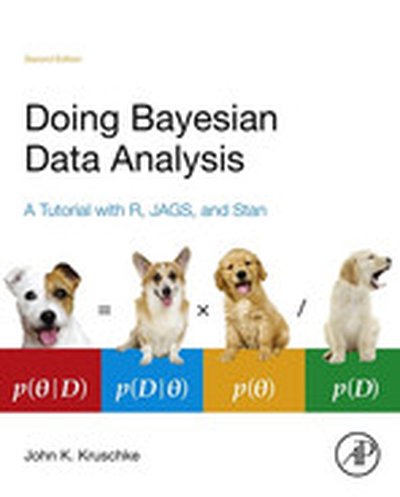
Doing Bayesian Data Analysis, 2nd Edition

Doing Bayesian Data Analysis: A Tutorial with R, JAGS, and Stan, Second Edition provides an accessible approach for conducting Bayesian data analysis, as material is explained clearly with concrete examples. Included are step-by-step instructions on how to carry out Bayesian data analyses in the popular and free software R and WinBugs, as well as new programs in JAGS and Stan. The new programs are designed to be much easier to use than the scripts in the first edition. In particular, there are now compact high-level scripts that make it easy to run the programs on your own data sets. The book is divided into three parts and begins with the basics: models, probability, Bayes’ rule, and the R programming language. The discussion then moves to the fundamentals applied to inferring a binomial probability, before concluding with chapters on the generalized linear model. Topics include metric-predicted variable on one or two groups; metric-predicted variable with one metric predictor; metric-predicted variable with multiple metric predictors; metric-predicted variable with one nominal predictor; and metric-predicted variable with multiple nominal predictors. The exercises found in the text have explicit purposes and guidelines for accomplishment. This book is intended for first-year graduate students or advanced undergraduates in statistics, data analysis, psychology, cognitive science, social sciences, clinical sciences, and consumer sciences in business. Accessible, including the basics of essential concepts of probability and random sampling Examples with R programming language and JAGS software Comprehensive coverage of all scenarios addressed by non-Bayesian textbooks: t-tests, analysis of variance (ANOVA) and comparisons in ANOVA, multiple regression, and chi-square (contingency table analysis) Coverage of experiment planning R and JAGS computer programming code on website Exercises have explicit purposes and guidelines for accomplishment Provides step-by-step instructions on how to conduct Bayesian data analyses in the popular and free software R and WinBugs

Bayesian Methods for Management and Business: Pragmatic Solutions for Real Problems

HIGHLIGHTS THE USE OF BAYESIAN STATISTICS TO GAIN INSIGHTS FROM EMPIRICAL DATA Featuring an accessible approach, Bayesian Methods for Management and Business: Pragmatic Solutions for Real Problems demonstrates how Bayesian statistics can help to provide insights into important issues facing business and management. The book draws on multidisciplinary applications and examples and utilizes the freely available software WinBUGS and R to illustrate the integration of Bayesian statistics within data-rich environments. Computational issues are discussed and integrated with coverage of linear models, sensitivity analysis, Markov Chain Monte Carlo (MCMC), and model comparison. In addition, more advanced models including hierarchal models, generalized linear models, and latent variable models are presented to further bridge the theory and application in real-world usage. Bayesian Methods for Management and Business: Pragmatic Solutions for Real Problems also features: Numerous real-world examples drawn from multiple management disciplines such as strategy, international business, accounting, and information systems An incremental skill-building presentation based on analyzing data sets with widely applicable models of increasing complexity An accessible treatment of Bayesian statistics that is integrated with a broad range of business and management issues and problems A practical problem-solving approach to illustrate how Bayesian statistics can help to provide insight into important issues facing business and management Bayesian Methods for Management and Business: Pragmatic Solutions for Real Problems is an important textbook for Bayesian statistics courses at the advanced MBA-level and also for business and management PhD candidates as a first course in methodology. In addition, the book is a useful resource for management scholars and practitioners as well as business academics and practitioners who seek to broaden their methodological skill sets.

Bayesian Networks for Probabilistic Inference and Decision Analysis in Forensic Science, 2nd Edition

"This book should have a place on the bookshelf of every forensic scientist who cares about the science of evidence interpretation" Dr. Ian Evett, Principal Forensic Services Ltd, London, UK Continuing developments in science and technology mean that the amounts of information forensic scientists are able to provide for criminal investigations is ever increasing. The commensurate increase in complexity creates difficulties for scientists and lawyers with regard to evaluation and interpretation, notably with respect to issues of inference and decision. Probability theory, implemented through graphical methods, and specifically Bayesian networks, provides powerful methods to deal with this complexity. Extensions of these methods to elements of decision theory provide further support and assistance to the judicial system. Bayesian Networks for Probabilistic Inference and Decision Analysis in Forensic Science provides a unique and comprehensive introduction to the use of Bayesian decision networks for the evaluation and interpretation of scientific findings in forensic science, and for the support of decision-makers in their scientific and legal tasks. Includes self-contained introductions to probability and decision theory. Develops the characteristics of Bayesian networks, object-oriented Bayesian networks and their extension to decision models. Features implementation of the methodology with reference to commercial and academically available software. Presents standard networks and their extensions that can be easily implemented and that can assist in the reader's own analysis of real cases. Provides a technique for structuring problems and organizing data based on methods and principles of scientific reasoning. Contains a method for the construction of coherent and defensible arguments for the analysis and evaluation of scientific findings and for decisions based on them. Is written in a lucid style, suitable for forensic scientists and lawyers with minimal mathematical background. Includes a foreword by Ian Evett. The clear and accessible style of this second edition makes this book ideal for all forensic scientists, applied statisticians and graduate students wishing to evaluate forensic findings from the perspective of probability and decision analysis. It will also appeal to lawyers and other scientists and professionals interested in the evaluation and interpretation of forensic findings, including decision making based on scientific information.

Applied Bayesian Modelling, 2nd Edition

This book provides an accessible approach to Bayesian computing and data analysis, with an emphasis on the interpretation of real data sets. Following in the tradition of the successful first edition, this book aims to make a wide range of statistical modeling applications accessible using tested code that can be readily adapted to the reader's own applications. The second edition has been thoroughly reworked and updated to take account of advances in the field. A new set of worked examples is included. The novel aspect of the first edition was the coverage of statistical modeling using WinBUGS and OPENBUGS. This feature continues in the new edition along with examples using R to broaden appeal and for completeness of coverage.

Bayesian Networks

Understand the Foundations of Bayesian Networks—Core Properties and Definitions Explained Bayesian Networks: With Examples in R introduces Bayesian networks using a hands-on approach. Simple yet meaningful examples in R illustrate each step of the modeling process. The examples start from the simplest notions and gradually increase in complexity. The authors also distinguish the probabilistic models from their estimation with data sets. The first three chapters explain the whole process of Bayesian network modeling, from structure learning to parameter learning to inference. These chapters cover discrete Bayesian, Gaussian Bayesian, and hybrid networks, including arbitrary random variables. The book then gives a concise but rigorous treatment of the fundamentals of Bayesian networks and offers an introduction to causal Bayesian networks. It also presents an overview of R and other software packages appropriate for Bayesian networks. The final chapter evaluates two real-world examples: a landmark causal protein signaling network paper and graphical modeling approaches for predicting the composition of different body parts. Suitable for graduate students and non-statisticians, this text provides an introductory overview of Bayesian networks. It gives readers a clear, practical understanding of the general approach and steps involved.