talk-data.com talk-data.com

Topic

data-engineering

3377

tagged

Activity Trend

1 peak/qtr
2020-Q1 2026-Q1

Activities

Showing filtered results

Filtering by: O'Reilly Data Engineering Books ×
Just Hibernate

If you’re looking for a short, sweet, and simple introduction (or reintroduction) to Hibernate, this is the book you want. Through clear real-world examples, you’ll learn Hibernate and object-relational mapping from the ground up, starting with the basics. Then you’ll dive into the framework’s moving parts to understand how they work in action. Storing Java objects in relational databases is usually a challenging and complex task for any Java developer, experienced or not. This book, like others in the Just series, delivers a concise, example-driven tutorial for Java beginners. You’ll gain enough knowledge and confidence to start working on real-world projects with Hibernate. Compare how JDBC and Hibernate work with object persistence Learn how annotations are used to create Hibernate applications Understand how to persist and retrieve Java data structures Focus on the fundamentals of associations and their mappings Delve into advanced concepts such as caching, inheritance, and types Walk through the Hibernate Query Language API, with examples Develop Java Persistence API applications, using Hibernate as the provider Work hands-on with code snippets to understand the technology
Troubleshooting Oracle Performance, Second Edition

Troubleshooting Oracle Performance, 2nd Edition is your systematic guide to diagnosing and resolving performance problems in database-backed applications involving Oracle's database engine. Christian Antognini brings a decade and a half experience to his topic. His first edition is one of the most well-respected books in its field. This second edition has been rigorously updated to cover the latest developments in Oracle Database 11 g Release 2 through Oracle Database 12 c. What do you do when your database application isn't running fast enough? You troubleshoot, of course. Finding the slow part of an application is often the easy part of the battle. It's finding a solution that's difficult. Troubleshooting Oracle Performance, 2nd Edition helps by providing a systematic approach to addressing the underlying causes of poor database application performance. The author freely shares his experience while explaining the underlying foundations of how SQL statements are executed by the Oracle database engine. You'll be able to draw a solid foundation of theory and shared experience as you face head-on the performance challenges in your daily work. Written for developers by an application developer who has learned by doing Gives a systematic approach to solving database application performance problems Helps you plan for performance as you would for any other application requirement What you'll learn Systematically identify performance problems Configure the query optimizer to meet performance goals Read and recognize inefficient execution plans Minimize the impact of parsing upon performance Optimize data access, joins, and the physical design of your database Improve performance through parallel processing, materialized views, and result caching Apply SQL tuning techniques such as hints, SQL profiles, stored outlines, and SQL plan baselines Reduce inefficiencies from too much procedural code Who this book is for Troubleshooting Oracle Performance, Second Edition is targeted at application developers and database administrators involved in troubleshooting performance problems in Oracle-based applications.

IBM System Storage N series Clustered Data ONTAP

IBM® System Storage® N series storage systems offer an excellent solution for a broad range of deployment scenarios. IBM System Storage N series storage systems function as a multiprotocol storage device that is designed to allow you to simultaneously serve both file and block-level data across a single network. These activities are demanding procedures that, for some solutions, require multiple, separately managed systems. The flexibility of IBM System Storage N series storage systems, however, allows them to address the storage needs of a wide range of organizations, including distributed enterprises and data centers for midrange enterprises. IBM System Storage N series storage systems also support sites with computer and data-intensive enterprise applications, such as database, data warehousing, workgroup collaboration, and messaging. This IBM Redbooks® publication explains the software features of the IBM System Storage N series storage systems with Clustered Data ONTAP (cDOT) Version 8.2, which is the first version available on the IBM System Storage N series, and as of October 2013, is also the most current version available. cDOT is different from previous ONTAP versions by the fact that it offers a storage solution that operates as a cluster with flexible scaling capabilities. cDOT configurations allow clients to build a scale-out architecture, protecting their investment and allowing horizontal scaling of their environment. This book also covers topics such as installation, setup, and administration of those software features from the IBM System Storage N series storage systems and clients, and provides example scenarios.

Advanced Case Management with IBM Case Manager

Organizations face case management challenges that require insight, responsiveness, and collaboration. IBM® Case Manager, Version 5.2, is an advanced case management product that unites information, process, and people to provide the 360-degree view of case information and achieve optimized outcomes. With IBM Case Manager, knowledge workers can extract critical case information through integrated business rules, collaboration, and analytics. This easy access to information enhances decision-making ability and leads to more successful case outcomes. IBM Case Manager also helps capture industry preferred practices in frameworks and templates to empower business users and accelerate return on investment. This IBM Redbooks® publication introduces the case management concept. It includes the reason for and benefits of case management, and why it is different from the traditional business process management or content management. In addition, this book addresses how you can design and build a case management solution with IBM Case Manager and integrate that solution with external products and components. This book is intended to provide IT architects and IT specialists with the high-level concepts of case management and the capabilities of IBM Case Manager. It also serves as a practical guide for IT professionals who are responsible for designing, building, customizing, and deploying IBM Case Manager solutions.

IBM System Storage N series Hardware Guide

This IBM® Redbooks® publication provides a detailed look at the features, benefits, and capabilities of the IBM System Storage® N series hardware offerings. The IBM System Storage N series systems can help you tackle the challenge of effective data management by using virtualization technology and a unified storage architecture. The N series delivers low- to high-end enterprise storage and data management capabilities with midrange affordability. Built-in serviceability and manageability features help support your efforts to increase reliability, simplify and unify storage infrastructure and maintenance, and deliver exceptional economy. The IBM System Storage N series systems provide a range of reliable, scalable storage solutions to meet various storage requirements. These capabilities are achieved by using network access protocols, such as Network File System (NFS), Common Internet File System (CIFS), HTTP, and iSCSI, and storage area network technologies, such as Fibre Channel. By using built-in Redundant Array of Independent Disks (RAID) technologies, all data is protected with options to enhance protection through mirroring, replication, Snapshots, and backup. These storage systems also have simple management interfaces that make installation, administration, and troubleshooting straightforward. In addition, this book addresses high-availability solutions, including clustering and MetroCluster that support highest business continuity requirements. MetroCluster is a unique solution that combines array-based clustering with synchronous mirroring to deliver continuous availability.

OCA Oracle Database 12c Installation and Administration Exam Guide (Exam 1Z0-062), 2nd Edition

A Complete Study System for OCA Exam 1Z0-062 Prepare for the Oracle Certified Associate Oracle Database 12 c Installation and Administration exam with this exclusive Oracle Press guide. Each chapter features challenging exercises, a certification summary, a two-minute drill, and a self-test to reinforce the topics presented. This authoritative resource helps you pass the exam and also serves as an essential, on-the-job reference. Get complete coverage of all OCA objectives for exam 1Z0-062, including: Installing and upgrading Oracle Database software Managing the database instance Configuring the Oracle network environment Managing database storage structures Administering user security Managing undo data and data concurrency Implementing Oracle Database auditing Performing database maintenance Managing performance and tuning SQL Managing resources using Oracle Database Resource Manager Automating tasks Moving data Performing backup and recovery Installing Oracle Grid Infrastructure for a standalone server Electronic content includes: 185+ practice exam questions with detailed answers and explanations Test engine that provides custom exams by chapter or by domain

IBM Intelligent Operations Center 1.6 Programming Guide

IBM® Intelligent Operations Center is an integrated solution. It provides a rich set of capabilities and line of business tools that business users with domain expertise and no technical background can use without customization. IBM Intelligent Operations Center also provides services and extension points that developers can use to extend the IBM Intelligent Operations Center standard functions and develop capabilities specific to the domain and client requirements. IBM Intelligent Operations Center includes an application-based programming model that supports all the interactions with the solution components. The programming model is based on industry standard Representational State Transfer (REST) and Java technologies. IBM Intelligent Operations Center includes a full set of REST and Java application programming interfaces (APIs) that provide a simplified development environment and make the platform easy to extend and customize for a large community of developers. This IBM Redbooks® publication gives a broad understanding of the IBM Intelligent Operations Center 1.6.0.1 programming model and available extension points. Many of the chapters describe working examples and usage scenarios that demonstrate how to extend the IBM Intelligent Operations Center base platform. This book includes sample code that can be downloaded from the IBM Redbooks website. The target audience for this book consists of solution architects, developers, technical consultants, and solution administrators who will learn the following information: The options available to extend the IBM Intelligent Operations Center solution programmatically How to configure customizations tailored to specific customer requirements How to use the available configuration tools to configure the solution without requiring programming IBM® Intelligent Operations Center 1.5 to 1.6 Migration Guide , SG24-8202.

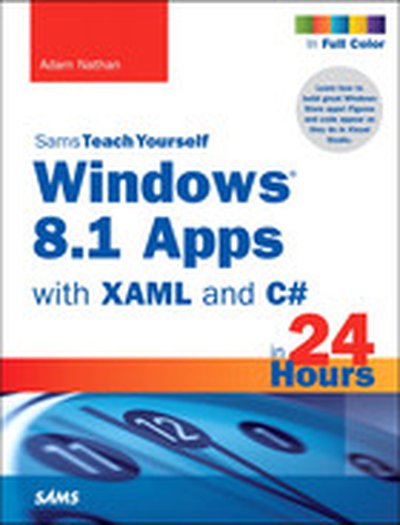
Windows® 8.1 Apps with XAML and C# Sams Teach Yourself in 24 Hours

Learn how to build great Windows Store apps! Figures and code appear as they do in Visual Studio. In just 24 sessions of one hour or less, Sams Teach Yourself Windows 8.1 Apps with XAML and C# in 24 Hours will help you build compelling apps for Windows 8.1 devices of all kinds. Using this book’s straightforward approach, you’ll learn to design and build apps, create flexible user interfaces, handle inputs, integrate controls, and more. Step by step, you’ll discover how to leverage XAML’s visual richness and the immense power of Windows 8.1. Every lesson builds on what you’ve already learned, giving you a rock-solid foundation for real-world success! Step-by-step instructions carefully walk you through today’s most common XAML and C# development tasks. Quizzes at the end of each chapter help you test your knowledge. Notes present interesting information related to the discussion. Tips offer advice or show you easier ways to perform tasks. Cautions alert you to possible problems and give you advice on how to avoid them. Learn how to… Create user interfaces that adapt to any device, from tablets to high-def TVs Handle input from touch, mouse, pen, and keyboard Manage the entire Windows 8.1 app lifecycle and all execution states Master powerful XAML controls for text, images, audio, video, and more Integrate vector graphics that scale perfectly to any size Apply rich animations Work with styles, templates, and visual states Exploit the Windows charms within your apps Take full advantage of data binding and contracts Read data from sensors and control external devices Provide dynamic updates via live tiles, notifications, and the lock screen Discover the many ways to monetize your Windows Store apps

Geographical Information Systems

Web services, cloud computing, location based services, NoSQLdatabases, and Semantic Web offer new ways of accessing, analyzing, and elaborating geo-spatial information in both real-world and virtual spaces. This book explores the how-to of the most promising recurrent technologies and trends in GIS, such as Semantic GIS, Web GIS, Mobile GIS, NoSQL Geographic Databases, Cloud GIS, Spatial Data Warehousing-OLAP, and Open GIS. The text discusses and emphasizes the methodological aspects of such technologies and their applications in GIS.

IBM SmartCloud Storage Access V1.2 Implementation Guide

This IBM® Redbooks® publication will help you learn how to build a storage cloud with the IBM SmartCloud® Storage Access solution, which consists of multiple hardware and software products, including IBM Scale Out Network Attached Storage, IBM Storwize® V7000 Unified, IBM Tivoli® Storage Productivity Center, and more. The new self-service storage provisioning for IBM Storwize V7000, IBM System Storage® SAN Volume Controller (SAN Volume Controller), and IBM XIV® storage systems for storage area network (SAN) or block access is included. To get you started, this book provides information about the planning, installation, and configuration for each component. IBM SmartCloud Storage Access is an IBM software product for storage cloud management that provides the cloud service with virtualization and automation. IBM SmartCloud Storage Access is the focal point to administer the storage cloud environment, providing a self-service provision approach for storage cloud users. New storage capacity can be easily deployed and accessed by the Internet or intranet. IBM SmartCloud Storage Access also supports simple and fast resource elasticity as user demand changes. With the IBM SmartCloud Storage Access solution, the storage resources will be displayed as unified resource pools with different service levels. Users no longer need to know the exact location of their files, and there is no more need to configure the underlying storage subsystems manually. All storage resources are still well monitored, and the cloud administrators can easily track the historical storage resource usage. The IBM SmartCloud Storage Access solution provides all of the essential characteristics of a cloud service. IBM SmartCloud Storage Access acts as the cloud management portal. All cloud users work with the portal, and IBM SmartCloud Storage Access forwards the storage requests to Tivoli Storage Productivity Center to process. Tivoli Storage Productivity Center provides the storage configuration and usage details to IBM SmartCloud Storage Access. Some additional small, but important, components are required for the IBM SmartCloud Storage Access solution: Lightweight Directory Access Protocol (LDAP) or Active Directory (AD) system for authentication Domain Name System (DNS) for naming converting Simple Mail Transfer Protocol (SMTP) component for mail notification Network Time Protocol (NTP) system for clock synchronization

Oracle WebLogic Server 12c Administration Handbook

Best Practices for Oracle WebLogic Server 12 c Configuration and Administration Maintain a high-performance enterprise application framework using the detailed information in this authoritative resource. Through expert instruction and real-world examples, Oracle WebLogic Server 12c Administration Handbook fully explains the latest management tools and techniques. Learn how to work from the Oracle WebLogic Server Administration Console or command line, configure servers and clusters, deploy applications, and optimize application performance. Tuning, troubleshooting, and load balancing are thoroughly covered in this Oracle Press guide. Install Oracle WebLogic Server 12 c or perform an upgrade Manage domains, server instances, networks, and virtual hosts Work with the WebLogic Scripting Tool feature and Node Manager Build custom network channels and resource adapters Monitor performance with the WebLogic Diagnostics Framework feature Prioritize requests using Oracle WebLogic Server Work Managers Configure Oracle WebLogic clusters and migrate servers and services Deploy web applications, Enterprise JavaBeans, and Java EE modules Establish security realms and authenticate and authorize users Allocate memory, optimize throughput, and tune the Java Virtual Machine

Learning Cypher

"Learning Cypher" provides an in-depth look into Cypher, the functional query language for Neo4j, the powerful graph database. Whether you're transitioning from relational databases or exploring graph technology for the first time, this book offers practical guidance to help you write efficient, clear, and reusable queries. What this Book will help me do Master the Cypher declarative query syntax for graph databases. Write optimized Cypher queries for better application performance. Transform relational database data to graph database structures with ease. Understand the nuances of transitioning from SQL to graph paradigms. Learn the common pitfalls in Neo4j programming and how to avoid them. Author(s) Onofrio Panzarino is an experienced database developer specializing in graph technologies and Neo4j. He is passionate about teaching industry best practices to developers and has extensive experience in designing graph-based solutions. Through his approachable style, he empowers readers to excel in using graph databases effectively. Who is it for? This book is for database developers, data analysts, and software engineers who want to expand their knowledge into graph databases. If you work with large-scale connected data or are transitioning from SQL to a graph model, this book is ideal for you. Prior experience with any database query language will be helpful. The book is also suitable for students and professionals looking to integrate graph technology into their projects.

Experiences with Oracle Database 12c Release 1 on Linux on System z

Oracle Database 12c Release 1 is now supported on Linux on IBM® System z®. This platform offers many advantages to customers who rely upon the IBM mainframe systems to run their businesses. Linux on System z takes advantage of the qualities of service in the System z hardware and in IBM z/VM®, making it a robust industrial strength version of Linux. This provides an excellent platform for hosting Oracle solutions that run in an enterprise. This IBM Redbooks® publication shares experiences that are gained while installing and testing Oracle Database 12c Release 1: Recommendations about how to set up an infrastructure Installing an Oracle Grid Infrastructure Installing Oracle 12C R1 Real Application Clusters (RAC) and creating a RAC Database, including a multitenant database Using the Cloud Control Agent to manage Oracle Database 12c Release 1 Installing Oracle WebLogic Server 12c Upgrading from an Oracle Database from 11gR2 to 12c Release 1

IBM b-type Gen 5 16 Gbps Switches and Network Advisor

IBM® System Storage® Gen 5 fabric backbones are among the industry's most powerful Fibre Channel switching infrastructure offerings. They provide reliable, scalable, and high-performance foundations for mission-critical storage. These fabric backbones also deliver enterprise connectivity options to add support for IBM FICON® connectivity, offering a high-performing and reliable FICON infrastructure with fast and scalable IBM System z® servers. Designed to increase business agility while providing nonstop access to information and reducing infrastructure and administrative costs, Gen 5 Fibre Channel fabric backbones deliver a new level of scalability and advanced capabilities to this robust, reliable, and high-performance technology. Although every network type has unique management requirements, most organizations face similar challenges managing their network environments. These challenges can include minimizing network downtime, reducing operational expenses, managing application service level agreements (SLAs), and providing robust security. Until now, no single tool could address these needs across different network types. To address this issue, the IBM Network Advisor management tool provides comprehensive management for data, storage, and converged networks. This single application can deliver end-to-end visibility and insight across different network types by integrating with Fabric Vision technology; it supports Fibre Channel SANs, including Gen 5 Fibre Channel platforms, IBM FICON, and IBM b-type SAN FCoE networks. In addition, this tool supports comprehensive lifecycle management capabilities across different networks through a simple, seamless user experience. This IBM Redbooks® publication introduces the concepts, architecture, and basic implementation of Gen 5 and IBM Network Advisor. It is aimed at system administrators, and pre- and post-sales support staff.

IBM Intelligent Operations Center V1.5 to V1.6 Migration Guide

IBM® Intelligent Operations Center is an integrated solution, and a continually evolving platform and set of capabilities. The platform grows as the capabilities increase over time, and new interfaces and integration points are introduced in each release. The purpose of this IBM Redbooks® publication is to guide planners, architects, and implementers through the options that they have, to take advantage of the new capabilities and maximize the benefits of moving to the new release. This book considers what has already been deployed with IBM Intelligent Operations Center V1.5, the benefits of the new version (IBM Intelligent Operations Center V1.6.0.1), and the best way to take advantage of the new capabilities as you transition. IBM Intelligent Operations Center has several integration and extension points for the previous and current versions of the product, which points are documented and described in this book. This IBM Redbooks publication describes options and considerations for the best way to migrate customizations and benefit from the new architecture. Thorough details about the differences between the prior and new versions of the product are provided, to enable a clear understanding of migration choices, options, and preferred practices. This book includes descriptions of the trade-offs for each migration option, and in-depth information about data flows, available tools, and scripting changes that might affect existing IBM Intelligent Operations Center installations. This book is targeted to the following audiences: Line of business managers or stakeholders who are interested in understanding the new features in IBM Intelligent Operations Center V1.6, and who are looking for information about how to plan the migration of their current IBM Intelligent Operations Center V1.5 environments. Architects who need to understand the effect that IBM Intelligent Operations Center V1.6 will have on the architecture of IBM Intelligent Operations Center V1.5 solutions. IT specialists and product specialists who are responsible for implementing the migration of a solution based on IBM Intelligent Operations Center V1.5 to a V1.6 solution. IBM Intelligent Operations Center 1.6 Programming Guide, SG24-8201.

IBM MobileFirst Strategy Software Approach

IBM® MobileFirst enables an enterprise to support a mobile strategy. With this end-to-end solution, IBM makes it possible for an enterprise to benefit from mobile interactions with customers, with business partners, and in organizations. There are products available from the IBM MobileFirst solution to support management, security, analytics, and development of the application and data platforms in a mobile environment. This IBM Redbooks® publication explores four areas crucial to developing a mobile strategy: Application development Mobile quality management Mobile device management Mobile analytics This IBM Redbooks publication provides an in-depth look at IBM Worklight®, IBM Rational® Test Workbench, IBM Endpoint Manager for Mobile Devices, and IBM Tealeaf® CX Mobile. This book is of interest to architects looking to design mobile enterprise solutions, and to practitioners looking to build these solutions. Related blog post 5 Things To Know About IBM MobileFirst

Big Data Analytics Beyond Hadoop: Real-Time Applications with Storm, Spark, and More Hadoop Alternatives

Master alternative Big Data technologies that can do what Hadoop can't: real-time analytics and iterative machine learning. When most technical professionals think of Big Data analytics today, they think of Hadoop. But there are many cutting-edge applications that Hadoop isn't well suited for, especially real-time analytics and contexts requiring the use of iterative machine learning algorithms. Fortunately, several powerful new technologies have been developed specifically for use cases such as these. Big Data Analytics Beyond Hadoop is the first guide specifically designed to help you take the next steps beyond Hadoop. Dr. Vijay Srinivas Agneeswaran introduces the breakthrough Berkeley Data Analysis Stack (BDAS) in detail, including its motivation, design, architecture, Mesos cluster management, performance, and more. He presents realistic use cases and up-to-date example code for: Spark, the next generation in-memory computing technology from UC Berkeley Storm, the parallel real-time Big Data analytics technology from Twitter GraphLab, the next-generation graph processing paradigm from CMU and the University of Washington (with comparisons to alternatives such as Pregel and Piccolo) Halo also offers architectural and design guidance and code sketches for scaling machine learning algorithms to Big Data, and then realizing them in real-time. He concludes by previewing emerging trends, including real-time video analytics, SDNs, and even Big Data governance, security, and privacy issues. He identifies intriguing startups and new research possibilities, including BDAS extensions and cutting-edge model-driven analytics. Big Data Analytics Beyond Hadoop is an indispensable resource for everyone who wants to reach the cutting edge of Big Data analytics, and stay there: practitioners, architects, programmers, data scientists, researchers, startup entrepreneurs, and advanced students.

IBM Tivoli Storage Productivity Center for Replication for System z

IBM® Tivoli® Storage Productivity Center for Replication provides support for the advanced copy services capabilities on the DS8000® and DS6000™, in addition to the support for SAN Volume Controller. This support focuses on automating administration and configuration of these services, operational control (starting, suspending, resuming) copy services tasks, and monitoring and managing the copy services sessions. In addition to the support for FlashCopy® and Metro Mirror, Tivoli Storage Productivity Center for Replication supports Global Mirror on the DS8000, and SAN Volume hardware platforms. Advanced disaster recovery functions are also supported with failover/failback (planned and unplanned) from a primary site to a disaster recovery site. A new product, IBM Tivoli Storage Productivity Center for Replication Basic Edition for System z® enables Basic HyperSwap® on z/OS®, which allows the management of disk replication services using an intuitive GUI on z/OS systems. Tivoli Storage Productivity Center for Replication also can monitor the performance of the copy services that provide a measurement of the amount of replication and the amount of time that is required to complete the replication operations. This IBM Redbooks® publication provides the information you need to install Tivoli Storage Productivity Center for Replication V5.1, and create and manage replication sessions on a z/OS platform. Scenarios are provided that document the work performed in our laboratory setting, using the GUI and CLI.

Building Better Econometric Models Using Cross Section and Panel Data

Many empirical researchers yearn for an econometric

model that better explains their data. Yet these researchers

rarely pursue this objective for fear of the

statistical complexities involved in specifying that

model. This book is intended to alleviate those anxieties

by providing a practical methodology that anyone

familiar with regression analysis can employ—a

methodology that will yield a model that is both more

informative and is a better representation of the data.

This book outlines simple, practical procedures

that can be used to specify a model that better explains

the data. Such procedures employ the use of

purely statistical techniques performed upon a publicly

available data set, which allows readers to follow

along at every stage of the procedure. Using the

econometric software Stata (though most other statistical

software packages can be used as well), this

book demonstrates how to test for model misspecification

and how to respecify these models in a practical

way that not only enhances the inference drawn

from the results, but adds a level of robustness that

can increase the researcher’s confidence in the output

generated. By following this procedure, researchers

will be led to a better, more finely tuned empirical

model that yields better results.

OCA Oracle Database 12c SQL Fundamentals I Exam Guide (Exam 1Z0-061), 2nd Edition

A Complete Study System for OCA Exam 1Z0-061 Prepare for the Oracle Certified Associate Oracle Database 12 c SQL Fundamentals I exam with this Oracle Press guide. Each chapter features challenging exercises, a certification summary, a two-minute drill, and a self-test to reinforce the topics presented. This authoritative resource helps you pass the exam and also serves as an essential, on-the-job reference. Get complete coverage of all OCA objectives for exam 1Z0-061, including: Data retrieval using the SQL SELECT statement Restricting and sorting data Single-row functions Using conversion functions and conditional expressions Reporting aggregated data with the group functions Displaying data from multiple tables with joins Using subqueries to solve problems Using the set operators Manipulating data with DML statements Using DDL statements to create and manage tables Electronic content includes: 150+ practice exam questions with detailed answers and explanations Score report performance assessment tool