talk-data.com talk-data.com

Topic

data-science

2091

tagged

Activity Trend

1 peak/qtr
2020-Q1 2026-Q1

Activities

Showing filtered results

Filtering by: O'Reilly Data Science Books ×
Numbers Rule Your World: The Hidden Influence of Probabilities and Statistics on Everything You Do

WHAT ARE THE ODDS YOU'LL WIN THE LOTTERY? How long will your kids wait in line at Disney World? Who decides that “standardized tests” are fair? Why do highway engineers build slow-moving ramps? What does it mean, statistically, to be an “Average Joe”? NUMBERS RULE YOUR WORLD In the popular tradition of eye-opening bestsellers like Freakonomics, The Tipping Point, and Super Crunchers, this fascinating book from renowned statistician and blogger Kaiser Fung takes you inside the hidden world of facts and figures that affect you every day, in every way. These are the statistics that rule your life, your job, your commute, your vacation, your food, your health, your money, and your success. This is how engineers calculate your quality of living, how corporations determine your needs, and how politicians estimate your opinions. These are the numbers you never think about-even though they play a crucial role in every single aspect of your life. What you learn may surprise you, amuse you, or even enrage you. But there's one thing you won't be able to deny: Numbers Rule Your World… "An easy read with a big benefit." —Fareed Zakaria, CNN "For those who have anxiety about how organization data-mining is impacting their world, Kaiser Fung pulls back the curtain to reveal the good and the bad of predictive analytics." —Ian Ayres,Yale professor and author of Super Crunchers: Why Thinking By Numbers is the New Way to Be Smart "A book that engages us with stories that a journalist would write, the compelling stories behind the stories as illuminated by the numbers, and the dynamics that the numbers reveal." —John Sall, Executive Vice President, SAS Institute "Little did I suspect, when I picked up Kaiser Fung's book, that I would become so entranced by it - an illuminating and accessible exploration of the power of statistical analysis for those of us who have no prior training in a field that he explores so ably." —Peter Clarke, author of Keynes: The Rise, Fall, and Return of the 20th Century's Most Influential Economist "A tremendous book. . . . If you want to understand how to use statistics, how to think with numbers and yet to do this without getting lost in equations, if you've been looking for the book to unlock the door to logical thinking about problems, well, you will be pleased to know that you are holding that book in your hands." —Daniel Finkelstein, Executive Editor, The Times of London "I thoroughly enjoyed this accessible book and enthusiastically recommend it to anyone looking to understand and appreciate the role of statistics and data analysis in solving problems and in creating a better world." —Michael Sherman, Texas A&M University, American Statistician
Common Statistical Methods for Clinical Research with SAS Examples, Third Edition, 3rd Edition

Glenn Walker and Jack Shostak's Common Statistical Methods for Clinical Research with SAS Examples, Third Edition, is a thoroughly updated edition of the popular introductory statistics book for clinical researchers. This new edition has been extensively updated to include the use of ODS graphics in numerous examples as well as a new emphasis on PROC MIXED. Straightforward and easy to use as either a text or a reference, the book is full of practical examples from clinical research to illustrate both statistical and SAS methodology. Each example is worked out completely, step by step, from the raw data.

Common Statistical Methods for Clinical Research with SAS Examples, Third Edition, is an applications book with minimal theory. Each section begins with an overview helpful to nonstatisticians and then drills down into details that will be valuable to statistical analysts and programmers. Further details, as well as bonus information and a guide to further reading, are presented in the extensive appendices. This text is a one-source guide for statisticians that documents the use of the tests used most often in clinical research, with assumptions, details, and some tricks--all in one place.

This book is part of the SAS Press program.

Analytics at Work

Most companies have massive amounts of data at their disposal, yet fail to utilize it in any meaningful way. But a powerful new business tool - analytics - is enabling many firms to aggressively leverage their data in key business decisions and processes, with impressive results. In their previous book, Competing on Analytics, Thomas Davenport and Jeanne Harris showed how pioneering firms were building their entire strategies around their analytical capabilities. Rather than "going with the gut" when pricing products, maintaining inventory, or hiring talent, managers in these firms use data, analysis, and systematic reasoning to make decisions that improve efficiency, risk-management, and profits. Now, in Analytics at Work, Davenport, Harris, and coauthor Robert Morison reveal how any manager can effectively deploy analytics in day-to-day operations—one business decision at a time. They show how many types of analytical tools, from statistical analysis to qualitative measures like systematic behavior coding, can improve decisions about everything from what new product offering might interest customers to whether marketing dollars are being most effectively deployed. Based on all-new research and illustrated with examples from companies including Humana, Best Buy, Progressive Insurance, and Hotels.com, this implementation-focused guide outlines the five-step DELTA model for deploying and succeeding with analytical initiatives. You'll learn how to: · Use data more effectively and glean valuable analytical insights · Manage and coordinate data, people, and technology at an enterprise level · Understand and support what analytical leaders do · Evaluate and choose realistic targets for analytical activity · Recruit, hire, and manage analysts Combining the science of quantitative analysis with the art of sound reasoning, Analytics at Work provides a road map and tools for unleashing the potential buried in your company's data.

The Critical Assessment of Research

This book examines the following factors: sponsorship of research, control of the dissemination of research, effects of dominant research paradigms, financial interests of authors, publishers, and editors, role of new technologies (for example, Web 2.0). It is widely accepted among researchers and educators that the peer review process, the reputation of the publisher and examination of the author's credentials are the gold standards for assessing the quality of research and information. However, the traditional gold standards are not sufficient, and the effective evaluation of information requires the consideration of additional factors. Controversies about positive evaluations of new medications that appear in peer-reviewed journals, the financial reports on Enron prior to the revelations that led to its collapse, and obstacles to the publication of research that does not conform to dominant paradigms are just a few examples that indicate the need for a more sophisticated and nuanced approach to evaluating information. Each of the factors is discussed in a factual manner, supported by many examples that illustrate not only the nature of the issues but also their complexity. Practical suggestions for the evaluation of information are an integral part of the text. Highlights frequently overlooked criteria for evaluating research Challenges the assumption that the gold standards for evaluation are sufficient Examines the role of new technologies in evaluating and disseminating research

Random Data: Analysis and Measurement Procedures, Fourth Edition

A timely update of the classic book on the theory and application of random data analysis First published in 1971, Random Data served as an authoritative book on the analysis of experimental physical data for engineering and scientific applications. This Fourth Edition features coverage of new developments in random data management and analysis procedures that are applicable to a broad range of applied fields, from the aerospace and automotive industries to oceanographic and biomedical research. This new edition continues to maintain a balance of classic theory and novel techniques. The authors expand on the treatment of random data analysis theory, including derivations of key relationships in probability and random process theory. The book remains unique in its practical treatment of nonstationary data analysis and nonlinear system analysis, presenting the latest techniques on modern data acquisition, storage, conversion, and qualification of random data prior to its digital analysis. The Fourth Edition also includes: A new chapter on frequency domain techniques to model and identify nonlinear systems from measured input/output random data New material on the analysis of multiple-input/single-output linear models The latest recommended methods for data acquisition and processing of random data Important mathematical formulas to design experiments and evaluate results of random data analysis and measurement procedures Answers to the problem in each chapter Comprehensive and self-contained, Random Data, Fourth Edition is an indispensible book for courses on random data analysis theory and applications at the upper-undergraduate and graduate level. It is also an insightful reference for engineers and scientists who use statistical methods to investigate and solve problems with dynamic data.

Presenting Data in Charts and Tables: Categorical and Numerical Variables

This Element is an excerpt from Even You Can Learn Statistics: A Guide for Everyone Who Has Ever Been Afraid of Statistics (ISBN: 9780137010592) by David M. Levine and David F. Stephan. Available in print and digital formats. How to present charts and tables that viewers will grasp immediately: visual information anyone can use! In an information-overloaded world, you simply must present information effectively. Using charts and tables, you can present categorical and numerical data far more clearly and efficiently. In this Element, we’ll show you exactly how to select and develop easy-to-understand charts and tables for the types of data you’re most likely to work with.

Statistical Graphics in SAS®: An Introduction to the Graph Template Language and the Statistical Graphics Procedures

The Graph Template Language (GTL) and the Statistical Graphics (SG) procedures are powerful new additions to SAS for creating high-quality statistical graphics. Warren F. Kuhfeld's Statistical Graphics in SAS: An Introduction to the Graph Template Language and the Statistical Graphics Procedures provides a parallel and example-driven introduction to the SG procedures and the GTL. Most graphs in the book are produced in at least two ways. Each example provides prototype code for getting started with the GTL and with the SG procedures. While you do not need to write a template to make many useful graphs, understanding the GTL enables you to create custom graphs that cannot be produced by the SG procedures. Knowing the GTL also helps you modify the sometimes complex templates that SAS provides. Written for anyone interested in statistical graphics, Statistical Graphics in SAS is a comprehensive introduction to these two aspects of ODS Graphics. It helps you understand the basics of what you can do with the SG procedures as well as how you can go beyond that by using the full power of the GTL.

SPSS For Dummies®, 2nd Edition

The fun and friendly guide to the world's leading statistical software Predictive Analysis Software (PASW), formerly SPSS software, is the leading statistical software used by commerical, government, and academic organizations around the world to solve business and research problems. It allows you to quickly and easily discover new insights from data, test hypotheses, and build powerful predictive models. PASW Statistics For Dummies covers everything you need to know to get up and running with this efficient and practical software. * PASW Statistics is the leading statistical software used to analyze data and create predictive models; it is used by business, academic, and government entities worldwide This guide explains how to work with automatic codebook generation and customize the variable view Walks you through the rounding method that is used in all calculations and explains using predictive analysis Shows how to maximize your use of graph templates, and much more* Even if you have little or no statistical or mathematical background, PASW Statistics For Dummies will show you how to generate statistical support and decision-making information quickly and easily.

Power and Love

The two methods most frequently employed to solve our toughest social problems—either relying on violence and aggression or submitting to endless negotiation and compromise—are fundamentally flawed. This is because the seemingly contradictory drives behind these approaches—power, the desire to achieve one's purpose, and love, the urge to unite with others—are actually complementary. As Dr. Martin Luther King Jr. put it, “Power without love is reckless and abusive, and love without power is sentimental and anemic.” But how do you combine them? For the last twenty years Adam Kahane of Reos Partners and the University of Oxford has worked around the world on many tough and vital challenges: food security, health care, economic development, judicial reform, peacemaking, climate change. In this extraordinary book he draws on this experience to delve deeply into the dual natures of both power and love, exploring their subtle and intricate interplay. With disarming honesty Kahane relates how, through trial and error, he has learned to balance them and offers practical guidance for how others can learn that balance as well.

R in a Nutshell

Why learn R? Because it's rapidly becoming the standard for developing statistical software. R in a Nutshell provides a quick and practical way to learn this increasingly popular open source language and environment. You'll not only learn how to program in R, but also how to find the right user-contributed R packages for statistical modeling, visualization, and bioinformatics. The author introduces you to the R environment, including the R graphical user interface and console, and takes you through the fundamentals of the object-oriented R language. Then, through a variety of practical examples from medicine, business, and sports, you'll learn how you can use this remarkable tool to solve your own data analysis problems. Understand the basics of the language, including the nature of R objects Learn how to write R functions and build your own packages Work with data through visualization, statistical analysis, and other methods Explore the wealth of packages contributed by the R community Become familiar with the lattice graphics package for high-level data visualization Learn about bioinformatics packages provided by Bioconductor "I am excited about this book. R in a Nutshell is a great introduction to R, as well as a comprehensive reference for using R in data analytics and visualization. Adler provides 'real world' examples, practical advice, and scripts, making it accessible to anyone working with data, not just professional statisticians."

Bioinformatics Programming Using Python

Powerful, flexible, and easy to use, Python is an ideal language for building software tools and applications for life science research and development. This unique book shows you how to program with Python, using code examples taken directly from bioinformatics. In a short time, you'll be using sophisticated techniques and Python modules that are particularly effective for bioinformatics programming. Bioinformatics Programming Using Python is perfect for anyone involved with bioinformatics -- researchers, support staff, students, and software developers interested in writing bioinformatics applications. You'll find it useful whether you already use Python, write code in another language, or have no programming experience at all. It's an excellent self-instruction tool, as well as a handy reference when facing the challenges of real-life programming tasks. Become familiar with Python's fundamentals, including ways to develop simple applications Learn how to use Python modules for pattern matching, structured text processing, online data retrieval, and database access Discover generalized patterns that cover a large proportion of how Python code is used in bioinformatics Learn how to apply the principles and techniques of object-oriented programming Benefit from the "tips and traps" section in each chapter

Google Analytics™ Third Edition

With 2 billion sites on the Web, who's looking at yours? Google Analytics can tell you. With great new features including advanced customization and segmentation capabilities, Analytics supplies information about your site visitors that helps you ramp up the value of your site. And like its two previous editions, this guide shows you what's new in Google Analytics, how to get the most from the program, and what to do with what you learn. Understand the concepts, set up your Google Analytics program, use the right goals and filters, and read the reports Learn to interpret and apply Analytics results, even if you're not a Web pro See how other companies use Analytics data Explore new features such as AdSense integration, cost data settings, motion charts, custom reports, and event tracking Apply the information you'll get from reports on traffic, visitors, content, site searches, and more Drill down deeper with advanced techniques, tips, and hacks

The Humongous Book of Statistics Problems

Following the successful, 'The Humongous Books', in calculus and algebra, bestselling author Mike Kelley takes a typical statistics workbook, full of solved problems, and writes notes in the margins, adding missing steps and simplifying concepts and solutions. By learning how to interpret and solve problems as they are presented in statistics courses, students prepare to solve those difficult problems that were never discussed in class but are always on exams. - With annotated notes and explanations of missing steps throughout, like no other statistics workbook on the market - An award-winning former math teacher whose website (calculus-help.com) reaches thousands every month, providing exposure for all his books

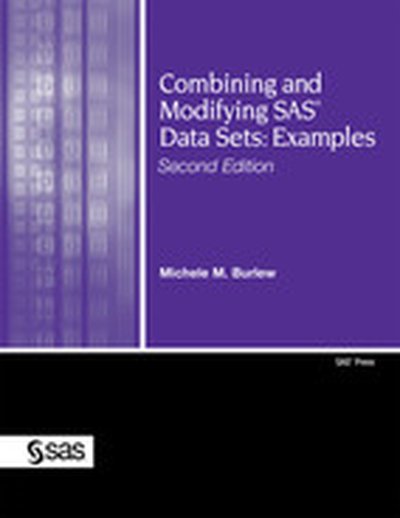
Combining and Modifying SAS® Data Sets: Examples Second Edition

Building on the popularity of the first edition, Michele Burlew has revised this popular examples book to include expanded content and new features of SAS software. Completely updated for SAS 9.2, Combining and Modifying SAS Data Sets: Examples, Second Edition, presents examples that show solutions to common programming tasks that involve combining, modifying, and reshaping data sets. Expanded examples demonstrate how to combine data sets vertically and horizontally; retrieve data from lookup tables; modify and update data sets; combine summary and detail data sets; reshape and transpose observations in a data set; and manipulate data in a data set with utilities and functions. The tools used to combine and modify data sets include the SET, MERGE, MODIFY, and UPDATE statements in the DATA step; joins and set operators in PROC SQL; BY-group processing; indexes; hash objects in the DATA step; the use of PROC FORMAT and hash tables as table lookups; and generation data sets. Unique features of this book include the following: Examples are grouped by task, not by code, so you can easily find a solution to a particular task; alternative solutions are presented in addition to the main examples; most examples that combine and modify data sets include both a DATA step and a PROC SQL solution; many examples include a "Closer Look" section that describes in-depth how the example helps you complete the task; and each example stands on its own so you do not need to read the book from beginning to end. Designed for SAS programmers at all levels, this examples book will help simplify the challenging task of combining and modifying data sets.

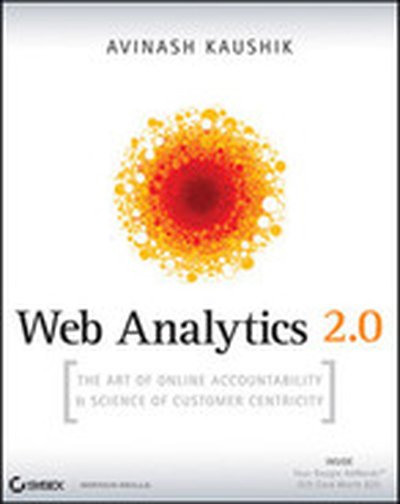
Web Analytics 2.0: The Art of Online Accountability and Science of Customer Centricity

Adeptly address today’s business challenges with this powerful new book from web analytics thought leader Avinash Kaushik. Web Analytics 2.0 presents a new framework that will permanently change how you think about analytics. It provides specific recommendations for creating an actionable strategy, applying analytical techniques correctly, solving challenges such as measuring social media and multichannel campaigns, achieving optimal success by leveraging experimentation, and employing tactics for truly listening to your customers. The book will help your organization become more data driven while you become a super analysis ninja!

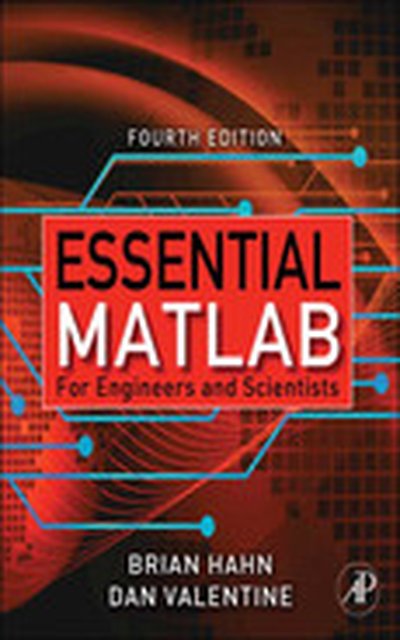
Essential MATLAB for Engineers and Scientists Fourth Edition

The essential guide to MATLAB as a problem solving tool This text presents MATLAB both as a mathematical tool and a programming language, giving a concise and easy to master introduction to its potential and power. The fundamentals of MATLAB are illustrated throughout with many examples from a wide range of familiar scientific and engineering areas, as well as from everyday life. The new edition has been updated to include coverage of Symbolic Math and SIMULINK. It also adds new examples and applications, and uses the most recent release of Matlab.

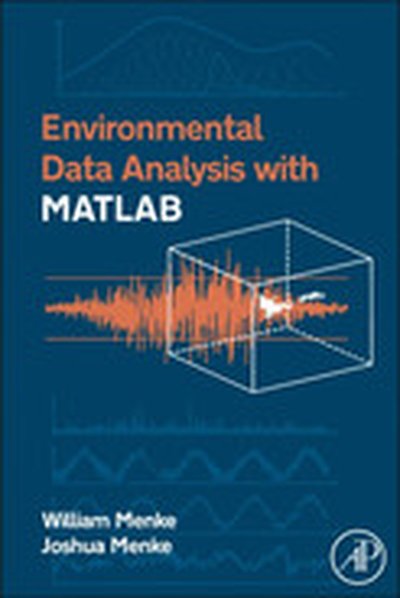
Environmental Data Analysis with MatLab

Environmental Data Analysis with MatLab is for students and researchers working to analyze real data sets in the environmental sciences. One only has to consider the global warming debate to realize how critically important it is to be able to derive clear conclusions from often-noisy data drawn from a broad range of sources. This book teaches the basics of the underlying theory of data analysis, and then reinforces that knowledge with carefully chosen, realistic scenarios. MatLab, a commercial data processing environment, is used in these scenarios; significant content is devoted to teaching how it can be effectively used in an environmental data analysis setting. The book, though written in a self-contained way, is supplemented with data sets and MatLab scripts that can be used as a data analysis tutorial. Well written and outlines a clear learning path for researchers and students Uses real world environmental examples and case studies MatLab software for application in a readily-available software environment Homework problems help user follow up upon case studies with homework that expands them

The Breakthrough Imperative

Every general manager today—all the way up to the CEO—is expected by his or her stakeholders to achieve new breakthroughs in performance—and fast. Those who don't make visible progress toward that goal within the first year or two will likely find themselves looking for another job. It is precisely because of this growing breakthrough imperative that managers today, whether in corporations or nonprofits, need to get off to a fast start. They don't have time for mistakes or for going back and redoing what they should have done right in the first place. But, despite the intensity of these pressures, despite the high expectations and short time frames, a number of CEOs and general managers turn in truly exceptional results. How do they meet and exceed the breakthrough imperative? To answer this question, consultants and former managers Mark Gottfredson and Steve Schaubert interviewed more than forty CEOs from both industry and the nonprofit sector, conducted an intensive study of what successful managers do right—and what some do wrong—and drew on their own combined fifty-plus years of experience at Bain & Company, where their insights have consistently been found in the pages of the Harvard Business Review. Together they came up with the four straightforward principles—deceptively simple yet remarkably powerful—that everyone must follow to succeed at achieving breakthrough results: 1. Costs and prices always decline 2. Competitive position determines options 3. Customers and profit pools don't stand still 4. Simplicity gets results Although seemingly simplistic, mastering these four laws means mastering the basics of great management—a foundation on which to build the rest of one's management strategy. Whether you're managing a small work group or a multinational corporation, a single division or an entire nonprofit, The Breakthrough Imperative presents these core laws of business to help you determine where you are, just how far you can go, and how to get there with stellar results.

Output Delivery System: The Basics and Beyond

Incorporating broad coverage of the best ODS features in one book, Output Delivery System: The Basics and Beyond goes beyond Lauren Haworth's original ODS text to demonstrate the many new and enhanced features of ODS and SAS 9.2. With SAS 9.2, ODS provides a myriad of choices for reporting and displaying analytical results with a greater variety of formatting selections and output destinations. As experienced SAS users, Lauren E. Haworth, Cynthia L. Zender, and Michele M. Burlew know how important it is to be able to produce customized output in different formats to meet the needs of clients.Geared toward all levels of SAS users, Output Delivery System: The Basics and Beyond is an example-driven book that presents each of the wide array of ODS techniques in an easy-to-use, two-page layout, with the text and code on one page and the resulting output on the facing page. The book begins with basic syntax and progresses to more complex techniques and custom styles. You will learn to take basic SAS output and transform it into an HTML page, a word-processor-friendly RTF file, or printer-friendly PDF output. You'll learn how to generate a table of contents page for RTF and PDF files, generate bookmarks for PDF files, and generate custom page numbering for those destinations. You will also learn the basic concepts of changing style templates, using table templates with the DATA step, and using tagset templates to generate custom markup language tags and output. Other new features of ODS are also discussed, such as the ODS Graphics Framework and the new ODS Statistical Graphics procedures.

Software Testing as a Service

Software Testing as a Service explains, in simple language, how to use software testing to improve productivity, reduce time to market, and reduce costly errors. It explains how the normal functions of manufacturing can be applied to commoditize the software testing service to achieve consistent quality across all software projects. This up-to-date reference reviews different software testing tools, techniques, and practices and provides succinct guidance on how to estimate costs, allocate resources, and make competitive bids. Replete with examples and case histories, this resource illustrates how proper planning can lead to the creation of software that's head and shoulders above the competition.