talk-data.com talk-data.com

Topic

data

2093

tagged

Activity Trend

3 peak/qtr
2020-Q1 2026-Q1

Activities

Showing filtered results

Filtering by: O'Reilly Data Science Books ×
Even You Can Learn Statistics and Analytics: An Easy to Understand Guide to Statistics and Analytics, Third Edition

Related Content Even You Can Learn Statistics, Fourth Edition, is now available with new and expanded content. Thought you couldn’t learn statistics? You can – and you will! Even You Can Learn Statistics and Analytics, Third Edition is the practical, up-to-date introduction to statistics – for everyone! Now fully updated for "big data" analytics and the newest applications, it'll teach you all the statistical techniques you’ll need for finance, marketing, quality, science, social science, and more – one easy step at a time. Simple jargon-free explanations help you understand every technique, and extensive practical examples and worked problems give you all the hands-on practice you'll need. This edition contains more practical examples than ever – all updated for the newest versions of Microsoft Excel. You'll find downloadable practice files, templates, data sets, and sample models – including complete solutions you can put right to work! Learn how to do all this, and more: Apply statistical techniques to analyze huge data sets and transform them into valuable knowledge Construct and interpret statistical charts and tables with Excel or OpenOffice.org Calc 3 Work with mean, median, mode, standard deviation, Z scores, skewness, and other descriptive statistics Use probability and probability distributions Work with sampling distributions and confidence intervals Test hypotheses with Z, t, chi-square, ANOVA, and other techniques Perform powerful regression analysis and modeling Use multiple regression to develop models that contain several independent variables Master specific statistical techniques for quality and Six Sigma programs Hate math? No sweat. You’ll be amazed at how little you need. Like math? Optional "Equation Blackboard" sections reveal the mathematical foundations of statistics right before your eyes. If you need to understand, evaluate, or use statistics in business, academia, or anywhere else, this is the book you've been searching for!
Time Series Databases: New Ways to Store and Access Data

Time series data is of growing importance, especially with the rapid expansion of the Internet of Things. This concise guide shows you effective ways to collect, persist, and access large-scale time series data for analysis. You’ll explore the theory behind time series databases and learn practical methods for implementing them. Authors Ted Dunning and Ellen Friedman provide a detailed examination of open source tools such as OpenTSDB and new modifications that greatly speed up data ingestion.

Create Web Charts with D3

Create Web Charts with D3 shows how to convert your data into eye-catching, innovative, animated, and highly interactive browser-based charts. This book is suitable for developers of all experience levels and needs: if you want power and control and need to create data visualization beyond traditional charts, then D3 is the JavaScript library for you. By the end of the book, you will have a good knowledge of all the elements needed to manage data from every possible source, from high-end scientific instruments to Arduino boards, from PHP SQL databases queries to simple HTML tables, and from Matlab calculations to reports in Excel. This book contains content previously published in Beginning JavaScript Charts. Create all kinds of charts using the latest technologies available on browsers Full of step-by-step examples, Create Web Charts with D3 introduces you gradually to all aspects of chart development, from the data source to the choice of which solution to apply. This book provides a number of tools that can be the starting point for any project requiring graphical representations of data, whether using commercial libraries or your own

Developing Credit Risk Models Using SAS Enterprise Miner and SAS/STAT

Combine complex concepts facing the financial sector with the software toolsets available to analysts.

The credit decisions you make are dependent on the data, models, and tools that you use to determine them. Developing Credit Risk Models Using SAS Enterprise Miner and SAS/STAT: Theory and Applications combines both theoretical explanation and practical applications to define as well as demonstrate how you can build credit risk models using SAS Enterprise Miner and SAS/STAT and apply them into practice.

The ultimate goal of credit risk is to reduce losses through better and more reliable credit decisions that can be developed and deployed quickly. In this example-driven book, Dr. Brown breaks down the required modeling steps and details how this would be achieved through the implementation of SAS Enterprise Miner and SAS/STAT.

Users will solve real-world risk problems as well as comprehensively walk through model development while addressing key concepts in credit risk modeling. The book is aimed at credit risk analysts in retail banking, but its applications apply to risk modeling outside of the retail banking sphere. Those who would benefit from this book include credit risk analysts and managers alike, as well as analysts working in fraud, Basel compliancy, and marketing analytics. It is targeted for intermediate users with a specific business focus and some programming background is required.

Efficient and effective management of the entire credit risk model lifecycle process enables you to make better credit decisions. Developing Credit Risk Models Using SAS Enterprise Miner and SAS/STAT: Theory and Applications demonstrates how practitioners can more accurately develop credit risk models as well as implement them in a timely fashion.

This book is part of the SAS Press Program.

JMP Essentials, 2nd Edition

Grasp essential steps in order to generate meaningful results quickly with JMP.

JMP Essentials: An Illustrated Step-by-Step Guide for New Users, Second Edition is designed for the new or occasional JMP user who needs to generate meaningful graphs or results quickly. Drawing on their own experience working with these customers, the authors provide essential steps for what new users typically need to carry out with JMP. This newest edition has all new instructions and screen shots reflecting the latest release of JMP software. In addition, it has eight new detailed sections and 10 new subsections that include creating maps, filtering data, creating dashboards, and working with Excel data, all of which highlight new, useful and basic level enhancements to JMP.

The format of the book is unique. It adopts a show-and-tell design with essential step-by-step instructions and corresponding screen illustrations, which help users quickly see how to generate the desired results. In most cases, each section completes a JMP task, which maximizes the book's utility as a reference. In addition, each chapter contains a family of features that are carefully crafted to first introduce you to basic features and then on to more advanced ones. JMP Essentials: An Illustrated Step-by-Step Guide for New Users, Second Edition is the quickest and most accessible reference book available.

This is part of the SAS Press program.

Optical Fiber Communication Systems with MATLAB® and Simulink® Models, 2nd Edition

Carefully structured to instill practical knowledge of fundamental issues, Optical Fiber Communication Systems with MATLABdescribes the modeling of optically amplified fiber communications systems using MATLAB ® and Simulink ® Models ® and Simulink ®. This lecture-based book focuses on concepts and interpretation, mathematical procedures, and engineering applications, shedding light on device behavior and dynamics through computer modeling. Supplying a deeper understanding of the current and future state of optical systems and networks, this Second Edition: Reflects the latest developments in optical fiber communications technology Includes new and updated case studies, examples, end-of-chapter problems, and MATLAB ® and Simulink ® models Emphasizes DSP-based coherent reception techniques essential to advancement in short- and long-term optical transmission networks Optical Fiber Communication Systems with MATLAB ® and Simulink ® Models, Second Edition is intended for use in university and professional training courses in the specialized field of optical communications. This text should also appeal to students of engineering and science who have already taken courses in electromagnetic theory, signal processing, and digital communications, as well as to optical engineers, designers, and practitioners in industry.

SAS Certification Prep Guide, 4th Edition
Businesses rely on career professionals with strong SAS knowledge and skills. Set yourself apart from the competition by earning the only globally recognized credential endorsed by SAS.

The SAS Certification Prep Guide: Advanced Programming for SAS 9, Fourth Edition, prepares you to take the Advanced Programming for SAS 9 exam. Major topics include SQL processing with SAS, the SAS macro language, advanced SAS programming techniques, and optimizing SAS programs, as well as a new chapter on creating functions with PROC FCMP. You will also become familiar with the enhancements and new functionality that are available in SAS 9.

New or experienced SAS users will find this guide to be an invaluable resource that covers the objectives tested on the exam. The text contains quizzes that enable you to test your understanding of material in each chapter. Quiz solutions are included at the end of the book. Candidates must earn the SAS Certified Base Programmer for SAS 9 Credential before taking the SAS Advanced Programming for SAS 9 exam.

You’ll find instructions on how to obtain sample data when accessing SAS through SAS Enterprise Guide, SAS Studio, SAS University Edition, and the SAS windowing environment. This edition provides significant improvements to numerous examples, making the code even more efficient.

Experience is a critical component to becoming a SAS Certified Professional. This comprehensive guide along with training in SAS SQL1, SAS Macro Language 1, and SAS Programming 3 are valuable resources designed to help you prepare for the Advanced SAS Certification exam.

Test Scoring and Analysis Using SAS

Develop your own multiple-choice tests, score students, produce student rosters (in print form or Excel), and explore item response theory (IRT).

Aimed at nonstatisticians working in education or training, Test Scoring and Analysis Using SAS describes item analysis and test reliability in easy-to-understand terms, and teaches you SAS programming to score tests, perform item analysis, and estimate reliability. Maximizing flexibility, the scoring and analysis programs enable you to analyze tests with multiple versions, define alternate correct responses for selected items, and repeat the scoring with selected items deleted.

You will be guided step-by-step on how to design multiple-choice items, use analysis to improve your tests, and even detect cheating on students’ submitted multiple-choice tests. Other subjects addressed include reading in data from a variety of sources (text files and Excel workbooks, for example), detecting errors in the input data, and producing class rosters in printed form or Excel workbooks. Also included is a chapter on IRT—widely used in education to calibrate and evaluate items in tests in education such as the SAT and GRE—with instructions for running the new SAS procedure PROC IRT.

This book is part of the SAS Press program.

The Essential Guide to SAS Dates and Times, Second Edition, 2nd Edition

Why does SAS use January 1, 1960 as its arbitrary reference date? How do you convert a value such as 27 January 2003 into a SAS date? How do you put a date into a filename, or label an Excel worksheet with the date?

You'll find the answers to these questions and much more in Derek Morgan's Essential Guide to SAS Dates and Times, Second Edition, which makes it easy to understand how to use and manipulate dates, times, and datetimes in SAS. Updated for SAS 9.4, with additional functions, formats, and capabilities, the Second Edition has a new chapter dedicated to the ISO 8601 standard and the formats and functions that are new to SAS, including how SAS works with Universal Coordinated Time (UTC).

Novice users will appreciate the new "Troubleshooting" appendix, which discusses questions common to newer SAS users in a conversational way and provides clear examples of simple solutions to these questions. Both novice and intermediate users will find the clear, task-based examples on how to accomplish date-related tasks and the detailed explanations of standard formats and functions invaluable. Users working with intervals will appreciate the expanded discussion of the topic, which details the new custom interval capability, among other enhancements to intervals.

Users working with international dates and times will benefit from the detailed discussion of the NLS facility as it relates to dates and times. Included are bonus "Quick Reference Guides" that list both the standard date and time formats and the NLS date and time formats with examples. These guides illustrate how each format displays the same date, time, or datetime, so you can find the format you want to use at a glance.

The Essential Guide to SAS Dates and Times, Second Edition is the most complete and up-to-date collection of examples on how to write complex programs involving dates, times, or datetime values.

This book is part of the SAS Press Program.

Statistical Graphics Procedures by Example

Sanjay Matange and Dan Heath's Statistical Graphics Procedures by Example: Effective Graphs Using SAS shows the innumerable capabilities of SAS Statistical Graphics (SG) procedures. The authors begin with a general discussion of the principles of effective graphics, ODS Graphics, and the SG procedures. They then move on to show examples of the procedures' many features. The book is designed so that you can easily flip through it, find the graph you need, and view the code right next to the example. Among the topics included are how to combine plot statements to create custom graphs; customizing graph axes, legends, and insets; advanced features, such as annotation and attribute maps; tips and tricks for creating the optimal graph for the intended usage; real-world examples from the health and life sciences domain; and ODS styles. The procedures in Statistical Graphics Procedures by Example are specifically designed for the creation of analytical graphs. That makes this book a must-read for analysts and statisticians in the health care, clinical trials, financial, and insurance industries. However, you will find that the examples here apply to all fields. This book is part of the SAS Press program.

Predictive Analytics and Data Mining

Put Predictive Analytics into ActionLearn the basics of Predictive Analysis and Data Mining through an easy to understand conceptual framework and immediately practice the concepts learned using the open source RapidMiner tool. Whether you are brand new to Data Mining or working on your tenth project, this book will show you how to analyze data, uncover hidden patterns and relationships to aid important decisions and predictions. Data Mining has become an essential tool for any enterprise that collects, stores and processes data as part of its operations. This book is ideal for business users, data analysts, business analysts, business intelligence and data warehousing professionals and for anyone who wants to learn Data Mining.You’ll be able to:1. Gain the necessary knowledge of different data mining techniques, so that you can select the right technique for a given data problem and create a general purpose analytics process.2. Get up and running fast with more than two dozen commonly used powerful algorithms for predictive analytics using practical use cases.3. Implement a simple step-by-step process for predicting an outcome or discovering hidden relationships from the data using RapidMiner, an open source GUI based data mining tool Predictive analytics and Data Mining techniques covered: Exploratory Data Analysis, Visualization, Decision trees, Rule induction, k-Nearest Neighbors, Naïve Bayesian, Artificial Neural Networks, Support Vector machines, Ensemble models, Bagging, Boosting, Random Forests, Linear regression, Logistic regression, Association analysis using Apriori and FP Growth, K-Means clustering, Density based clustering, Self Organizing Maps, Text Mining, Time series forecasting, Anomaly detection and Feature selection. Implementation files can be downloaded from the book companion site at www.LearnPredictiveAnalytics.com Demystifies data mining concepts with easy to understand language Shows how to get up and running fast with 20 commonly used powerful techniques for predictive analysis Explains the process of using open source RapidMiner tools Discusses a simple 5 step process for implementing algorithms that can be used for performing predictive analytics Includes practical use cases and examples

Mastering QlikView

"Mastering QlikView" is your advanced guide to unlocking the potential of business intelligence through QlikView. Dive deep into powerful data modeling, performance tuning, and visualization techniques, crafted to empower you in making data-driven decisions and optimizing your BI workflows. What this Book will help me do Understand and implement advanced QlikView data modeling techniques for efficient analysis. Master performance tuning methods to ensure your QlikView applications are fast and scalable. Apply industry best practices for ETL and data loading using QVDs and other QlikView features. Create advanced visualizations and dashboards that distill analytics into actionable insights. Leverage metadata management tools and governance techniques to maintain data integrity and consistency. Author(s) Stephen Redmond, an expert in business intelligence and data visualization, brings years of hands-on experience with QlikView and Qlik Sense. As a seasoned developer and thought leader, Stephen specializes in distilling complex BI methodologies into practical skills. His approachable style makes advanced topics accessible and engaging to readers. Who is it for? This book is tailored for business application developers and system analysts already familiar with QlikView. Ideal for professionals seeking to enhance their BI proficiency with advanced QlikView capabilities. If you're aiming to solve complex data challenges or refine your visualization skills, this book provides the expert guidance to take your knowledge further.

Statistics: An Introduction Using R, 2nd Edition

"...I know of no better book of its kind..." (Journal of the Royal Statistical Society, Vol 169 (1), January 2006) A revised and updated edition of this bestselling introductory textbook to statistical analysis using the leading free software package R This new edition of a bestselling title offers a concise introduction to a broad array of statistical methods, at a level that is elementary enough to appeal to a wide range of disciplines. Step-by-step instructions help the non-statistician to fully understand the methodology. The book covers the full range of statistical techniques likely to be needed to analyse the data from research projects, including elementary material like t--tests and chi--squared tests, intermediate methods like regression and analysis of variance, and more advanced techniques like generalized linear modelling. Includes numerous worked examples and exercises within each chapter.

Text Mining and Analysis

Big data: It's unstructured, it's coming at you fast, and there's lots of it. In fact, the majority of big data is text-oriented, thanks to the proliferation of online sources such as blogs, emails, and social media.

However, having big data means little if you can't leverage it with analytics. Now you can explore the large volumes of unstructured text data that your organization has collected with Text Mining and Analysis: Practical Methods, Examples, and Case Studies Using SAS.

This hands-on guide to text analytics using SAS provides detailed, step-by-step instructions and explanations on how to mine your text data for valuable insight. Through its comprehensive approach, you'll learn not just how to analyze your data, but how to collect, cleanse, organize, categorize, explore, and interpret it as well. Text Mining and Analysis also features an extensive set of case studies, so you can see examples of how the applications work with real-world data from a variety of industries.

Text analytics enables you to gain insights about your customers' behaviors and sentiments. Leverage your organization's text data, and use those insights for making better business decisions with Text Mining and Analysis.

This book is part of the SAS Press program.

Multiple Factor Analysis by Example Using R

Multiple factor analysis (MFA) enables users to analyze tables of individuals and variables in which the variables are structured into quantitative, qualitative, or mixed groups. Written by the co-developer of the methodology, this book brings together the theoretical and methodological aspects of MFA. It also covers principal component analysis, multiple correspondence analysis, factor analysis for mixed data, hierarchical MFA, and more. The book also includes examples of applications and details on how to implement MFA using an R package, with the data and R scripts available online.

Correspondence Analysis: Theory, Practice and New Strategies

A comprehensive overview of the internationalisation of correspondence analysis Correspondence Analysis: Theory, Practice and New Strategies examines the key issues of correspondence analysis, and discusses the new advances that have been made over the last 20 years. The main focus of this book is to provide a comprehensive discussion of some of the key technical and practical aspects of correspondence analysis, and to demonstrate how they may be put to use. Particular attention is given to the history and mathematical links of the developments made. These links include not just those major contributions made by researchers in Europe (which is where much of the attention surrounding correspondence analysis has focused) but also the important contributions made by researchers in other parts of the world. Key features include: A comprehensive international perspective on the key developments of correspondence analysis. Discussion of correspondence analysis for nominal and ordinal categorical data. Discussion of correspondence analysis of contingency tables with varying association structures (symmetric and non-symmetric relationship between two or more categorical variables). Extensive treatment of many of the members of the correspondence analysis family for two-way, three-way and multiple contingency tables. Correspondence Analysis offers a comprehensive and detailed overview of this topic which will be of value to academics, postgraduate students and researchers wanting a better understanding of correspondence analysis. Readers interested in the historical development, internationalisation and diverse applicability of correspondence analysis will also find much to enjoy in this book.

Introduction to Mixed Modelling: Beyond Regression and Analysis of Variance, 2nd Edition

Mixed modelling is very useful, and easier than you think! Mixed modelling is now well established as a powerful approach to statistical data analysis. It is based on the recognition of random-effect terms in statistical models, leading to inferences and estimates that have much wider applicability and are more realistic than those otherwise obtained. Introduction to Mixed Modelling leads the reader into mixed modelling as a natural extension of two more familiar methods, regression analysis and analysis of variance. It provides practical guidance combined with a clear explanation of the underlying concepts. Like the first edition, this new edition shows diverse applications of mixed models, provides guidance on the identification of random-effect terms, and explains how to obtain and interpret best linear unbiased predictors (BLUPs). It also introduces several important new topics, including the following: Use of the software SAS, in addition to GenStat and R. Meta-analysis and the multiple testing problem. The Bayesian interpretation of mixed models. Including numerous practical exercises with solutions, this book provides an ideal introduction to mixed modelling for final year undergraduate students, postgraduate students and professional researchers. It will appeal to readers from a wide range of scientific disciplines including statistics, biology, bioinformatics, medicine, agriculture, engineering, economics, archaeology and geography. Praise for the first edition: "One of the main strengths of the text is the bridge it provides between traditional analysis of variance and regression models and the more recently developed class of mixed models...Each chapter is well-motivated by at least one carefully chosen example...demonstrating the broad applicability of mixed models in many different disciplines...most readers will likely learn something new, and those previously unfamiliar with mixed models will obtain a solid foundation on this topic."— Kerrie Nelson University of South Carolina, in American Statistician, 2007

Design and Analysis of Experiments by Douglas Montgomery: A Supplement for Using JMP

With a growing number of scientists and engineers using JMP software for design of experiments, there is a need for an example-driven book that supports the most widely used textbook on the subject, Design and Analysis of Experiments by Douglas C. Montgomery. Design and Analysis of Experiments by Douglas Montgomery: A Supplement for Using JMP meets this need and demonstrates all of the examples from the Montgomery text using JMP. In addition to scientists and engineers, undergraduate and graduate students will benefit greatly from this book.
While users need to learn the theory, they also need to learn how to implement this theory efficiently on their academic projects and industry problems. In this first book of its kind using JMP software, Rushing, Karl and Wisnowski demonstrate how to design and analyze experiments for improving the quality, efficiency, and performance of working systems using JMP. Topics include JMP software, two-sample t-test, ANOVA, regression, design of experiments, blocking, factorial designs, fractional-factorial designs, central composite designs, Box-Behnken designs, split-plot designs, optimal designs, mixture designs, and 2 k factorial designs. JMP platforms used include Custom Design, Screening Design, Response Surface Design, Mixture Design, Distribution, Fit Y by X, Matched Pairs, Fit Model, and Profiler.
With JMP software, Montgomery’s textbook, and Design and Analysis of Experiments by Douglas Montgomery: A Supplement for Using JMP, users will be able to fit the design to the problem, instead of fitting the problem to the design. This book is part of the SAS Press program.

Fixed Effects Regression Methods for Longitudinal Data Using SAS

Fixed Effects Regression Methods for Longitudinal Data Using SAS, written by Paul Allison, is an invaluable resource for all researchers interested in adding fixed effects regression methods to their tool kit of statistical techniques. First introduced by economists, fixed effects methods are gaining widespread use throughout the social sciences. Designed to eliminate major biases from regression models with multiple observations (usually longitudinal) for each subject (usually a person), fixed effects methods essentially offer control for all stable characteristics of the subjects, even characteristics that are difficult or impossible to measure. This straightforward and thorough text shows you how to estimate fixed effects models with several SAS procedures that are appropriate for different kinds of outcome variables. The theoretical background of each model is explained, and the models are then illustrated with detailed examples using real data. The book contains thorough discussions of the following uses of SAS procedures: PROC GLM for estimating fixed effects linear models for quantitative outcomes, PROC LOGISTIC for estimating fixed effects logistic regression models, PROC PHREG for estimating fixed effects Cox regression models for repeated event data, PROC GENMOD for estimating fixed effects Poisson regression models for count data, and PROC CALIS for estimating fixed effects structural equation models. To gain the most benefit from this book, readers should be familiar with multiple linear regression, have practical experience using multiple regression on real data, and be comfortable interpreting the output from a regression analysis. An understanding of logistic regression and Poisson regression is a plus. Some experience with SAS is helpful, but not required. This book is part of the SAS Press program.

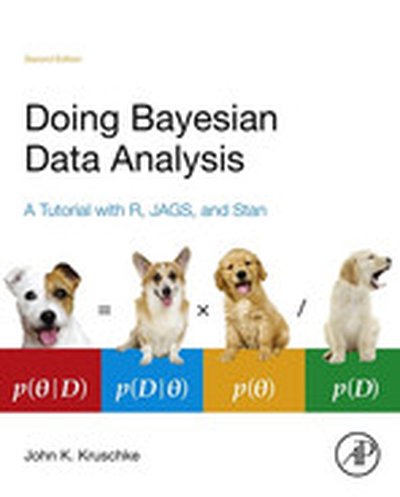
Doing Bayesian Data Analysis, 2nd Edition

Doing Bayesian Data Analysis: A Tutorial with R, JAGS, and Stan, Second Edition provides an accessible approach for conducting Bayesian data analysis, as material is explained clearly with concrete examples. Included are step-by-step instructions on how to carry out Bayesian data analyses in the popular and free software R and WinBugs, as well as new programs in JAGS and Stan. The new programs are designed to be much easier to use than the scripts in the first edition. In particular, there are now compact high-level scripts that make it easy to run the programs on your own data sets. The book is divided into three parts and begins with the basics: models, probability, Bayes’ rule, and the R programming language. The discussion then moves to the fundamentals applied to inferring a binomial probability, before concluding with chapters on the generalized linear model. Topics include metric-predicted variable on one or two groups; metric-predicted variable with one metric predictor; metric-predicted variable with multiple metric predictors; metric-predicted variable with one nominal predictor; and metric-predicted variable with multiple nominal predictors. The exercises found in the text have explicit purposes and guidelines for accomplishment. This book is intended for first-year graduate students or advanced undergraduates in statistics, data analysis, psychology, cognitive science, social sciences, clinical sciences, and consumer sciences in business. Accessible, including the basics of essential concepts of probability and random sampling Examples with R programming language and JAGS software Comprehensive coverage of all scenarios addressed by non-Bayesian textbooks: t-tests, analysis of variance (ANOVA) and comparisons in ANOVA, multiple regression, and chi-square (contingency table analysis) Coverage of experiment planning R and JAGS computer programming code on website Exercises have explicit purposes and guidelines for accomplishment Provides step-by-step instructions on how to conduct Bayesian data analyses in the popular and free software R and WinBugs