talk-data.com talk-data.com

Topic

data

5765

tagged

Activity Trend

3 peak/qtr
2020-Q1 2026-Q1

Activities

5765 activities · Newest first

Risk Assessment and Decision Analysis with Bayesian Networks

Although many Bayesian Network (BN) applications are now in everyday use, BNs have not yet achieved mainstream penetration. Focusing on practical real-world problem solving and model building, as opposed to algorithms and theory, Risk Assessment and Decision Analysis with Bayesian Networks explains how to incorporate knowledge with data to develop and use (Bayesian) causal models of risk that provide powerful insights and better decision making. Provides all tools necessary to build and run realistic Bayesian network models Supplies extensive example models based on real risk assessment problems in a wide range of application domains provided; for example, finance, safety, systems reliability, law, and more Introduces all necessary mathematics, probability, and statistics as needed The book first establishes the basics of probability, risk, and building and using BN models, then goes into the detailed applications. The underlying BN algorithms appear in appendices rather than the main text since there is no need to understand them to build and use BN models. Keeping the body of the text free of intimidating mathematics, the book provides pragmatic advice about model building to ensure models are built efficiently. A dedicated website, www.BayesianRisk.com, contains executable versions of all of the models described, exercises and worked solutions for all chapters, PowerPoint slides, numerous other resources, and a free downloadable copy of the AgenaRisk software.
Statistical Concepts - A Second Course, 4th Edition

Statistical Concepts consists of the last 9 chapters of An Introduction to Statistical Concepts, 3rd ed. Designed for the second course in statistics, it is one of the few texts that focuses just on intermediate statistics. The book highlights how statistics work and what they mean to better prepare students to analyze their own data and interpret SPSS and research results. As such it offers more coverage of non-parametric procedures used when standard assumptions are violated since these methods are more frequently encountered when working with real data. Determining appropriate sample sizes is emphasized throughout. Only crucial equations are included. The new edition features: New co-author, Debbie L. Hahs-Vaughn, the 2007 recipient of the University of Central Florida's College of Education Excellence in Graduate Teaching Award. A new chapter on logistic regression models for today's more complex methodologies. Much more on computing confidence intervals and conducting power analyses using G*Power. All new SPSS version 19 screenshots to help navigate through the program and annotated output to assist in the interpretation of results. Sections on how to write-up statistical results in APA format and new templates for writing research questions. New learning tools including chapter-opening vignettes, outlines, a list of key concepts, "Stop and Think" boxes, and many more examples, tables, and figures. More tables of assumptions and the effects of their violation including how to test them in SPSS. 33% new conceptual, computational, and all new interpretative problems. A website with Power Points, answers to the even-numbered problems, detailed solutions to the odd-numbered problems, and test items for instructors, and for students the chapter outlines, key concepts, and datasets. Each chapter begins with an outline, a list of key concepts, and a research vignette related to the concepts. Realistic examples from education and the behavioral sciences illustrate those concepts. Each example examines the procedures and assumptions and provides tips for how to run SPSS and develop an APA style write-up. Tables of assumptions and the effects of their violation are included, along with how to test assumptions in SPSS. Each chapter includes computational, conceptual, and interpretive problems. Answers to the odd-numbered problems are provided. The SPSS data sets that correspond to the book’s examples and problems are available on the web. The book covers basic and advanced analysis of variance models and topics not dealt with in other texts such as robust methods, multiple comparison and non-parametric procedures, and multiple and logistic regression models. Intended for courses in intermediate statistics and/or statistics II taught in education and/or the behavioral sciences, predominantly at the master's or doctoral level. Knowledge of introductory statistics is assumed.

Statistics for Sport and Exercise Studies

Statistics for Sport and Exercise Studies guides the student through the full research process, from selecting the most appropriate statistical procedure, to analysing data, to the presentation of results, illustrating every key step in the process with clear examples, case-studies and data taken from real sport and exercise settings. Every chapter includes a range of features designed to help the student grasp the underlying concepts and relate each statistical procedure to their own research project, including definitions of key terms, practical exercises, worked examples and clear summaries. The book also offers an in-depth and practical guide to using SPSS in sport and exercise research, the most commonly used data analysis software in sport and exercise departments. In addition, a companion website includes more than 100 downloadable data sets and work sheets for use in or out of the classroom, full solutions to exercises contained in the book, plus over 1,300 PowerPoint slides for use by tutors and lecturers. Statistics for Sport and Exercise Studies is a complete, user-friendly introduction to the use of statistical tests, techniques and procedures in sport, exercise and related subjects. Visit the companion website at: www.routledge.com/cw/odonoghue

Understanding The New Statistics

This is the first book to introduce the new statistics - effect sizes, confidence intervals, and meta-analysis - in an accessible way. It is chock full of practical examples and tips on how to analyze and report research results using these techniques. The book is invaluable to readers interested in meeting the new APA Publication Manual guidelines by adopting the new statistics - which are more informative than null hypothesis significance testing, and becoming widely used in many disciplines. Accompanying the book is the Exploratory Software for Confidence Intervals (ESCI) package, free software that runs under Excel and is accessible at www.thenewstatistics.com. The book’s exercises use ESCI's simulations, which are highly visual and interactive, to engage users and encourage exploration. Working with the simulations strengthens understanding of key statistical ideas. There are also many examples, and detailed guidance to show readers how to analyze their own data using the new statistics, and practical strategies for interpreting the results. A particular strength of the book is its explanation of meta-analysis, using simple diagrams and examples. Understanding meta-analysis is increasingly important, even at undergraduate levels, because medicine, psychology and many other disciplines now use meta-analysis to assemble the evidence needed for evidence-based practice. The book’s pedagogical program, built on cognitive science principles, reinforces learning: Boxes provide "evidence-based" advice on the most effective statistical techniques. Numerous examples reinforce learning, and show that many disciplines are using the new statistics. Graphs are tied in with ESCI to make important concepts vividly clear and memorable. Opening overviews and end of chapter take-home messages summarize key points. Exercises encourage exploration, deep understanding, and practical applications. This highly accessible book is intended as the core text for any course that emphasizes the new statistics, or as a supplementary text for graduate and/or advanced undergraduate courses in statistics and research methods in departments of psychology, education, human development , nursing, and natural, social, and life sciences. Researchers and practitioners interested in understanding the new statistics, and future published research, will also appreciate this book. A basic familiarity with introductory statistics is assumed.

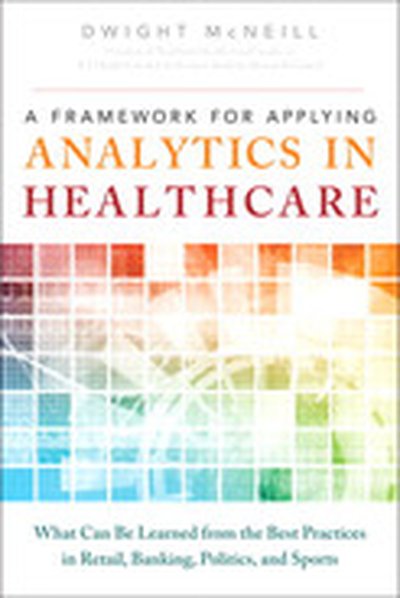
A Framework for Applying Analytics in Healthcare: What Can Be Learned from the Best Practices in Retail, Banking, Politics, and Sports

In A Framework for Applying Analytics in Healthcare, Dwight McNeill shows healthcare analysts and decision-makers exactly how to adapt and apply the best analytics techniques from retail, finance, politics, and sports. McNeill describes each method in depth, presenting numerous case studies that show how these approaches have been deployed and the results that have been achieved. Most important, he explains how these methods can be successfully adapted to the most critical challenges you now face in your healthcare organization. From predictive modeling to social media, this book focuses on innovative techniques with demonstrated effectiveness and direct relevance to healthcare. You’ll discover powerful new ways to manage population health; improve patient activation, support, and experience of care; focus on health outcomes; measure what matters for team performance; make information more actionable; and build more customer-centric organizations.

IBM System z Personal Development Tool: Volume 2 Installation and Basic Use

This IBM® Redbooks® publication introduces the IBM System z® Personal Development Tool (zPDT®), which runs on an underlying Linux system based on an Intel processor. zPDT provides a System z system on a PC capable of running current System z operating systems, including emulation of selected System z I/O devices and control units. It is intended as a development, demonstration, and learning platform and is not designed as a production system. This book, providing specific installation instructions, is the second of three volumes. The first volume describes the general concepts of zPDT and a syntax reference for zPDT commands and device managers. The third volume discusses more advanced topics that may not interest all zPDT users. The IBM order numbers for the three volumes are SG24-7721, SG24-7722, and SG24-7723. The systems discussed in these volumes are complex, with elements of Linux (for the underlying PC machine), IBM z/Architecture® (for the core zPDT elements), System z I/O functions (for emulated I/O devices), and IBM z/OS® (providing the System z application interface), and possibly with other System z operating systems. We assume the reader is familiar with the general concepts and terminology of System z hardware and software elements and with basic PC Linux characteristics.

IBM System z Personal Development Tool: Volume 3 Additional Topics

This IBM® Redbooks® publication introduces the IBM System z® Personal Development Tool (zPDT), which runs on an underlying Linux system based on an Intel processor. zPDT provides a System z system on a PC capable of running current System z operating systems, including emulation of selected System z I/O devices and control units. It is intended as a development, demonstration, and learning platform; it is not designed as a production system. This book, discussing more advanced topics, is the last of three volumes. The first volume introduces zPDT and provides reference material for zPDT commands and device managers. The second volume describes the installation of zPDT (including the underlying Linux, and a particular z/OS® distribution) and basic usage patterns. The third volume discusses more advanced topics that may not interest all zPDT users. The IBM order numbers for the three volumes are SG24-7721, SG24-7722, and SG24-7723. The systems discussed in these volumes are complex, with elements of Linux (for the underlying PC machine), z/Architecture® (for the core zPDT elements), System z I/O functions (for emulated I/O devices), and z/OS (providing the System z application interface), and possibly with other System z operating systems. We assume the reader is familiar with the general concepts and terminology of System z hardware and software elements and with basic PC Linux characteristics.

Implementing IBM SmartCloud Entry on IBM PureFlex System

Distributed computing has been transformed with the introduction of virtualization technology. This has driven a re-architecture of traditional data center workload placement. In 2012, IBM® announced IBM PureSystems™, a new offering based on preconfigured software, servers, and storage that form an expert integrated system. Expert integrated systems now combine traditional IT resources into a single optimized solution, with prepackaged components including servers, storage devices, networking equipment, and software. With this evolution of technology, we move from discrete, siloed, and underutilized IT resources to shared resource pools. This IBM Redbooks® publication can help you install, tailor, and configure IBM SmartCloud® Entry on the IBM PureFlex™ System offering. This book is intended for anyone who wants to learn more about cloud computing with IBM SmartCloud Entry and offerings based on IBM Flex System™ elements.

Oracle WebLogic Server 12c Advanced Administration Cookbook

Dive into advanced administration of Oracle WebLogic Server 12c with this cookbook-style guide. With 70 practical recipes, you'll gain the knowledge and skills to handle both basic and complex administrative tasks effectively. This book provides expert guidance to help you elevate your WebLogic server management proficiency to the next level. What this Book will help me do Master the installation and configuration of Oracle WebLogic Server 12c for efficient system setup. Configure high-availability administration servers to ensure consistent and reliable performance. Effectively create and manage different types of JDBC data sources and multi-data sources for database connectivity. Utilize WebLogic Diagnostic Framework to monitor performance and handle threshold notifications. Optimize server settings for enhanced stability and resilience to meet enterprise needs. Author(s) Dalton Iwazaki is a seasoned professional with extensive experience in managing and deploying Oracle WebLogic Servers in various enterprise environments. With years of hands-on expertise, Dalton shares his practical insights and tested methods throughout his writing. His approachable style and thorough teaching make complex topics accessible to all technical readers. Who is it for? This book is designed for system administrators, developers, and IT professionals who want to master the administration of Oracle WebLogic Server 12c. Readers should have basic knowledge of the Java platform and web server concepts. Whether you're a beginner looking to establish foundational skills or an experienced professional seeking advanced configurations, this cookbook is tailored for your learning.

Redis in Action

Redis in Action introduces Redis and walks you through examples that demonstrate how to use it effectively. You'll begin by getting Redis set up properly and then exploring the key-value model. Then, you'll dive into real use cases including simple caching, distributed ad targeting, and more. You'll learn how to scale Redis from small jobs to massive datasets. Experienced developers will appreciate chapters on clustering and internal scripting to make Redis easier to use. About the Technology When you need near-real-time access to a fast-moving data stream, key-value stores like Redis are the way to go. Redis expands on the key-value pattern by accepting a wide variety of data types, including hashes, strings, lists, and other structures. It provides lightning-fast operations on in-memory datasets, and also makes it easy to persist to disk on the fly. Plus, it's free and open source. About the Book What's Inside Redis from the ground up Preprocessing real-time data Managing in-memory datasets Pub/sub and configuration Persisting to disk About the Reader Written for developers familiar with database concepts. No prior exposure to Redis or other NoSQL databases required. Appropriate for systems administrators comfortable with programming. About the Author Dr. Josiah L. Carlson is a seasoned database professional and an active contributor to the Redis community. Quotes A great addition to the Redis ecosystem. - From the Foreword by Salvatore Sanfilippo, Creator of Redis The examples, taken from real-world use cases, are one of the major strengths of the book. - Filippo Pacini, SG Consulting From beginner to expert with real and comprehensive examples. - Felipe Gutierrez, VMware/Spring Source Excellent in-depth analysis ... insightful real-world examples. - Bobby Abraham, Integri LLC Pure gold! - Leo Cassarani, Unboxed Consulting

Statistical Techniques for Forensic Accounting: Understanding the Theory and Application of Data Analysis

Master powerful statistical techniques for uncovering fraud or misrepresentation in complex financial data. The discipline of statistics has developed sophisticated, well-accepted approaches for identifying financial fraud and demonstrating that it is deliberate. Statistical Techniques for Forensic Accounting is the first comprehensive guide to these tools and techniques. Leading expert Dr. Saurav Dutta explains their mathematical underpinnings, shows how to use them properly, and guides you in communicating your findings to other interested and knowledgeable parties, or assessing others' analyses. Dutta is singularly well-qualified to write this book: he has been engaged as an expert in many of the world's highest-profile financial fraud cases, including Worldcom, Global Crossing, Cendant, and HealthSouth. Here, he covers everything professionals need to know to construct and conduct valid and defensible statistical tests, perform analyses, and interpret others' analyses. Coverage includes: exploratory data analysis to identify the "Fraud Triangle" and other red flags… data mining tools, usage, and limitations… statistical terms and methods applicable to forensic accounting… relevant uncertainty and probability concepts… Bayesian analysis and networks… statistical inference, sampling, sample size, estimation, regression, correlation, classification, prediction, and much more. For all forensic accountants, auditors, investigators, and litigators involved with corporate financial reporting; and for all students interested in forensic accounting and related fields.

Applied Data Mining

Data mining has witnessed substantial advances in recent decades. New research questions and practical challenges have arisen from emerging areas and applications within the various fields closely related to human daily life, e.g. social media and social networking. This book aims to bridge the gap between traditional data mining and the latest advances in newly emerging information services. It explores the extension of well-studied algorithms and approaches into these new research arenas.

Applied Multiple Regression/Correlation Analysis for the Behavioral Sciences, 3rd Edition

This classic text on multiple regression is noted for its nonmathematical, applied, and data-analytic approach. Readers profit from its verbal-conceptual exposition and frequent use of examples. The applied emphasis provides clear illustrations of the principles and provides worked examples of the types of applications that are possible. Researchers learn how to specify regression models that directly address their research questions. An overview of the fundamental ideas of multiple regression and a review of bivariate correlation and regression and other elementary statistical concepts provide a strong foundation for understanding the rest of the text. The third edition features an increased emphasis on graphics and the use of confidence intervals and effect size measures, and an accompanying website with data for most of the numerical examples along with the computer code for SPSS, SAS, and SYSTAT, at www.psypress.com/9780805822236 . Applied Multiple Regression serves as both a textbook for graduate students and as a reference tool for researchers in psychology, education, health sciences, communications, business, sociology, political science, anthropology, and economics. An introductory knowledge of statistics is required. Self-standing chapters minimize the need for researchers to refer to previous chapters.

Internet and Surveillance

The Internet has been transformed in the past years from a system primarily oriented on information provision into a medium for communication and community-building. The notion of “Web 2.0”, social software, and social networking sites such as Facebook, Twitter and MySpace have emerged in this context. With such platforms comes the massive provision and storage of personal data that are systematically evaluated, marketed, and used for targeting users with advertising. In a world of global economic competition, economic crisis, and fear of terrorism after 9/11, both corporations and state institutions have a growing interest in accessing this personal data. Here, contributors explore this changing landscape by addressing topics such as commercial data collection by advertising, consumer sites and interactive media; self-disclosure in the social web; surveillance of file-sharers; privacy in the age of the internet; civil watch-surveillance on social networking sites; and networked interactive surveillance in transnational space. This book is a result of a research action launched by the intergovernmental network COST (European Cooperation in Science and Technology).

Measuring Sustainability

' Measuring the sustainability of development is crucial to achieving it, and is one of the most actively studied issues in the area. To date, most studies of measurements or indicators have been largely theoretical.

However, this book, a follow-on to Bell and Morse's highly influential Sustainability Indicators (1999), presents valuable practical advice on how to develop measurements that will work in real-life development contexts. It describes and analyses how to derive, validate and apply indicators in the course of an actual development project - in this case the Mediterranean Action Plan in Malta.

The authors explain the trade-offs and constraints involved and how it is possible to combine the open-ended and flexible perspectives of sustainability with the more linear processes and fixed targets of specific projects through the use of pragmatic and reflective methodologies.

Microsoft SQL Server 2012 Administration: Real-World Skills for MCSA Certification and Beyond (Exams 70-461, 70-462, and 70-463)

Implement, maintain, and repair SQL Server 2012 databases As the most significant update since 2008, Microsoft SQL Server 2012 boasts updates and new features that are critical to understand. Whether you manage and administer SQL Server 2012 or are planning to get your MCSA: SQL Server 2012 certification, this book is the perfect supplement to your learning and preparation. From understanding SQL Server's roles to implementing business intelligence and reporting, this practical book explores tasks and scenarios that a working SQL Server DBA faces regularly and shows you step by step how to handle them. Includes practice exams and coverage of exam objectives for those seeking MSCA: SQL Server 2012 certification Explores the skills you'll need on the job as a SQL Server 2012 DBA Discusses designing and implementing database solutions Walks you through administrating, maintaining, and securing SQL Server 2012 Addresses implementing high availability and data distribution Includes bonus videos where the author walks you through some of the more difficult tasks expected of a DBA Featuring hands-on exercises and real-world scenarios, this resource guides you through the essentials of implementing, maintaining, and repairing SQL Server 2012 databases. Note: The ebook version does not provide access to the companion files.

Structural Equation Modeling with Mplus

Modeled after Barbara Byrne’s other best-selling structural equation modeling (SEM) books, this practical guide reviews the basic concepts and applications of SEM using M plus Versions 5 & 6. The author reviews SEM applications based on actual data taken from her own research. Using non-mathematical language, it is written for the novice SEM user. With each application chapter, the author "walks" the reader through all steps involved in testing the SEM model including: an explanation of the issues addressed illustrated and annotated testing of the hypothesized and post hoc models explanation and interpretation of all M plus input and output files important caveats pertinent to the SEM application under study a description of the data and reference upon which the model was based the corresponding data and syntax files available under "Supplementary Material" below The first two chapters introduce the fundamental concepts of SEM and important basics of the M plus program. The remaining chapters focus on SEM applications and include a variety of SEM models presented within the context of three sections: Single-group analyses, Multiple-group analyses, and other important topics, the latter of which includes the multitrait-multimethod, latent growth curve, and multilevel models. Intended for researchers, practitioners, and students who use SEM and M plus, this book is an ideal resource for graduate level courses on SEM taught in psychology, education, business, and other social and health sciences and/or as a supplement for courses on applied statistics, multivariate statistics, intermediate or advanced statistics, and/or research design. Appropriate for those with limited exposure to SEM or M plus, a prerequisite of basic statistics through regression analysis is recommended.