talk-data.com talk-data.com

Topic

data

5765

tagged

Activity Trend

3 peak/qtr
2020-Q1 2026-Q1

Activities

5765 activities · Newest first

Access® 2010 Bible

The expert guidance you need to get the most out of Access 2010 Get the Access 2010 information you need to succeed with this comprehensive reference. If this is your first encounter with Access, you'll appreciate the thorough attention to database fundamentals and terminology. If you're familiar with earlier versions, you can jump right into Access 2010 enhancements such as the new Access user interface and wider use of XML and Web services. Takes you under the hood of Microsoft Access 2010, the database application included with Microsoft Office 2010 Explores the latest enhancements, such as a new user interface and wider use of XML and Web services; also, how to exchange data with Word, Excel, PowerPoint, and other Office apps Covers how to create tables, manipulate datasheets, and work with multiple tables Explains the seven database objects and how to use a seven-step design method to build a database tailored to your needs Shows you how to build forms, use Visual Basic and the VBA Editor, automate query parameters, create functions and subroutines, use XML to create data access pages, and more Includes a CD with all source code from the book and working examples, plus bonus shareware, freeware, trial, demo and evaluation programs that work with or enhance Microsoft Office You’ll want to keep this soup-to-nuts Access reference close at hand! Note: CD-ROM/DVD and other supplementary materials are not included as part of eBook file.

Access 2010: The Missing Manual

Unlock the secrets of this powerful database program and discover how to use your data in creative ways. With this book’s easy step-by-step process, you’ll quickly learn how to build and maintain a complete Access database, using Access 2013’s new, simpler user interface and templates. You also get practices and tips from the pros for good database design—ideal whether you’re using Access for school, business, or at home. The important stuff you need to know: Build a database with ease. Store information to track numbers, products, documents, and more. Customize the interface. Build your own forms to make data entry a snap. Find what you need fast. Search, sort, and summarize huge amounts of information. Put your data to use. Turn raw info into printed reports with attractive formatting. Share your data. Collaborate online with SharePoint and the Access web database. Dive into Access programming. Get tricks and techniques to automate common tasks. Create rich data connections. Build dynamic links with SQL Server, SharePoint, and other systems.

Microsoft® Access® 2010 Plain & Simple

Get the guide that makes learning Microsoft Access 2010 plain and simple! This full color, no-nonsense book shows you the quickest ways to build a database and sort information, using easy-to-follow steps and concise, straightforward language. You'll learn how out-of-the-box templates and reusable components make Access 2010 a fast and simple database solution. Here's WHAT you'll learn: Design and build your own database quickly Use Access forms to collect information with ease Create and modify tables to organize your data Store files such as documents and images Exchange data with other databases and documents Bring your data alive with colorful reports Here's HOW you'll learn it: Jump in whenever you need answers Easy-to-follow STEPS and SCREENSHOTS show exactly what to do Handy TIPS teach new techniques and shortcuts Quick TRY THIS! exercises help apply what you learn right away

Professional Microsoft® PowerPivot for Excel® and SharePoint®

With PowerPivot, Microsoft brings the power of Microsoft's business intelligence tools to Excel and SharePoint users. Self-service business intelligence today augments traditional BI methods, allowing faster response time and greater flexibility. If you're a business decision-maker who uses Microsoft Office or an IT professional responsible for deploying and managing your organization's business intelligence systems, this guide will help you make the most of PowerPivot. Professional Microsoft PowerPivot for Excel and SharePoint describes all aspects of PowerPivot and shows you how to use each of its major features. By the time you are finished with this book, you will be well on your way to becoming a PowerPivot expert. This book is for people who want to learn about PowerPivot from end to end. You should have some rudimentary knowledge of databases and data analysis. Familiarity with Microsoft Excel and Microsoft SharePoint is helpful, since PowerPivot builds on those two products. This book covers the first version of PowerPivot, which ships with SQL Server 2008 R2 and enhances Microsoft Office 2010. It provides an overview of PowerPivot and a detailed look its two components: PowerPivot for Excel and PowerPivot for SharePoint. It explains the technologies that make up these two components, and gives some insight into why these components were implemented the way they were. Through an extended example, it shows how to build a PowerPivot application from end to end. The companion Web site includes all the sample applications and reports discussed. What This Book Covers After discussing self-service BI and the motivation for creating PowerPivot, the book presents a quick, end-to-end tutorial showing how to create and publish a simple PowerPivot application. It then drilsl into the features of PowerPivot for Excel in detail and, in the process, builds a more complex PowerPivot application based on a real-world case study. Finally, it discusses the server side of PowerPivot (PowerPivot for SharePoint) and provides detailed information about its installation and maintenance. Chapter 1, "Self-Service Business Intelligence and Microsoft PowerPivot," begins Part I of the book. This chapter describes self-service BI and introduces PowerPivot, Microsoft's first self-service BI tool. It provides a high-level look at the two components that make up PowerPivot - PowerPivot for Excel and PowerPivot for SharePoint. Chapter 2, "A First Look at PowerPivot," walks you through a simple example of creating a PowerPivot application from end to end. In the process, it shows how to set up the two components of PowerPivot, and describes the normal workflow of creating a simple PowerPivot application. Chapter 3, "Assembling Data," starts off Part II of the book, and explains how to bring data into PowerPivot from various external data sources. It also introduces the extended example that you will build in this and subsequent chapters. Chapter 4, "Enriching Data," shows how to enhance the data you brought into your application by creating relationships and using PowerPivot's expression language, Data Analysis Expressions (DAX). Chapter 5, "Self-Service Analysis," describes how to use your PowerPivot data with various Excel features, such as PivotTables, PivotCharts, and slicers to do analysis. Chapter 5 also delves further into DAX, showing how to create and use DAX measures. Chapter 6, "Self-Service Reporting," shows how to publish your PowerPivot workbook to the server side of PowerPivot (PowerPivot for SharePoint), and make use of its features to view and update PowerPivot reports. It also shows how to use the data in a PowerPivot workbook as a data source for reports created in other tools such as Report Builder 3.0 and Excel. Chapter 7, "Preparing for SharePoint 2010," is the first chapter in Part III of the book. It describes the components of SharePoint 2010 that are relevant for PowerPivot, and looks at how PowerPivot for SharePoint interacts with those components. Chapter 8, "PowerPivot for SharePoint Setup and Configuration," provides instructions on how to set up and configure a multi-machine SharePoint farm that contains PowerPivot for SharePoint. Chapter 9, "Troubleshooting, Monitoring, and Securing PowerPivot Services," gives tips on how to troubleshoot PowerPivot for SharePoint issues. It also shows how to monitor the health of your PowerPivot for SharePoint environment, and discusses relevant security issues. Chapter 10, "Diving into the PowerPivot Architecture," describes at a deeper level the architecture of PowerPivot, both client and server. It also explains the Windows Identity Foundation and discusses the use of Kerberos in the context of PowerPivot for SharePoint. Chapter 11, "Enterprise Considerations," talks about common PowerPivot for SharePoint enterprise considerations: capacity planning, optimizing the environment, upgrade considerations, and uploading performance. Appendix A provides instructions for setting up the data sources that are used to build the SDR Healthcare extended example in Chapters 3 through 6. Additionally, two "bonus" elements are available online at this book's companion Web site: Appendix B is a comprehensive DAX reference that describes all the DAX functions and provides code snippets that show how to use them. A special chapter describes real-world scenarios in which PowerPivot is used to solve common problems.

Pro SQL Server 2008 Analysis Services

Every business has a reams of business data locked away in databases, business systems, and spreadsheets. While you may be able to build some reports by pulling a few of these repositories together, actually performing any kind of analysis on the data that runs your business can range from problematic to impossible. Pro SQL Server 2008 Analysis Services will show you how to pull that data together and present it for reporting and analysis in a way that makes the data accessible to business users, instead of needing to rely on the IT department every time someone needs a different report. Accessible-With a single author's voice, this book conducts a guided tour through the technology that makes it easy to dive into. Solution-oriented-While technically deep, the goal is to focus on practical application of the technologies instead of acting as a technical manual. ComprehensiveThis book covers every aspect of Analysis Services and ancillary technologies to enable you to make the most of SQL Server.

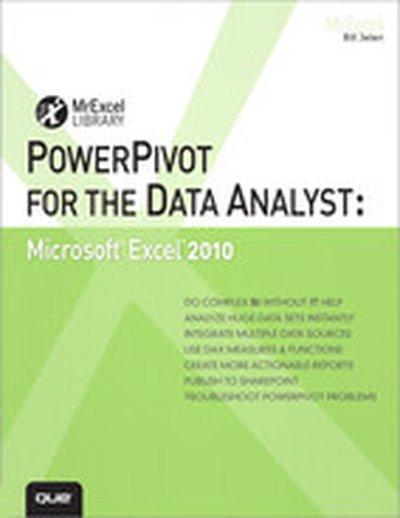
PowerPivot for the Data Analyst: Microsoft® Excel 2010

ANALYZE HUGE AMOUNTS OF BUSINESS DATA FASTER, MORE EASILY, AND MORE ACCURATELY! Use Microsoft’s free PowerPivot add-in for Excel 2010 to analyze immense amounts of data from any source, perform state-of-the-art business analysis far more easily, and make better decisions in less time! Simple, step-by-step instructions walk you through installing PowerPivot, importing data, using PivotTables with PowerPivot, using super-powerful DAX functions and measures, reporting to print or SharePoint, and a whole lot more. Whatever your Excel data analysis experience, this book will help you use PowerPivot to get the right answers, right now—without IT’s help! • Import and integrate data from spreadsheets, SQL Server, Access, Oracle, text files, Atom data feeds, and other sources • Analyze multiple tables together, without complicated VLOOKUPs • Format, sort, and filter data in the PowerPivot window • Add calculated columns using new DAX functions • Create powerful reports from PowerPivot data–and format them so executives instantly get your point • Discover PivotTable tricks that work even better in PowerPivot • Control multiple PivotTable elements on one worksheet, with one set of Excel 2010 Slicers • Use DAX Measures to quickly perform tasks that were difficult or impossible with Calculated Fields • Compare today’s sales to yesterday’s–or to sales from the parallel period last fiscal year. • Use Named Sets to prepare asymmetric reports, show actuals for past months and plan for future months. About MrExcel Library: Every book in the MrExcel Library pinpoints a specific set of crucial Excel tasks and presents focused skills and examples for performing them rapidly and effectively. Selected by Bill Jelen, Microsoft Excel MVP and mastermind behind the leading Excel solutions website MrExcel.com, these books will • Dramatically increase your productivity–saving you 50 hours a year, or more • Present proven, creative strategies for solving real-world problems • Show you how to get great results, no matter how much data you have • Help you avoid critical mistakes that even experienced users make

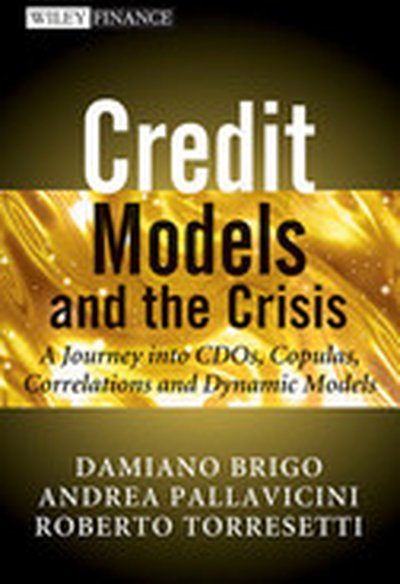
Credit Models and the Crisis: A Journey into CDOs, Copulas, Correlations and Dynamic Models

The recent financial crisis has highlighted the need for better valuation models and risk management procedures, better understanding of structured products, and has called into question the actions of many financial institutions. It has become commonplace to blame the inadequacy of credit risk models, claiming that the crisis was due to sophisticated and obscure products being traded, but practitioners have for a long time been aware of the dangers and limitations of credit models. It would seem that a lack of understanding of these models is the root cause of their failures but until now little analysis had been published on the subject and, when published, it had gained very limited attention. Credit Models and the Crisis is a succinct but technical analysis of the key aspects of the credit derivatives modeling problems, tracing the development (and flaws) of new quantitative methods for credit derivatives and CDOs up to and through the credit crisis. Responding to the immediate need for clarity in the market and academic research environments, this book follows the development of credit derivatives and CDOs at a technical level, analyzing the impact, strengths and weaknesses of methods ranging from the introduction of the Gaussian Copula model and the related implied correlations to the introduction of arbitrage-free dynamic loss models capable of calibrating all the tranches for all the maturities at the same time. It also illustrates the implied copula, a method that can consistently account for CDOs with different attachment and detachment points but not for different maturities, and explains why the Gaussian Copula model is still used in its base correlation formulation. The book reports both alarming pre-crisis research and market examples, as well as commentary through history, using data up to the end of 2009, making it an important addition to modern derivatives literature. With banks and regulators struggling to fully analyze at a technical level, many of the flaws in modern financial models, it will be indispensable for quantitative practitioners and academics who want to develop stable and functional models in the future.

IBM Cognos 8 Report Studio Cookbook

The "IBM Cognos 8 Report Studio Cookbook" by Abhishek Sanghani provides over 80 hands-on recipes to enhance your proficiency in creating business reports using Cognos 8 Report Studio. From mastering basic techniques to leveraging advanced features, this book is your guide to developing reports that meet real-world business demands. What this Book will help me do Understand and utilize advanced techniques for sorting, filtering, and aggregating data in reports. Implement features like conditional formatting, cascaded prompts, and master-detail queries to enhance report functionality. Create dynamic, user-friendly business reports tailored to specific requirements. Make use of XML specifications to customize reports beyond the capabilities of the default tools. Adopt best practices in report development such as version control and regression testing. Author(s) Abhishek Sanghani is an experienced Business Intelligence professional specializing in IBM Cognos and data analytics. With practical knowledge from implementing solutions for various industries, he brings a wealth of insight into creating powerful business reports. Abhishek's approachable writing makes advanced Report Studio concepts accessible to readers. Who is it for? This book is ideally suited for Business Intelligence or MIS developers working with Cognos Report Studio, seeking advanced guidance for creating reports. Business analysts and power users wanting to extend beyond basic report authoring will also benefit greatly. The book assumes a functional understanding of Cognos Studio and familiarity with its ecosystem.

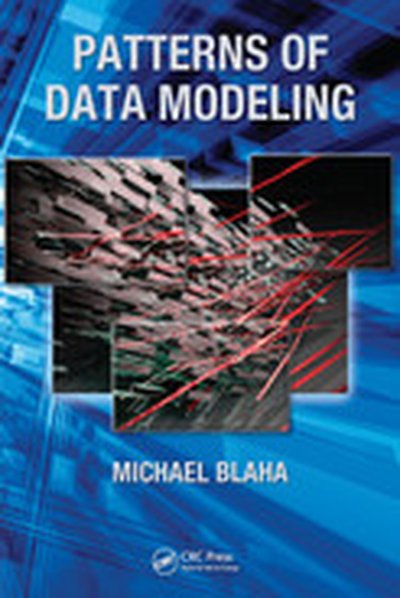
Patterns of Data Modeling

Helping readers avoid common mistakes and build better models, this is one of the first books to apply the popular patterns perspective to database systems and the data models that are used to design state-of-the-art, efficient database systems. Best-selling author and database expert Dr. Michael Blaha provides detailed data model patterns as a basis for expertly building data models. Since most commercial software is built around a database, he focuses on databases rather than programming. He emphasizes how database representation sets the path for the software, determines its flexibility, affects its quality, and influences whether the software succeeds or fails.

Using FileMaker Bento

Get comfortable with the latest version of FileMaker Bento. Don’t just read about it: See it and hear it with step-by-step video tutorials and valuable audio sidebars delivered through the Free Web Edition that comes with every USING book. For the price of the book, you get online access anywhere with a web connection–no books to carry, updated content, and the benefit of video and audio learning. Way more than just a book, this is all the help you’ll ever need where you want, when you want! learn fast, learn easy, using web, video, and audio Show Me video walks through tasks you’ve just got to see–including bonus advanced techniques Tell Me More audio delivers practical insights straight from the experts

FileMaker Pro 11: The Missing Manual

This hands-on, friendly guide shows you how to harness FileMaker's power to make your information work for you. With a few mouse clicks, the FileMaker Pro 11 database helps you create and print corporate reports, manage a mailing list, or run your entire business. FileMaker Pro 11: The Missing Manual helps you get started, build your database, and produce results, whether you're running a business, pursuing a hobby, or planning your retirement. It's a thorough, accessible guide for new, non-technical users, as well as those with more experience. Start up: Get your first database up and running in minutes Catalog your data: Organize contacts, to-do items, and product information with speedy data-entry and sorting tools Create professional documents: Publish reports, invoices, and more, with ease Add visual power and clarity: Create colorful charts to illustrate and summarize your data Harness processing power: Crunch numbers and search text with dozens of built-in formulas Learn advanced topics: Explore the high-level features of FileMaker Pro Advanced and FileMaker Server

Knowledge Discovery from Data Streams

Exploring how to extract knowledge structures from evolving and time-changing data, this book presents a coherent overview of state-of-the-art research in learning from data streams. It covers the fundamentals that are imperative to understanding data streams and describes important applications, such as TCP/IP traffic, GPS data, sensor networks, and customer click streams. It also explores advanced areas, such as ubiquitous data stream mining; addresses several challenges of data mining in the future, when stream mining will be at the core of many applications; and includes pseudo-code of more than 30 streaming-like algorithms.

Data Warehousing Fundamentals for IT Professionals

Cutting-edge content and guidance from a data warehousing expert—now expanded to reflect field trends Data warehousing has revolutionized the way businesses in a wide variety of industries perform analysis and make strategic decisions. Since the first edition of Data Warehousing Fundamentals, numerous enterprises have implemented data warehouse systems and reaped enormous benefits. Many more are in the process of doing so. Now, this new, revised edition covers the essential fundamentals of data warehousing and business intelligence as well as significant recent trends in the field. The author provides an enhanced, comprehensive overview of data warehousing together with in-depth explanations of critical issues in planning, design, deployment, and ongoing maintenance. IT professionals eager to get into the field will gain a clear understanding of techniques for data extraction from source systems, data cleansing, data transformations, data warehouse architecture and infrastructure, and the various methods for information delivery. This practical Second Edition highlights the areas of data warehousing and business intelligence where high-impact technological progress has been made. Discussions on developments include data marts, real-time information delivery, data visualization, requirements gathering methods, multi-tier architecture, OLAP applications, Web clickstream analysis, data warehouse appliances, and data mining techniques. The book also contains review questions and exercises for each chapter, appropriate for self-study or classroom work, industry examples of real-world situations, and several appendices with valuable information. Specifically written for professionals responsible for designing, implementing, or maintaining data warehousing systems, Data Warehousing Fundamentals presents agile, thorough, and systematic development principles for the IT professional and anyone working or researching in information management.

Time Series

Focusing on Bayesian approaches and computations using simulation-based methods for inference, Time Series: Modeling, Computation, and Inference integrates mainstream approaches for time series modeling with significant recent developments in methodology and applications of time series analysis. It encompasses a graduate-level account of Bayesian t

Relational Data Clustering

A culmination of the authors' years of extensive research on the topic, this book provides a complete, self-contained introduction to advances in relational data clustering. It presents a novel theoretical framework as well as the most state-of-the-art models for relational data clustering. The authors also describe a family of new algorithms for various relational clustering problems arising in a wide range of important applications. Concepts and theory are explained through detailed application examples and the book includes a comprehensive reference list of related literature.

SQL Server® 2008 Administration: Real World Skills for MCITP Certification and Beyond

The ideal on-the-job reference guide for SQL Server 2008 database administrators If you manage and administer SQL Server 2008 in the real world, you need this detailed guide at your desk. From planning to disaster recovery, this practical book explores tasks and scenarios that a working SQL Server DBA faces regularly and shows you step by step how to handle them. Topics include installation and configuration, creating databases and tables, optimizing the database server, planning for high availability, and more. And, if you're preparing for MCTS or MCITP certification in SQL Server 2008 administration, this book is the perfect supplement to your preparation, featuring a CD with practice exams, flashcards, and video walkthroughs of the more difficult administrative tasks Delves into Microsoft's SQL Server 2008, a rich set of enterprise-level database services for business-critical applications Explores the skills you'll need on the job as a SQL Server 2008 administrator Shows you how to implement, maintain, and repair the SQL Server database, including bonus videos on the CD where the authors walks you through the more difficult tasks Covers database design, installation and configuration, creating databases and tables, security, backup and high availability, and more Supplements your preparation for MCTS and MCITP SQL Server 2008 certification with in-depth coverage of the skill sets required for certification, as defined by Microsoft Uses hands-on exercises and real-world scenarios to keep what you're learning grounded in the reality of the workplace Make sure you're not only prepared for certification, but also for your job as a SQL Server 2008 administrator, with this practical reference! Note: CD-ROM/DVD and other supplementary materials are not included as part of eBook file.

Statistics for Business

Statistical analysis is essential to business decision-making and management, but the underlying theory of data collection, organization and analysis is one of the most challenging topics for business students and practitioners. This user-friendly text and CD-ROM package will help you to develop strong skills in presenting and interpreting statistical information in a business or management environment. Based entirely on using Microsoft Excel rather than more complicated applications, it includes a clear guide to using Excel with the key functions employed in the book, a glossary of terms and equations, plus a section specifically for those readers who feel rusty in basic maths. Each chapter has worked examples and explanations to illustrate the use of statistics in real life scenarios, with databases for the worked examples, cases and answers on the accompanying CD-ROM.

Oracle Enterprise Manager 10g Grid Control Handbook

Master Oracle Enterprise Manager 10 g Grid Control Centralize and simplify enterprise infrastructure administration using the detailed information contained in this Oracle Press guide. Oracle Enterprise Manager 10g Control Handbook shows you how to implement a grid-based management system and maintain on-demand access to critical services. Develop rollout plans, configure hardware and software, deploy targets and agents, control access, and distribute business reports. This authoritative resource also explains how to generate reliable backups, implement top-down performance monitoring, and maximize system availability. Plan and carry out an Oracle Enterprise Manager 10 g Grid Control rollout Set up customized metrics, alerts, thresholds, targets, and agents Manage IT resources from a centralized control console or the command line Manage your infrastructure using secure protocols Automate administrative tasks with Oracle's management agent Distribute business intelligence using the reporting and dashboard features Work with Oracle Enterprise Manager Database Control and Oracle Real Application Clusters Build physical and logical standby databases using Oracle Data Guard

Oracle RMAN 11g Backup and Recovery

Master Oracle Recovery Master Protect your databases from hardware, software, and operator failures using the detailed information in this Oracle Press guide. Oracle RMAN 11g Backup and Recovery explains how to configure databases, generate accurate archives, and carry out system restores. Work from the command line or Oracle Enterprise Manager, automate the backup process, perform Oracle Flashback recoveries, and integrate cloud computing technology. This authoritative resource also shows you how to create reports, optimize performance, and implement third-party administration utilities. Set up, configure, and maintain Oracle Recovery Manager (Oracle RMAN) Manage physical and virtual media with Oracle Secure Backup Work with Oracle RMAN catalogs, packages, and control files Use the Amazon Web Services cloud as an offsite storage solution Create online, offline, and incremental system backups Perform full and partial Oracle RMAN database restores Correct user-induced errors with Oracle Flashback Product clone and standby databases on local or remote servers Use Oracle Real Application Clusters and synch and split technology For a complete list of Oracle Press titles, visit www.OraclePressBooks.com

Oracle Self-Service Applications

Maximize the Capabilities of Oracle Self-Service Applications Get complete coverage of Oracle E-Business Suite's self-service modules, including Oracle iProcurement, Oracle Internet Expenses, Oracle iSupplier Portal, and Oracle iReceivables, inside this Oracle Press guide. Oracle Self-Service Applications discusses the features of each module and how they benefit organizational workflow, and reviews common implementation considerations that apply to all the applications. The book also provides detailed configuration instructions explaining each screen and field. Learn how to set up and use: Oracle iProcurement for automating both the requesting and approval of requisitions Oracle Internet Expenses for streamlining the entry, approval, and auditing of expense reports, including credit card processing Oracle iSupplier Portal to allow secure supplier collaboration Oracle iReceivables to enable customers and employees to review account information online The order management portal for granting inquiry-only viewing and tracking of orders and delivery status Oracle Bill Presentment Architecture for customizing invoices Oracle Approvals Management to accommodate complex rules for approving transactions Oracle Application Framework to customize both the options and usability of the self-service applications