Data storytelling is a perpetually hot topic in analytics and data science. It's easy to say, and it feels pretty easy to understand, but it's quite difficult to consistently do well. As our guest, Duncan Clark, co-founder and CEO of Flourish and Head of Europe for Canva, described it, there's a difference between "communicating" and "understanding" (or, as Moe put it, there's a difference between "explaining" and "exploring"). Data storytelling is all about the former, and it requires hard work and practice: being crystal clear as to why your audience should care about the information, being able boil the story down to a single sentence (and then expand from there), and crafting a narrative that is much, much more than an accelerated journey through the path the analyst took with the data. Give it a listen and then live happily ever after! For complete show notes, including links to items mentioned in this episode and a transcript of the show, visit the show page.
 talk-data.com
Topic
Data Science
20
tagged
Activity Trend
Top Events
To data analyst, or to data science? To individually contribute, or to manage the individual contributions of others? To mid-career pivot into analytics, or to… oh, hell yes! That last one isn't really a choice, is it? At least, not for listeners who are drawn to this podcast. And this episode is a show that can be directly attributed to listeners. As we gathered feedback in our recent listener survey, we asked for topic suggestions, and a neat little set of those suggestions were all centered around career development. And thus, a show was born! All five co-hosts—Julie, Michael, Moe, Tim, and Val—hopped on the mic to collaborate on some answers in this episode. For complete show notes, including links to items mentioned in this episode and a transcript of the show, visit the show page.
For those who celebrate or acknowledge it, Christmas is now in the rearview mirror. Father Time has a beard that reaches down to his toes, and he's ready to hand over the clock to an absolutely adorable little Baby Time when 2024 rolls in. That means it's time for our annual set of reflections on the analytics and data science industry. Somehow, the authoring of this description of the show was completely unaided by an LLM, although the show did include quite a bit of discussion around generative AI. It also included the announcement of a local LLM based on all of our podcast episodes to date (updated with each new episode going forward!), which you can try out here! The discussion was wide-ranging beyond AI: Google Analytics 4, Marketing Mix Modelling (MMM), the technical/engineering side of analytics versus the softer skills of creative analytical thought and engaging with stakeholders, and more, as well as a look ahead to 2024! For complete show notes, including links to items mentioned in this episode and a transcript of the show, visit the show page.
One of the biggest challenges for the analyst or data scientist is figuring out just how wide and just how deep to go with stakeholders when it comes to key (but, often, complicated) concepts that underpin the work that's being delivered to them. Tell them too little, and they may overinterpret or misinterpret what's been presented. Tell them too much, and they may tune out or fall asleep… and, as a result, overinterpret or misinterpret what's been presented. On this episode, Dr. Nicholas Cifuentes-Goodbody from WorldQuant University joined Julie, Val, and Tim to discuss how to effectively thread that particular needle. For complete show notes, including links to items mentioned in this episode and a transcript of the show, visit the show page.
When it comes to simulation, we're all really asking the same question: are we living in one? Alas! We did not tackle that on this episode. Instead, with Julie Hoyer as a guest co-host while Moe is on leave, we were joined by Frances Sneddon, the CTO of Simul8, to dig into some of the nuts and bolts of simulation as a tool for improving processes. It turns out that effectively putting simulations to use means focusing on some of the same foundational aspects of effectively using analytics, data science, or experimentation: clearly defining the problem, tapping into the domain experts to actually understand the process or scenario of focus, and applying some level of "art" to complement the science of the work! For complete show notes, including links to items mentioned in this episode and a transcript of the show, visit the show page.
Ethics in AI is a broad, deep, and tough subject. It's also, arguably, one of the most important subjects for analysts, data scientists, and organizations overall to deliberately and determinedly tackle as a standard part of how they do work. On this episode, Renée Cummings, Professor of Practice in Data Science and Data Activist in Residence at the University of Virginia (among many other roles), joined us for a discussion of the subject. Her knowledge of the topic is as deep as her passion for it, and both are bordering on the limitless, so it was an incredibly informative chat! For complete show notes, including links to items mentioned in this episode and a transcript of the show, visit the show page.
So, you finally took that recruiter's call, and then you made it through the initial phone screen. You weren't really expecting that to happen, but now you're facing an actual interview! It sounds intense and, yet, you're not sure what to expect or how to prepare for it. Flash cards with statistical concepts? A crash course in Python? LinkedIn stalking of current employees of the company? Maybe. We asked Jay Feng from Interview Query to join us to discuss strategies and tactics for data scientists and analyst interviews, and we definitely wanted to hire him by the time we were done! For complete show notes, including links to items mentioned in this episode and a transcript of the show, visit the show page.
What is a system without empathy? What is a show summary without an attempt to overly distill the discussion to the point of sounding like nonsense? On this episode, Hilary Parker (who you may know from the Not So Standard Deviations podcast or elsewhere) joined us to discuss what we can learn from the design process (as in: actual designers) when it comes to analytics and data science. Among other things, that mindset highlights the importance of the analyst empathizing with stakeholders. Tim got very uncomfortable. Michael said he understood Tim's discomfort. For complete show notes, including links to items mentioned in this episode and a transcript of the show, visit the show page.
What's in a job title? that which we call a senior data scientist by any other job title would model as predictively… This, dear listener, is why the hosts of this podcast crunch data rather than dabble in iambic pentameter. With sincere apologies to William Shakespeare, we sat down with Maryam Jahanshahi to discuss job titles, job descriptions, and the research, experiments, and analysis that she has conducted as a research scientist at Datapeople (formerly TapRecruit), specifically relating to data science and analytics roles. The discussion was intriguing and enlightening! For complete show notes, including links to items mentioned in this episode and a transcript of the show, visit the show page.
Did curiosity kill the cat? Perhaps. A claim could be made that a LACK of curiosity can (and should!) kill an analyst's career! On this episode, Dr. Debbie Berebichez, who, as Tim noted, sorta' pegs out on the extreme end of the curiosity spectrum, joined the show to explore the subject: the societal norms that (still!) often discourage young women from exploring and developing their curiosity; exploratory data analysis as one way to spark curiosity about a data set; the (often) misguided expectations of "the business" when it comes to analytics and data science (and the imperative to continue to promote data literacy to combat them), and more! For complete show notes, including links to items mentioned in this episode and a transcript of the show, visit the show page.
Did you know that there were monks in the 1400s doing text-based sentiment analysis? Can you name the 2016 movie that starred Amy Adams as a linguist? Have you ever laid awake at night wondering if stopword removal is ever problematic? Is the best therapist you ever had named ELIZA? The common theme across all of these questions is the broad and deep topic of natural language processing (NLP), a topic we've been wanting to form and exchange words regarding for quite some time. Dr. Joe Sutherland, the Head of Data Science at Search Discovery, joined the discussion and converted many of his thoughts on the subject into semantic constructs that, ultimately, were digitized into audio files for your auditory consumption. For complete show notes, including links to items mentioned in this episode and a transcript of the show, visit the show page.
Have you ever noticed that 68.2% of the people who explain machine learning use a "this picture is a cat" example, and another 24.3% use "this picture is a dog?" Is there really a place for machine learning and the world of computer vision (or machine vision, which we have conclusively determined is a synonym) in the real world of digital analytics? The short answer is the go-to answer of every analyst: it depends. On this episode, we sat down with Ali Vanderveld, Director of Data Science at ShopRunner, to chat about some real world applications of computer vision, as well as the many facets and considerations therein! For complete show notes, including links to items mentioned in this episode and a transcript of the show, visit the show page.
What's in a job title? That which we call a senior data scientist by any other job title would model as predictively... This, dear listener, is why the hosts of this podcast crunch data rather than dabble in iambic pentameter. With sincere apologies to William Shakespeare, we sat down with Maryam Jahanshahi to discuss job titles, job descriptions, and the research, experiments, and analysis that she has conducted as a research scientist at TapRecruit, specifically relating to data science and analytics roles. The discussion was intriguing and enlightening! For complete show notes, including links to items mentioned in this episode and a transcript of the show, visit the show page.
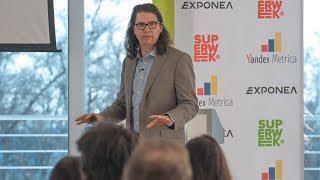
Past attendees of Superweek have ridden along with Tim as he explored R, and then as he dove deeper into some of the fundamental concepts of statistics. In this session, he will provide the latest update on that journey: how he is putting his exploration into the various dimensions of data science to use with real data and real clients. The statistical methods will be real, the code will be R (and available on GitHub), and the data will only be lightly obfuscated. So, you will be able to head back to your room at the next break and try one or more of the examples out on your own data! (But, don't do that -- the food and conversation at the breaks is too good to miss!)
What does it really take to bring data science into the enterprise? Or... what does it take to bring it into your part of the enterprise? In this episode, the gang sits down with Dr. Katie Sasso from the Columbus Collaboratory...because that's similar to what she does! From the criticality of defining the business problem clearly, to ensuring the experts with the deep knowledge of the data itself are included in the process, to the realities of information security and devops support needs, it was a pretty wide-ranging discussion. And there were convolutional neural networks (briefly). For complete show notes, including links to items mentioned in this episode and a transcript of the show, visit the show page.
Business Intelligence. It's a term that's been around for a few decades, but that is every bit as difficult to nail down as "data science," "big data," or a jellyfish. Think too hard about it, and you might actually find yourself struggling to define "analytics!" With the latest generation of BI tools, though, it's a topic that is making the rounds at cocktail parties the world over! (Cocktail parties just aren't what they used to be.) On this episode, the crew snags Taylor Udell from Heap to join in a discussion on the subject, and Moe (unsuccessfully) attempts to end the episode after six minutes. Possibly because neither Tableau nor Superset can definitively prove where avocado toast originated (but Wikipedia backs her up). But we all know Tim can't be shut up that quickly, right?! For complete show notes, including links to items mentioned in this episode and a transcript of the show, visit the show page.
Have you learned R yet? No? Well, then Tim is disappointed in you. Or, maybe that's totally okay! Way back on episode #035, we asked the question if data science was the future of digital analytics. We concluded...maybe...for some. On this episode, we dive deeper into what the career options are for digital analysts with longtime digital analytics industry recruiting and staffing maven Corry Prohens, founder and CEO of IQ Workforce. The good news? There are lots of options (if you find your passion and follow it)! For complete show notes, including links to items mentioned in this episode and a transcript of the show, visit the show page.
Somewhere along the spectrum of "logging into Google Analytics" and "the machines are in control" is the world of the power analyst who interacts with the data on the fly, applies statistics to large data sets, and develops interactive visualizations that go well beyond the capabilities of Excel. Those power analysts are operating on the fringes of the domain of the "data scientist" -- a role for which no one can really agree on a concrete definition! In this session, Tim -- who has never claimed to be and never will claim to be a data scientist -- will share what he has learned from trying to understand the scope and nature of that role. And, beyond that, how he has grown as a digital analyst, expanded his skills to "program with data" with R, and increased his value to the organizations with which he works as a result.
Once upon a time, in an industry near and dear, lived an analyst. And that analyst needed to present the results of her analysis to a big, scary, business user. This is not a tale for the faint of heart, dear listener. We're talking the Brothers Grimm before Disney got their sugar-tipped screenwriting pens on the stories! Actually, this isn't a fairy tale at all. It's a practical reality of the analyst's role: effectively communicating the results of our work out to the business. Join Michael and Tim and special guest, Storytelling Maven Brent Dykes, as they look for a happy ending to The Tale of the Analyst with Data to Be Conveyed. Tangential tales referenced in this episode include: Web Analytics Action Hero, Brent Dykes Articles on Forbes.com, The Wizard of Oz, Made to Stick, Data Storytelling: The Essential Data Science Skill Everyone Needs, The Story of Maths, and mockaroo.com.
Are you a data scientist? Have you pondered whether you're really a growth hacker? Well...get over yourself! Picking up on a debate that started onstage at eMetrics, Michael, Jim, and Tim discuss whether a fundamental shift in the role (and requisite skills) of the web analyst are changing. You know, getting more "science-y" (if "science" is "more technical and more maths"). all in 2,852 seconds (each second of which can be pulled into R and used to build a predictive model showing the expected ROI of listening to future episodes; at least, we assume that's what a data scientist could do).