 talk-data.com
Topic
GenAI
Generative AI
ai
machine_learning
llm
1517
tagged
Activity Trend
192
peak/qtr
2020-Q1
2026-Q1
Top Events
Google Cloud Next '24
294
Google Cloud Next '25
165
AWS re:Invent 2024
124
Data + AI Summit 2025
98
DataFramed
94
Big Data LDN 2024
61
Big Data LDN 2025
31
Microsoft Ignite 2025
27
Secrets of Data Analytics Leaders
26
Exhibitors' Events - Auto created
23
O'Reilly AI & ML Books
23
gartner-data-analytics-india-2025
23
Generative AI and AI tools are democratizing data and blurring lines between business, data, and IT, making traditional operating models obsolete. Zilveren Kruis, the largest health insurer in the Netherlands, is modernizing by enabling self-service, implementing AI productivity suites, fostering collaboration across departments, and redefining data roles to drive rapid, compliant innovation.
by
Rients Dotinga
(DataFryslân)
,
Rudolf Simons
(DataFryslân)
,
Carlos de Matos Fernandes
(DataFryslân)
Hoe bouw je als regio aan digitale autonomie, met aandacht voor publieke waarden? DataFryslân deelt het transitieverhaal van strategie naar praktijk. Met concrete lessen over het inzetten van generatieve AI voor datarapportages en het borgen van ethiek via een onafhankelijke regionale commissie. Wat werkt, wat niet – en hoe je koers houdt in een complexe omgeving.
In deze kleine groepsessie gaan we echt de techniek in. Breng je concrete vragen over GenAI monitoring mee - hoe bepaal je of het werkt, welke metrics tellen, hoe ga je live? Geen presentatie maar échte discussie waar we van elkaar leren. Als Head of Development deel ik onze aanpak, maar ben minstens zo benieuwd naar jullie ervaringen. Kom maar door!
When time is critical, finding the right clinical trial can mean the difference between hope and despair. In this session, Marshall Van Beurden, CTO at myTomorrows, shares how his team built a GenAI-powered platform on Amazon Bedrock that’s transforming this process—turning complex global trial data into life-changing matches with 98% accuracy and 90% faster than before
Van werkend prototype naar échte klanten: hoe bepaal je of je GenAI-toepassing " goed werkt"? In deze praktische sessie deel ik concrete technieken voor het meten en sturen van non-deterministische AI-modellen op schaal. Van monitoring tot bijsturing - met passie de technologie nuchtere blik resultaten. Voor data specialists zakelijke stakeholders die GenAI daadwerkelijk willen inzetten.
Wat als je het Handelsregister zélf vragen kon stellen – zonder technische kennis? KVK onderzoekt hoe generative AI dit mogelijk kan maken. In deze sessie laten we zien hoe we in een pilot met een slimme chatbot gebruikers in staat stellen om ‘in gesprek’ te gaan met het Handelsregister om direct antwoord te krijgen op hun vragen. We delen onze aanpak, uitdagingen en inzichten voor een veilige en schaalbare inzet van AI.
How do organizations move from predictive ML to impactful Generative AI? This session presents a strategic blueprint for this transition. It showcases how Google leverages Gemini and AI Agents to automate complex engineering workflows, achieving an 80% reduction in time spent on issue resolution. Gain a framework for fostering innovation, enabling teams, and driving measurable results with LLMs.
Brought to You By: • Statsig — The unified platform for flags, analytics, experiments, and more. Statsig built a complete set of data tools that allow engineering teams to measure the impact of their work. This toolkit is SO valuable to so many teams, that OpenAI - who was a huge user of Statsig - decided to acquire the company, the news announced last week. Talk about validation! Check out Statsig. • Linear – The system for modern product development. Here’s an interesting story: OpenAI switched to Linear as a way to establish a shared vocabulary between teams. Every project now follows the same lifecycle, uses the same labels, and moves through the same states. Try Linear for yourself. — The Pragmatic Engineer Podcast is back with the Fall 2025 season. Expect new episodes to be published on most Wednesdays, looking ahead. Code Complete is one of the most enduring books on software engineering. Steve McConnell wrote the 900-page handbook just five years into his career, capturing what he wished he’d known when starting out. Decades later, the lessons remain relevant, and Code Complete remains a best-seller. In this episode, we talk about what has aged well, what needed updating in the second edition, and the broader career principles Steve has developed along the way. From his “career pyramid” model to his critique of “lily pad hopping,” and why periods of working in fast-paced, all-in environments can be so rewarding, the emphasis throughout is on taking ownership of your career and making deliberate choices. We also discuss: • Top-down vs. bottom-up design and why most engineers default to one approach • Why rewriting code multiple times makes it better • How taking a year off to write Code Complete crystallized key lessons • The 3 areas software designers need to understand, and why focusing only on technology may be the most limiting • And much more! Steve rarely gives interviews, so I hope you enjoy this conversation, which we recorded in Seattle. — Timestamps (00:00) Intro (01:31) How and why Steve wrote Code Complete (08:08) What code construction is and how it differs from software development (11:12) Top-down vs. bottom-up design approach (14:46) Why design documents frustrate some engineers (16:50) The case for rewriting everything three times (20:15) Steve’s career before and after Code Complete (27:47) Steve’s career advice (44:38) Three areas software designers need to understand (48:07) Advice when becoming a manager, as a developer (53:02) The importance of managing your energy (57:07) Early Microsoft and why startups are a culture of intense focus (1:04:14) What changed in the second edition of Code Complete (1:10:50) AI’s impact on software development: Steve’s take (1:17:45) Code reviews and GenAI (1:19:58) Why engineers are becoming more full-stack (1:21:40) Could AI be the exception to “no silver bullets?” (1:26:31) Steve’s advice for engineers on building a meaningful career — The Pragmatic Engineer deepdives relevant for this episode: • What changed in 50 years of computing • The past and future of modern backend practices • The Philosophy of Software Design – with John Ousterhout • AI tools for software engineers, but without the hype – with Simon Willison (co-creator of Django) • TDD, AI agents and coding – with Kent Beck — Production and marketing by https://penname.co/. For inquiries about sponsoring the podcast, email [email protected].
Get full access to The Pragmatic Engineer at newsletter.pragmaticengineer.com/subscribe
To fully unlock the potential of AI within KPN, scaling is key. Therefore KPN focuses on 4 pillars: AI Literacy, Governance, end-to-end implementation with business, IT, data and AI, and the expansion of our technical infrastructure. Together, these elements support the democratization of AI capabilities across the organization. With the emergence of Generative AI—especially Agentic AI—broad enablement has become even more critical. In this session, KPN will share organizational opportunities and challenges related to AI adoption at scale, and how it utilizes Dataiku as the central Data Science platform to drive this transformation.
Join Signify and AWS as we explore the journey of bringing natural language AI control to Philips Hue smart lighting. Follow their path through critical decisions around model selection, evaluation frameworks, and knowledge base architecture as they developed custom classifiers and orchestration flows to transform casual conversation into magical lighting experiences. See how AWS's evolving GenAI capabilities, from foundation model platform to enterprise-grade features, are helping organizations bring innovative AI solutions to production with confidence
Knowledge graphs are key to taking GenAI from proof of concept to production — making applications more reliable, transparent and secure. In this session we’ll show how to build one: connect siloed data, enrich it with semantics and structure it for GenAI. With real tools, examples and steps, you’ll see how graphs prepare enterprise data for AI and unlock faster, more trustworthy results.
Rabobank scales GenAI through complementary approaches. First, with an analytics platform strategy: a lab platform for low-friction experimentation on non-sensitive data, and a lab platform for secure development and a governed promotion path to production. Second, the availability of re-usable GenAI building blocks that enable secure, responsible, standardized, and scalable development of GenAI solutions.
In the GenAI era, enabling everyone to build with AI is critical. Learn how Dataiku, The Universal AI Platform™, empowers teams of all skill levels to build and deliver GenAI and agentic AI products with speed, control, and confidence. Uncover approaches for integrating GenAI and orchestrating AI agents in production across functions with the right controls, access, and oversight.
Business challenges that were once sporadic are now persistent and widespread—impacting everyone from business users and analysts to data engineers and scientists. Learn how the latest innovations in Gen AI are reshaping the BI landscape and unlocking actionable insights for every user. Here's what we'll cover: What defines a truly Gen AI-powered BI platform How businesses can empower every user with Gen AI How Agentic AI is shaping BI Live demos showcasing Gen AI and Agentic AI capabilities in BI
The role of databases in AI powered systems & Introduction to TiDB & TiDB Gen AI Capabilities
by
Barbara Humpton
(Siemens Corporation)
,
Richie
(DataCamp)
,
Olympia Brikis
(Siemens Industrial AI Research in the U.S.)
The manufacturing floor is undergoing a technological revolution with industrial AI at its center. From predictive maintenance to quality control, AI is transforming how products are designed, produced, and maintained. But implementing these technologies isn't just about installing sensors and software—it's about empowering your workforce to embrace new tools and processes. How do you overcome AI hesitancy among experienced workers? What skills should your team develop to make the most of these new capabilities? And with limited resources, how do you prioritize which AI applications will deliver the greatest impact for your specific manufacturing challenges? The answers might be simpler than you think. Barbara Humpton is President and CEO of Siemens Corporation, responsible for strategy and engagement in Siemens’ largest market. Under her leadership, Siemens USA operates across all 50 states and Puerto Rico with 45,000 employees and generated $21.1 billion in revenue in fiscal year 2024. She champions the role of technology in expanding what’s humanly possible and is a strong advocate for workforce development, mentorship, and building sustainable work-life integration. Previously, she was President and CEO of Siemens Government Technologies, leading delivery of Siemens’ products and services to U.S. federal agencies. Before joining Siemens in 2011, she held senior roles at Booz Allen Hamilton and Lockheed Martin, where she oversaw programs in national security, biometrics, border protection, and critical infrastructure, including the FBI’s Next Generation Identification and TSA’s Transportation Workers’ Identification Credential. Olympia Brikis is a seasoned technology and business leader with over a decade of experience in AI research. As the Technology and Engineering Director for Siemens' Industrial AI Research in the U.S., she leads AI strategy, technology roadmapping, and R&D for next-gen AI products. Olympia has a strong track record in developing Generative AI products that integrate industrial and digital ecosystems, driving real-world business impact. She is a recognized thought leader with numerous patents and peer-reviewed publications in AI for manufacturing, predictive analytics, and digital twins. Olympia actively engages with executives, policymakers, and AI practitioners on AI's role in enterprise strategy and workforce transformation. With a background in Computer Science from LMU Munich and an MBA from Wharton, she bridges AI research, product strategy, and enterprise adoption, mentoring the next generation of AI leaders. In the episode, Richie, Barbara, and Olympia explore the transformative power of AI in manufacturing, from predictive maintenance to digital twins, the role of industrial AI in enhancing productivity, the importance of empowering workers with new technology, real-world applications, overcoming AI hesitancy, and much more. Links Mentioned in the Show: Siemens Industrial AI SuiteConnect with Barbara and OlympiaCourse: Implementing AI Solutions in BusinessRelated Episode: Master Your Inner Game to Avoid Burnout with Klaus Kleinfeld, Former CEO at Alcoa and SiemensRewatch RADAR AI where...
The line between human work and AI capabilities is blurring in today's business environment. AI agents are now handling autonomous tasks across customer support, data management, and sales prospecting with increasing sophistication. But how do you effectively integrate these agents into your existing workflows? What's the right approach to training and evaluating AI team members? With data quality being the foundation of successful AI implementation, how can you ensure your systems have the unified context they need while maintaining proper governance and privacy controls? Karen Ng is the Head of Product at HubSpot, where she leads product strategy, design, and partnerships with the mission of helping millions of organizations grow better. Since joining in 2022, she has driven innovation across Smart CRM, Operations Hub, Breeze Intelligence, and the developer ecosystem, with a focus on unifying structured and unstructured data to make AI truly useful for businesses. Known for leading with clarity and “AI speed,” she pushes HubSpot to stay ahead of disruption and empower customers to thrive. Previously, Karen held senior product leadership roles at Common Room, Google, and Microsoft. At Common Room, she built the product and data science teams from the ground up, while at Google she directed Android’s product frameworks like Jetpack and Jetpack Compose. During more than a decade at Microsoft, she helped shape the company’s .NET strategy and launched the Roslyn compiler platform. Recognized as a Product 50 Winner and recipient of the PM Award for Technical Strategist, she also advises and invests in high-growth technology companies. In the episode, Richie and Karen explore the evolving role of AI agents in sales, marketing, and support, the distinction between chatbots, co-pilots, and autonomous agents, the importance of data quality and context, the concept of hybrid teams, the future of AI-driven business processes, and much more. Links Mentioned in the Show: Hubspot Breeze AgentsConnect with KarenWebinar: Pricing & Monetizing Your AI Products with Sam Lee, VP of Pricing Strategy & Product Operations at HubSpotRelated Episode: Enterprise AI Agents with Jun Qian, VP of Generative AI Services at OracleRewatch RADAR AI New to DataCamp? Learn on the go using the DataCamp mobile appEmpower your business with world-class data and AI skills with DataCamp for business
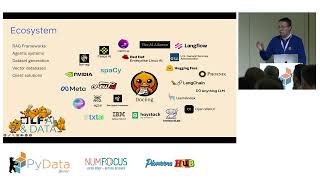
Docling, an open source package, is rapidly becoming the de facto standard for document parsing and export in the Python community. Earning close to 30,000 GitHub in less than one year and now part of the Linux AI & Data Foundation. Docling is redefining document AI with its ease and speed of use. In this session, we’ll introduce Docling and its features, including usages with various generative AI frameworks and protocols (e.g. MCP).