talk-data.com talk-data.com

Topic

GenAI

Generative AI

ai machine_learning llm

1517

tagged

Activity Trend

192 peak/qtr
2020-Q1 2026-Q1

Activities

1517 activities · Newest first

Advancements in Open Source LLM Tooling, Including MLflow

MLflow is one of the most used open source machine learning frameworks with over 13 million monthly downloads. With the recent advancements in generative AI, MLflow has been rapidly integrating support for a lot of the popular AI tools being used such as Hugging Face, LangChain, and OpenAI. This means that it’s becoming easier than ever to build AI pipelines with your data as the foundation, yet expanding your capabilities with the incredible advancements of the AI community.

Come to this session to learn how MLflow can help you:

  • Easily grab open source models from Hugging Face and use Transformers pipelines in MLflow
  • Integrate LangChain for more advanced services and to add context into your model pipelines
  • Bring in OpenAI APIs as part of your pipelines
  • Quickly track and deploy models on the lakehouse using MLflow

Talk by: Corey Zumar and Ben Wilson

Connect with us: Website: https://databricks.com Twitter: https://twitter.com/databricks LinkedIn: https://www.linkedin.com/company/databricks Instagram: https://www.instagram.com/databricksinc Facebook: https://www.facebook.com/databricksinc
In a time when AI is evolving at breakneck speeds, taking a step back and gaining a bird's-eye view of the evolving AI ecosystem is paramount to understanding where the field is headed. With this bird's-eye view come a series of questions. Which trends will dominate generative AI in the foreseeable future? What are the truly transformative use-cases that will reshape our business landscape? What does the skills economy look like in an age of hyper intelligence? Enter Joanne Chen, General Partner at Foundation Capital. Joanne invests in early-stage AI-first B2B applications and data platforms that are the building blocks of the automated enterprise. She has shared her learnings as a featured speaker at conferences, including CES, SXSW, WebSummit, and has spoken about the impact of AI on society in her TED talk titled "Confessions of an AI Investor." Joanne began her career as an engineer at Cisco Systems and later co-founded a mobile gaming company. She also spent many years working on Wall Street at Jefferies & Company, helping tech companies go through the IPO and M&A processes, and at Probitas Partners, advising venture firms on their fundraising process. Throughout the episode, Richie and Joanne cover emerging trends in generative AI, business use cases that have emerged in the past year since the advent of tools like ChatGPT, the role of AI in augmenting work, the ever-changing job market and AI's impact on it, as well as actionable insights for individuals and organizations wanting to adopt AI. Links mentioned in the show: JasperAIAnyScaleCerebras[Course] Introduction to ChatGPT[Course] Implementing AI Solutions in Business[Course] Generative AI Concepts

Generative Models: Explore a variety of generative models, such as autoencoders, GANs, and VAEs, and their applications in various domains. Training Techniques: Learn proven techniques for training and optimizing models, including adversarial training, self-supervised learning, and more. Applications: Discover the limitless possibilities of generative AI across a wide range of domains, from art and design to gaming and advertising. Interpreting Gen AI: Dive deep into how models generate content and the latest techniques for interpreting the output. Ethics and Governance: Discuss the importance of fairness, privacy, and accountability in generative models. Future Trends: Explore the latest open source projects, research, developments, and trends in the field.

Spreadsheets have been the unsung heroes of the data world for many decades now. Yet, despite their ubiquity and importance, they've seen little disruption or evolution. The grid of cells we interact with today isn't far removed from the ones our predecessors used in the 1980s. However, the winds of change have started to blow. As we stand on the cusp of a new era in data and AI, the humble spreadsheet is poised for transformation. The coming changes could redefine how we interact with data, derive insights, and how we make decisions. The implications are vast given the popularity and dependence we have on spreadsheets, and the potential impacts could ripple through every corner of the professional world.  Hjalmar Gislason is the founder and CEO of GRID, with their main product being a smart spreadsheet with an interactive data visualization layer and integrated AI assistance. Hjalmar previously served as VP of Product Management at Qlik. He was the founder and CEO of DataMarket, founded in 2008 and sold to Qlik in 2014. A career data nerd and entrepreneur, GRID is Hjalmar’s fifth software startup as a founder.  In the episode, Richie and Hjalmar explore the integral role of spreadsheets in today's data-driven world, the limitations of traditional Business Intelligence tools, and the transformative potential of generative AI in the realm of spreadsheets.

Live from the Lakehouse: Developer relations, generative AI, and conference wrap-up

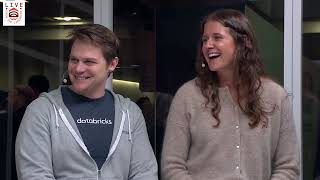
Hear from two guests: Mary Grace Moesta and Sam Raymond (both Sr Data Scientists at Databricks) on developer relations, and generative AI. Plus the co-hosts wrap up the entire conference with all the exciting happenings at the Data & AI Summit by Databricks. Hosted by Holly Smith (Sr Resident Solutions Architect, Databricks) and Jimmy Obeyeni (Strategic Account Executive, Databricks)

Connect with us: Website: https://databricks.com Twitter: https://twitter.com/databricks LinkedIn: https://www.linkedin.com/company/databricks Instagram: https://www.instagram.com/databricksinc Facebook: https://www.facebook.com/databricksinc
Live from the Lakehouse: LLMs, LangChain, and analytics engineering workflow with dbt Labs

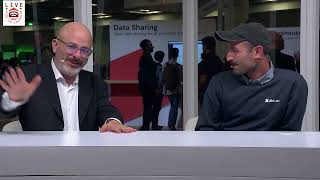
Hear from three guests. Harrison Chase (CEO, LangChain) and Nicolas Palaez (Sr. Technical Marketing Manager, Databricks) on LLMs and generative AI. Third guest, Drew Banin (co-founder, dbt Labs), discusses analytics engineering workflow with his company dbt Labs, how he started the company, and how they provide value with the Databricks partnership. Hosted by Ari Kaplan (Head of Evangelism, Databricks) and Pearl Ubaru (Sr Technical Marketing Engineer, Databricks)

Connect with us: Website: https://databricks.com Twitter: https://twitter.com/databricks LinkedIn: https://www.linkedin.com/company/databricks Instagram: https://www.instagram.com/databricksinc Facebook: https://www.facebook.com/databricksinc
In this episode, Marijn Markus & I talked about what it is ACTUALLY like being in the data field, how he transitioned from social science to data science, & discuss some real-world data use cases.

Marijn also shared his experience managing data teams, what makes a good junior hire, why you might not need machine learning, & much, much more.

You don’t want to miss this episode!

📊 Come to my next free “How to Land Your First Data Job” training

🏫 Check out my 10-week data analytics bootcamp

Connect with Marijn: https://www.linkedin.com/in/marijnmarkus/

Timestamps:

(4:40) - Diverse backgrounds matter for programming and stats! (17:42) - Model explanations matter for business (21:00)- The real reason why generative AI became big in December (25:24) - Focus on what you know, not what you don't know (30:14) - You can't control the interview session? Think again!

Mentioned in this episode: Join the last cohort of 2025! The LAST cohort of The Data Analytics Accelerator for 2025 kicks off on Monday, December 8th and enrollment is officially open!

To celebrate the end of the year, we’re running a special End-of-Year Sale, where you’ll get: ✅ A discount on your enrollment 🎁 6 bonus gifts, including job listings, interview prep, AI tools + more

If your goal is to land a data job in 2026, this is your chance to get ahead of the competition and start strong.

👉 Join the December Cohort & Claim Your Bonuses: https://DataCareerJumpstart.com/daa https://www.datacareerjumpstart.com/daa

podcast_episode
by Val Kroll , Julie Hoyer , Dr. Janet Bastiman (Napier) , Tim Wilson (Analytics Power Hour - Columbus (OH) , Moe Kiss (Canva) , Michael Helbling (Search Discovery)

To trust something, you need to understand it. And, to understand something, someone often has to explain it. When it comes to AI, explainability can be a real challenge (definitionally, a "black box" is unexplainable)! With AI getting new levels of press and prominence thanks to the explosion of generative AI platforms, the need for explainability continues to grow. But, it's just as important in more conventional situations. Dr. Janet Bastiman, the Chief Data Scientist at Napier, joined Moe and Tim to, well, explain the topic! For complete show notes, including links to items mentioned in this episode and a transcript of the show, visit the show page.

Generative AI brings a promise to improve lives in a blistering innovation race, but also a threat to people, corporations, and even nations. Data analytics leaders must understand the risks of generative AI, both societal and business-related, to use it positively and avoid the destructive consequences seen with nuclear energy development. Published at: https://www.eckerson.com/articles/the-opportunity-and-risk-of-generative-ai-part-i-a-nuclear-explosion

On today’s episode, we’re joined by Swathi Young, Chief Technology Officer, SustainChain, a global systems-based technology platform designed to drive unprecedented collaboration and joint action among organizations with a high commitment to sustainability.

We talk about:

Key steps to get started with generative AI & MLBreaking down organizational silos to leverage emerging technologiesReducing cloud computing costs & mitigating environmental impacts of MLThe “self-service” trend of empowering business users with tools for decision-makingThe ethics of AI-generated art, writing, & music

In the realm of Applied Intelligence, Accenture leads the way in harnessing the power of data and AI to transform industries. From consumer products to life sciences, retail, and aerospace, Accenture's influence is far-reaching. But what drives the organization? How does it navigate the complex landscape of data modernization and transformation? And more importantly, how does it leverage technology not just as an enabler, but as a catalyst for innovation?  Tracy Ring leads Accenture’s Applied Intelligence Products Category Group, in this role she has leadership across Consumer and Industrial Products, Automotive, Life Sciences, Retail and Aerospace and Defense. As the CDO and Global Generative AI lead for Life Sciences, she personally anchors the NA Applied Intelligence Life Sciences practice of more than 500 practitioners. Tracy has created solutions for Generative AI, Data led transformation, Artificial Intelligence, Data and Cloud Modernization, Analytics, and the organization and operating model strategies for next-generation adoption and AI fluency.  In the episode, Tracy initially clarifies the difference between data modernization and data transformation, highlighting their distinct meanings and why the terms aren’t interchangeable.  Tracy also emphasizes the importance of involving business end-users from the outset of data projects as well as advocating for a product-oriented approach to data. The discussion also covers the topic of team diversity and inclusivity. Tracy shares practical advice on how to build diverse teams and create an environment that encourages curiosity and open dialogue. Tracy also shares her perspective on the future of work and the importance of fostering meaningful conversations in the workplace. She advocates for an attitude of infinite curiosity within teams. In the context of life sciences, Tracy highlights the high stakes involved and underscores the need for responsible AI, data sharing, and data privacy. She also points out that the challenges in this field are more similar than dissimilar to those in other industries. Tune in for a wealth of insights from a seasoned leader in the field of Applied Intelligence.

A lot of the times when we walk into a supermarket, we don't necessarily think about the impact data science had in getting these products on shelves. However, as you’ll learn in today's episode, it's safe to say there's a myriad of applications for data science in the FMCG industry. Whether be that supply chain use-cases that leverage time-series forecasting techniques, to computer vision use-cases for on-shelf optimization—the use-cases are endless here. So how can data scientists and data leaders maximize value in this space? Enter Anastasia Zygmantovich. Anastasia is a Global Data Science Director at Reckitt, which is most known for products like Airwick, Lysol, Detol, and Durex. Throughout the episode, we discuss how data science can be used in the FMCG industry, how data leaders can hire impactful data teams in this space, why FMCG is a great place to work in for data scientists, some awesome use-cases she's worked on, how data scientists can best maximize their value in this space, what generative AI means for organizations, and a lot more.

Generative AI for Product Builders | Continual

ABOUT THE TALK: The emergence of generative AI models such as GTP-3, DALL•E, and Stable Diffusion has the potential to fundamentally change knowledge and creative work. This talk highlight the ways generative AI can enhance products, accelerating workflows and unlocking creativity. It also discusses some of the technical challenges involved in building generative AI products, including prompt chaining, data privacy, learning from human and AI feedback, and AI-human interaction.

ABOUT THE SPEAKER: Tristan Zajonc is the co-founder and CEO of Continual, an ML delivery platform that provides lifecycle management for production machine learning. He was previously CTO for Machine Learning at Cloudera and co-founder of Sense, a data science platform acquired by Cloudera in 2016. He has spent over 10 years in the trenches of machine learning infrastructure and operations.

ABOUT DATA COUNCIL: Data Council (https://www.datacouncil.ai/) is a community and conference series that provides data professionals with the learning and networking opportunities they need to grow their careers.

Make sure to subscribe to our channel for the most up-to-date talks from technical professionals on data related topics including data infrastructure, data engineering, ML systems, analytics and AI from top startups and tech companies.

FOLLOW DATA COUNCIL: Twitter: https://twitter.com/DataCouncilAI LinkedIn: https://www.linkedin.com/company/datacouncil-ai/

Generative AI for Search | Tonita

ABOUT THE TALK: D. Sivakumar discusses the evolving -- and immensely powerful -- role that generative AI methods, especially in NLP and Vision, play in Search, broadly construed. Through a number of anecdotes and organizing principles, he highlights a handful of key challenges and promising directions.

ABOUT THE SPEAKER: D. Sivakumar (Siva) is co-founder and CEO of Tonita.co, whose mission is to bring fluent natural-language search to every search box on the Web. Prior to founding Tonita in 2021, he worked in the research organizations at Google, Yahoo!, and IBM. His research has spanned algorithms and complexity, web search, and deep learning.

ABOUT DATA COUNCIL: Data Council (https://www.datacouncil.ai/) is a community and conference series that provides data professionals with the learning and networking opportunities they need to grow their careers.

Make sure to subscribe to our channel for the most up-to-date talks from technical professionals on data related topics including data infrastructure, data engineering, ML systems, analytics and AI from top startups and tech companies.

FOLLOW DATA COUNCIL: Twitter: https://twitter.com/DataCouncilAI LinkedIn: https://www.linkedin.com/company/datacouncil-ai/

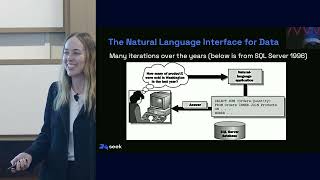
Generative AI & the Natural Language Interface for Data |  Seek AI

ABOUT THE TALK: With the advancement of AI, the natural language interface for data is more valuable than ever before. This talk explores three key questions. First, what would a natural language interface for data actually look like? Second, what kind of value would it add to organizations using the Modern Data Stack? Third, what will the challenges look like when it comes to working with a natural language interface for data? Sarah Nagy will share real-world learnings from Seek's customers for each of these questions.

ABOUT THE SPEAKER: A former quant, Sarah Nagy founded Seek AI in 2021. Prior to starting Seek, Sarah most recently led the consumer data team at Citadel's Ashler Capital. Prior to joining Citadel, Sarah led the quant arms at two startups, Edison and Predata, which both successfully exited. Sarah started her career as a quant at ITG developing algorithmic trading strategies. Sarah has a Master in Finance degree from Princeton and dual Bachelor's degrees in Astrophysics and Business Economics from UCLA.

ABOUT DATA COUNCIL: Data Council (https://www.datacouncil.ai/) is a community and conference series that provides data professionals with the learning and networking opportunities they need to grow their careers.

Make sure to subscribe to our channel for the most up-to-date talks from technical professionals on data related topics including data infrastructure, data engineering, ML systems, analytics and AI from top startups and tech companies.

FOLLOW DATA COUNCIL: Twitter: https://twitter.com/DataCouncilAI LinkedIn: https://www.linkedin.com/company/datacouncil-ai/

With the advances in AI products and the explosion of ChatGPT in recent months, it is becoming easier to imagine a world where AI and humans work seamlessly together—revolutionizing how we solve complex problems and transform our daily lives. This is especially the case for data professionals. In this episode of our AI series, we speak to Sarah Schlobohm, Head of AI at Kubrick Group. Dr. Schlobohm leads the training of the next generation of machine learning engineers. With a background in finance and consulting, Sarah has a deep understanding of the intersection between business strategy, data science, and AI. Prior to her work in finance, Sarah became a chartered accountant, where she honed her skills in financial analysis and strategy. Sarah worked for one of the world's largest banks, where she used data science to fight financial crime, making significant contributions to the industry's efforts to combat money laundering and other illicit activities. Sarah shares her extensive knowledge on incorporating AI within data teams for maximum impact, covering a wide array of AI-related topics, including upskilling, productivity, and communication, to help data professionals understand how to integrate generative AI effectively in their daily work. Throughout the episode, Sarah explores the challenges and risks of AI integration, touching on the balance between privacy and utility. She highlights the risks data teams can avoid when using AI products and how to approach using AI products the right way. She also covers how different roles within a data team might make use of generative AI, as well as how it might effect coding ability going forward. Sarah also shares use cases for those in non-data teams, such as marketing, while also highlighting what to consider when using outputs from GPT models. Sarah shares the impact chatbots might have on education calling attention to the power of AI tutors in schools. Sarah encourages people to start using AI now, considering the barrier to entry is so low, and how that might not be the case going forward. From automating mundane tasks to enabling human-AI collaboration that makes work more enjoyable, Sarah underscores the transformative power of AI in shaping the future of humanity. Whether you're an AI enthusiast, data professional, or someoone with an interest in either this episode will provide you with a deeper understanding of the practical aspects of AI implementation.

With the advent of any new technology that promises to make humans lives easier, replacing concious actions with automation, there is always backlash. People are often aware of the displacement of jobs, and often, it is viewed in a negative light. But how do we try to change the collective understanding to one of hope and excitement? What use cases can be shared that will change the opinion of those that are weary of AI?  Noelle Silver Russell is the Global AI Solutions & Generative AI & LLM Industry Lead at Accenture, responsible for enterprise-scale industry playbooks for generative AI and LLMs. In this episode of our AI series, Noelle discusses how to prioritize ChatGPT use cases by focusing on the different aspects of value creation that GPT models can bring to individuals and organizations. She addresses common misconceptions surrounding ChatGPT and AI in general, emphasizing the importance of understanding their potential benefits and selecting use cases that maximize positive impact, foster innovation, and contribute to job creation. Noelle draws parallels between the fast-moving AI projects today and the launch of Amazon Alexa, which she worked on, and points out that many of the discussions being raised today were also talked about 10 years ago. She discusses how companies can now use AI to focus both on business efficiencies and customer experience, no longer having to settle for a trade-off between the two. Noelle explains the best way for companies to approach adding GPT tools into their processes, which focusses on taking a holistic view to implementation. She also recommends use-cases for companies that are just beginning to use AI, as well as the challenges they might face when deploying models into production, and how they can mitigate them.  On the topic of the displacement of jobs, Noelle draws parallels from when Alexa was launched, and how it faced similar criticisms, digging into the fear that people have around new technology, which could be transformed into enthusiasm. Noelle suggests that there is a burden on leadership within organizations to create a culture where people are excited to use AI tools, rather than feeling threatened by them.

ChatGPT was the iPhone moment for AI, and things are moving insanely quickly. What do generative AI models mean for us, especially children, who are arguably the last of the Pre-AI generation? I dive into some thoughts this week about how we need to work alongside the machines, the impact of generative AI on kids, and so on. Buckle up. We are in for a very interesting next few years as we sort out where AI fits into our day-to-day lives.

data #datascience #dataengineering #chatgpt #ai


If you like this show, give it a 5-star rating on your favorite podcast platform.

Purchase Fundamentals of Data Engineering at your favorite bookseller.

Check out my substack: https://joereis.substack.com/