talk-data.com talk-data.com

Topic

GenAI

Generative AI

ai machine_learning llm

1517

tagged

Activity Trend

192 peak/qtr
2020-Q1 2026-Q1

Activities

1517 activities · Newest first

Summary In this crossover episode of the AI Engineering Podcast, host Tobias Macey interviews Brijesh Tripathi, CEO of Flex AI, about revolutionizing AI engineering by removing DevOps burdens through "workload as a service". Brijesh shares his expertise from leading AI/HPC architecture at Intel and deploying supercomputers like Aurora, highlighting how access friction and idle infrastructure slow progress. Join them as they discuss Flex AI's innovative approach to simplifying heterogeneous compute, standardizing on consistent Kubernetes layers, and abstracting inference across various accelerators, allowing teams to iterate faster without wrestling with drivers, libraries, or cloud-by-cloud differences. Brijesh also shares insights into Flex AI's strategies for lifting utilization, protecting real-time workloads, and spanning the full lifecycle from fine-tuning to autoscaled inference, all while keeping complexity at bay.

Pre-amble I hope you enjoy this cross-over episode of the AI Engineering Podcast, another show that I run to act as your guide to the fast-moving world of building scalable and maintainable AI systems. As generative AI models have grown more powerful and are being applied to a broader range of use cases, the lines between data and AI engineering are becoming increasingly blurry. The responsibilities of data teams are being extended into the realm of context engineering, as well as designing and supporting new infrastructure elements that serve the needs of agentic applications. This episode is an example of the types of work that are not easily categorized into one or the other camp.

Announcements Hello and welcome to the Data Engineering Podcast, the show about modern data managementData teams everywhere face the same problem: they're forcing ML models, streaming data, and real-time processing through orchestration tools built for simple ETL. The result? Inflexible infrastructure that can't adapt to different workloads. That's why Cash App and Cisco rely on Prefect. Cash App's fraud detection team got what they needed - flexible compute options, isolated environments for custom packages, and seamless data exchange between workflows. Each model runs on the right infrastructure, whether that's high-memory machines or distributed compute. Orchestration is the foundation that determines whether your data team ships or struggles. ETL, ML model training, AI Engineering, Streaming - Prefect runs it all from ingestion to activation in one platform. Whoop and 1Password also trust Prefect for their data operations. If these industry leaders use Prefect for critical workflows, see what it can do for you at dataengineeringpodcast.com/prefect.Data migrations are brutal. They drag on for months—sometimes years—burning through resources and crushing team morale. Datafold's AI-powered Migration Agent changes all that. Their unique combination of AI code translation and automated data validation has helped companies complete migrations up to 10 times faster than manual approaches. And they're so confident in their solution, they'll actually guarantee your timeline in writing. Ready to turn your year-long migration into weeks? Visit dataengineeringpodcast.com/datafold today for the details. Your host is Tobias Macey and today I'm interviewing Brijesh Tripathi about FlexAI, a platform offering a service-oriented abstraction for AI workloadsInterview IntroductionHow did you get involved in machine learning?Can you describe what FlexAI is and the story behind it?What are some examples of the ways that infrastructure challenges contribute to friction in developing and operating AI applications?How do those challenges contribute to issues when scaling new applications/businesses that are founded on AI?There are numerous managed services and deployable operational elements for operationalizing AI systems. What are some of the main pitfalls that teams need to be aware of when determining how much of that infrastructure to own themselves?Orchestration is a key element of managing the data and model lifecycles of these applications. How does your approach of "workload as a service" help to mitigate some of the complexities in the overall maintenance of that workload?Can you describe the design and architecture of the FlexAI platform?How has the implementation evolved from when you first started working on it?For someone who is going to build on top of FlexAI, what are the primary interfaces and concepts that they need to be aware of?Can you describe the workflow of going from problem to deployment for an AI workload using FlexAI?One of the perennial challenges of making a well-integrated platform is that there are inevitably pre-existing workloads that don't map cleanly onto the assumptions of the vendor. What are the affordances and escape hatches that you have built in to allow partial/incremental adoption of your service?What are the elements of AI workloads and applications that you are explicitly not trying to solve for?What are the most interesting, innovative, or unexpected ways that you have seen FlexAI used?What are the most interesting, unexpected, or challenging lessons that you have learned while working on FlexAI?When is FlexAI the wrong choice?What do you have planned for the future of FlexAI?Contact Info LinkedInParting Question From your perspective, what are the biggest gaps in tooling, technology, or training for AI systems today?Links Flex AIAurora Super ComputerCoreWeaveKubernetesCUDAROCmTensor Processing Unit (TPU)PyTorchTritonTrainiumASIC == Application Specific Integrated CircuitSOC == System On a ChipLoveableFlexAI BlueprintsTenstorrentThe intro and outro music is from The Hug by The Freak Fandango Orchestra / CC BY-SA
In this episode, we talk with Michael Lanham, an AI and software innovator with over two decades of experience spanning game development, fintech, oil and gas, and agricultural tech. Michael shares his journey from building neural network-based games and evolutionary algorithms to writing influential books on AI agents and deep learning. He offers insights into the evolving AI landscape, practical uses of AI agents, and the future of generative AI in gaming and beyond.

TIMECODES 00:00 Micheal Lanham’s career journey and AI agent books 05:45 Publishing journey: AR, Pokémon Go, sound design, and reinforcement learning 10:00 Evolution of AI: evolutionary algorithms, deep learning, and agents 13:33 Evolutionary algorithms in prompt engineering and LLMs 18:13 AI agent books second edition and practical applications 20:57 AI agent workflows: minimalism, task breakdown, and collaboration 26:25 Collaboration and orchestration among AI agents 31:24 Tools and reasoning servers for agent communication 35:17 AI agents in game development and generative AI impact 38:57 Future of generative AI in gaming and immersive content 41:42 Coding agents, new LLMs, and local deployment 45:40 AI model trends and data scientist career advice 53:36 Cognitive testing, evaluation, and monitoring in AI 58:50 Publishing details and closing remarks

Connect with Micheal Linkedin - https://www.linkedin.com/in/micheal-lanham-189693123/ Connect with DataTalks.Club: Join the community - https://datatalks.club/slack.htmlSubscribe to our Google calendar to have all our events in your calendar - https://calendar.google.com/calendar/...Check other upcoming events - https://lu.ma/dtc-eventsGitHub: https://github.com/DataTalksClubLinkedIn -   / datatalks-club   Twitter -   / datatalksclub   Website - https://datatalks.club/

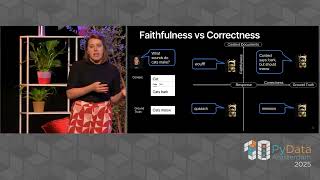
How to Keep Your LLM Chatbots Real: A Metrics Survival Guide

In this brave new world of vibe coding and YOLO-to-prod mentality, let’s take a step back and keep things grounded (pun intended). None of us would ever deploy a classical ML model to production without clearly defined metrics and proper evaluation, so let's talk about methodologies for measuring performance of LLM-powered chatbots. Think of retriever recall, answer relevancy, correctness, faithfulness and hallucination rates. With the wild west of metric standards still in full swing, I’ll guide you through the challenges of curating a synthetic test set, and selecting suitable metrics and open-source packages that help evaluating your use case. Everything is possible, from simple LLM-as-a-judge approaches like those inherent to many packages like MLFLow now up to complex multi-step quantification approaches with Ragas. If you work in the GenAI space or with LLM-powered chatbots, this session is for you! Prior or background knowledge is of advantage, but not required.

Recently, the integration of Generative AI (GenAI) technologies into both our personal and professional lives has surged. In most organizations, the deployment of GenAI applications is on the rise, and this trend is expected to continue in the foreseeable future. Evaluating GenAI systems presents unique challenges not present in traditional ML. The main peculiarity is the absence of ground truth for textual metrics such as: text clarity, location extraction accuracy, factual accuracy and so on. Nevertheless the non-negligible model serving cost demands an even more thorough evaluation of the system to be deployed in production.

Defining the metric ground truth is a costly and time consuming process requiring human annotation. To address this, we are going to present how to evaluate LLM-based applications by leveraging LLMs themselves as evaluators. Moreover we are going to outline the complexities and evaluation methods for LLM-based Agents which operate with autonomy and present further evaluation challenges. Lastly, we will explore the critical role of evaluation in the GenAI lifecycle and outline the steps taken to integrate these processes seamlessly.

Whether you are an AI practitioner, user or enthusiast, join us to gain insights into the future of GenAI evaluation and its impact on enhancing application performance.

Model Context Protocol: Principles and Practice

Large‑language‑model agents are only as useful as the context and tools they can reach.

Anthropic’s Model Context Protocol (MCP) proposes a universal, bidirectional interface that turns every external system—SQL databases, Slack, Git, web browsers, even your local file‑system—into first‑class “context providers.”

In just 30 minutes we’ll step from high‑level buzzwords to hands‑on engineering details:

  • How MCP’s JSON‑RPC message format, streaming channels, and version‑negotiation work under the hood.
  • Why per‑tool sandboxing via isolated client processes hardens security (and what happens when an LLM tries rm ‑rf /).
  • Techniques for hierarchical context retrieval that stretch a model’s effective window beyond token limits.
  • Real‑world patterns for accessing multiple tools—Postgres, Slack, GitHub—and plugging MCP into GenAI applications.

Expect code snippets and lessons from early adoption.

You’ll leave ready to wire your own services into any MCP‑aware model and level‑up your GenAI applications—without the N×M integration nightmare.

Image processing, artificial intelligence, and autonomous systems

In this talk, an overview of the field of image processing and the impact of artificial intelligence on this field are shown. Starting from the different tasks that can be performed with image processing, solutions using different AI technologies are shown, including the use of generative AI. Finally, the effect of AI for autonomous systems, and the challenges that are faced are discussed.

As enterprises scale their deployment of Generative AI (Gen AI), a central constraint has come into focus: the primary limitation is no longer model capability, but data infrastructure. Existing platforms, optimized for human interpretation and batch-oriented analytics, are misaligned with the operational realities of autonomous agents that consume, reason over, and act upon data continuously at machine scale. 

In this talk, Zhamak Dehghani — originator of the Data Mesh and a leading advocate for decentralized data architectures — presents a framework for data infrastructure designed explicitly for the AI-native era. She identifies the foundational capabilities required by Gen AI applications: embedded semantics, runtime computational policy enforcement, agent-centric, context-driven discovery.

The session contrasts the architectural demands of AI with the limitations of today’s fragmented, pipeline-driven systems—systems that rely heavily on human intervention and customized orchestration. Dehghani introduces autonomous data products as the next evolution: self-contained, self-governing services that continuously sense and respond to their environment. She offers an architectural deep dive and showcases their power with real-world use cases.  

Attendees will learn the architecture of “Data 3.0”, and how to both use GenAI to transform to this new architecture, and how this new architecture serves GenAI agents at scale.

This talk will introduce NVIDIA Inference Microservices (NIMs), a set of easy-to-use microservices designed to accelerate the deployment of generative AI models across various platforms, including clouds, data centers, and workstations. We will explore how NIMs simplify and speed up the deployment of AI applications to provide AI solutions for various industries.

Face To Face
by Sian Rodway (Manuka AI) , Sam Cremins (Kingsley Napley) , Leanne Lynch (ISS UK&I)

Data remains one of the most valuable assets a company has to guide its decision making. How that data is processed, used and presented is changing rapidly and with it the role and skills of data engineers. 

In this fireside chat, Manuka will explore the future of data engineering and the ongoing challenges of overcoming legacy constrains and governance with the latest breakthroughs in AI.

Expect a grounded discussion on:

• What “AI-ready” really means for data engineers

• Engineering through legacy constraints in a highly regulated environment

• Designing ingestion, orchestration, and observability that scale

• Embedding governance and quality without slowing delivery

• What’s next for data engineering in the age of generative AI

Whether you’re building pipelines, managing platforms, or designing modern data infrastructure, this is a rare behind-the-scenes look at how data engineering is evolving to meet the AI moment.

AI can enable you to achieve a lot for your business in terms of increased revenue, more efficient operations, and reduced risk. However, most organisations are not getting the traction or the value. 

We’ll look at how you get traction, moving from concept to value and everything in between. Referring to Generative AI and Agentic AI. You’ll also understand that starting with a project is a mistake and will stop you scaling and growing your capabilities. 

You’ll get an understanding of a framework for identifying and aligning AI activities to your business strategy. Using a proven approach to enable you to identify and prioritise projects with the best impact and greatest chance of success, which in turn will generate most value for you

You’ll also gain an understanding of how you need to organise yourself and manage your data to ensure the success of AI.

Deepak has building AI systems since 2014 starting with a Logistic Regression based model to now building Gen AI based systems in 2025. His talk will feature both the technical, business and human aspects of the AI systems he has built and contrast and compare them over the years. The intention is to peek into what could be possible in the future, keeping the past in mind. 

The term 'agentic AI' is all the rage these days, but there's still not much clarity around what it means. We'll walk through the basic building blocks of these agentic AI systems - predictive AI, generative AI, and workflow automation - and discuss why it's harder (and more important) than ever to ensure a trusted, enterprise-grade, and secure data backbone to get the reliable and trusted solutions our end-users are looking for. We'll also touch on market trends where we see the technology and capabilities evolving in the coming months.

Face To Face
by Sebastian Weir (IBM Consulting)

Agentic AI—systems that autonomously set goals, make decisions, and execute multi-step business processes—is transforming the enterprise, unlocking new levels of productivity. But with greater autonomy comes greater risk, as agentic AI amplifies the challenges of traditional and generative AI by increasing agency.

In this session, attendees will learn how to govern agentic AI with trust and transparency, enabling innovation without compromising safety. The speaker will discuss how targeted controls—enabled by the right tools and frameworks at the right time—can keep pace with fast-moving technology. Real-world case studies will illustrate how leading organizations are successfully managing agentic AI to transform workflows, boost productivity, and scale responsibly.

75% of GenAI projects fail to scale—not because the models lack sophistication, but because they’re built on fragmented data. If your systems don’t know who they're talking about, how can your AI deliver reliable insights?

This talk unveils how real-time Entity Resolution (ER) is becoming the silent engine behind trusted, AI-ready data architecture. We will discuss how organizations across financial services, public safety, and digital platforms are embedding ER into modern data stacks—delivering identity clarity, regulatory confidence, and faster outcomes without the drag of legacy MDM.

You’ll learn:

  • Why ER is foundational for AI trust, governance, and analytics
  • Patterns for embedding ER into streaming and event-driven architectures
  • How ecosystem partners and data platforms are amplifying ER value
  • How to build trust at the entity level—without slowing down innovation

Whether you’re modernizing architecture, launching AI programs, or tightening compliance, this session will equip you to embed trust from the ground up.

Sound AI outcomes start with trusted, high-quality data and delivering it efficiently is now a core part of every data and AI strategy. In this session, we’ll discuss how AI-supportive capabilities such as autonomous data catalogs, unstructured metadata ingestion and automated data trust scoring are transforming how organizations deliver AI-ready data products at scale with less hands-on staff involvement.

You’ll see how GenAI and agentic AI can accelerate reliable data delivery at every stage, from identifying and fixing data issues to building semantic business layers that give your AI models the context-rich inputs needed for success. We’ll also explore how agentic AI enables self-updating catalogs, proactive data quality monitoring, and automated remediation to free your teams to focus on innovation instead of maintenance.

If you’re shaping your organization’s data and AI strategy as a CDO, CDAIO, CIO, or data leader, this is your blueprint to operationalizing trusted, governed, and AI-ready data for every initiative, faster and smarter.

SAP Business Data Cloud is a fully managed solution that unifies and governs all SAP data while seamlessly integrating with third-party sources. With SAP Business Data Cloud, organisations can accelerate decision-making by empowering business users to make more impactful choices. It also provides a trusted foundation for AI, ensuring that data across applications and operations is reliable, responsible, and relevant—enabling organisations to harness the full potential of generative AI.