talk-data.com talk-data.com

Topic

IBM

technology cloud ai

39

tagged

Activity Trend

26 peak/qtr
2020-Q1 2026-Q1

Activities

Showing filtered results

Filtering by: O'Reilly Data Science Books ×
The Well-Grounded Data Analyst

Complete eight data science projects that lock in important real-world skills—along with a practical process you can use to learn any new technique quickly and efficiently. Data analysts need to be problem solvers—and The Well-Grounded Data Analyst will teach you how to solve the most common problems you'll face in industry. You'll explore eight scenarios that your class or bootcamp won’t have covered, so you can accomplish what your boss is asking for. In The Well-Grounded Data Analyst you'll learn: High-value skills to tackle specific analytical problems Deconstructing problems for faster, practical solutions Data modeling, PDF data extraction, and categorical data manipulation Handling vague metrics, deciphering inherited projects, and defining customer records The Well-Grounded Data Analyst is for junior and early-career data analysts looking to supplement their foundational data skills with real-world problem solving. As you explore each project, you'll also master a proven process for quickly learning new skills developed by author and Half Stack Data Science podcast host David Asboth. You'll learn how to determine a minimum viable answer for your stakeholders, identify and obtain the data you need to deliver, and reliably present and iterate on your findings. The book can be read cover-to-cover or opened to the chapter most relevant to your current challenges. About the Technology Real world data analysis is messy. Success requires tackling challenges like unreliable data sources, ambiguous requests, and incompatible formats—often with limited guidance. This book goes beyond the clean, structured examples you see in classrooms and bootcamps, offering a step-by-step framework you can use to confidently solve any data analysis problem like a pro. About the Book The Well-Grounded Data Analyst introduces you to eight scenarios that every data analyst is bound to face. You’ll practice author David Asboth’s results-oriented approach as you model data by identifying customer records, navigate poorly-defined metrics, extract data from PDFs, and much more! It also teaches you how to take over incomplete projects and create rapid prototypes with real data. Along the way, you’ll build an impressive portfolio of projects you can showcase at your next interview. What's Inside Deconstructing problems Handling vague metrics Data modeling Categorical data manipulation About the Reader For early-career data scientists. About the Author David Asboth is a data generalist educator, and software architect. He co-hosts the Half Stack Data Science podcast. Quotes Well reasoned and well written, with approaches to solve many sorts of data analysis problems. - Naomi Ceder, Fellow of the Python Software Foundation An excellent resource for any aspiring data scientist! - Andrew R. Freed, IBM David’s clear and repeatable framework will give you confidence to tackle open-ended stakeholder requests and reach an answer much faster! - Shaun McGirr, DevOn Software Services A book version of shadowing a senior data analyst while they explain handling frequent data problems at work, including all the ugly gotchas. - Randy Au, Google
LLMs and Generative AI for Healthcare

Large language models (LLMs) and generative AI are rapidly changing the healthcare industry. These technologies have the potential to revolutionize healthcare by improving the efficiency, accuracy, and personalization of care. This practical book shows healthcare leaders, researchers, data scientists, and AI engineers the potential of LLMs and generative AI today and in the future, using storytelling and illustrative use cases in healthcare. Authors Kerrie Holley, former Google healthcare professionals, guide you through the transformative potential of large language models (LLMs) and generative AI in healthcare. From personalized patient care and clinical decision support to drug discovery and public health applications, this comprehensive exploration covers real-world uses and future possibilities of LLMs and generative AI in healthcare. With this book, you will: Understand the promise and challenges of LLMs in healthcare Learn the inner workings of LLMs and generative AI Explore automation of healthcare use cases for improved operations and patient care using LLMs Dive into patient experiences and clinical decision-making using generative AI Review future applications in pharmaceutical R&D, public health, and genomics Understand ethical considerations and responsible development of LLMs in healthcare "The authors illustrate generative's impact on drug development, presenting real-world examples of its ability to accelerate processes and improve outcomes across the pharmaceutical industry." --Harsh Pandey, VP, Data Analytics & Business Insights, Medidata-Dassault Kerrie Holley is a retired Google tech executive, IBM Fellow, and VP/CTO at Cisco. Holley's extensive experience includes serving as the first Technology Fellow at United Health Group (UHG), Optum, where he focused on advancing and applying AI, deep learning, and natural language processing in healthcare. Manish Mathur brings over two decades of expertise at the crossroads of healthcare and technology. A former executive at Google and Johnson & Johnson, he now serves as an independent consultant and advisor. He guides payers, providers, and life sciences companies in crafting cutting-edge healthcare solutions.

Programming in MATLAB ®: A Problem-Solving Approach by Pearson

MATLAB provides an interactive programming interface for numerical computation and data visualization making it the default framework used for analysis, design and research in many domains of science and industry. Programming in MATLAB is intended as an aid to engineers and scientists with no prior programming expertise. The book focuses on the systematic development of practical programming skills through MATLAB language constructs, backed by several well-designed examples and exercises. Designed to be as much a MATLAB reference tool for researchers in varied fields as it is a guide for undergraduate readers, the book builds on the concepts sequentially as it progresses through the chapters. Each chapter is complete, independent of the book's remaining contents. Thus, for teaching purposes, one can suitably the relevant portions.

About The Authors –

Ramnarayan Patel did his Ph.D. in the area of power systems from Indian Institute of Technology Delhi, in 2003. He received his M.Tech. from IIT Delhi and a graduate degree in electrical engineering from SGSITS, Indore. His manifold fields of interest include power system stability, optimization in electric power systems, application of artificial intelligence techniques, design of intelligent controllers and renewable energy systems. He has over 14 years of hands-on experience working with MATLAB and Simulink, as an instructor, researcher and trainer.

Dr Patel has served as faculty in the electrical engineering department at IIT Roorkee and at the Birla Institute of Technology and Science, Pilani. Currently, he is Professorin the Department of Electrical and Electronics Engineering, Shri Shankaracharya Technical Campus (SSGI), Bhilai, and has many publications to his credit in various international journals of repute. He has presented his research at various international conferences and organized many workshops and conferences within the country. He is a recipient of the prestigious ‘Career Award for Young Teachers’ from All India Council for Technical Education (AICTE), New Delhi. Dr Patel has successfully handled many research projects funded by AICTE, New Delhi, and Department of Science and Technology, Government of India, New Delhi.

Ankush Mittal received his B.Tech. in computer science and engineering from Indian Institute of Technology Delhi in 1996, and later, his Master’s degree in 1998 from the same institute. He received his Ph.D. degree in electrical and computer engineering from the National University of Singapore in 2001 and was a faculty member in the Department of Computer Science, National University of Singapore, for two years. He has also served as Associate Professor at IIT Roorkee. Currently, he is Director (Research) at Graphic Era University, Dehradun.

Dr Mittal has contributed more than 250 research papers in journals and conferences of high repute with significant impact in academic circles. A dedicated teacher and active researcher, he is a recipient of the IIT Roorkee Outstanding Teacher Award and the IBM Faculty Award. He has taught more than 20 courses and worked on MATLAB extensively since his Ph.D.

Book Contents –

  1. Introduction to MATLAB® Desktop
  2. Matrix Operations and Applications
  3. MATLAB® Graphics and Plotting
  4. Control Structures, Loops, and File Handling
  5. Scripts and Functions
  6. Numerical Methods, Calculus, and Statistics
  7. Using Memory Efficiently
  8. Using the MATLAB® Debugger and Profiler
  9. Efficient Coding Using Vectorization Technique
  10. Precision and Errors
  11. Advanced Concepts in MATLAB®
  12. Modeling with Simulink®
  13. Digital Image Processing Index
SPSS Statistics Workbook For Dummies

Practice making sense of data with IBM’s SPSS Statistics software SPSS Statistics Workbook For Dummies gives you the practice you need to navigate the leading statistical software suite. Data management and analysis, advanced analytics, business intelligence—SPSS is a powerhouse of a research platform, and this book helps you master the fundamentals and analyze data more effectively. You’ll work through practice problems that help you understand the calculations you need to perform, complete predictive analyses, and produce informative graphs. This workbook gives you hands-on exercises to hone your statistical analysis skills with SPSS Statistics 28. Plus, explanations and insider tips help you navigate the software with ease. Practical and easy-to-understand, in classic Dummies style. Practice organizing, analyzing, and graphing data Learn to write, edit, and format SPSS syntax Explore the upgrades and features new to SPSS 28 Try your hand at advanced data analysis procedures For academics using SPSS for research, business analysts and market researchers looking to extract valuable insights from data, and anyone with a hankering for more stats practice.

Data Science Bookcamp

Learn data science with Python by building five real-world projects! Experiment with card game predictions, tracking disease outbreaks, and more, as you build a flexible and intuitive understanding of data science. In Data Science Bookcamp you will learn: Techniques for computing and plotting probabilities Statistical analysis using Scipy How to organize datasets with clustering algorithms How to visualize complex multi-variable datasets How to train a decision tree machine learning algorithm In Data Science Bookcamp you’ll test and build your knowledge of Python with the kind of open-ended problems that professional data scientists work on every day. Downloadable data sets and thoroughly-explained solutions help you lock in what you’ve learned, building your confidence and making you ready for an exciting new data science career. About the Technology A data science project has a lot of moving parts, and it takes practice and skill to get all the code, algorithms, datasets, formats, and visualizations working together harmoniously. This unique book guides you through five realistic projects, including tracking disease outbreaks from news headlines, analyzing social networks, and finding relevant patterns in ad click data. About the Book Data Science Bookcamp doesn’t stop with surface-level theory and toy examples. As you work through each project, you’ll learn how to troubleshoot common problems like missing data, messy data, and algorithms that don’t quite fit the model you’re building. You’ll appreciate the detailed setup instructions and the fully explained solutions that highlight common failure points. In the end, you’ll be confident in your skills because you can see the results. What's Inside Web scraping Organize datasets with clustering algorithms Visualize complex multi-variable datasets Train a decision tree machine learning algorithm About the Reader For readers who know the basics of Python. No prior data science or machine learning skills required. About the Author Leonard Apeltsin is the Head of Data Science at Anomaly, where his team applies advanced analytics to uncover healthcare fraud, waste, and abuse. Quotes Valuable and accessible… a solid foundation for anyone aspiring to be a data scientist. - Amaresh Rajasekharan, IBM Corporation Really good introduction of statistical data science concepts. A must-have for every beginner! - Simone Sguazza, University of Applied Sciences and Arts of Southern Switzerland A full-fledged tutorial in data science including common Python libraries and language tricks! - Jean-François Morin, Laval University This book is a complete package for understanding how the data science process works end to end. - Ayon Roy, Internshala

IBM SPSS Essentials, 2nd Edition

Master the fundamentals of SPSS with this newly updated and instructive resource The newly and thoroughly revised Second Edition of SPSS Essentials delivers a comprehensive guide for students in the social sciences who wish to learn how to use the Statistical Package for the Social Sciences (SPSS) for the effective collection, management, and analysis of data. The accomplished researchers and authors provide readers with the practical nuts and bolts of SPSS usage and data entry, with a particular emphasis on managing and manipulating data. The book offers an introduction to SPSS, how to navigate it, and a discussion of how to understand the data the reader is working with. It also covers inferential statistics, including topics like hypothesis testing, one-sample Z-testing, T-testing, ANOVAs, correlations, and regression. Five unique appendices round out the text, providing readers with discussions of dealing with real-world data, troubleshooting, advanced data manipulations, and new workbook activities. SPSS Essentials offers a wide variety of features, including: A revised chapter order, designed to match the pacing and content of typical undergraduate statistics classes An explanation of when particular inferential statistics are appropriate for use, given the nature of the data being worked with Additional material on understanding your data sample, including discussions of SPSS output and how to find the most relevant information A companion website offering additional problem sets, complete with answers Perfect for undergraduate students of the social sciences who are just getting started with SPSS, SPSS Essentials also belongs on the bookshelves of advanced placement high school students and practitioners in social science who want to brush up on the fundamentals of this powerful and flexible software package.

Advanced Analytics in Power BI with R and Python: Ingesting, Transforming, Visualizing

This easy-to-follow guide provides R and Python recipes to help you learn and apply the top languages in the field of data analytics to your work in Microsoft Power BI. Data analytics expert and author Ryan Wade shows you how to use R and Python to perform tasks that are extremely hard, if not impossible, to do using native Power BI tools. For example, you will learn to score Power BI data using custom data science models and powerful models from Microsoft Cognitive Services. The R and Python languages are powerful complements to Power BI. They enable advanced data transformation techniques that are difficult to perform in Power BI in its default configuration but become easier by leveraging the capabilities of R and Python. If you are a business analyst, data analyst, or a data scientist who wants to push Power BI and transform it from being just a business intelligence tool into an advanced data analytics tool, then this is the book to help you do that. What You Will Learn Create advanced data visualizations via R using the ggplot2 package Ingest data using R and Python to overcome some limitations of Power Query Apply machine learning models to your data using R and Python without the need of Power BI premium capacity Incorporate advanced AI in Power BI without the need of Power BI premium capacity via Microsoft Cognitive Services, IBM Watson Natural Language Understanding, and pre-trained models in SQL Server Machine Learning Services Perform advanced string manipulations not otherwise possible in Power BI using R and Python Who This Book Is For Power users, data analysts, and data scientists who want to go beyond Power BI’s built-in functionality to create advanced visualizations, transform data in ways not otherwise supported, and automate data ingestion from sources such as SQL Server and Excel in a more concise way

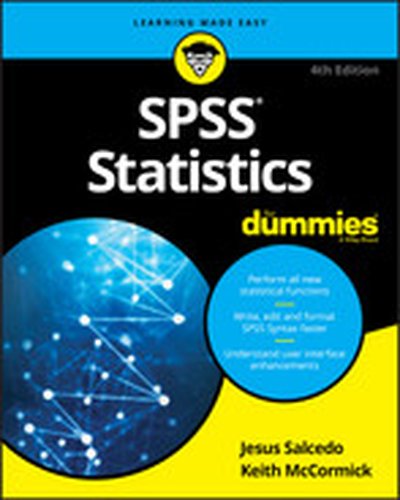
SPSS Statistics For Dummies, 4th Edition

The fun and friendly guide to mastering IBM’s Statistical Package for the Social Sciences Written by an author team with a combined 55 years of experience using SPSS, this updated guide takes the guesswork out of the subject and helps you get the most out of using the leader in predictive analysis. Covering the latest release and updates to SPSS 27.0, and including more than 150 pages of basic statistical theory, it helps you understand the mechanics behind the calculations, perform predictive analysis, produce informative graphs, and more. You’ll even dabble in programming as you expand SPSS functionality to suit your specific needs. Master the fundamental mechanics of SPSS Learn how to get data into and out of the program Graph and analyze your data more accurately and efficiently Program SPSS with Command Syntax Get ready to start handling data like a pro—with step-by-step instruction and expert advice!

Data Science for Business and Decision Making

Data Science for Business and Decision Making covers both statistics and operations research while most competing textbooks focus on one or the other. As a result, the book more clearly defines the principles of business analytics for those who want to apply quantitative methods in their work. Its emphasis reflects the importance of regression, optimization and simulation for practitioners of business analytics. Each chapter uses a didactic format that is followed by exercises and answers. Freely-accessible datasets enable students and professionals to work with Excel, Stata Statistical Software®, and IBM SPSS Statistics Software®. Combines statistics and operations research modeling to teach the principles of business analytics Written for students who want to apply statistics, optimization and multivariate modeling to gain competitive advantages in business Shows how powerful software packages, such as SPSS and Stata, can create graphical and numerical outputs

Mathematical Statistics

Explores mathematical statistics in its entirety—from the fundamentals to modern methods This book introduces readers to point estimation, confidence intervals, and statistical tests. Based on the general theory of linear models, it provides an in-depth overview of the following: analysis of variance (ANOVA) for models with fixed, random, and mixed effects; regression analysis is also first presented for linear models with fixed, random, and mixed effects before being expanded to nonlinear models; statistical multi-decision problems like statistical selection procedures (Bechhofer and Gupta) and sequential tests; and design of experiments from a mathematical-statistical point of view. Most analysis methods have been supplemented by formulae for minimal sample sizes. The chapters also contain exercises with hints for solutions. Translated from the successful German text, Mathematical Statistics requires knowledge of probability theory (combinatorics, probability distributions, functions and sequences of random variables), which is typically taught in the earlier semesters of scientific and mathematical study courses. It teaches readers all about statistical analysis and covers the design of experiments. The book also describes optimal allocation in the chapters on regression analysis. Additionally, it features a chapter devoted solely to experimental designs. Classroom-tested with exercises included Practice-oriented (taken from day-to-day statistical work of the authors) Includes further studies including design of experiments and sample sizing Presents and uses IBM SPSS Statistics 24 for practical calculations of data Mathematical Statistics is a recommended text for advanced students and practitioners of math, probability, and statistics.

IBM SPSS Modeler Essentials

Learn how to leverage IBM SPSS Modeler for your data mining and predictive analytics needs in this comprehensive guide. With step-by-step instructions, you'll acquire the skills to import, clean, analyze, and model your data using this robust platform. By the end, you'll be equipped to uncover patterns and trends, enabling data-driven decision-making confidently. What this Book will help me do Understand the fundamentals of data mining and the visual programming interface of IBM SPSS Modeler. Prepare, clean, and preprocess data effectively for analysis and modeling. Build robust predictive models such as decision trees using best practices. Evaluate the performance of your analytical models to ensure accuracy and reliability. Export resulting analyses to apply insights to real-world data projects. Author(s) Keith McCormick and Jesus Salcedo are accomplished professionals in data analytics and statistical modeling. With extensive experience in consulting and teaching, they have guided many in mastering IBM SPSS Modeler through both hands-on workshops and written material. Their approachable teaching style and commitment to clarity ensure accessibility for learners. Who is it for? This book is designed for beginner users of IBM SPSS Modeler who wish to gain practical and actionable skills in data analytics. If you're a data enthusiast looking to explore predictive analytics or a professional eager to discover the insights hidden in your organizational data, this book is for you. A basic understanding of data mining concepts is advantageous but not required. This resource will set any novice on the path toward expert-level comprehension and application.

Data Analysis with IBM SPSS Statistics

"Data Analysis with IBM SPSS Statistics" is a comprehensive guide designed to help you master IBM SPSS Statistics for performing robust statistical analyses. Through a practical approach, the book delves into critical techniques like data visualization, regression analysis, and hypothesis testing, enabling you to uncover patterns, make informed decisions, and enhance data interpretation. What this Book will help me do Set up and configure IBM SPSS Statistics for effective data analysis workflows. Perform data cleaning and preparation, including addressing missing data and restructuring datasets. Master statistical techniques such as ANOVA, regression analysis, and clustering to draw insights from data. Generate intuitive visualizations like charts and graphs to communicate findings effectively. Build predictive models and evaluate their effectiveness for decision-making purposes. Author(s) Ken Stehlik-Barry and Anthony Babinec are seasoned data analysts and IBM SPSS experts with extensive experience in statistical methodologies and data science. They have a knack for translating complex concepts into accessible lessons, making this book an ideal resource for learners aiming to build their SPSS aptitude. Their expertise ensures a well-rounded learning journey. Who is it for? This book is tailored for data analysts and researchers who need to analyze and interpret data effectively using IBM SPSS Statistics. Readers should have basic familiarity with statistical concepts, making it ideal for those with a foundational understanding of statistics. If you aim to grasp practical applications of SPSS for real-world data challenges, this book is for you.

Breaking Data Science Open

Over the past decade, data science has come out of the back office to become a force of change across the entire organization. At the forefront of this change is the open data science movement that advocates the use of open source tools in a powerful, connected ecosystem. This report explores how open data science can help your organization break free from the shackles of proprietary tools, embrace a more open and collaborative work style, and unleash new intelligent applications quickly. Authors Michele Chambers and Christine Doig explain how open source tools have helped bring about many facets of the data science evolution, including collaboration, self-service, and deployment. But you’ll discover that open data science is about more than tools; it’s about a new way of working as an organization. Learn how data science—particularly open data science—has become part of everyday business Understand how open data science engages people from other disciplines, not just statisticians Examine tools and practices that enable data science to be open across technical, operational, and organizational aspects Learn benefits of open data science, including rich resources, agility, transparency, and collective intelligence Explore case studies that demonstrate different ways to implement open data science Discover how open data science can help you break down department barriers and make bold market moves Michele Chambers, Chief Marketing Officer and VP Products at Continuum Analytics, is an entrepreneurial executive with over 25 years of industry experience. Prior to Continuum Analytics, Michele held executive leadership roles at several database and analytic companies, including Netezza, IBM, Revolution Analytics, MemSQL, and RapidMiner. Christine Doig is a senior data scientist at Continuum Analytics, where she's worked on several projects, including MEMEX, a DARPA-funded open data science project to help stop human trafficking. She has 5+ years of experience in analytics, operations research, and machine learning in a variety of industries.

Effective CRM using Predictive Analytics

A step-by-step guide to data mining applications in CRM. Following a handbook approach, this book bridges the gap between analytics and their use in everyday marketing, providing guidance on solving real business problems using data mining techniques. The book is organized into three parts. Part one provides a methodological roadmap, covering both the business and the technical aspects. The data mining process is presented in detail along with specific guidelines for the development of optimized acquisition, cross/ deep/ up selling and retention campaigns, as well as effective customer segmentation schemes. In part two, some of the most useful data mining algorithms are explained in a simple and comprehensive way for business users with no technical expertise. Part three is packed with real world case studies which employ the use of three leading data mining tools: IBM SPSS Modeler, RapidMiner and Data Mining for Excel. Case studies from industries including banking, retail and telecommunications are presented in detail so as to serve as templates for developing similar applications. Key Features: Includes numerous real-world case studies which are presented step by step, demystifying the usage of data mining models and clarifying all the methodological issues. Topics are presented with the use of three leading data mining tools: IBM SPSS Modeler, RapidMiner and Data Mining for Excel. Accompanied by a website featuring material from each case study, including datasets and relevant code. Combining data mining and business knowledge, this practical book provides all the necessary information for designing, setting up, executing and deploying data mining techniques in CRM. Effective CRM using Predictive Analytics will benefit data mining practitioners and consultants, data analysts, statisticians, and CRM officers. The book will also be useful to academics and students interested in applied data mining.

Predictive Analytics, Revised and Updated

"Mesmerizing & fascinating..." — The Seattle Post-Intelligencer "The Freakonomics of big data." —Stein Kretsinger, founding executive of Advertising.com Award-winning | Used by over 30 universities | Translated into 9 languages An introduction for everyone. In this rich, fascinating — surprisingly accessible — introduction, leading expert Eric Siegel reveals how predictive analytics works, and how it affects everyone every day. Rather than a “how to” for hands-on techies, the book serves lay readers and experts alike by covering new case studies and the latest state-of-the-art techniques. Prediction is booming. It reinvents industries and runs the world. Companies, governments, law enforcement, hospitals, and universities are seizing upon the power. These institutions predict whether you're going to click, buy, lie, or die. Why? For good reason: predicting human behavior combats risk, boosts sales, fortifies healthcare, streamlines manufacturing, conquers spam, optimizes social networks, toughens crime fighting, and wins elections. How? Prediction is powered by the world's most potent, flourishing unnatural resource: data. Accumulated in large part as the by-product of routine tasks, data is the unsalted, flavorless residue deposited en masse as organizations churn away. Surprise! This heap of refuse is a gold mine. Big data embodies an extraordinary wealth of experience from which to learn. unleashes the power of data. With this technology Predictive Analytics , the computer literally learns from data how to predict the future behavior of individuals. Perfect prediction is not possible, but putting odds on the future drives millions of decisions more effectively, determining whom to call, mail, investigate, incarcerate, set up on a date, or medicate. In this lucid, captivating introduction — now in its Revised and Updated edition — former Columbia University professor and Predictive Analytics World founder Eric Siegel reveals the power and perils of prediction: What type of mortgage risk Chase Bank predicted before the recession. Predicting which people will drop out of school, cancel a subscription, or get divorced before they even know it themselves. Why early retirement predicts a shorter life expectancy and vegetarians miss fewer flights. Five reasons why organizations predict death — including one health insurance company. How U.S. Bank and Obama for America calculated — and Hillary for America 2016 plans to calculate — the way to most strongly persuade each individual. Why the NSA wants all your data: machine learning supercomputers to fight terrorism. How IBM's Watson computer used predictive modeling to answer questions and beat the human champs on TV's Jeopardy! How companies ascertain untold, private truths — how Target figures out you're pregnant and Hewlett-Packard deduces you're about to quit your job. How judges and parole boards rely on crime-predicting computers to decide how long convicts remain in prison. 182 examples from Airbnb, the BBC, Citibank, ConEd, Facebook, Ford, Google, the IRS, LinkedIn, Match.com, MTV, Netflix, PayPal, Pfizer, Spotify, Uber, UPS, Wikipedia, and more. How does predictive analytics work? This jam-packed book satisfies by demystifying the intriguing science under the hood. For future hands-on practitioners pursuing a career in the field, it sets a strong foundation, delivers the prerequisite knowledge, and whets your appetite for more. A truly omnipresent science, predictive analytics constantly affects our daily lives. Whether

IBM Cognos Dynamic Cubes

IBM® Cognos® Business Intelligence (BI) provides a proven enterprise BI platform with an open data strategy. Cognos BI provides customers with the ability to use data from any source, package it into a business model, and make it available to consumers in various interfaces that are tailored to the task. IBM Cognos Dynamic Cubes complements the existing Cognos BI capabilities and continues the tradition of an open data model. It focuses on extending the scalability of the IBM Cognos platform to enable speed-of-thought analytics over terabytes of enterprise data, without having to invest in a new data warehouse appliance. This capability adds a new level of query intelligence so you can unleash the power of your enterprise data warehouse. This IBM Redbooks® publication addresses IBM Cognos Business Intelligence V10.2.2 and specifically, the IBM Cognos Dynamic Cubes capabilities. This book can help you in the following ways: Understand core features of the Cognos Dynamic Cubes capabilities of Cognos BI V10.2 Learn by example with practical scenarios by using the IBM Cognos samples This book uses fictional business scenarios to demonstrate the power and capabilities of IBM Cognos Dynamic Cubes. It primarily focuses on the roles of the modeler, administrator, and IT architect.

Analytics Across the Enterprise: How IBM Realizes Business Value from Big Data and Analytics

How to Transform Your Organization with Analytics: Insider Lessons from IBM’s Pioneering Experience Analytics is not just a technology: It is a better way to do business. Using analytics, you can systematically inform human judgment with data-driven insight. This doesn’t just improve decision-making: It also enables greater innovation and creativity in support of strategy. Your transformation won’t happen overnight; however, it is absolutely achievable, and the rewards are immense. This book demystifies your analytics journey by showing you how IBM has successfully leveraged analytics across the enterprise, worldwide. Three of IBM’s pioneering analytics practitioners share invaluable real-world perspectives on what does and doesn’t work and how you can start or accelerate your own transformation. This book provides an essential framework for becoming a smarter enterprise and shows through 31 case studies how IBM has derived value from analytics throughout its business. Coverage Includes Creating a smarter workforce through big data and analytics More effectively optimizing supply chain processes Systematically improving financial forecasting Managing financial risk, increasing operational efficiency, and creating business value Reaching more B2B or B2C customers and deepening their engagement Optimizing manufacturing and product management processes Deploying your sales organization to increase revenue and effectiveness Achieving new levels of excellence in services delivery and reducing risk Transforming IT to enable wider use of analytics “Measuring the immeasurable” and filling gaps in imperfect data Whatever your industry or role, whether a current or future leader, analytics can make you smarter and more competitive. Analytics Across the Enterprise shows how IBM did it--and how you can, too. Learn more about IBM Analytics

Nonparametric Statistics for Social and Behavioral Sciences

Incorporating a hands-on pedagogical approach, this text presents the concepts, principles, and methods used in performing many nonparametric procedures. It also demonstrates practical applications of the most common nonparametric procedures using IBM's SPSS software. The text is the only current nonparametric book written specifically for students in the behavioral and social sciences. With examples of real-life research problems, it emphasizes sound research designs, appropriate statistical analyses, and accurate interpretations of results.

IBM SPSS Modeler Cookbook

"IBM SPSS Modeler Cookbook" is your practical guide to mastering data mining with IBM SPSS Modeler. This comprehensive book takes you beyond the basics, offering expert insights, time-saving techniques, and powerful workflows to grow your skills and elevate your analytical abilities. You will learn to apply the CRISP-DM methodology, efficiently prepare and explore data, build advanced models, and confidently incorporate analytical results into your business decisions. What this Book will help me do Effectively apply the CRISP-DM standard process to organize your data mining projects. Leverage efficient techniques for data extraction, transformation, and preparation. Develop and evaluate predictive models for practical applications in your organization. Enhance your models by utilizing advanced features and expert tips. Automate and streamline your data mining process with scripting for ultimate control. Author(s) Keith McCormick and None Abbott are seasoned data mining professionals with deep expertise in IBM SPSS Modeler and predictive analytics. Together, they have extensive experience in consulting, training, and applying advanced analytical techniques across industries. Through their approachable and insightful writing style, they share practical knowledge and expert workflows to empower readers. Who is it for? This book is designed for individuals who have basic experience with IBM SPSS Modeler and aspire to deepen their expertise. Whether you are a data analyst looking to advance your analytical capabilities or a professional aiming to integrate data-driven solutions into your organization, this book provides the knowledge and practical guidance you need to take the next step in your data mining journey.

Risk Scoring for a Loan Application on IBM System z: Running IBM SPSS Real-Time Analytics

When ricocheting a solution that involves analytics, the mainframe might not be the first platform that comes to mind. However, the IBM® System z® group has developed some innovative solutions that include the well-respected mainframe benefits. This book describes a workshop that demonstrates the use of real-time advanced analytics for enhancing core banking decisions using a loan origination example. The workshop is a live hands-on experience of the entire process from analytics modeling to deployment of real-time scoring services for use on IBM z/OS®. In this IBM Redbooks® publication, we include a facilitator guide chapter as well as a participant guide chapter. The facilitator guide includes information about the preparation, such as the needed material, resources, and steps to set up and run this workshop. The participant guide shows step-by-step the tasks for a successful learning experience. The goal of the first hands-on exercise is to learn how to use IBM SPSS® Modeler for Analytics modeling. This provides the basis for the next exercise "Configuring risk assessment in SPSS Decision Management". In the third exercise, the participant experiences how real-time scoring can be implemented on a System z. This publication is written for consultants, IT architects, and IT administrators who want to become familiar with SPSS and analytics solutions on the System z.