Despite the popularity of retrieval-augmented generation, organizations are struggling to optimize large language model applications based on RAG. Attend this session to get suggestions and recommendations on improving your RAG solution, LLMOps for RAG systems and scaling considerations.
 talk-data.com
Topic
LLM
Large Language Models (LLM)
nlp
ai
machine_learning
1405
tagged
Activity Trend
158
peak/qtr
2020-Q1
2026-Q2
Top Events
This session is crucial for organizations aiming to maximize the utility of large language models by integrating internal data. Gain actionable insights and practical solutions to improve model performance and business outcomes. Ideal for technology leaders, data scientists and business strategists looking to harness the full power of LLMs.
AI's potential depends on quality data. Many struggle with AI due to data governance or slow processes, especially with unstructured data. Join peers in discussing strategies for improving and governance to maximise AI potential, managing structured and unstructured data, connecting LLMs with enterprise data and data security best practices.
As we enter an increasingly AI-driven world, it is becoming increasingly clear that leveraging the power of LLMs presents considerable challenges. Hallucinations, trust issues, and governance risks cause considerable concerns. This session will demonstrate how comprehensive and relevant metadata forms the foundation of data understanding and governance. You'll see how Ab Initio’s platform enables the automation of trusted, well-documented, and end-to-end governed data products, ensuring AI models operate with greater reliability and confidence.
In this podcast episode, we talked with Lavanya Gupta about Building a Strong Career in Data. About the Speaker: Lavanya is a Carnegie Mellon University (CMU) alumni of the Language Technologies Institute (LTI). She works as a Sr. AI/ML Applied Associate at JPMorgan Chase in their specialized Machine Learning Center of Excellence (MLCOE) vertical. Her latest research on long-context evaluation of LLMs was published in EMNLP 2024.
In addition to having a strong industrial research background of 5+ years, she is also an enthusiastic technical speaker. She has delivered talks at events such as Women in Data Science (WiDS) 2021, PyData, Illuminate AI 2021, TensorFlow User Group (TFUG), and MindHack! Summit. She also serves as a reviewer at top-tier NLP conferences (NeurIPS 2024, ICLR 2025, NAACL 2025). Additionally, through her collaborations with various prestigious organizations, like Anita BOrg and Women in Coding and Data Science (WiCDS), she is committed to mentoring aspiring machine learning enthusiasts.
In this episode, we talk about Lavanya Gupta’s journey from software engineer to AI researcher. She shares how hackathons sparked her passion for machine learning, her transition into NLP, and her current work benchmarking large language models in finance. Tune in for practical insights on building a strong data career and navigating the evolving AI landscape.
🕒 TIMECODES 00:00 Lavanya’s journey from software engineer to AI researcher 10:15 Benchmarking long context language models 12:36 Limitations of large context models in real domains 14:54 Handling large documents and publishing research in industry 19:45 Building a data science career: publications, motivation, and mentorship 25:01 Self-learning, hackathons, and networking 33:24 Community work and Kaggle projects 37:32 Mentorship and open-ended guidance 51:28 Building a strong data science portfolio 🔗 CONNECT WITH LAVANYALinkedIn - / lgupta18 🔗 CONNECT WITH DataTalksClub Join the community - https://datatalks.club/slack.html Subscribe to our Google calendar to have all our events in your calendar - https://calendar.google.com/calendar/... Check other upcoming events - https://lu.ma/dtc-events LinkedIn - / datatalks-club Twitter - / datatalksclub Website - https://datatalks.club/
In this episode, Conor talks about his recent experience with Cursor, Claude 3.7, Gemini 2.5 Pro and several C++ unit testing frameworks! Link to Episode 233 on WebsiteDiscuss this episode, leave a comment, or ask a question (on GitHub)Socials ADSP: The Podcast: TwitterConor Hoekstra: Twitter | BlueSky | MastodonShow Notes Date Generated: 2025-05-07 Date Released: 2025-05-09 GoogleTestboost/ext-utMinUnitDocTestIntro Song Info Miss You by Sarah Jansen https://soundcloud.com/sarahjansenmusic Creative Commons — Attribution 3.0 Unported — CC BY 3.0 Free Download / Stream: http://bit.ly/l-miss-you Music promoted by Audio Library https://youtu.be/iYYxnasvfx8
Takeaways Code2Story Pro turns Python code into engaging blog posts. Traditional documentation methods are often insufficient. Effective communication of code is crucial for collaboration. The tool allows users to select tone and emotion for their writing. Mukund built the tool out of frustration with documentation. The technical setup involves Streamlit and OpenAI's GPT-4. Users can generate blog posts in under 30 seconds. Future updates will include file uploads and image generation. The tool is aimed at helping developers share their work easily. Storytelling in coding can enhance career opportunities.
Blog: https://medium.com/data-science-collective/i-built-an-ai-tool-that-turns-any-python-code-into-an-emotionally-engaging-blog-post-f6d14daeddbd
Website: Subscribe for free access to the code: https://mukundansankar.substack.com/
Welcome to DataFramed Industry Roundups! In this series of episodes, Adel & Richie sit down to discuss the latest and greatest in data & AI. In this episode, we touch upon the launch of OpenAI’s O3 and O4-mini models, Meta’s rocky release of Llama 4, Google’s new agent tooling ecosystem, the growing arms race in AI, the latest from the Stanford AI Index report, the plausibility of AGI and superintelligence, how agents might evolve in the enterprise, global attitudes toward AI, and a deep dive into the speculative—but chilling—AI 2027 scenario. All that, Easter rave plans, and much more. Links Mentioned in the Show: Introducing OpenAI o3 and o4-miniThe Median: Scaling Models or Scaling People? Llama 4, A2A, and the State of AI in 2025LLama 4Google: Announcing the Agent2Agent Protocol (A2A)Stanford University's Human Centered AI Institute Releases 2025 AI Index ReportAI 2027Rewatch sessions from RADAR: Skills Edition New to DataCamp? Learn on the go using the DataCamp mobile appEmpower your business with world-class data and AI skills with DataCamp for business
Supported by Our Partners • Modal — The cloud platform for building AI applications • CodeRabbit — Cut code review time and bugs in half. Use the code PRAGMATIC to get one month free. — What happens when LLMs meet real-world codebases? In this episode of The Pragmatic Engineer, I am joined by Varun Mohan, CEO and Co-Founder of Windsurf. Varun talks me through the technical challenges of building an AI-native IDE (Windsurf) —and how these tools are changing the way software gets built. We discuss: • What building self-driving cars taught the Windsurf team about evaluating LLMs • How LLMs for text are missing capabilities for coding like “fill in the middle” • How Windsurf optimizes for latency • Windsurf’s culture of taking bets and learning from failure • Breakthroughs that led to Cascade (agentic capabilities) • Why the Windsurf teams build their LLMs • How non-dev employees at Windsurf build custom SaaS apps – with Windsurf! • How Windsurf empowers engineers to focus on more interesting problems • The skills that will remain valuable as AI takes over more of the codebase • And much more! — Timestamps (00:00) Intro (01:37) How Windsurf tests new models (08:25) Windsurf’s origin story (13:03) The current size and scope of Windsurf (16:04) The missing capabilities Windsurf uncovered in LLMs when used for coding (20:40) Windsurf’s work with fine-tuning inside companies (24:00) Challenges developers face with Windsurf and similar tools as codebases scale (27:06) Windsurf’s stack and an explanation of FedRAMP compliance (29:22) How Windsurf protects latency and the problems with local data that remain unsolved (33:40) Windsurf’s processes for indexing code (37:50) How Windsurf manages data (40:00) The pros and cons of embedding databases (42:15) “The split brain situation”—how Windsurf balances present and long-term (44:10) Why Windsurf embraces failure and the learnings that come from it (46:30) Breakthroughs that fueled Cascade (48:43) The insider’s developer mode that allows Windsurf to dogfood easily (50:00) Windsurf’s non-developer power user who routinely builds apps in Windsurf (52:40) Which SaaS products won’t likely be replaced (56:20) How engineering processes have changed at Windsurf (1:00:01) The fatigue that goes along with being a software engineer, and how AI tools can help (1:02:58) Why Windsurf chose to fork VS Code and built a plugin for JetBrains (1:07:15) Windsurf’s language server (1:08:30) The current use of MCP and its shortcomings (1:12:50) How coding used to work in C#, and how MCP may evolve (1:14:05) Varun’s thoughts on vibe coding and the problems non-developers encounter (1:19:10) The types of engineers who will remain in demand (1:21:10) How AI will impact the future of software development jobs and the software industry (1:24:52) Rapid fire round — The Pragmatic Engineer deepdives relevant for this episode: • IDEs with GenAI features that Software Engineers love • AI tooling for Software Engineers in 2024: reality check • How AI-assisted coding will change software engineering: hard truths • AI tools for software engineers, but without the hype — See the transcript and other references from the episode at https://newsletter.pragmaticengineer.com/podcast — Production and marketing by https://penname.co/. For inquiries about sponsoring the podcast, email [email protected].
Get full access to The Pragmatic Engineer at newsletter.pragmaticengineer.com/subscribe
The roles within AI engineering are as diverse as the challenges they tackle. From integrating models into larger systems to ensuring data quality, the day-to-day work of AI professionals is anything but routine. How do you navigate the complexities of deploying AI applications? What are the key steps from prototype to production? For those looking to refine their processes, understanding the full lifecycle of AI development is essential. Let's delve into the intricacies of AI engineering and the strategies that lead to successful implementation. Maxime Labonne is a Senior Staff Machine Learning Scientist at Liquid AI, serving as the head of post-training. He holds a Ph.D. in Machine Learning from the Polytechnic Institute of Paris and is recognized as a Google Developer Expert in AI/ML. An active blogger, he has made significant contributions to the open-source community, including the LLM Course on GitHub, tools such as LLM AutoEval, and several state-of-the-art models like NeuralBeagle and Phixtral. He is the author of the best-selling book “Hands-On Graph Neural Networks Using Python,” published by Packt. Paul-Emil Iusztin designs and implements modular, scalable, and production-ready ML systems for startups worldwide. He has extensive experience putting AI and generative AI into production. Previously, Paul was a Senior Machine Learning Engineer at Metaphysic.ai and a Machine Learning Lead at Core.ai. He is a co-author of The LLM Engineer's Handbook, a best seller in the GenAI space. In the episode, Richie, Maxime, and Paul explore misconceptions in AI application development, the intricacies of fine-tuning versus few-shot prompting, the limitations of current frameworks, the roles of AI engineers, the importance of planning and evaluation, the challenges of deployment, and the future of AI integration, and much more. Links Mentioned in the Show: Maxime’s LLM Course on HuggingFaceMaxime and Paul’s Code Alongs on DataCampDecoding ML on SubstackConnect with Maxime and PaulSkill Track: AI FundamentalsRelated Episode: Building Multi-Modal AI Applications with Russ d'Sa, CEO & Co-founder of LiveKitRewatch sessions from RADAR: Skills Edition New to DataCamp? Learn on the go using the DataCamp mobile appEmpower your business with world-class data and AI skills with DataCamp for business
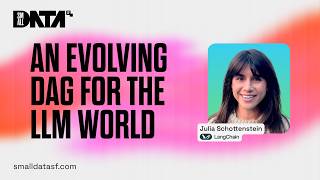
Directed Acyclic Graphs (DAGs) are the foundation of most orchestration frameworks. But what happens when you allow an LLM to act as the router? Acyclic graphs now become cyclic, which means you have to design for the challenges resulting from all this extra power. We'll cover the ins and outs of agentic applications and how to best use them in your work as a data practitioner or developer building today.
➡️ Follow Us LinkedIn: https://www.linkedin.com/company/small-data-sf/ X/Twitter : https://twitter.com/smalldatasf Website: https://www.smalldatasf.com/
Discover LangChain, the open-source framework for building powerful agentic systems. Learn how to augment LLMs with your private data, moving beyond their training cutoffs. We'll break down how LangChain uses "chains," which are essentially Directed Acyclic Graphs (DAGs) similar to data pipelines you might recognize from dbt. This structure is perfect for common patterns like Retrieval Augmented Generation (RAG), where you orchestrate steps to fetch context from a vector database and feed it to an LLM to generate an informed response, much like preparing data for analysis.
Dive into the world of AI agents, where the LLM itself determines the application's control flow. Unlike a predefined DAG, this allows for dynamic, cyclic graphs where an agent can iterate and improve its response based on previous attempts. We'll explore the core challenges in building reliable agents: effective planning and reflection, managing shared memory across multiple agents in a cognitive architecture, and ensuring reliability against task ambiguity. Understand the critical trade-offs between the dependability of static chains and the flexibility of dynamic LLM agents.
Introducing LangGraph, a framework designed to solve the agent reliability problem by balancing agent control with agency. Through a live demo in LangGraph Studio, see how to build complex AI applications using a cyclic graph. We'll demonstrate how a router agent can delegate tasks, execute a research plan with multiple steps, and use cycles to iterate on a problem. You'll also see how human-in-the-loop intervention can steer the agent for improved performance, a critical feature for building robust and observable agentic systems.
Explore some of the most exciting AI agents in production today. See how Roblox uses an AI assistant to generate virtual worlds from a prompt, how TripAdvisor’s agent acts as a personal travel concierge to create custom itineraries, and how Replit’s coding agent automates code generation and pull requests. These real-world examples showcase the practical power of moving from simple DAGs to dynamic, cyclic graphs for solving complex, agentic problems.
Agentic AI is here, but what is it? What are the differences between the traditional LLMs and this new agentic AI we're hearing about? With AI systems making autonomous decisions, driving analytics, and reshaping data strategies, what does this mean for analysts? We're joined by Vin Vashishta, CEO at V Squared and an expert in AI strategy and data science. Vin's book, From Data to Profit, lays out a roadmap for turning AI and analytics into real business value. AI isn't just a tool anymore; it's becoming a collaborator. How should we think about adapting? Don't miss his insights in this show! What You'll Learn: How Agentic AI will redefine the role of analysts in analytics. What makes an AI 'agent' different from a traditional LLM? Why knowledge graphs are the key to AI's next leap forward. How to future-proof your career in analytics. Register for free to be part of the next live session: https://bit.ly/3XB3A8b Follow us on Socials: LinkedIn YouTube Instagram (Mavens of Data) Instagram (Maven Analytics) TikTok Facebook Medium X/Twitter
Está no ar, o Data Hackers News !! Os assuntos mais quentes da semana, com as principais notícias da área de Dados, IA e Tecnologia, que você também encontra na nossa Newsletter semanal, agora no Podcast do Data Hackers !! Aperte o play e ouça agora, o Data Hackers News dessa semana ! Para saber tudo sobre o que está acontecendo na área de dados, se inscreva na Newsletter semanal: https://www.datahackers.news/ Conheça nossos comentaristas do Data Hackers News: Monique Femme Paulo Vasconcellos Demais canais do Data Hackers: Site Linkedin Instagram Tik Tok You Tube
Send us a text 👤 About the Guest Dr. Ruchir Puri is IBM Fellow and Chief Scientist at IBM Research. He’s a master inventor with 70+ patents and decades of leadership in scalable AI, chip innovation, and open-source contributions. From Watson to watsonx, he’s been shaping the AI landscape for decades — and he’s not slowing down. Inside This Episode In Part 2, Ruchir unpacks the macro forces shaping AI — from Jensen Huang’s bold prediction to IBM’s leadership in open-model ecosystems and the emerging blueprint for AGI (Artificial General Intelligence). It’s a mix of sharp insight, grounded realism, and future-forward thinking.
⏱️ Chapters & Timing 00:12 – Jensen Huang's Prediction Ruchir’s take on NVIDIA’s CEO and whether the 2029 AGI forecast holds water.04:15 – The Open-Model Ecosystem Why IBM is betting on openness — and what that means for enterprise AI.07:21 – Why IBM Granite? A breakdown of Granite’s strengths, flexibility, and why it’s built to scale responsibly.09:58 – Model Indemnification The legal side of LLMs. Ruchir explains how IBM handles risk and accountability.11:32 – AI Implementation Challenges Beyond the hype: What really gets in the way of successful AI deployment?14:20 – AI in Politics A frank look at how AI is already reshaping elections, media, and power dynamics.15:35 – AI Chipsets From GPUs to custom silicon, Ruchir highlights what’s next in the AI compute race.18:37 – AGI = IQ, EQ, RQ Artificial General Intelligence, demystified. Why intellect alone isn’t enough — and how reasoning and empathy fit in.24:15 – The Human Brain’s Efficiency What AI can learn from 20 watts of organic genius.💬 Key Ideas You can’t have AGI without reasoning. That’s the ‘RQ’ — and it’s the missing piece.
The future isn’t one model to rule them all. It’s an ecosystem — modular, open, and responsible.
IBM’s commitment to indemnification isn’t just legal — it’s about trust in enterprise AI.
🔥 Why You Should Listen This episode goes beyond buzzwords. If you're serious about what’s coming next in AI — how we’ll build it, govern it, and live with it — Ruchir offers a rare combination of technical clarity and visionary leadership. 🎧 Subscribe for More Don't miss upcoming episodes that help you lead with clarity in the AI era — the Making Data Simple way. Want to be featured as a guest on Making Data Simple? Reach out to us at [email protected] and tell us why you should be next. The Making Data Simple Podcast is hosted by Al Martin, WW VP Technical Sales, IBM, where we explore trending technologies, business innovation, and leadership ... while keeping it simple & fun.
by
Val Kroll
,
Julie Hoyer
,
Tim Wilson
(Analytics Power Hour - Columbus (OH)
,
Moe Kiss
(Canva)
,
Michael Helbling
(Search Discovery)
We finally did it: devoted an entire episode to AI. And, of course, by devoting an episode entirely to AI, we mean we just had GPT-4o generate a script for the entire show, and we just each read our parts. It's pretty impressive how the result still sounds so natural and human and spontaneous. It picked up on Tim's tendency to get hot and bothered, on Moe's proclivity for dancing right up to the edge of oversharing specific work scenarios, on Michael's knack for bringing in personality tests, on Val's patience in getting the whole discussion to get back on track, and on Julie being a real (or artificial, as the case may be?) Gem. Even though it includes the word "proclivity," this show overview was entirely generated without the assistance of AI. And yet, it's got a whopper of a hallucination: the episode wasn't scripted at all! For complete show notes, including links to items mentioned in this episode and a transcript of the show, visit the show page.
Are you ready to level up your analytics game and tackle the challenges that come with data-heavy projects? In this episode, Harpreet Sahota, a data science leader with years of experience helping analysts and teams thrive, shares actionable insights and strategies for staying ahead in the fast-evolving world of data. Harpreet will help you develop a practical mindset to tackle real-world challenges and build the confidence to lead impactful projects. From cleaning messy datasets, to deciding between building or buying a solution, to training a computer vision model, Harpreet is here to share his expertise. Whether you're an aspiring data analyst or a seasoned professional, this episode will equip you with the skills and clarity to succeed. What You'll Learn: Data Cleaning for Any Data Type: Proven techniques to clean and prepare your data for analysis. Training a Computer Vision Model: What to consider before you start and how to ensure success. Build vs. Buy for LLMs: When to create your own solution and when to leverage existing tools. Setting Yourself Up for Success as an Analyst: Strategies to stand out and make your work impactful. Register for free to be part of the next live session: https://bit.ly/3XB3A8b Interested in learning more from Harpreet? Connect with him on LinkedIn Follow us on Socials: LinkedIn YouTube Instagram (Mavens of Data) Instagram (Maven Analytics) TikTok Facebook Medium X/Twitter

by
Ethan Brown
