
talk-data.com talk-data.com

Topic

MLOps

machine_learning devops ai

47

tagged

Activity Trend

26 peak/qtr
2020-Q1 2026-Q1

Activities

Showing filtered results

Filtering by: Databricks DATA + AI Summit 2023 ×
Colossal AI: Scaling AI Models in Big Model Era

The proliferation of large models based on Transformer has outpaced advances in hardware, resulting in an urgent need for the ability to distribute enormous models across multiple GPUs. Despite this growing demand, best practices for choosing an optimal strategy are still lacking due to the breadth of knowledge required across HPC, DL, and distributed systems. These difficulties have stimulated both AI and HPC developers to explore the key questions: How can training and inference efficiency of large models be improved to reduce costs? How can larger AI models be accommodated even with limited resources?

What can be done to enable more community members to easily access large models and large-scale applications? In this session, we investigate efforts to solve the questions mentioned above. Firstly, diverse parallelization is an important tool to improve the efficiency of large model training and inference. Heterogeneous memory management can help enhance the model accommodation capacity of processors like GPUs.

Furthermore, user-friendly DL systems for large models significantly reduce the specialized background knowledge users need, allowing more community members to get started with larger models more efficiently. We will provide participants with a system-level open-source solution, Colossal-AI. More information can be found at https://github.com/hpcaitech/ColossalAI.

Talk by: James Demmel and Yang You

Here’s more to explore: LLM Compact Guide: https://dbricks.co/43WuQyb Big Book of MLOps: https://dbricks.co/3r0Pqiz

Connect with us: Website: https://databricks.com Twitter: https://twitter.com/databricks LinkedIn: https://www.linkedin.com/company/databricks Instagram: https://www.instagram.com/databricksinc Facebook: https://www.facebook.com/databricksinc
Enterprise Use of Generative AI Needs Guardrails: Here's How to Build Them

Large Language Models (LLMs) such as ChatGPT have revolutionized AI applications, offering unprecedented potential for complex real-world scenarios. However, fully harnessing this potential comes with unique challenges such as model brittleness and the need for consistent, accurate outputs. These hurdles become more pronounced when developing production-grade applications that utilize LLMs as a software abstraction layer.

In this session, we will tackle these challenges head-on. We introduce Guardrails AI, an open-source platform designed to mitigate risks and enhance the safety and efficiency of LLMs. We will delve into specific techniques and advanced control mechanisms that enable developers to optimize model performance effectively. Furthermore, we will explore how implementing these safeguards can significantly improve the development process of LLMs, ultimately leading to safer, more reliable, and robust real-world AI applications

Talk by: Shreya Rajpal

Here’s more to explore: LLM Compact Guide: https://dbricks.co/43WuQyb Big Book of MLOps: https://dbricks.co/3r0Pqiz

Connect with us: Website: https://databricks.com Twitter: https://twitter.com/databricks LinkedIn: https://www.linkedin.com/company/databricks Instagram: https://www.instagram.com/databricksinc Facebook: https://www.facebook.com/databricksinc
Navigating the Complexities of LLMs: Insights from Practitioners

Interested in diving deeper into the world of large language models (LLMs) and their real-life applications? In this session, we bring together our experienced team members and some of our esteemed customers to talk about their journey with LLMs. We'll delve into the complexities of getting these models to perform accurately and efficiently, the challenges, and the dynamic nature of LLM technology as it constantly evolves. This engaging conversation will offer you a broader perspective on how LLMs are being applied across different industries and how they’re revolutionizing our interaction with technology. Whether you're well-versed in AI or just beginning to explore, this session promises to enrich your understanding of the practical aspects of LLM implementation.

Talk by: Sai Ravuru, Eric Peter, Ankit Mathur, and Salman Mohammed

Here’s more to explore: LLM Compact Guide: https://dbricks.co/43WuQyb Big Book of MLOps: https://dbricks.co/3r0Pqiz

Connect with us: Website: https://databricks.com Twitter: https://twitter.com/databricks LinkedIn: https://www.linkedin.com/company/databricks Instagram: https://www.instagram.com/databricksinc Facebook: https://www.facebook.com/databricksinc
How to Train Your Own Large Language Models

Given the success of OpenAI’s GPT-4 and Google’s PaLM, every company is now assessing its own use cases for Large Language Models (LLMs). Many companies will ultimately decide to train their own LLMs for a variety of reasons, ranging from data privacy to increased control over updates and improvements. One of the most common reasons will be to make use of proprietary internal data.

In this session, we’ll go over how to train your own LLMs, from raw data to deployment in a user-facing production environment. We’ll discuss the engineering challenges, and the vendors that make up the modern LLM stack: Databricks, Hugging Face, and MosaicML. We’ll also break down what it means to train an LLM using your own data, including the various approaches and their associated tradeoffs.

Topics covered in this session: - How Replit trained a state-of-the-art LLM from scratch - The different approaches to using LLMs with your internal data - The differences between fine-tuning, instruction tuning, and RLHF

Talk by: Reza Shabani

Here’s more to explore: LLM Compact Guide: https://dbricks.co/43WuQyb Big Book of MLOps: https://dbricks.co/3r0Pqiz

Connect with us: Website: https://databricks.com Twitter: https://twitter.com/databricks LinkedIn: https://www.linkedin.com/company/databricks Instagram: https://www.instagram.com/databricksinc Facebook: https://www.facebook.com/databricksinc
Sponsored by: Infosys | Topaz AI First Innovations

Insights into Infosys' Topaz AI First Innovations including AI-enabled Analytics and AI-enabled Automation to help clients in significant cost savings, improved efficiency and customer experience across industry segments.

Talk by: Neeraj Dixit

Here’s more to explore: LLM Compact Guide: https://dbricks.co/43WuQyb Big Book of MLOps: https://dbricks.co/3r0Pqiz

Connect with us: Website: https://databricks.com Twitter: https://twitter.com/databricks LinkedIn: https://www.linkedin.com/company/databricks Instagram: https://www.instagram.com/databricksinc Facebook: https://www.facebook.com/databricksinc
Discuss How LLMs Will Change the Way We Work

Will LLMs change the way we work?  Ask questions from a panel of LLM and AI experts on what problems LLMs will solve and its potential new challenges

Talk by: Ben Harvey, Jan van der Vegt, Ankit Mathur, Debu Sinha, and Sean Owen

Here’s more to explore: LLM Compact Guide: https://dbricks.co/43WuQyb Big Book of MLOps: https://dbricks.co/3r0Pqiz

Connect with us: Website: https://databricks.com Twitter: https://twitter.com/databricks LinkedIn: https://www.linkedin.com/company/databricks Instagram: https://www.instagram.com/databricksinc Facebook: https://www.facebook.com/databricksinc

Foundation Models in the Modern Data Stack

As Foundation Models (FMs) continue to grow in size, innovations continue to push the boundaries of what these models can do on language and image tasks. This talk will describe our work on applying FMs to structured data tasks like data linkage, cleaning and querying. We will then discuss challenges and solutions that these models present for production deployment in the modern data stack.

Talk by: Ines Chami

Here’s more to explore: LLM Compact Guide: https://dbricks.co/43WuQyb Big Book of MLOps: https://dbricks.co/3r0Pqiz

Connect with us: Website: https://databricks.com Twitter: https://twitter.com/databricks LinkedIn: https://www.linkedin.com/company/databricks Instagram: https://www.instagram.com/databricksinc Facebook: https://www.facebook.com/databricksinc
PaLM 2: A Smaller, Faster and More Capable LLM

PaLM 2 is a new state-of-the-art language model that has better multilingual and reasoning capabilities and is more compute-efficient than its predecessor PaLM. PaLM 2 is a Transformer-based model trained using a mixture of objectives. Through extensive evaluations on English and multilingual language, and reasoning tasks, we demonstrate that PaLM 2 has significantly improved quality on downstream tasks across different model sizes, while simultaneously exhibiting faster and more efficient inference compared to PaLM. This improved efficiency enables broader deployment while also allowing the model to respond faster, for a more natural pace of interaction.

PaLM 2 demonstrates robust reasoning capabilities exemplified by large improvements over PaLM on BIG-Bench and other reasoning tasks. PaLM 2 exhibits stable performance on a suite of responsible AI evaluations, and enables inference-time control over toxicity without additional overhead or impact on other capabilities. Overall, PaLM 2 achieves state-of-the-art performance across a diverse set of tasks and capabilities.

Talk by: Andy Dai

Here’s more to explore: LLM Compact Guide: https://dbricks.co/43WuQyb Big Book of MLOps: https://dbricks.co/3r0Pqiz

Connect with us: Website: https://databricks.com Twitter: https://twitter.com/databricks LinkedIn: https://www.linkedin.com/company/databricks Instagram: https://www.instagram.com/databricksinc Facebook: https://www.facebook.com/databricksinc
Perplexity: A Copilot for All Your Web Searches and Research

In this demo, we will show you the fastest and functional answer engine and search copilot that exists right now: Perplexity.ai. It can solve a wide array of problems starting from giving you fast answers to any topic to planning trips and doing market research on things unfamiliar to you, all in a trustworthy way without hallucinations, providing you references in the form of citations. This is made possible by harnessing the power of LLMs along with retrieval augmented generation from traditional search engines and indexes.

We will also show you how information discovery can now be fully personalized to you: personalization through prompt engineering. Finally, we will see use cases of how this search copilot can help you in your day to day tasks in a data team: be it a data engineer, data scientist, or a data analyst.

Talk by: Aravind Srinivas

Here’s more to explore: LLM Compact Guide: https://dbricks.co/43WuQyb Big Book of MLOps: https://dbricks.co/3r0Pqiz

Connect with us: Website: https://databricks.com Twitter: https://twitter.com/databricks LinkedIn: https://www.linkedin.com/company/databricks Instagram: https://www.instagram.com/databricksinc Facebook: https://www.facebook.com/databricksinc
Sponsored by: Anomalo | Scaling Data Quality with Unsupervised Machine Learning Methods

The challenge is no longer how big, diverse, or distributed your data is. It's that you can't trust it. Companies are utilizing rules and metrics to monitor data quality, but they’re tedious to set up and maintain. We will present a set of fully unsupervised machine learning algorithms for monitoring data quality at scale, which requires no setup, catching unexpected issues and preventing alert fatigue by minimizing false positives. At the end of this talk, participants will be equipped with insight into unsupervised data quality monitoring, its advantages and limitations, and how it can help scale trust in your data.

Talk by: Vicky Andonova

Here’s more to explore: LLM Compact Guide: https://dbricks.co/43WuQyb Big Book of MLOps: https://dbricks.co/3r0Pqiz

Connect with us: Website: https://databricks.com Twitter: https://twitter.com/databricks LinkedIn: https://www.linkedin.com/company/databricks Instagram: https://www.instagram.com/databricksinc Facebook: https://www.facebook.com/databricksinc
Sponsored by: Wipro | Personalized Price Transparency Using Generative AI

Patients are increasingly taking an active role in managing their healthcare costs and are more likely to choose providers and treatments based on cost considerations. Learn how technology can help build cost-efficient care models across the healthcare continuum, delivering higher quality care while improving patient experience and operational efficiency.

Talk by: Janine Pratt

Here’s more to explore: LLM Compact Guide: https://dbricks.co/43WuQyb Big Book of MLOps: https://dbricks.co/3r0Pqiz

Connect with us: Website: https://databricks.com Twitter: https://twitter.com/databricks LinkedIn: https://www.linkedin.com/company/databricks Instagram: https://www.instagram.com/databricksinc Facebook: https://www.facebook.com/databricksinc
MLOps at Gucci: From Zero to Hero

Delta Lake is an open-source storage format that can be ideally used for storing large-scale datasets, which can be used for single-node and distributed training of deep learning models. Delta Lake storage format gives deep learning practitioners unique data management capabilities for working with their datasets. The challenge is that, as of now, it’s not possible to use Delta Lake to train PyTorch models directly.

PyTorch community has recently introduced a Torchdata library for efficient data loading. This library supports many formats out of the box, but not Delta Lake. This talk will demonstrate using the Delta Lake storage format for single-node and distributed PyTorch training using the torchdata framework and standalone delta-rs Delta Lake implementation.

Talk by: Michael Shtelma

Connect with us: Website: https://databricks.com Twitter: https://twitter.com/databricks LinkedIn: https://www.linkedin.com/company/databricks Instagram: https://www.instagram.com/databricksinc Facebook: https://www.facebook.com/databricksinc
LLMOps: Everything You Need to Know to Manage LLMs

With the recent surge in popularity of ChatGPT and other LLMs such as Dolly, many people are going to start training, tuning, and deploying their own custom models to solve their domain-specific challenges. When training and tuning these models, there are certain considerations that need to be accounted for in the MLOps process that differ from traditional machine learning. Come watch this session where you’ll gain a better understanding of what to look out for when starting to enter the world of applying LLMs in your domain.

In this session, you’ll learn about:

  • Grabbing foundational models and fine-tuning them
  • Optimizing resource management such as GPUs
  • Integrating human feedback and reinforcement learning to improve model performance
  • Different evaluation methods for LLMs

Talk by: Joseph Bradley and Eric Peter

Connect with us: Website: https://databricks.com Twitter: https://twitter.com/databricks LinkedIn: https://www.linkedin.com/company/databricks Instagram: https://www.instagram.com/databricksinc Facebook: https://www.facebook.com/databricksinc
ML on the Lakehouse: Bringing Data and ML Together to Accelerate AI Use Cases

Discover the latest innovations from Databricks that can help you build and operationalize the next generation of machine learning solutions. This session will dive into Databricks Machine Learning, a data-centric AI platform that spans the full machine learning lifecycle - from data ingestion and model training to production MLOps. You'll learn about key capabilities that you can leverage in your ML use cases and see the product in action. You will also directly hear how Databricks ML is being used to maximize supply chain logistics and keep millions of Coca-Cola products on the shelf.

Connect with us: Website: https://databricks.com Facebook: https://www.facebook.com/databricksinc Twitter: https://twitter.com/databricks LinkedIn: https://www.linkedin.com/company/data... Instagram: https://www.instagram.com/databricksinc/
MLOps at DoorDash

MLOps is one of the widely discussed topics in the ML practitioner community. Streamlining the ML development and productionalizing ML are important ingredients to realize the power of ML, however it requires a vast and complex infrastructure. The ROI of ML projects will start only when they are in production. The journey to implementing MLOps will be unique to each company. At DoorDash, we’ve been applying MLOps for a couple of years to support a diverse set of ML use cases and to perform large scale predictions at low latency.

This session will share our approach to MLOps, as well as some of the learnings and challenges. In addition, it will share some details about the DoorDash ML stack, which consists of a mixture of homegrown solutions, open source solutions and vendor solutions like Databricks.

Connect with us: Website: https://databricks.com Facebook: https://www.facebook.com/databricksinc Twitter: https://twitter.com/databricks LinkedIn: https://www.linkedin.com/company/data... Instagram: https://www.instagram.com/databricksinc/
MLOps on Databricks: A How-To Guide

As companies roll out ML pervasively, operational concerns become the primary source of complexity. Machine Learning Operations (MLOps) has emerged as a practice to manage this complexity. At Databricks, we see firsthand how customers develop their MLOps approaches across a huge variety of teams and businesses. In this session, we will show how your organization can build robust MLOps practices incrementally. We will unpack general principles which can guide your organization’s decisions for MLOps, presenting the most common target architectures we observe across customers. Combining our experiences designing and implementing MLOps solutions for Databricks customers, we will walk through our recommended approaches to deploying ML models and pipelines on Databricks. You will come away with a deeper understanding of how to scale deployment of ML models across your organization, as well as a practical, coded example illustrating how to implement an MLOps workflow on Databricks.

Connect with us: Website: https://databricks.com Facebook: https://www.facebook.com/databricksinc Twitter: https://twitter.com/databricks LinkedIn: https://www.linkedin.com/company/data... Instagram: https://www.instagram.com/databricksinc/

Multimodal Deep Learning Applied to E-commerce Big Data

At Mirakl, we empower marketplaces with Artificial Intelligence solutions. Catalogs data is an extremely rich source of e-commerce sellers and marketplaces products which include images, descriptions, brands, prices and attributes (for example, size, gender, material or color). Such big volumes of data are suitable for training multimodal deep learning models and present several technical Machine Learning and MLOps challenges to tackle.

We will dive deep into two key use cases: deduplication and categorization of products. For categorization the creation of quality multimodal embeddings plays a crucial role and is achieved through experimentation of transfer learning techniques on state-of-the-art models. Finding very similar or almost identical products among millions and millions can be a very difficult problem and that is where our deduplication algorithm comes to bring a fast and computationally efficient solution.

Furthermore we will show how we deal with big volumes of products using robust and efficient pipelines, Spark for distributed and parallel computing, TFRecords to stream and ingest data optimally on multiple machines avoiding memory issues, and MLflow for tracking experiments and metrics of our models.

Connect with us: Website: https://databricks.com Facebook: https://www.facebook.com/databricksinc Twitter: https://twitter.com/databricks LinkedIn: https://www.linkedin.com/company/data... Instagram: https://www.instagram.com/databricksinc/
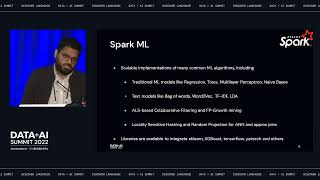
Automating Model Lifecycle Orchestration with Jenkins

A key part of the lifecycle involves bringing a model to production. In regular software systems, this is accomplished via a CI/CD pipeline such as one built with Jenkins. However, integrating Jenkins into a typical DS/ML workflow is not straightforward for X, Y, Z reasons. In this hands-on talk, I will talk about what Jenkins and CI/CD practices can bring to your ML workflows, demonstrate a few of these workflows, and share some best practices on how a bit of Jenkins can level up your MLOps processes.

Connect with us: Website: https://databricks.com Facebook: https://www.facebook.com/databricksinc Twitter: https://twitter.com/databricks LinkedIn: https://www.linkedin.com/company/data... Instagram: https://www.instagram.com/databricksinc/
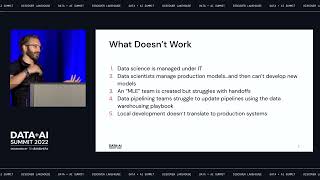
Quick to Production with the Best of Both Apache Spark and Tensorflow on Databricks

Using Tensorflow with big datasets has been an impediment for building deep learning models due to the added complexities of running it in a distributed setting and complicated MLOps code, recent advancements in tensorflow 2, and some extension libraries for Spark has now simplified a lot of this. This talk focuses on how we can leverage the best of both Spark and tensorflow to build machine learning and deep learning models using minimal MLOps code letting Spark handle the grunt of work, enabling us to focus more on feature engineering and building the model itself. This design also enables us to use any of the libraries in the tensorflow ecosystem (like tensorflow recommenders) with the same boilerplate code. For businesses like ours, fast prototyping and quick experimentations are key to building completely new experiences in an efficient and iterative way. It is always preferable to have tangible results before putting more resources into a certain project. This design provides us with that capability and lets us spend more time on research, building models, testing quickly, and rapidly iterating. It also provides us with the flexibility to use our choice of framework at any stage of the machine learning lifecycle. In this talk, we will go through some of the best and new features of both spark and tensorflow, how to go from single node training to distributed training with very few extra lines of code, how to leverage MLFlow as a central model store, and finally, using these models for batch and real-time inference.

Connect with us: Website: https://databricks.com Facebook: https://www.facebook.com/databricksinc Twitter: https://twitter.com/databricks LinkedIn: https://www.linkedin.com/company/data... Instagram: https://www.instagram.com/databricksinc/

Survey of Production ML Tech Stacks

Production machine learning demand stitching together many tools ranging from open source standards to cloud-specific and third party solutions. This session surveys the current ML deployment technology landscape to contextualize which tools solve for which features off production ML systems such as CI/CD, REST endpoint, and monitoring. It'll help answer the questions: what tools are out there? Where do I start with the MLops tech stack for my application? What are the pros and cons of open source versus managed solutions? This talk takes a features driven approach to tool selection for MLops tacks to provide best practices in the most rapidly evolving field of data science.

Connect with us: Website: https://databricks.com Facebook: https://www.facebook.com/databricksinc Twitter: https://twitter.com/databricks LinkedIn: https://www.linkedin.com/company/data... Instagram: https://www.instagram.com/databricksinc/