talk-data.com talk-data.com

Topic

RDBMS

Relational Database Management System (RDBMS)

databases sql data_storage

199

tagged

Activity Trend

5 peak/qtr
2020-Q1 2026-Q1

Activities

199 activities · Newest first

Microsoft® SQL Server™ 2005 Integration Services Step by Step

Teach yourself the fundamentals of SQL Server Integration Services—one step at a time. This practical, learn-by-doing tutorial delivers the guidance you need to transform and consolidate data—and build solutions that support your business intelligence needs. Discover how to: Design and execute packages that transform data between files and relational databases Configure connection managers to access other data sources Create data flows that alter, split, match, and merge data Develop event-handlers and monitor package performance Encrypt sensitive information and control access to packages Customize script code to automate Control Flow and Data Flow tasks Debug, troubleshoot, and optimize packages CD features: All practice exercises Sample databases Fully searchable eBook For customers who purchase an ebook version of this title, instructions for downloading the CD files can be found in the ebook.

Microsoft SQL Server 2005 Analysis Services

Microsoft SQL Server Analysis Services provides fast access to data by means of multidimensional data structures and the multidimensional query languag MDX. Analysis Services provides the capability to design, create, and manage multidimensional cubes based on data warehouse tables, and it serves as the foundation for the Microsoft Business Intelligence strategy. Microsoft SQL Server 2005 Analysis Services gives the reader insight into the way Analysis Services functions. It not only explains ways to design and create multidimensional objects, databases, dimensions, and cubes, but also provides invaluable information about the reasons behind design decisions made by the development team. Here's what you will find inside: Understand the key concepts of multidimensional modeling Explore the multidimensional object model and its definition language Learn the main concepts of the MDX language and gain an in-depth understanding of advanced MDX concepts Understand the mechanisms of integrating multidimensional and relational databases Learn how to build client applications to access data in Analysis Services Examine server architecture, including main data structures, data processing, and query resolution algorithms Gain a deep understanding of the internal and external protocols for data transfer, including the XML/A protocol Explore how Analysis Services manages memory Explore the security model, including role-based security, code-access security, and data security Discover how to monitor and manage Analysis Services All the code for the sample database used in the book can be found at www.informit.com/title/0672327821.

Getting Started with IBM Tivoli Workload Scheduler V8.3

IBM Tivoli Workload Scheduler is an IBM strategic scheduling product that runs on different platforms including the mainframe. The new version of the product, IBM Tivoli Workload Scheduler V8.3, comes with some important enhancements, such as relational database management system (RDBMS) support, new advanced planning system, which allows the definition of plans that span more that 24 hours, removal of framework requirements, new application programming interface (API), Job Scheduling Console enhancements, and so on. This IBM Redbooks publication documents the architecture, deployment, best practices, and migration scenarios for IBM Tivoli Workload Scheduler V8.3 on distributed environment. In addition, we cover IBM Tivoli Workload Scheduler V8.3 security, IBM DB2 and IBM WebSphere considerations, troubleshooting, tuning for performance, application programming interface, and JnextPlan, which has replaced the JnextDay process in this release. Clients and Tivoli professionals who are responsible for installing, administering, maintaining, or using IBM Tivoli Workload Scheduler V8.3 will find this book a major reference.

Joe Celko's SQL Puzzles and Answers, 2nd Edition

Joe Celko's SQL Puzzles and Answers, Second Edition, challenges you with his trickiest puzzles and then helps solve them with a variety of solutions and explanations. Author Joe Celko demonstrates the thought processes that are involved in attacking a problem from an SQL perspective to help advanced database programmers solve the puzzles you frequently face. These techniques not only help with the puzzle at hand, but also help develop the mindset needed to solve the many difficult SQL puzzles you face every day. This updated edition features many new puzzles; dozens of new solutions to puzzles; and new chapters on temporal query puzzles and common misconceptions about SQL and RDBMS that leads to problems. This book is recommended for database programmers with a good knowledge of SQL. A great collection of tricky SQL puzzles with a variety of solutions and explanations Uses the proven format of puzzles and solutions to provide a user-friendly, practical look into SQL programming problems - many of which will help users solve their own problems New edition features: Many new puzzles added!, Dozens of new solutions to puzzles, and using features in SQL-99, Code is edited to conform to SQL STYLE rules, New chapter on temporal query puzzles, New chapter on common misconceptions about SQL and RDBMS that leads to problems

The Relational Database Dictionary

Avoid misunderstandings that can affect the design, programming, and use of database systems. Whether you're using Oracle, DB2, SQL Server, MySQL, or PostgreSQL, The Relational Database Dictionary will prevent confusion about the precise meaning of database-related terms (e.g., attribute, 3NF, one-to-many correspondence, predicate, repeating group, join dependency), helping to ensure the success of your database projects. Carefully reviewed for clarity, accuracy, and completeness, this authoritative and comprehensive quick-reference contains more than 600 terms, many with examples, covering issues and concepts arising from the relational model of data. This one-of-a-kind dictionary provides a single, compact source where DBAs, database designers, DBMS implementers, application developers, and database professors and students can find the accurate definitions they need on a daily basis, information that isn't readily available anywhere else. If you're working with or learning about relational databases, you need this pocket-sized quick-reference.

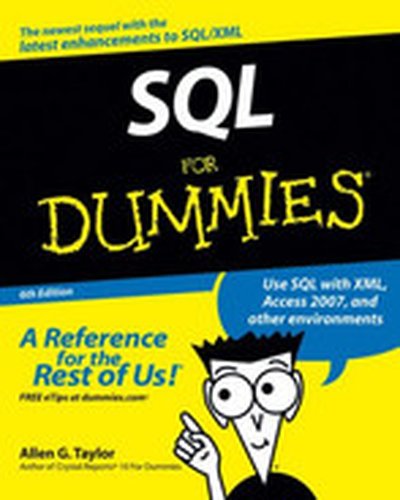
SQL For Dummies®

See how SQL interfaces with today's environments Start building and using relational databases with SQL's newest features The database may be the twenty-first century filing cabinet, but building one is a little more complex than sliding drawers into a metal box. With this book to guide you through all the newest features of SQL, you'll soon be whipping up relational databases, using SQL with XML to power data-driven Web sites, and more! Discover how to * Use SQL in a client/server system * Build a multitable relational database * Construct nested and recursive queries * Set up database security * Use SQL within applications * Map SQL to XML

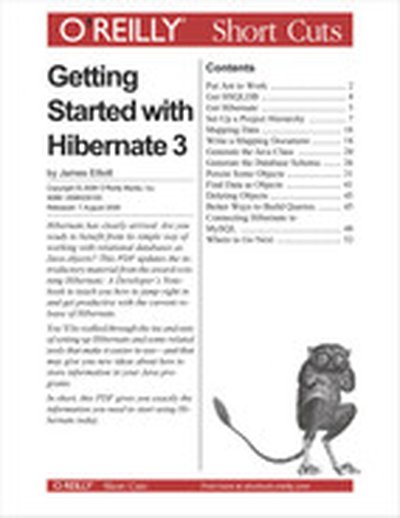
Getting Started with Hibernate 3

Hibernate has clearly arrived. Are you ready to benefit from its simple way of working with relational databases as Java objects? This PDF updates the introductory material from the award-winning Hibernate: A Developer's Notebook to teach you how to jump right in and get productive with the current release of Hibernate. You'll be walked through the ins and outs of setting up Hibernate and some related tools that make it easier to use--and that may give you new ideas about how to store information in your Java programs. In short, this PDF gives you exactly the information you need to start using Hibernate today.

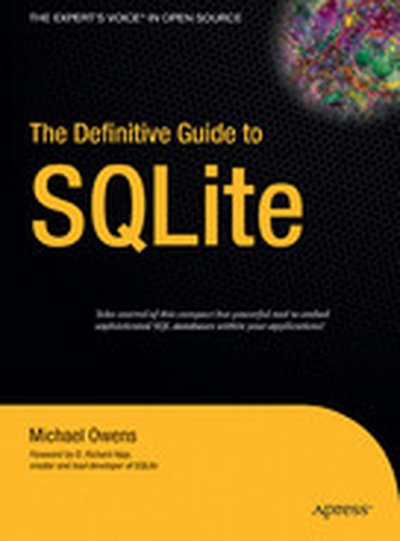
The Definitive Guide to SQLite

Traditional relational databases and embedded databases both have shortcomings that can leave a developer perplexed. So for many people, the solution resides in an open source embeddable database with an amazingly small footprint (less than 250 kilobytes). SQLite packs a powerful array of features and can handle databases as large as 2 terabytes. It offers a flexible set of datatypes and the ability to perform transactions, and it is supported by languages like C, PHP, Perl, and Python. And because SQLite's databases are completely file based, privileges are granted at the operating system level, allowing for easy and fast user management. The Definitive Guide to SQLite is the first book to devote complete coverage to this powerful database. It offers you a thorough overview of SQLite capabilities and APIs, while remaining cognizant of newcomers who may be making their first foray into a database environment with SQLite. This book serves as both a first-time tutorial and future reference guide.

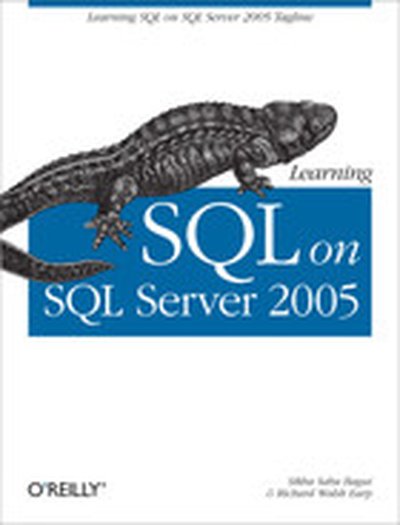
Learning SQL on SQL Server 2005

Anyone who interacts with today's modern databases needs to know SQL (Structured Query Language), the standard language for generating, manipulating, and retrieving database information. In recent years, the dramatic rise in the popularity of relational databases and multi-user databases has fueled a healthy demand for application developers and others who can write SQL code efficiently and correctly. If you're new to databases, or need a SQL refresher, Learning SQL on SQL Server 2005 is an ideal step-by-step introduction to this database query tool, with everything you need for programming SQL using Microsoft's SQL Server 2005-one of the most powerful and popular database engines used today. Plenty of books explain database theory. This guide lets you apply the theory as you learn SQL. You don't need prior database knowledge, or even prior computer knowledge. Based on a popular university-level course designed by authors Sikha Saha Bagui and Richard Walsh Earp, Learning SQL on SQL Server 2005 starts with very simple SQL concepts, and slowly builds into more complex query development. Every topic, concept, and idea comes with examples of code and output, along with exercises to help you gain proficiency in SQL and SQL Server 2005. With this book, you'll learn: Beginning SQL commands, such as how and where to type an SQL query, and how to create, populate, alter and delete tables How to customize SQL Server 2005's settings and about SQL Server 2005's functions About joins, a common database mechanism for combining tables Query development, the use of views and other derived structures, and simple set operations Subqueries, aggregate functions and correlated subqueries, as well as indexes and constraints that can be added to tables in SQL Server 2005 Whether you're an undergraduate computer science or MIS student, a self-learner who has access to the new Microsoft database, or work for your company's IT department, Learning SQL on SQL Server 2005 will get you up to speed on SQL in no time.

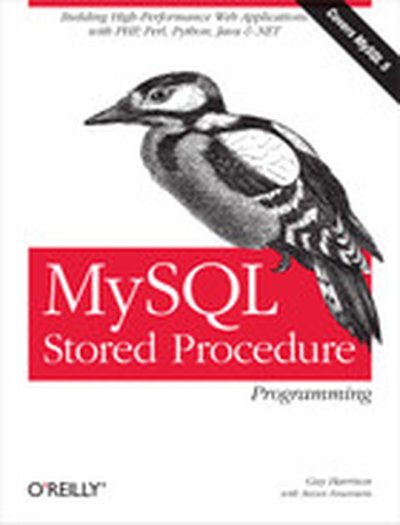
MySQL Stored Procedure Programming

The implementation of stored procedures in MySQL 5.0 a hugemilestone -- one that is expected to lead to widespread enterprise adoption ofthe already extremely popular MySQL database. If you are serious aboutbuilding the web-based database applications of the future, you need toget up to speed quickly on how stored procedures work -- and how tobuild them the right way. This book, destined to be the bible of storedprocedure development, is a resource that no real MySQL programmer canafford to do without. In the decade since MySQL burst on the scene, it has become thedominant open source database, with capabilities and performancerivaling those of commercial RDBMS offerings like Oracle and SQLServer. Along with Linux and PHP, MySQL is at the heart of millions ofapplications. And now, with support for stored procedures, functions,and triggers in MySQL 5.0, MySQL offers the programming power neededfor true enterprise use. MySQL's new procedural language has a straightforward syntax, making iteasy to write simple programs. But it's not so easy to write secure,easily maintained, high-performance, and bug-free programs. Few in theMySQL world have substantial experience yet with stored procedures, butGuy Harrison and Steven Feuerstein have decades of combined expertise. In MySQL Stored Procedure Programming, they putthat hard-won experience to good use. Packed with code examples and coveringeverything from language basics to application building to advancedtuning and best practices, this highly readable book is the one-stopguide to MySQL development. It consists of four major sections: MySQL stored programming fundamentals -- tutorial, basicstatements, SQL in stored programs, and error handling Building MySQL stored programs -- transaction handling,built-in functions, stored functions, and triggers MySQL stored programs in applications -- using storedprograms with PHP, Java, Perl, Python, and .NET (C# and VB.NET) Optimizing MySQL stored programs -- security, basic andadvanced SQL tuning, optimizing stored program code, and programmingbest practices A companion web site contains many thousands of lines of code, that youcan put to use immediately. Guy Harrison is Chief Architect of Database Solutions at Quest Softwareand a frequent speaker and writer on MySQL topics. Steven Feuerstein isthe author of Oracle PL/SQL Programming, the classic reference for Oracle stored programming for more than ten years. Both have decades of experience as database developers, and between them they have authored a dozen books.

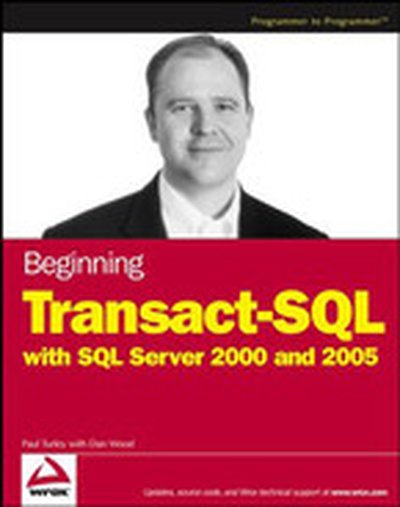
Beginning Transact-SQL with SQL Server 2000 and 2005

Beginning Transact-SQL with SQL Server 2000 and 2005 Transact-SQL is a powerful implementation of the ANSI standard SQL database query language. In order to build effective database applications, you must gain a thorough understanding of these features. This book provides you with a comprehensive introduction to the T-SQL language and shows you how it can be used to work with both the SQL Server 2000 and 2005 releases. Beginning with an overview of the SQL Server query operations and tools that are used with T-SQL, the author goes on to explain how to design and build applications of increasing complexity. By gaining an understanding of the power of the T-SQL language, you'll be prepared to meet the ever-increasing demands of programming. What you will learn from this book How T-SQL provides you with the means to create tools for managing hundreds of databases Various programming techniques that use views and stored procedures Ways to optimize query performance How to create databases that will be an essential foundation to applications you develop later Who this book is for This book is for database developers and administrators who have not yet programmed with Transact-SQL. Some familiarity with relational databases and basic SQL is helpful, and some programming experience is helpful. Wrox Beginning guides are crafted to make learning programming languages and technologies easier than you think, providing a structured, tutorial format that will guide you through all the techniques involved.

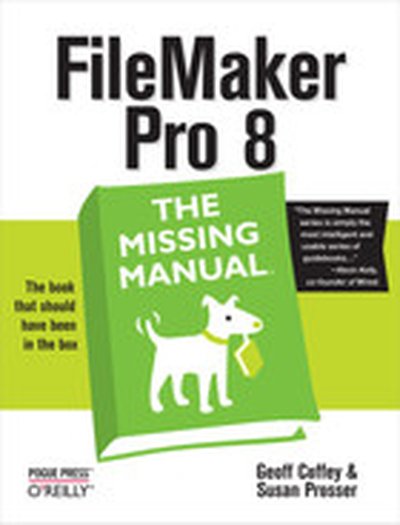
FileMaker Pro 8: The Missing Manual

Used by millions worldwide, FileMaker Pro is an award-winning database program for managing people, projects, images, assets, and other information. It's easy to use and totally customizable--so long as you know what you're doing. But FileMaker Pro doesn't come with a printed manual, so FileMaker Pro: The Missing Manual is the authoritative, jargon-free book that should have been in the box. FileMaker Pro: The Missing Manual approaches FileMaker the way FileMaker approaches you: it's user-friendly and seemingly straightforward enough, but it offers plenty of substance worthy of deeper exploration. Packed with practical information as well as countless expert tips and invaluable guidance, it's an in-depth guide to designing and building useful databases with the powerful and pliable FileMaker Pro. Covering FileMaker for both Windows and Macintosh, FileMaker Pro: The Missing Manual is ideal for small business users, home users, school teachers, developers--anyone who wants to organize information efficiently and effectively. Whether you want to run a business, publish a shopping cart on the Web, plan a wedding, manage a student information system at your school, or program databases for clients, this book delivers. Author Geoff Coffey has many years of experience using FileMaker Pro (he was, in fact, an early beta tester for the product). Author Susan Prosser is a FileMaker Certified Developer who trains other developers. Together, Coffey and Prosser show you how to: Get FileMaker up and running quickly and smoothly Import and organize information with ease Design relational databases that are simple to use, yet powerful Take advantage of FileMaker Pro calculation capabilities Automate processes with scripting Customize FileMaker Pro to your needs and preferences Share information with other people (coworkers, clients, and customers) and other programs Understand and select the best security options What could easily come across as dry and intimidating--things like relational theory, calculations, and scripting--are presented in a way that is interesting and intuitive to mainstream users. In no time, you'll be working more productively and efficiently using FileMaker Pro.

Database in Depth

This book sheds light on the principles behind the relational model, which is fundamental to all database-backed applications--and, consequently, most of the work that goes on in the computing world today. Database in Depth: The Relational Model for Practitioners goes beyond the hype and gets to the heart of how relational databases actually work.Ideal for experienced database developers and designers, this concise guide gives you a clear view of the technology--a view that's not influenced by any vendor or product. Featuring an extensive set of exercises, it will help you: understand why and how the relational model is still directly relevant to modern database technology (and will remain so for the foreseeable future) see why and how the SQL standard is seriously deficient use the best current theoretical knowledge in the design of their databases and database applications make informed decisions in their daily database professional activities Database in Depth will appeal not only to database developers and designers, but also to a diverse field of professionals and academics, including database administrators (DBAs), information modelers, database consultants, and more. Virtually everyone who deals with relational databases should have at least a passing understanding of the fundamentals of working with relational models.Author C.J. Date has been involved with the relational model from its earliest days. An exceptionally clear-thinking writer, Date lays out principle and theory in a manner that is easily understood. Few others can speak as authoritatively the topic of relational databases as Date can.

Modernizing IBM eServer iSeries Application Data Access - A Roadmap Cornerstone

In 1978 IBM introduced the System/38 as part of its midrange platform hardware base. One of the many outstanding features of this system was the built-in Relational Database Management System (RDMS) support. The system included a utility for defining databases, screens, and reports. This utility used a form named Data Description Specifications (DDS) to define the database physical (PF) and logical (LF) files (base tables, views, and indexes). In 1988, IBM announced the AS/400. The OS/400 operating system also contained a built-in RDMS, however, IBM offered Structured Query Language (SQL) as an alternative to DDS for creating databases. In addition, SQL Data Manipulation Language (DML) statements were made available as an ad hoc query language tool. These statements could also be embedded and compiled within high level language (HLL) programs. SQL Data Definition Language (DDL) has become the industry standard for defining RDMS databases. Many customers are in the process of modernizing their database definition and the database access. This IBM Redbooks publication will help you understand how to reverse engineer a DDS-created database along, and provides you with tips and techniques for modernizing applications to use SQL as the database access method. Additional Resources on DB2 for i Modernization:

XML for DB2 Information Integration

In many organizations, relational databases are the backbone for data storage and retrieval. Over the last couple of years, XML has become the de facto standard to exchange information between organizations, as well as between departments or applications within the same organization. Since data tends to live in databases, it needs to be converted from a relational format into an XML format when involved in those data exchanges, as well as converted (back) from XML into a relational format for storage, or for handling by other applications. How can we achieve this? This IBM Redbooks publication describes how to design the mapping between XML and relational data, and vice versa, to enable a flexible exchange of information. IBM provides a number of products to help you bridge the gap between XML and its relational database, DB2. The DB2 engine itself provides support to generate XML fragments from relational data through the use of SQL/XML built-in functions. DB2 also provides the DB2 XML Extender. It allows you to perform XML composition, like SQL/XML, but also provides functionality to decompose XML documents and store XML documents intact inside the database. XML Extender also provides a set of transformation and validation functions. Another option to work with XML is to use the XML wrapper, a part of the set of non-relational wrappers of DB2 Information Integrator. This book also looks at the IBM tools available to assist you when dealing with XML, specifically WebSphere Application Developer and DB2 Control Center. Please note that the additional material referenced in the text is not available from IBM.

Implementing IBM Lotus Enterprise Integrator 6

This IBM Redbooks publication helps you to implement Lotus Enterprise Integrator (LEI) 6. It is targeted for system administrators who plan to implement or upgrade to LEI 6 in their organization. This book provides tips and techniques to help you successfully deploy and administer LEI 6. We begin by providing a brief introduction to what’s new with LEI 6 and cover some architectural scenarios of how LEI 6 infrastructure could be implemented in a customer’s environment. We then provide detailed information on how to install and administer LEI 6, as well as how to migrate or upgrade from LEI 3.x to LEI 6. Tools, techniques and utilities for debugging activities are described in depth, for testing connectivity to relational databases and testing connection documents in the LEI Administrator. Working examples are provided to illustrate how to use the Advanced RealTime activities that are new in LEI 6. It also provides examples of some of the batch activities previously available in LEI 3.x such as a scripted activity and a replication activity. Finally, the book concludes with a discussion of the LC LSX, the LotusScript programming interface to the Lotus Connectors which lets you program any functionality you need that isn’t available through the LEI forms. Please note that the additional material referenced in the text is not available from IBM.

MySQL Tutorial

A concise introduction to the fundamentals of working with MySQL. MySQL is an open-source relational database management system that is rapidly growing in popularity. Known for its speed, reliability, and ease of use, MySQL has proven itself to be particularly well suited both for beginners and for experienced developers to create sophisticated database-backed Web sites and applications. MySQL Tutorial is a clear, concise introduction to the fundamental concepts and techniques of working with MySQL. It teaches the beginning MySQL user how to create and administer powerful databases that can be used at home, at work, and on the Web. Whether you are a novice to databases or a technical professional looking to find out more about how MySQL works, MySQL Tutorial efficiently guides you through the information you need in order to get started with MySQL and quickly become proficient.

Transact-SQL Desk Reference

This is the SQL reference you'll reach for first, every time! If you're an SQL programmer, you can easily picture how useful a comprehensive, single-volume Transact-SQL command reference manual would be in streamlining your work. And if that book was rich in examples, was written with users of all levels of expertise in mind, and was even designed to fit comfortably on your desktop, you'd probably buy it right away, wouldn't you? Well, look no further— Transact-SQL Desk Reference, by noted programming instructor Deac Lancaster, is exactly the book you need. As it turns out, Transact-SQL Desk Reference is just the book Deac himself was looking for. The problem was, no such book existed, so he saved programmers everywhere a lot of trouble and he wrote it himself! The book answers the question, "How exactly do I write a statement to do a particular job?" by providing the full syntax of each command along with examples showing each command in action. Then, to assist you in making your code more portable, Transact-SQL Desk Reference shows where Transact-SQL diverges from the ANSI SQL standard. The commands are arranged by functional area and are well indexed and cross-referenced, making it as easy as possible to find what you're looking for-even if you don't know the command's name. Inside, you'll find: SQL commands grouped logically by purpose and function, plus an index so you can jump right to the command Definitions that give the full syntax of each command, along with examples of each command in use plus tips on maximizing portability Additional chapters covering RDBMS concepts, details of Transact-SQL, and advanced SELECT queries! This book is intended for programmers of all levels working with Microsoft SQL Server.

DB2 Cube Views: A Primer

Business Intelligence and OLAP systems are no longer limited to the privileged few business analysts: they are being democratized by being shared with the rank and file employee demanding a Relational Database Management System (RDBMS) that is more OLAP-aware. DB2 Cube Views and its cube model provide DB2 the ability to address multidimensional analysis and become an actor in the OLAP world. This IBM Redbooks publication focuses on the innovative technical functionalities of IBM DB2 Cube Views V8.1 to store multidimensional metadata in DB2 catalog; to build automatically model-based summary tables to speed up query performance; and to provide an advanced API to allow other Business Intelligence partners’ tools to benefit from both metadata exchange and improved query performance. This book positions the new functionalities and their benefits, so you can understand and evaluate their applicability in your own Business Intelligence and OLAP system environment. It provides information and examples to help you to get started planning and implementing the new functionalities.