talk-data.com talk-data.com

Topic

SAS

statistical_software analytics data_management

245

tagged

Activity Trend

8 peak/qtr
2020-Q1 2026-Q1

Activities

Showing filtered results

Filtering by: O'Reilly Data Science Books ×
An Introduction to SAS University Edition

SAS ® OnDemand for Academics is now the primary software choice for learners. SAS OnDemand for Academics is available for free access to SAS for individual learners as well as university educators and students. Access to SAS University Edition will end Aug. 2, 2021; users will no longer be able to download it after Apr. 30, 2021. Get up and running with the SAS University Edition using Ron Cody’s easy-to-follow, step-by-step guide. Aimed at beginners who have downloaded the free SAS University Edition and want to either use the point-and-click interactive environment of SAS Studio, or who want to write their own SAS programs, or both, An Introduction to SAS University Edition, begins by showing you how to obtain the SAS University Edition, and how you can run SAS on a PC or Macintosh computer. The first part of the book shows you how to perform basic tasks, such as producing a report, summarizing data, producing charts and graphs, and using the SAS Studio built-in tasks. The first part also describes how you can perform basic statistical tests using the interactive point-and-click environment. The second part of the book shows you how to write your own SAS programs, and how to use SAS procedures to perform a variety of tasks. This part of the book also explains how to read data from a variety of sources: text files, Excel workbooks, and CSV files. In order to get familiar with the SAS Studio environment, this book also shows you how to access dozens of interesting data sets that are included with the product.
SAS Certification Prep Guide, 4th Edition

Prepare for the SAS Base Programming for SAS 9 exam with the official guide by the SAS Global Certification Program. New and experienced SAS users who want to prepare for the SAS Base Programming for SAS 9 exam will find this guide to be an invaluable, convenient, and comprehensive resource that covers all of the objectives tested on the exam. Now in its fourth edition, the guide has been extensively updated, and revised to streamline explanations. Major topics include importing and exporting raw data files, creating and modifying SAS data sets, and identifying and correcting data syntax and programming logic errors. The chapter quizzes have been thoroughly updated and full solutions are included at the back of the book. In addition, links are provided to the exam objectives, practice exams, and other helpful resources, such as the updated Base SAS glossary and an expanded collection of practice data sets. Content updates are available here.

Fundamentals of Predictive Analytics with JMP, Second Edition

Written for students in undergraduate and graduate statistics courses, as well as for the practitioner who wants to make better decisions from data and models, this updated and expanded second edition of Fundamentals of Predictive Analytics with JMP(R) bridges the gap between courses on basic statistics, which focus on univariate and bivariate analysis, and courses on data mining and predictive analytics. Going beyond the theoretical foundation, this book gives you the technical knowledge and problem-solving skills that you need to perform real-world multivariate data analysis. First, this book teaches you to recognize when it is appropriate to use a tool, what variables and data are required, and what the results might be. Second, it teaches you how to interpret the results and then, step-by-step, how and where to perform and evaluate the analysis in JMP . Using JMP 13 and JMP 13 Pro, this book offers the following new and enhanced features in an example-driven format: an add-in for Microsoft Excel Graph Builder dirty data visualization regression ANOVA logistic regression principal component analysis LASSO elastic net cluster analysis decision trees k-nearest neighbors neural networks bootstrap forests boosted trees text mining association rules model comparison With today’s emphasis on business intelligence, business analytics, and predictive analytics, this second edition is invaluable to anyone who needs to expand his or her knowledge of statistics and to apply real-world, problem-solving analysis. This book is part of the SAS Press program.

Big Data Analytics with SAS

Discover how to leverage the power of SAS for big data analytics in 'Big Data Analytics with SAS.' This book helps you unlock key techniques for preparing, analyzing, and reporting on big data effectively using SAS. Whether you're exploring integration with Hadoop and Python or mastering SAS Studio, you'll advance your analytics capabilities. What this Book will help me do Set up a SAS environment for performing hands-on data analytics tasks efficiently. Master the fundamentals of SAS programming for data manipulation and analysis. Use SAS Studio and Jupyter Notebook to interface with SAS efficiently and effectively. Perform preparatory data workflows and advanced analytics, including predictive modeling and reporting. Integrate SAS with platforms like Hadoop, SAP HANA, and Cloud Foundry for scaling analytics processes. Author(s) None Pope is a seasoned data analytics expert with extensive experience in SAS and big data platforms. With a passion for demystifying complex data workflows, None teaches SAS techniques in an approachable way. Their expert insights and practical examples empower readers to confidently analyze and report on data. Who is it for? If you're a SAS professional or a data analyst looking to expand your skills in big data analysis, this book is for you. It suits readers aiming to integrate SAS into diverse tech ecosystems or seeking to learn predictive modeling and reporting with SAS. Both beginners and those familiar with SAS can benefit.

SAS 9.4 Language Reference, 6th Edition

Provides conceptual information for the Base SAS language. Major topics include SAS keywords and naming conventions, SAS variables and expressions, error processing and debugging, SAS data sets and files, creating and customizing output, DATA step concepts and DATA step processing, reading raw data, and creating and managing SAS libraries.

Practical and Efficient SAS Programming

Learn to write SAS programs quickly and efficiently.

Programming in SAS is flexible, but it can also be overwhelming. Many novice and experienced programmers learn how to write programs that use the DATA step and macros, but they often don’t realize that a simpler or better way can achieve the same results. In a user-friendly tutorial style, Practical and Efficient SAS® Programming: The Insider's Guide provides general SAS programming tips that use the tools available in Base SAS, including the DATA step, the SAS macro facility, and SQL.

Drawing from the author’s 30 years of SAS programming experience, this book offers self-contained sections that describe each tip or trick and present numerous examples. It therefore serves as both an easy reference for a specific question, and a useful cover-to-cover read. As a bonus, the utility programs included in the appendixes will help you simplify your programs, as well as help you develop a sleek and efficient coding style.

With this book, you will learn how to do the following:

use the DATA step, the SAS macro facility, SQL, and other Base SAS tools more efficiently

choose the best tool for a task

use lookup tables

simulate recursion with macros

read metadata with the DATA step

create your own programming style in order to write programs that are easily maintained

Using this book, SAS programmers of all levels will discover new techniques to help them write programs quickly and efficiently.

Exchanging Data From SAS to Excel

Microsoft Excel remains the leading spreadsheet application on the market; nearly every SAS user will need to move their data and reports into Excel workbooks at some point during their career. Exchanging Data From SAS(R) to Excel: The ODS Excel Destination shows SAS users how to create Excel workbooks that are presentation ready, eliminating manual changes to the workbooks after creation.

While the original book Exchanging Data between SAS and Microsoft Excel: Tips and Techniques to Transfer and Manage Data More Efficiently touched upon many topics involved in moving data between SAS and Excel, this companion book delves into the options that are available with the ODS Excel destination. This book also has numerous examples that include syntax and graphical output.

With this book, you can learn how to:

Create native Excel files

Insert graphs and images into Excel files

Place multiple tables on multiple tabs within the file

Customize spreadsheets with workbook-level options, print features, column features, row features, and cell-level features

Exchanging Data from SAS® to Excel: The ODS Excel Destination will make sending your output and graphics to Excel a breeze, enhancing any presentation!

Business Survival Analysis Using SAS

Solve business problems involving time-to-event and resulting probabilities by following the modeling tutorials in Business Survival Analysis Using SAS®: An Introduction to Lifetime Probabilities, the first book to be published in the field of business survival analysis! Survival analysis is a challenge. Books applying to health sciences exist, but nothing about survival applications for business has been available until now. Written for analysts, forecasters, econometricians, and modelers who work in marketing or credit risk and have little SAS modeling experience, Business Survival Analysis Using SAS® builds on a foundation of SAS code that works in any survival model and features numerous annotated graphs, coefficients, and statistics linked to real business situations and data sets. This guide also helps recent graduates who know the statistics but do not necessarily know how to apply them get up and running in their jobs. By example, it teaches the techniques while avoiding advanced theoretical underpinnings so that busy professionals can rapidly deliver a survival model to meet common business needs.

From first principles, this book teaches survival analysis by highlighting its relevance to business cases. A pragmatic introduction to survival analysis models, it leads you through business examples that contextualize and motivate the statistical methods and SAS coding. Specifically, it illustrates how to build a time-to-next-purchase survival model in SAS® Enterprise Miner, and it relates each step to the underlying statistics and to Base SAS® and SAS/STAT® software. Following the many examples—from data preparation to validation to scoring new customers—you will learn to develop and apply survival analysis techniques to scenarios faced by companies in the financial services, insurance, telecommunication, and marketing industries, including the following scenarios:

Time-to-next-purchase for marketing

Employer turnover for human resources

Small business portfolio macroeconometric stress tests for banks

International Financial Reporting Standard (IFRS 9) lifetime probability of default for banks and building societies

"Churn," or attrition, models for the telecommunications and insurance industries

Predictive Modeling with SAS Enterprise Miner, 3rd Edition

A step-by-step guide to predictive modeling!

Kattamuri Sarma's Predictive Modeling with SAS Enterprise Miner: Practical Solutions for Business Applications, Third Edition, will show you how to develop and test predictive models quickly using SAS Enterprise Miner. Using realistic data, the book explains complex methods in a simple and practical way to readers from different backgrounds and industries. Incorporating the latest version of Enterprise Miner, this third edition also expands the section on time series.

Written for business analysts, data scientists, statisticians, students, predictive modelers, and data miners, this comprehensive text provides examples that will strengthen your understanding of the essential concepts and methods of predictive modeling. Topics covered include logistic regression, regression, decision trees, neural networks, variable clustering, observation clustering, data imputation, binning, data exploration, variable selection, variable transformation, and much more, including analysis of textual data.

Develop predictive models quickly, learn how to test numerous models and compare the results, gain an in-depth understanding of predictive models and multivariate methods, and discover how to do in-depth analysis. Do it all with Predictive Modeling with SAS Enterprise Miner!

Analysis of Clinical Trials Using SAS, 2nd Edition

Analysis of Clinical Trials Using SAS®: A Practical Guide, Second Edition bridges the gap between modern statistical methodology and real-world clinical trial applications. Tutorial material and step-by-step instructions illustrated with examples from actual trials serve to define relevant statistical approaches, describe their clinical trial applications, and implement the approaches rapidly and efficiently using the power of SAS. Topics reflect the International Conference on Harmonization (ICH) guidelines for the pharmaceutical industry and address important statistical problems encountered in clinical trials. Commonly used methods are covered, including dose-escalation and dose-finding methods that are applied in Phase I and Phase II clinical trials, as well as important trial designs and analysis strategies that are employed in Phase II and Phase III clinical trials, such as multiplicity adjustment, data monitoring, and methods for handling incomplete data. This book also features recommendations from clinical trial experts and a discussion of relevant regulatory guidelines.

This new edition includes more examples and case studies, new approaches for addressing statistical problems, and the following new technological updates:

SAS procedures used in group sequential trials (PROC SEQDESIGN and PROC SEQTEST)

SAS procedures used in repeated measures analysis (PROC GLIMMIX and PROC GEE)

macros for implementing a broad range of randomization-based methods in clinical trials, performing complex multiplicity adjustments, and investigating the design and analysis of early phase trials (Phase I dose-escalation trials and Phase II dose-finding trials)

Clinical statisticians, research scientists, and graduate students in biostatistics will greatly benefit from the decades of clinical research experience and the ready-to-use SAS macros compiled in this book.

Preparing Data for Analysis with JMP

Access and clean up data easily using JMP®! Data acquisition and preparation commonly consume approximately 75% of the effort and time of total data analysis. JMP provides many visual, intuitive, and even innovative data-preparation capabilities that enable you to make the most of your organization's data. Preparing Data for Analysis with JMP® is organized within a framework of statistical investigations and model-building and illustrates the new data-handling features in JMP, such as the Query Builder. Useful to students and programmers with little or no JMP experience, or those looking to learn the new data-management features and techniques, it uses a practical approach to getting started with plenty of examples. Using step-by-step demonstrations and screenshots, this book walks you through the most commonly used data-management techniques that also include lots of tips on how to avoid common problems. With this book, you will learn how to: Manage database operations using the JMP Query Builder Get data into JMP from other formats, such as Excel, csv, SAS, HTML, JSON, and the web Identify and avoid problems with the help of JMP’s visual and automated data-exploration tools Consolidate data from multiple sources with Query Builder for tables Deal with common issues and repairs that include the following tasks: reshaping tables (stack/unstack) managing missing data with techniques such as imputation and Principal Components Analysis cleaning and correcting dirty data computing new variables transforming variables for modelling reconciling time and date Subset and filter your data Save data tables for exchange with other platforms

An Introduction to SAS Visual Analytics

When it comes to business intelligence and analytical capabilities, SAS Visual Analytics is the premier solution for data discovery, visualization, and reporting. An Introduction to SAS Visual Analytics will show you how to make sense of your complex data with the goal of leading you to smarter, data-driven decisions without having to write a single line of code – unless you want to! You will be able to use SAS Visual Analytics to access, prepare, and present your data to anyone anywhere in the world. SAS Visual Analytics automatically highlights key relationships, outliers, clusters, trends and more. These abilities will guide you to critical insights that inspire action from your data. With this book, you will become proficient using SAS Visual Analytics to present data and results in customizable, robust visualizations, as well as guided analyses through auto-charting. With interactive dashboards, charts, and reports, you will create visualizations which convey clear and actionable insights for any size and type of data. This book largely focuses on the version of SAS Visual Analytics on SAS 9.4, although it is available on both 9.4 and SAS Viya platforms. Each version is considered the latest release, with subsequent releases planned to continue on each platform; hence, the Viya version works similarly to the 9.4 version and will look familiar. This book covers new features of each and important differences between the two. With this book, you will learn how to: Build your first report using the SAS Visual Analytics Designer Prepare a dashboard and determine the best layout Effectively use geo-spatial objects to add location analytics to reports Understand and use the elements of data visualizations Prepare and load your data with the SAS Visual Analytics Data Builder Analyze data with a variety of options, including forecasting, word clouds, heat maps, correlation matrix, and more Understand administration activities to keep SAS Visual Analytics humming along Optimize your environment for considerations such as scalability, availability, and efficiency between components of your SAS software deployment and data providers

SAS 9.4 SQL Procedure User's Guide, Fourth Edition, 4th Edition

Describes the basics of using the SQL procedure and provides comprehensive reference information. The usage information includes retrieving data from single and multiple tables; selecting specific data from tables; subsetting, ordering, and summarizing data; updating tables; combining tables to create new tables and useful reports; performing queries on database management system (DBMS) tables; using PROC SQL with the SAS macro facility; and debugging and optimizing PROC SQL code. The reference information includes statements, dictionary components, and system options.

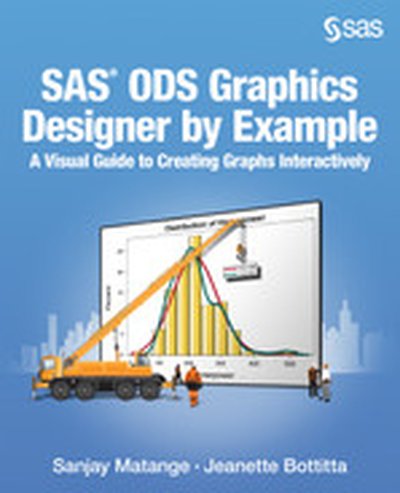
SAS ODS Graphics Designer by Example

You just got the results from your study, and need to get some quick graphical views of your data before you begin the analysis. Do you need a crash course in the SG procedures (also known as ODS Graphics procedures) just to get a simple histogram? What should you do? The ODS Graphics Designer is the answer. With this application, you can use the interactive drag-and-drop feature to create many graphs, including histograms, box plots, scatter plot matrices, classification panels, and more. You can render your graph in batch with new data and output the results to any open ODS destination, or view the generated Graph Template Language (GTL) code as a leg-up to GTL programming. You can do all this with ease!

SAS(R) ODS Graphics Designer by Example: A Visual Guide to Creating Graphs Interactively describes in detail the features of the ODS Graphics Designer. The designer application lets you, the analyst, create graphs interactively so that you can focus on the analysis, and not on learning graph syntax. This book will take you step-by-step through the features of the designer, providing you with examples of graphs that are commonly used for the analysis of data in the health care, life sciences, and finance industries. The examples in this book will help you create just the right graph with ease!

Implementing CDISC Using SAS

For decades researchers and programmers have used SAS to analyze, summarize, and report clinical trial data. Now Chris Holland and Jack Shostak have updated their popular Implementing CDISC Using SAS, the first comprehensive book on applying clinical research data and metadata to the Clinical Data Interchange Standards Consortium (CDISC) standards.

Implementing CDISC Using SAS: An End-to-End Guide, Second Edition, is an all-inclusive guide on how to implement and analyze the Study Data Tabulation Model (SDTM) and the Analysis Data Model (ADaM) data and prepare clinical trial data for regulatory submission. Updated to reflect the 2017 FDA mandate for adherence to CDISC standards, this new edition covers creating and using metadata, developing conversion specifications, implementing and validating SDTM and ADaM data, determining solutions for legacy data conversions, and preparing data for regulatory submission. The book covers products such as Base SAS, SAS Clinical Data Integration, and the SAS Clinical Standards Toolkit, as well as JMP Clinical. Topics included in this new edition include an implementation of the Define-XML 2.0 standard, new SDTM domains, validation with Pinnacle 21 software, event narratives in JMP Clinical, and of course new versions of SAS and JMP software.

Any manager or user of clinical trial data in this day and age is likely to benefit from knowing how to either put data into a CDISC standard or analyzing and finding data once it is in a CDISC format. If you are one such person--a data manager, clinical and/or statistical programmer, biostatistician, or even a clinician--then this book is for you.

Biostatistics by Example Using SAS Studio

Learn how to solve basic statistical problems with Ron Cody's easy-to-follow style using the point-and-click SAS Studio tasks. Aimed specifically at the health sciences, Biostatistics by Example Using SAS Studio, provides an introduction to SAS Studio tasks. The book includes many biological and health-related problem sets and is fully compatible with SAS University Edition. After reading this book you will be able to understand temporary and permanent SAS data sets, and you will learn how to create them from various data sources. You will also be able to use SAS Studio statistics tasks to generate descriptive statistics for continuous and categorical data. The inferential statistics portion of the book covers the following topics: paired and unpaired t tests one-way analysis of variance N-way ANOVA correlation simple and multiple regression logistic regression categorical data analysis power and sample size calculations Besides describing each of these statistical tests, the book also discusses the assumptions that need to be met before running and interpreting these tests. For two-sample tests and N-way tests, nonparametric tests are also described. This book leads you step-by-step through each of the statistical tests with numerous screen shots, and you will see how to read and interpret all of the output generated by these tests. Experience with some basic statistical tests used to analyze medical data or classroom experience in biostatistics or statistics is required. Although the examples are related to the medical and biology fields, researchers in other fields such as psychology or education will find this book helpful. No programming experience is required. Loading data files into SAS University Edition? Click here for more information.

Strategic Analytics and SAS

Use aggregate data to answer high-level business questions!

Data miners, data scientists, analytic managers, and analysts who work in all industries will find the insights in Randy Collica's Strategic Analytics and SAS: Using Aggregate Data to Drive Organizational Initiatives invaluable in their work. This book shows you how to use your existing data at aggregate levels to answer high-level business questions. Written in a detailed, step-by-step format, the multi-industry use cases begin with a high-level question that a C-level executive might ask. Collica then progresses through the steps to perform the analysis, including many tables and screenshots to guide you along the way. He then ends each use case with the solution to the high-level question. Topics covered include logistic analysis, models developed from surveys, survival analysis, confidence intervals, text mining and analysis, visual analytics, hypothesis tests, and size and magnitude of analytic effects. Connect the dots between detailed data on your customers and the high-level business goals of your organization with Strategic Analytics and SAS!

The Analytical Marketer

How to lead the change Analytics are driving big changes, not only in what marketing departments do but in how they are organized, staffed, led, and run. Leaders are grappling with issues that range from building an analytically driven marketing organization and determining the kinds of structure and talent that are needed to leading interactions with IT, finance, and sales and creating a unified view of the customer. The Analytical Marketer provides critical insight into the changing marketing organization—digital, agile, and analytical—and the tools for reinventing it. Written by the head of global marketing for SAS, The Analytical Marketer is based on the author’s firsthand experience of transforming a marketing organization from “art” to “art and science.” Challenged and inspired by their company’s own analytics products, the SAS marketing team was forced to rethink itself in order to take advantage of the new capabilities that those tools offer the modern marketer. Key marketers and managers at SAS tell their stories alongside the author’s candid lessons learned as she led the marketing organization’s transformation. With additional examples from other leading companies, this book is a practical guide and set of best practices for creating a new marketing culture that thrives on and adds value through data and analytics.