Standardizes the definition and framework of analytics ABOK stands for Analytics Body of Knowledge. Based on the authors’ definition of analytics—which is “a process by which a team of people helps an organization make better decisions (the objective) through the analysis of data (the activity)”— this book from Institute for Operations Research and the Management Sciences (INFORMS) represents the perspectives of some of the most respected experts on analytics. The INFORMS ABOK documents the core concepts and skills with which an analytics professional should be familiar; establishes a dynamic resource that will be used by practitioners to increase their understanding of analytics; and, presents instructors with a framework for developing academic courses and programs in analytics. The INFORMS ABOK offers in-depth insight from peer-reviewed chapters that provide readers with a better understanding of the dynamic field of analytics. Chapters cover: Introduction to Analytics; Getting Started with Analytics; The Analytics Team; The Data; Solution Methodology; Model Building; Machine Learning; Deployment and Life Cycle Management; and The Blossoming Analytics Talent Pool: An Overview of the Analytics Ecosystem. Across industries and academia, readers with various backgrounds in analytics – from novices who are interested in learning more about the basics of analytics to experienced professionals who want a different perspective on some aspect of analytics – will benefit from reading about and implementing the concepts and methods covered by the INFORMS ABOK.
 talk-data.com
Activities tracked
333
Collection of O'Reilly books on Data Science.
Top Topics
Sessions & talks
Showing 251–275 of 333 · Newest first
Learn the essentials of data science with Python through this comprehensive guide. By the end of this book, you'll have an in-depth understanding of core data science workflows, tools, and techniques. What this Book will help me do Understand and apply data manipulation techniques with pandas and NumPy. Build and optimize machine learning models with scikit-learn. Analyze and visualize complex datasets for derived insights. Implement exploratory data analysis to uncover trends in data. Leverage advanced techniques like graph analysis and deep learning for sophisticated projects. Author(s) Alberto Boschetti and Luca Massaron combine their extensive expertise in data science and Python programming to guide readers effectively. With hands-on knowledge and a passion for teaching, they provide practical insights across the data science lifecycle. Who is it for? This book is ideal for aspiring data scientists, data analysts, and software developers aiming to enhance their data analysis skills. Suited for beginners familiar with Python and basic statistics, this guide bridges the gap to real-world applications. Advance your career by unlocking crucial data science expertise.
Explore the latest Python tools and techniques to help you tackle the world of data acquisition and analysis. You'll review scientific computing with NumPy, visualization with matplotlib, and machine learning with scikit-learn. This revision is fully updated with new content on social media data analysis, image analysis with OpenCV, and deep learning libraries. Each chapter includes multiple examples demonstrating how to work with each library. At its heart lies the coverage of pandas, for high-performance, easy-to-use data structures and tools for data manipulation Author Fabio Nelli expertly demonstrates using Python for data processing, management, and information retrieval. Later chapters apply what you've learned to handwriting recognition and extending graphical capabilities with the JavaScript D3 library. Whether you are dealing with sales data, investment data, medical data, web page usage, or other data sets, Python Data Analytics, Second Edition is an invaluable reference with its examples of storing, accessing, and analyzing data. What You'll Learn Understand the core concepts of data analysis and the Python ecosystem Go in depth with pandas for reading, writing, and processing data Use tools and techniques for data visualization and image analysis Examine popular deep learning libraries Keras, Theano,TensorFlow, and PyTorch Who This Book Is For Experienced Python developers who need to learn about Pythonic tools for data analysis
"Security has become a ""big data"" problem. The growth rate of malware has accelerated to tens of millions of new files per year while our networks generate an ever-larger flood of security-relevant data each day. In order to defend against these advanced attacks, you'll need to know how to think like a data scientist. In Malware Data Science, security data scientist Joshua Saxe introduces machine learning, statistics, social network analysis, and data visualization, and shows you how to apply these methods to malware detection and analysis. You'll learn how to: • Analyze malware using static analysis• Observe malware behavior using dynamic analysis• Identify adversary groups through shared code analysis• Catch 0-day vulnerabilities by building your own machine learning detector• Measure malware detector accuracy• Identify malware campaigns, trends, and relationships through data visualization Whether you're a malware analyst looking to add skills to your existing arsenal, or a data scientist interested in attack detection and threat intelligence, Malware Data Science will help you stay ahead of the curve."
Examine business problems and use a practical analytical approach to solve them by implementing predictive models and machine learning techniques using SAS and the R analytical language. This book is ideal for those who are well-versed in writing code and have a basic understanding of statistics, but have limited experience in implementing predictive models and machine learning techniques for analyzing real world data. The most challenging part of solving industrial business problems is the practical and hands-on knowledge of building and deploying advanced predictive models and machine learning algorithms. Applied Analytics through Case Studies Using SAS and R is your answer to solving these business problems by sharpening your analytical skills. What You'll Learn Understand analytics and basic data concepts Use an analytical approach to solve Industrial business problems Build predictive model with machine learning techniques Create and apply analytical strategies Who This Book Is For Data scientists, developers, statisticians, engineers, and research students with a great theoretical understanding of data and statistics who would like to enhance their skills by getting practical exposure in data modeling.
Navigate the fascinating intersection of healthcare and data science with the book "Healthcare Analytics Made Simple." This comprehensive guide empowers you to use Python and machine learning techniques to analyze and improve real healthcare systems. Demystify intricate concepts with Python code and SQL to gain actionable insights and build predictive models for healthcare. What this Book will help me do Understand healthcare incentives, policies, and datasets to ground your analysis in practical knowledge. Master the use of Python libraries and SQL for healthcare data analysis and visualization. Develop skills to apply machine learning for predictive and descriptive analytics in healthcare. Learn to assess quality metrics and evaluate provider performance using robust tools. Get acquainted with upcoming trends and future applications in healthcare analytics. Author(s) The authors, None Kumar and None Khader, are experts in data science and healthcare informatics. They bring years of experience teaching, researching, and applying data analytics in healthcare. Their approach is hands-on and clear, aiming to make complex topics accessible and engaging for their audience. Who is it for? This book is perfect for data science professionals eager to specialize in healthcare analytics. Additionally, clinicians aiming to leverage computing and data analytics in improving healthcare processes will find valuable insights. Programming enthusiasts and students keen to enter healthcare analytics will also greatly benefit. Tailored for beginners in this field, it is an educational yet robust resource.
Mastering Kibana 6.x is your guide to leveraging Kibana for creating impactful data visualizations and insightful dashboards. From setting up basic visualizations to exploring advanced analytics and machine learning integrations, this book equips you with the necessary skills to dive deep into your data and gain actionable insights at scale. You'll also learn to effectively manage and monitor data with powerful tools such as X-Pack and Beats. What this Book will help me do Build sophisticated dashboards to visualize elastic stack data effectively. Understand and utilize Timelion expressions for analyzing time series data. Incorporate X-Pack capabilities to enhance security and monitoring in Kibana. Extract, analyze, and visualize data from Elasticsearch for advanced analytics. Set up monitoring and alerting using Beats components for reliable data operations. Author(s) With extensive experience in big data technologies, the author brings a practical approach to teaching advanced Kibana topics. Having worked on real-world data analytics projects, their aim is to make complex concepts accessible while showing how to tackle analytics challenges using Kibana. Who is it for? This book is ideal for data engineers, DevOps professionals, and data scientists who want to optimize large-scale data visualizations. If you're looking to manage Elasticsearch data through insightful dashboards and visual analytics, or enhance your data operations with features like machine learning, then this book is perfect for you. A basic understanding of the Elastic Stack is helpful, though not required.
Python and R are two of the mainstream languages in data science. Fundamentally, Python is a language for programmers, whereas R is a language for statisticians. In a data science context, there is a significant degree of overlap when it comes to the capabilities of each language in the fields of regression analysis and machine learning. Your choice of language will depend highly on the environment in which you are operating. In a production environment, Python integrates with other languages much more seamlessly and is therefore the modus operandi in this context. However, R is much more common in research environments due to its more extensive selection of libraries for statistical analysis.
Hands-On Data Science with Anaconda is your guide to harnessing the full potential of Anaconda, a powerful platform for data science and machine learning. With this book, you will learn how to set up Anaconda, manage packages, explore advanced data processing techniques, and create robust machine learning models using Python, R, and Julia. What this Book will help me do Master data preprocessing techniques including cleaning, sorting, and classification using Anaconda. Understand and utilize the conda package manager for efficient package management. Learn to explore and visualize data using packages and frameworks supported by Anaconda. Perform advanced operations like clustering, regression, and building predictive models. Implement distributed computing and manage environments effectively with Anaconda Cloud. Author(s) Yuxing Yan and co-author None Yan are seasoned data science professionals with extensive experience in utilizing cutting-edge tools like Anaconda to simplify and enhance data science workflows. With a focus on making complex concepts accessible, they offer a practical and systematic approach to mastering tools that power real-world data science projects. Who is it for? This book is for data science practitioners, analysts, or developers with a basic understanding of Python, R, and linear algebra who want to scale their skills and learn to utilize the Anaconda platform for their projects. If you're seeking to work more effectively within the Anaconda ecosystem or equip yourself with efficient tools for data analysis and machine learning, this book is for you.
Learn how to leverage SQL Server 2017 Machine Learning Services and the R programming language to create robust, efficient data analysis and machine learning solutions. This book provides actionable insights and practical examples to help you implement and manage database-oriented analytics and predictive modeling. What this Book will help me do Understand and use SQL Server 2017 Machine Learning Services integrated with R. Gain experience in installing, configuring, and maintaining R services in SQL Server. Create and operationalize predictive models using RevoScaleR and other R packages. Improve database solutions by incorporating advanced analytics techniques. Monitor and manage R-based services effectively for reliable production solutions. Author(s) Tomaž Kaštrun and None Koesmarno bring a wealth of expertise as practitioners and educators in data science and SQL Server technologies. They share their experience innovatively, making intricate subjects approachable. Their unified teaching method ensures readers can directly benefit from practical examples and real-world applications. Who is it for? This book is tailored for database administrators, data analysts, and data scientists eager to integrate R with SQL Server. It caters to professionals with varying levels of R experience who are looking to enhance their proficiency in database-oriented analytics. Readers will benefit most if they are motivated to design effective, data-driven solutions in SQL Server environments.
Make the most of R’s extensive toolset R Projects For Dummies offers a unique learn-by-doing approach. You will increase the depth and breadth of your R skillset by completing a wide variety of projects. By using R’s graphics, interactive, and machine learning tools, you’ll learn to apply R’s extensive capabilities in an array of scenarios. The depth of the project experience is unmatched by any other content online or in print. And you just might increase your statistics knowledge along the way, too! R is a free tool, and it’s the basis of a huge amount of work in data science. It's taking the place of costly statistical software that sometimes takes a long time to learn. One reason is that you can use just a few R commands to create sophisticated analyses. Another is that easy-to-learn R graphics enable you make the results of those analyses available to a wide audience. This book will help you sharpen your skills by applying them in the context of projects with R, including dashboards, image processing, data reduction, mapping, and more. Appropriate for R users at all levels Helps R programmers plan and complete their own projects Focuses on R functions and packages Shows how to carry out complex analyses by just entering a few commands If you’re brand new to R or just want to brush up on your skills, R Projects For Dummies will help you complete your projects with ease.
Learn how to access analytics from SAS Cloud Analytic Services (CAS) using Python and the SAS Viya platform. SAS Viya : The Python Perspective is an introduction to using the Python client on the SAS Viya platform. SAS Viya is a high-performance, fault-tolerant analytics architecture that can be deployed on both public and private cloud infrastructures. While SAS Viya can be used by various SAS applications, it also enables you to access analytic methods from SAS, Python, Lua, and Java, as well as through a REST interface using HTTP or HTTPS. This book focuses on the perspective of SAS Viya from Python. SAS Viya is made up of multiple components. The central piece of this ecosystem is SAS Cloud Analytic Services (CAS). CAS is the cloud-based server that all clients communicate with to run analytical methods. The Python client is used to drive the CAS component directly using objects and constructs that are familiar to Python programmers. Some knowledge of Python would be helpful before using this book; however, there is an appendix that covers the features of Python that are used in the CAS Python client. Knowledge of CAS is not required to use this book. However, you will need to have a CAS server set up and running to execute the examples in this book. With this book, you will learn how to: Install the required components for accessing CAS from Python Connect to CAS, load data, and run simple analyses Work with CAS using APIs familiar to Python users Grasp general CAS workflows and advanced features of the CAS Python client SAS Viya : The Python Perspective covers topics that will be useful to beginners as well as experienced CAS users. It includes examples from creating connections to CAS all the way to simple statistics and machine learning, but it is also useful as a desktop reference.
A much-needed introduction to the field of discrete-valued time series, with a focus on count-data time series Time series analysis is an essential tool in a wide array of fields, including business, economics, computer science, epidemiology, finance, manufacturing and meteorology, to name just a few. Despite growing interest in discrete-valued time series—especially those arising from counting specific objects or events at specified times—most books on time series give short shrift to that increasingly important subject area. This book seeks to rectify that state of affairs by providing a much needed introduction to discrete-valued time series, with particular focus on count-data time series. The main focus of this book is on modeling. Throughout numerous examples are provided illustrating models currently used in discrete-valued time series applications. Statistical process control, including various control charts (such as cumulative sum control charts), and performance evaluation are treated at length. Classic approaches like ARMA models and the Box-Jenkins program are also featured with the basics of these approaches summarized in an Appendix. In addition, data examples, with all relevant R code, are available on a companion website. Provides a balanced presentation of theory and practice, exploring both categorical and integer-valued series Covers common models for time series of counts as well as for categorical time series, and works out their most important stochastic properties Addresses statistical approaches for analyzing discrete-valued time series and illustrates their implementation with numerous data examples Covers classical approaches such as ARMA models, Box-Jenkins program and how to generate functions Includes dataset examples with all necessary R code provided on a companion website An Introduction to Discrete-Valued Time Series is a valuable working resource for researchers and practitioners in a broad range of fields, including statistics, data science, machine learning, and engineering. It will also be of interest to postgraduate students in statistics, mathematics and economics.
Practical Big Data Analytics is your ultimate guide to harnessing Big Data technologies for enterprise analytics and machine learning. By leveraging tools like Hadoop, Spark, NoSQL databases, and frameworks such as R, this book equips you with the skills to implement robust data solutions that drive impactful business insights. Gain practical expertise in handling data at scale and uncover the value behind the numbers. What this Book will help me do Master the fundamental concepts of Big Data storage, processing, and analytics. Gain practical skills in using tools like Hadoop, Spark, and NoSQL databases for large-scale data handling. Develop and deploy machine learning models and dashboards with R and R Shiny. Learn strategies for creating cost-efficient and scalable enterprise data analytics solutions. Understand and implement effective approaches to combining Big Data technologies for actionable insights. Author(s) None Dasgupta is an expert in Big Data analytics, statistical methodologies, and enterprise data solutions. With years of experience consulting on enterprise data platforms and working with leading industry technologies, Dasgupta brings a wealth of practical knowledge to help readers navigate and succeed in the field of Big Data. Through this book, Dasgupta shares an accessible and systematic way to learn and apply key Big Data concepts. Who is it for? This book is ideal for professionals eager to delve into Big Data analytics, regardless of their current level of expertise. It accommodates both aspiring analysts and seasoned IT professionals looking to enhance their knowledge in data-driven decision making. Individuals with a technical inclination and a drive to build Big Data architectures will find this book particularly beneficial. No prior knowledge of Big Data is required, although familiarity with programming concepts will enhance the learning experience.
The Hands-On, Example-Rich Introduction to Pandas Data Analysis in Python Today, analysts must manage data characterized by extraordinary variety, velocity, and volume. Using the open source Pandas library, you can use Python to rapidly automate and perform virtually any data analysis task, no matter how large or complex. Pandas can help you ensure the veracity of your data, visualize it for effective decision-making, and reliably reproduce analyses across multiple datasets. brings together practical knowledge and insight for solving real problems with Pandas, even if you’re new to Python data analysis. Daniel Y. Chen introduces key concepts through simple but practical examples, incrementally building on them to solve more difficult, real-world problems. Pandas for Everyone Chen gives you a jumpstart on using Pandas with a realistic dataset and covers combining datasets, handling missing data, and structuring datasets for easier analysis and visualization. He demonstrates powerful data cleaning techniques, from basic string manipulation to applying functions simultaneously across dataframes. Once your data is ready, Chen guides you through fitting models for prediction, clustering, inference, and exploration. He provides tips on performance and scalability, and introduces you to the wider Python data analysis ecosystem. Work with DataFrames and Series, and import or export data Create plots with matplotlib, seaborn, and pandas Combine datasets and handle missing data Reshape, tidy, and clean datasets so they’re easier to work with Convert data types and manipulate text strings Apply functions to scale data manipulations Aggregate, transform, and filter large datasets with groupby Leverage Pandas’ advanced date and time capabilities Fit linear models using statsmodels and scikit-learn libraries Use generalized linear modeling to fit models with different response variables Compare multiple models to select the “best” Regularize to overcome overfitting and improve performance Use clustering in unsupervised machine learning Register your product at informit.com/register for convenient access to downloads, updates, and/or corrections as they become available.
Dive into the world of statistics specifically tailored for the needs of data science with 'Statistics for Data Science'. This book guides you from the fundamentals of statistical concepts to their practical application in data analysis, machine learning, and neural networks. Learn with clear explanations and practical R examples to fully grasp statistical methods for data-driven challenges. What this Book will help me do Understand foundational statistical concepts such as variance, standard deviation, and probability. Gain proficiency in using R for programmatically performing statistical computations for data science. Learn techniques for applying statistics in data cleaning, mining, and analysis tasks. Master methods for executing linear regression, regularization, and model assessment. Explore advanced techniques like boosting, SVMs, and neural network applications. Author(s) James D. Miller brings years of experience as a data scientist and educator. He has a deep understanding of how statistics foundationally supports data science and has worked across multiple industries applying these principles. Dedicated to teaching, James simplifies complex statistical concepts into approachable and actionable knowledge for developers aspiring to master data science applications. Who is it for? This book is intended for developers aiming to transition into the field of data science. If you have some basic programming knowledge and a desire to understand statistics essentials for data science applications, this book is designed for you. It's perfect for those who wish to apply statistical methods to practical tasks like data mining and analysis. A prior hands-on experience with R is helpful but not mandatory, as the book explains R methodologies comprehensively.
The definitive guide for statisticians and data scientists who understand the advantages of becoming proficient in both R and Python The first book of its kind, Python for R Users: A Data Science Approach makes it easy for R programmers to code in Python and Python users to program in R. Short on theory and long on actionable analytics, it provides readers with a detailed comparative introduction and overview of both languages and features concise tutorials with command-by-command translations—complete with sample code—of R to Python and Python to R. Following an introduction to both languages, the author cuts to the chase with step-by-step coverage of the full range of pertinent programming features and functions, including data input, data inspection/data quality, data analysis, and data visualization. Statistical modeling, machine learning, and data mining—including supervised and unsupervised data mining methods—are treated in detail, as are time series forecasting, text mining, and natural language processing. • Features a quick-learning format with concise tutorials and actionable analytics • Provides command-by-command translations of R to Python and vice versa • Incorporates Python and R code throughout to make it easier for readers to compare and contrast features in both languages • Offers numerous comparative examples and applications in both programming languages • Designed for use for practitioners and students that know one language and want to learn the other • Supplies slides useful for teaching and learning either software on a companion website Python for R Users: A Data Science Approach is a valuable working resource for computer scientists and data scientists that know R and would like to learn Python or are familiar with Python and want to learn R. It also functions as textbook for students of computer science and statistics. A. Ohri is the founder of Decisionstats.com and currently works as a senior data scientist. He has advised multiple startups in analytics off-shoring, analytics services, and analytics education, as well as using social media to enhance buzz for analytics products. Mr. Ohri's research interests include spreading open source analytics, analyzing social media manipulation with mechanism design, simpler interfaces for cloud computing, investigating climate change and knowledge flows. His other books include R for Business Analytics and R for Cloud Computing.
Machine Learning with R Cookbook, Second Edition, is your hands-on guide to applying machine learning principles using R. Through simple, actionable examples and detailed step-by-step recipes, this book will help you build predictive models, analyze data, and derive actionable insights. Explore core topics in data science, including regression, classification, clustering, and more. What this Book will help me do Apply the Apriori algorithm for association analysis to uncover relationships in transaction datasets. Effectively visualize data patterns and associations using a variety of plots and graphing methods. Master the application of regression techniques to address predictive modeling challenges. Leverage the power of R and Hadoop for performing big data machine learning efficiently. Conduct advanced analyses such as survival analysis and improve machine learning model performance. Author(s) Yu-Wei, Chiu (David Chiu), the author, is an experienced data scientist and R programmer who specializes in applying data science and machine learning principles to solve real-world problems. David's pragmatic and comprehensive teaching style provides readers with deep insights and practical methodologies for using R effectively in their projects. His passion for data science and expertise in R and big data make this book a reliable resource for learners. Who is it for? This book is ideal for data scientists, analysts, and professionals working with machine learning and R. It caters to intermediate users who are versed in the basics of R and want to deepen their skills. If you aim to become the go-to expert for machine learning challenges and enhance your efficiency and capability in machine learning projects, this book is for you.
Discover how to unlock the secrets of time-series data with "Practical Time Series Analysis". With a focus on hands-on learning, this book takes you on a journey through time series data processing, visualization, and modeling. Gain the technical expertise and confidence to tackle real-world datasets using Python. What this Book will help me do Understand the fundamental principles of time series analysis and their application to real-world datasets. Learn to utilize Python for data preparation, visualization, and processing in the context of time series. Master the techniques of evaluating and addressing common challenges such as non-stationarity and autocorrelation. Apply statistical methods and machine learning models, including ARIMA and deep learning approaches, to forecasting tasks. Develop practical skills to implement and deploy end-to-end predictive models for time series data analysis. Author(s) PKS Prakash and Avishek Pal bring decades of combined experience in data science and analytics. Their meticulous approach toward simplifying complex concepts makes learning time series approachable and engaging. Drawing from their professional expertise, they incorporate extensive examples to merge theory with practice. Who is it for? This book is ideal for data scientists and engineers keen on enhancing their abilities to analyze temporal data. Prior knowledge in Python and basic statistics will help you gain the most from this book. Whether advancing your career or solving practical problems, you'll find invaluable insights here.
R Data Analysis Cookbook, Second Edition, is your companion for mastering various data analysis techniques using R. Combining powerful R libraries like ggplot2, this book guides you through tasks such as data mining, visualization, and even advanced concepts like time series analysis. Whether you're cleaning and formatting data or generating actionable insights, this book offers hands-on recipes to upskill efficiently. What this Book will help me do Learn how to acquire, prepare, and visualize datasets using popular R libraries. Master exploratory data analysis concepts to discover insights in any data. Get introduced to machine learning algorithms in R such as regression and classification. Develop advanced skills like social network analysis, recommendation systems, and geospatial analysis. Learn to generate dynamic reports and interactive dashboards using tools like Shiny. Author(s) Kuntal Ganguly and Viswa Viswanathan bring a wealth of experience in data science, analytics, and R programming to this book. Their passion for teaching complex topics with clarity and practical insight shines throughout. The co-authors incorporate years of technical expertise to guide readers step-by-step in solving real-world data analysis challenges. Who is it for? This book is ideal for data scientists, analysts, or enthusiasts taking their first or next steps with R. It caters to professionals with a beginner or intermediate understanding of statistics and programming who are seeking practical examples and solutions to complex data tasks. If you want actionable knowledge to address real-world analytics challenges, this book is for you.
This book, 'Statistical Application Development with R and Python', is your gateway to mastering statistical analysis and applying it effectively in real-world contexts. Through integrated R and Python code, you'll learn how to utilize data processing, explore advanced statistical models like regression and CART, and develop applications that solve complex analytical challenges. What this Book will help me do Fully understand data visualization and exploratory analysis methods to uncover insights from datasets. Master techniques such as regression models, clustering, and classification to enhance your analytical toolkit. Gain proficiency in R and Python for data processing and statistical modeling tasks. Apply CART and other machine learning tools to tackle nonlinear data challenges effectively. Equip yourself with a comprehensive approach to data exploration and decision-making for impactful results. Author(s) The author(s) of this book bring extensive experience in statistical analysis, computational modeling, and the use of R and Python for data science. They are professionals and educators passionate about making statistics accessible and practical. Their engaging writing style ensures readers not only understand but also enjoy the journey of learning statistics. Who is it for? This book is perfect for aspiring data scientists or professionals wanting to deepen their understanding of statistical analysis. Whether you're new to R or Python or looking to integrate both into your workflow, this guide provides comprehensive knowledge and practical techniques. It's suitable for beginners with no prior experience as well as seasoned users seeking to enhance their data processing and modeling skills.
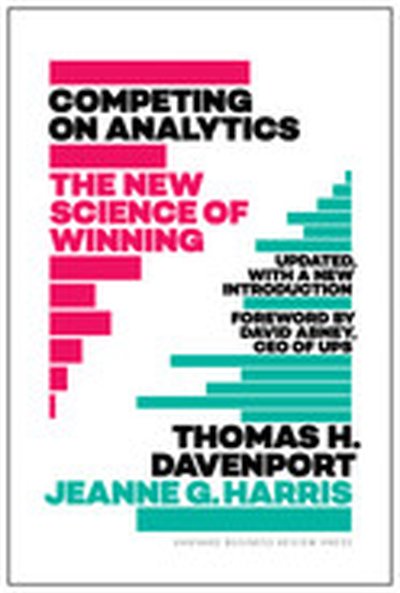
The New Edition of a Business Classic This landmark work, the first to introduce business leaders to analytics, reveals how analytics are rewriting the rules of competition. Updated with fresh content, Competing on Analytics provides the road map for becoming an analytical competitor, showing readers how to create new strategies for their organizations based on sophisticated analytics. Introducing a five-stage model of analytical competition, Davenport and Harris describe the typical behaviors, capabilities, and challenges of each stage. They explain how to assess your company’s capabilities and guide it toward the highest level of competition. With equal emphasis on two key resources, human and technological, this book reveals how even the most highly analytical companies can up their game. With an emphasis on predictive, prescriptive, and autonomous analytics for marketing, supply chain, finance, M&A, operations, R&D, and HR, the book contains numerous new examples from different industries and business functions, such as Disney’s vacation experience, Google’s HR, UPS’s logistics, the Chicago Cubs’ training methods, and Firewire Surfboards’ customization. Additional new topics and research include: Data scientists and what they do Big data and the changes it has wrought Hadoop and other open-source software for managing and analyzing data Data products—new products and services based on data and analytics Machine learning and other AI technologies The Internet of Things and its implications New computing architectures, including cloud computing Embedding analytics within operational systems Visual analytics The business classic that turned a generation of leaders into analytical competitors, Competing on Analytics is the definitive guide for transforming your company’s fortunes in the age of analytics and big data.
Learn the art of creating machine learning models and processing data efficiently with MATLAB. In this book, you will explore various techniques such as regression analysis, clustering, classification, and neural networks, all in the MATLAB environment. Each topic is detailed with practical examples for clear understanding and immediate application. What this Book will help me do Understand the key concepts of machine learning and how they integrate with MATLAB. Learn to preprocess and transform data for effective machine learning workflows. Explore regression methods and apply them to analyze and predict trends in your data. Master classification and clustering techniques for model creation and data categorization. Gain expertise in using MATLAB Neural Network Toolbox for building neural network-based solutions. Author(s) None Kolluru and Giuseppe Ciaburro are seasoned experts in using MATLAB for data analysis and machine learning. With years of experience in research and teaching, they have meticulously curated this book to bridge concepts of theory with real-world applications. Their writing approach is clear, instructional, and focused on equipping learners with practical skills. Who is it for? This book is ideal for data analysts, aspiring data scientists, and students eager to delve into machine learning using MATLAB. Even if you're new to the field, you'll find the instructions gentle yet comprehensive to help you follow along. However, having some background in math and statistics will definitely enhance your learning experience. If you're passionate about data and its insights, this is the guide for you.
This comprehensive guide dives into predictive analytics with R, exploring the powerful functionality and vast ecosystem of packages available in this programming language. By studying this book, you will gain mastery over predictive modeling techniques and learn how to apply machine learning to real-world problems efficiently and effectively. What this Book will help me do Develop proficiency in predictive modeling processes, from data preparation to model evaluation. Gain hands-on experience with R's diverse packages for machine learning. Understand the theoretical foundations and practical applications of various predictive models. Learn advanced techniques such as deep learning implementations of word embeddings and recurrent neural networks. Acquire the ability to handle large datasets using R for scalable predictive analytics workflows. Author(s) James D. Miller and Rui Miguel Forte are experts in data science and predictive analytics with decades of combined experience in the field. They bring practical insights from their work in both academia and industry. Their clear and engaging writing style aims at making complex concepts accessible to readers by integrating theoretical knowledge with real-world applications. Who is it for? This book is ideal for budding data scientists, predictive modelers, or quantitative analysts with some basic knowledge of R and statistics. Advanced learners aiming to refine their expertise in predictive analytics and those wishing to explore the functionality of R for applied machine learning will also greatly benefit from this resource. The book is suitable for professionals and enthusiasts keen to expand their understanding of predictive modeling and learn advanced techniques.
Get started with MATLAB for deep learning and AI with this in-depth primer. In this book, you start with machine learning fundamentals, then move on to neural networks, deep learning, and then convolutional neural networks. In a blend of fundamentals and applications, MATLAB Deep Learning employs MATLAB as the underlying programming language and tool for the examples and case studies in this book. With this book, you'll be able to tackle some of today's real world big data, smart bots, and other complex data problems. You'll see how deep learning is a complex and more intelligent aspect of machine learning for modern smart data analysis and usage. What You'll Learn Use MATLAB for deep learning Discover neural networks and multi-layer neural networks Work with convolution and pooling layers Build a MNIST example with these layers Who This Book Is For Those who want to learn deep learning using MATLAB. Some MATLAB experience may be useful.