talk-data.com talk-data.com

Event

O'Reilly Data Science Books

2013-08-09 – 2026-02-25 Oreilly Visit website ↗

Activities tracked

2118

Collection of O'Reilly books on Data Science.

Sessions & talks

Showing 301–325 of 2118 · Newest first

Search within this event →
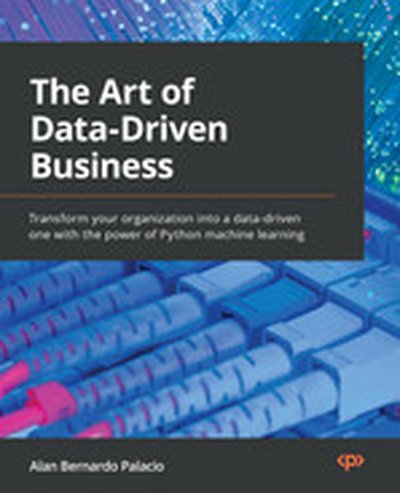
The Art of Data-Driven Business

Learn how to integrate data-driven methodologies and machine learning into your business decision-making processes with 'The Art of Data-Driven Business.' This comprehensive guide shows you how to apply Python-based machine learning techniques to real-world challenges, transforming your organization into an innovative and well-informed enterprise. What this Book will help me do Create professional-quality data visualizations using Python's seaborn library to derive business insights. Analyze customer behavior, including predicting churn, with machine learning techniques. Apply clustering algorithms to segment customers for targeted marketing campaigns. Utilize pandas effectively for pricing and sales analytics to optimize your pricing strategies. Forecast outcomes of promotional strategies to determine costs and benefits and maximize performance. Author(s) None Palacio is an experienced data scientist and educator who specializes in the application of machine learning to solve business problems. With extensive real-world industry experience, Palacio brings practical insights and methodologies to learners. Their teaching connects technical knowledge to actionable business strategies. Who is it for? This book is ideal for business professionals aiming to incorporate data science into their strategies and technical experts seeking to leverage machine learning for business scenarios. Beginners to Python can find foundational help, while data scientists will appreciate the focused practical applications. It's perfect for individuals seeking a strong data-driven perspective in marketing, sales, and customer management.
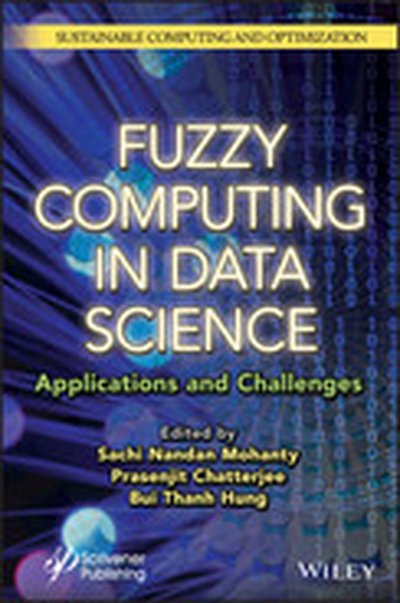
Fuzzy Computing in Data Science

FUZZY COMPUTING IN DATA SCIENCE This book comprehensively explains how to use various fuzzy-based models to solve real-time industrial challenges. The book provides information about fundamental aspects of the field and explores the myriad applications of fuzzy logic techniques and methods. It presents basic conceptual considerations and case studies of applications of fuzzy computation. It covers the fundamental concepts and techniques for system modeling, information processing, intelligent system design, decision analysis, statistical analysis, pattern recognition, automated learning, system control, and identification. The book also discusses the combination of fuzzy computation techniques with other computational intelligence approaches such as neural and evolutionary computation. Audience Researchers and students in computer science, artificial intelligence, machine learning, big data analytics, and information and communication technology.

Data Literacy in Practice

"Data Literacy in Practice" teaches readers to unlock the power of data for making smarter decisions. You'll learn how to understand and work with data, gain the ability to derive actionable insights, and develop the skills required for data-informed decision-making. What this Book will help me do Understand the basics of data literacy and the importance of data in decision-making. Learn to visualize data effectively using charts and graphs tailored to your audience. Master the application of the four-pillar model for organizational data literacy advancement. Develop proficiency in managing data environments and assessing data quality. Become competent in deriving actionable insights and critical questioning for better analysis. Author(s) Angelika Klidas and Kevin Hanegan are pioneers in the field of data literacy with extensive experience in data analytics. Both are seasoned educators at top universities and bring their expertise to this book to help readers understand and leverage the power of data. Who is it for? "Data Literacy in Practice" is ideal for data analysts, professionals, and teams looking to enhance their data literacy skills. Readers should have a desire to utilize data effectively in their roles, regardless of prior experience. The book is designed to guide both beginners starting out and those who aim to deepen their knowledge.

Scaling Python with Ray

Serverless computing enables developers to concentrate solely on their applications rather than worry about where they've been deployed. With the Ray general-purpose serverless implementation in Python, programmers and data scientists can hide servers, implement stateful applications, support direct communication between tasks, and access hardware accelerators. In this book, experienced software architecture practitioners Holden Karau and Boris Lublinsky show you how to scale existing Python applications and pipelines, allowing you to stay in the Python ecosystem while reducing single points of failure and manual scheduling. Scaling Python with Ray is ideal for software architects and developers eager to explore successful case studies and learn more about decision and measurement effectiveness. If your data processing or server application has grown beyond what a single computer can handle, this book is for you. You'll explore distributed processing (the pure Python implementation of serverless) and learn how to: Implement stateful applications with Ray actors Build workflow management in Ray Use Ray as a unified system for batch and stream processing Apply advanced data processing with Ray Build microservices with Ray Implement reliable Ray applications

Microsoft Power BI Quick Start Guide - Third Edition

Discover the power of transforming raw data into actionable insights with "Microsoft Power BI Quick Start Guide." This comprehensive guide introduces you to the core functionalities of Power BI, emphasizing practical demonstration on building data models, visualizations, and streamlining business intelligence processes. By following this book, you'll elevate your data analysis and storytelling skills. What this Book will help me do Connect and import data from various sources into Power BI. Master the usage of Power Query Editor for efficient data cleansing. Create effective and visually appealing Power BI dashboards. Understand and implement data security features, such as row-level and column-level security. Administer a Power BI environment effectively, including tenant management and cloud deployments. Author(s) Devin Knight, Erin Ostrowsky, Mitchell Pearson, and Bradley Schacht are seasoned experts in the field of data analysis and business intelligence. With years of practical experience, they bring a wealth of knowledge in Power BI and data visualization. Their passion for educating others is evident in their clear, approachable, and structured writing style. Who is it for? This book is designed for professionals seeking to delve into Microsoft Power BI's functionalities. Ideal readers include business analysts, data professionals, or enthusiasts aiming to transition from Excel-based solutions to BI platforms. Both beginners wanting to learn BI concepts and intermediate users looking to solidify their Power BI skills will benefit greatly.

Pro DAX and Data Modeling in Power BI: Creating the Perfect Semantic Layer to Drive Your Dashboard Analytics

Develop powerful data models that bind data from disparate sources into a coherent whole. Then extend your data models using DAX–the query language that underpins Power BI–to create reusable measures to deliver finely-crafted custom calculations in your dashboards. This book starts off teaching you how to define and enhance the core structures of your data model to make it a true semantic layer that transforms complex data into familiar business terms. You’ll learn how to create calculated columns to solve basic analytical challenges. Then you’ll move up to mastering DAX measures to finely slice and dice your data. The book also shows how to handle temporal analysis in Power BI using a Date dimension. You will see how DAX Time Intelligence functions can simplify your analysis of data over time. Finally, the book shows how to extend DAX to filter and calculate datasets and develop DAX table functions and variables to handle complex queries. What You Will Learn Create clear and efficient data models that support in-depth analytics Define core attributes such as data types and standardized formatting consistently throughout a data model Define cross-filtering settings to enhance the data model Make use of DAX to create calculated columns and custom tables Extend your data model with custom calculations and reusable measures using DAX Perform time-based analysis using a Date dimension and Time Intelligence functions Who This Book Is For Everyone from the CEO to the Business Intelligence developer and from BI and Data architects and analysts to power users and IT managers can use this book to outshine the competition and create the data framework that they need and interactive dashboards using Power BI

Creating Business Applications with Microsoft 365: Techniques in Power Apps, Power BI, SharePoint, and Power Automate

Learn how to automate processes, visualize your data, and improve productivity using Power Apps, Power Automate, Power BI, SharePoint, Forms, Teams, and more. This book will help you build complete solutions that often involve storing data in SharePoint, creating a front-end application in Power Apps or Forms, adding additional functionality with Power Automate, and effective reports and dashboards in Power BI. This new edition greatly expands the focus on Power Apps, Power BI, Power Automate, and Teams, along with SharePoint and Microsoft Forms. It starts with the basics of programming and shows how to build a simple email application in .NET, HTML/JavaScript, Power Apps on its own, and Power Apps and Power Automate in combination. It then covers how to connect Power Apps to SharePoint, create an approval process in Power Automate, visualize surveys in Power BI, and create your own survey solution with the combination of a number of Microsoft 365 tools. You’ll work with anextended example that shows how to use Power Apps and SharePoint together to create your own help ticketing system. This book offers a deep dive into Power BI, including working with JSON, XML, and Yes/No data, as well as visualizing learning data and using it to detect inconsistencies between Excel files. You’ll also see how to connect to Remedy and to the help system you will have created. Under author Jeffrey Rhodes’s guidance, you’ll delve into the Power Apps collection to learn how to avoid dreaded "delegation" issues with larger data sets. Back on applications, you will create a training class sign-up solution to only allow users to choose classes with available seats. Digging deeper into Teams, you’ll learn how to send chats, posts, and "adaptive cards" from Power Automate. Rounding things out, you’ll save Forms attachments to SharePoint with Power Automate, create your own "Employee Recognition" app with all of the Power Platform and Teams, add or edit weekly status reports, and learn how to create reservation and scoring applications. After reading the book, you will be able to build powerful applications using Power Apps, Power Automate, Power BI, SharePoint, Forms, and Teams. What You Will Learn Create productivity-enhancing applications with Power Apps, Power Automate, SharePoint, Forms, and/or Teams Transform and visualize data with Power BI to include custom columns, measures, and pivots Avoid delegation issues and tackle complicated Power Apps issues like complex columns, filtering, and ForAll loops Build scheduled or triggered Power Automate flows to schedule Teams Meetings, send emails, launch approvals, and much more Who This Book Is For Business and application developers.

Bayesian Analysis with Excel and R

Leverage the full power of Bayesian analysis for competitive advantage Bayesian methods can solve problems you can't reliably handle any other way. Building on your existing Excel analytics skills and experience, Microsoft Excel MVP Conrad Carlberg helps you make the most of Excel's Bayesian capabilities and move toward R to do even more. Step by step, with real-world examples, Carlberg shows you how to use Bayesian analytics to solve a wide array of real problems. Carlberg clarifies terminology that often bewilders analysts, provides downloadable Excel workbooks you can easily adapt to your own needs, and offers sample R code to take advantage of the rethinking package in R and its gateway to Stan. As you incorporate these Bayesian approaches into your analytical toolbox, you'll build a powerful competitive advantage for your organization---and yourself. Explore key ideas and strategies that underlie Bayesian analysis Distinguish prior, likelihood, and posterior distributions, and compare algorithms for driving sampling inputs Use grid approximation to solve simple univariate problems, and understand its limits as parameters increase Perform complex simulations and regressions with quadratic approximation and Richard McElreath's quap function Manage text values as if they were numeric Learn today's gold-standard Bayesian sampling technique: Markov Chain Monte Carlo (MCMC) Use MCMC to optimize execution speed in high-complexity problems Discover when frequentist methods fail and Bayesian methods are essential---and when to use both in tandem ...

Learning Google Analytics

Why is Google Analytics 4 the most modern data model available for digital marketing analytics? Rather than simply reporting what has happened, GA4's new cloud integrations enable more data activation, linking online and offline data across all your streams to provide end-to-end marketing data. This practical book prepares you for the future of digital marketing by demonstrating how GA4 supports these additional cloud integrations. Author Mark Edmondson, Google developer expert for Google Analytics and Google Cloud, provides a concise yet comprehensive overview of GA4 and its cloud integrations. Data, business, and marketing analysts will learn major facets of GA4's powerful new analytics model, with topics including data architecture and strategy, and data ingestion, storage, and modeling. You'll explore common data activation use cases and get the guidance you need to implement them. You'll learn: How Google Cloud integrates with GA4 The potential use cases that GA4 integrations can enable Skills and resources needed to create GA4 integrations How much GA4 data capture is necessary to enable use cases The process of designing dataflows from strategy through data storage, modeling, and activation How to adapt the use cases to fit your business needs

Statistics All-in-One For Dummies

The odds-on best way to master stats. Statistics All-in-One For Dummies is packed with lessons, examples, and practice problems to help you slay your stats course. Develop confidence and understanding in statistics with easy-to-understand (even fun) explanations of key concepts. Plus, you’ll get access to online chapter quizzes and other resources that will turn you into a stats master. This book teaches you how to interpret graphs, determine probability, critique data, and so much more. Written by an expert author and serious statistics nerd, Statistics AIO For Dummies explains everything in terms anyone can understand. Get a grasp of basic statistics concepts required in every statistics course Clear up the process of interpreting graphs, understanding polls, and analyzing data Master correlation, regression, and other data analysis tools Score higher on stats tests and get a better grade in your high school or college class Statistics All-in-One For Dummies follows the curriculum of intro college statistics courses (including AP Stats!) so you can learn everything you need to know to get the grade you need—the Dummies way.

Beginning MATLAB and Simulink: From Beginner to Pro

Employ essential tools and functions of the MATLAB and Simulink packages, which are explained and demonstrated via interactive examples and case studies. This revised edition covers features from the latest MATLAB 2022b release, as well as other features that have been released since the first edition published. This book contains dozens of simulation models and solved problems via m-files/scripts and Simulink models which will help you to learn programming and modelling essentials. You’ll become efficient with many of the built-in tools and functions of MATLAB/Simulink while solving engineering and scientific computing problems. Beginning MATLAB and Simulink, Second Edition explains various practical issues of programming and modelling in parallel by comparing MATLAB and Simulink. After studying and using this book, you'll be proficient at using MATLAB and Simulink and applying the source code and models from the book's examples as templates for your own projects in data science or engineering. What You Will Learn Master the programming and modelling essentials of MATLAB and Simulink Carry out data visualization with MATLAB Build a GUI and develop App with MATLAB Work with integration and numerical root finding methods Apply MATLAB to differential equations-based models and simulations Use MATLAB and Simulink for data science projects Who This Book Is For Engineers, programmers, data scientists, and students majoring in engineering and scientific computing who are new to MATLAB and Simulink.

Data Analysis and Related Applications, Volume 1

The scientific field of data analysis is constantly expanding due to the rapid growth of the computer industry and the wide applicability of computational and algorithmic techniques, in conjunction with new advances in statistical, stochastic and analytic tools. There is a constant need for new, high-quality publications to cover the recent advances in all fields of science and engineering. This book is a collective work by a number of leading scientists, computer experts, analysts, engineers, mathematicians, probabilists and statisticians who have been working at the forefront of data analysis and related applications. The chapters of this collaborative work represent a cross-section of current concerns, developments and research interests in the above scientific areas. The collected material has been divided into appropriate sections to provide the reader with both theoretical and applied information on data analysis methods, models and techniques, along with related applications.

Data Analysis and Related Applications, Volume 2

The scientific field of data analysis is constantly expanding due to the rapid growth of the computer industry and the wide applicability of computational and algorithmic techniques, in conjunction with new advances in statistical, stochastic and analytic tools. There is a constant need for new, high-quality publications to cover the recent advances in all fields of science and engineering. This book is a collective work by a number of leading scientists, computer experts, analysts, engineers, mathematicians, probabilists and statisticians who have been working at the forefront of data analysis and related applications. The chapters of this collaborative work represent a cross-section of current concerns, developments and research interests in the above scientific areas. The collected material has been divided into appropriate sections to provide the reader with both theoretical and applied information on data analysis methods, models and techniques, along with related applications.

Face Analysis Under Uncontrolled Conditions

Face analysis is essential for a large number of applications such as human-computer interaction or multimedia (e.g. content indexing and retrieval). Although many approaches are under investigation, performance under uncontrolled conditions is still not satisfactory. The variations that impact facial appearance (e.g. pose, expression, illumination, occlusion, motion blur) make it a difficult problem to solve. This book describes the progress towards this goal, from a core building block – landmark detection – to the higher level of micro and macro expression recognition. Specifically, the book addresses the modeling of temporal information to coincide with the dynamic nature of the face. It also includes a benchmark of recent solutions along with details about the acquisition of a dataset for such tasks.

R 4 Data Science Quick Reference: A Pocket Guide to APIs, Libraries, and Packages

In this handy, quick reference book you'll be introduced to several R data science packages, with examples of how to use each of them. All concepts will be covered concisely, with many illustrative examples using the following APIs: readr, dibble, forecasts, lubridate, stringr, tidyr, magnittr, dplyr, purrr, ggplot2, modelr, and more. With R 4 Data Science Quick Reference, you'll have the code, APIs, and insights to write data science-based applications in the R programming language. You'll also be able to carry out data analysis. All source code used in the book is freely available on GitHub.. What You'll Learn Implement applicable R 4 programming language specification features Import data with readr Work with categories using forcats, time and dates with lubridate, and strings with stringr Format data using tidyr and then transform that data using magrittr and dplyr Write functions with R for data science, data mining, and analytics-based applications Visualize data with ggplot2 and fit data to models using modelr Who This Book Is For Programmers new to R's data science, data mining, and analytics packages. Some prior coding experience with R in general is recommended.

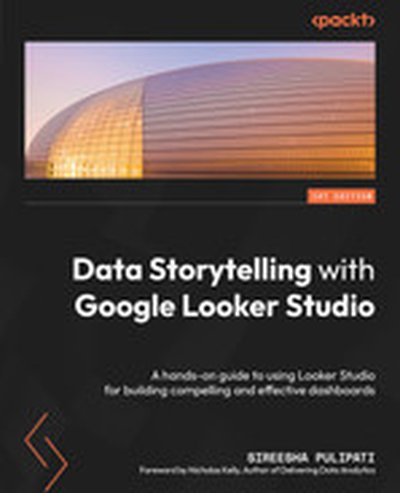
Data Storytelling with Google Looker Studio

Data Storytelling with Google Looker Studio is your definitive guide to creating compelling dashboards using Looker Studio. In this book, you'll journey through the principles of effective data visualization and learn how to harness Looker Studio to convey impactful data stories. Step by step, you'll acquire the skills to design, build, and refine dashboards using real-world data. What this Book will help me do Understand and apply data visualization principles to enhance data analysis and storytelling. Master the features and capabilities of Google Looker Studio for dashboard building. Learn to use a structured 3D approach - determine, design, and develop - for creating dashboards. Explore practical examples to apply your knowledge effectively in real projects. Gain insights into monitoring and measuring the impact of Looker Studio dashboards. Author(s) Sireesha Pulipati is an accomplished data analytics professional with extensive experience in business intelligence tools and data visualization. Leveraging her years of expertise, she has crafted this book to empower readers to effectively use Looker Studio. Sireesha's approachable teaching style and practical insights make complex concepts accessible to learners. Who is it for? This book is perfect for aspiring data analysts eager to master data visualization and dashboard design. It caters to beginners and requires no prior experience, making it a great starting point. Intermediate and seasoned professionals in analytics and business intelligence who are keen on using Looker Studio effectively will find immense value as well. If you aim to create insightful dashboards and refine your data storytelling skills, this book is for you.

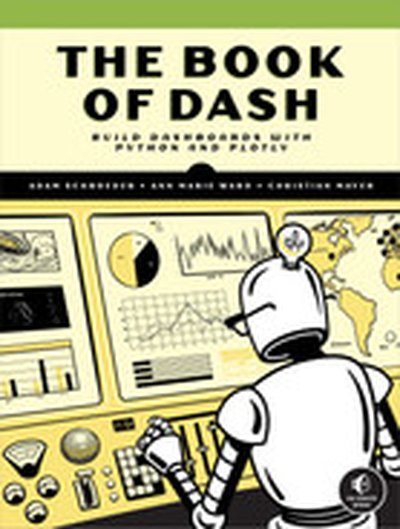
The Book of Dash

A swift and practical introduction to building interactive data visualization apps in Python, known as dashboards. Youâ??ve seen dashboards before; think election result visualizations you can update in real time, or population maps you can filter by demographic. With the Python Dash library youâ??ll create analytic dashboards that present data in effective, usable, elegant ways in just a few lines of code. The book is fast-paced and caters to those entirely new to dashboards. It will talk you through the necessary software, then get straight into building the dashboards themselves. Youâ??ll learn the basic format of a Dash app by building a twitter analysis dashboard that maps the number of likes certain accounts gained over time. Youâ??ll build up skills through three more sophisticated projects. The first is a global analysis app that compares country data in three areas: the percentage of a population using the internet, percentage of parliament seats held by women, and CO2 emissions. Youâ??ll then build an investment portfolio dashboard, and an app that allows you to visualize and explore machine learning algorithms. In this book you will: â?¢Create and run your first Dash apps â?¢Use the pandas library to manipulate and analyze social media data â?¢Use Git to download and build on existing apps written by the pros â?¢Visualize machine learning models in your apps â?¢Create and manipulate statistical and scientific charts and maps using Plotly Dash combines several technologies to get you building dashboards quickly and efficiently. This book will do the same.

Mathematical Foundations of Data Science Using R, 2nd Edition

The aim of the book is to help students become data scientists. Since this requires a series of courses over a considerable period of time, the book intends to accompany students from the beginning to an advanced understanding of the knowledge and skills that define a modern data scientist. The book presents a comprehensive overview of the mathematical foundations of the programming language R and of its applications to data science.

Nonparametric Statistics with Applications to Science and Engineering with R, 2nd Edition

NONPARAMETRIC STATISTICS WITH APPLICATIONS TO SCIENCE AND ENGINEERING WITH R Introduction to the methods and techniques of traditional and modern nonparametric statistics, incorporating R code Nonparametric Statistics with Applications to Science and Engineering with R presents modern nonparametric statistics from a practical point of view, with the newly revised edition including custom R functions implementing nonparametric methods to explain how to compute them and make them more comprehensible. Relevant built-in functions and packages on CRAN are also provided with a sample code. R codes in the new edition not only enable readers to perform nonparametric analysis easily, but also to visualize and explore data using R’s powerful graphic systems, such as ggplot2 package and R base graphic system. The new edition includes useful tables at the end of each chapter that help the reader find data sets, files, functions, and packages that are used and relevant to the respective chapter. New examples and exercises that enable readers to gain a deeper insight into nonparametric statistics and increase their comprehension are also included. Some of the sample topics discussed in Nonparametric Statistics with Applications to Science and Engineering with R include: Basics of probability, statistics, Bayesian statistics, order statistics, Kolmogorov–Smirnov test statistics, rank tests, and designed experiments Categorical data, estimating distribution functions, density estimation, least squares regression, curve fitting techniques, wavelets, and bootstrap sampling EM algorithms, statistical learning, nonparametric Bayes, WinBUGS, properties of ranks, and Spearman coefficient of rank correlation Chi-square and goodness-of-fit, contingency tables, Fisher exact test, MC Nemar test, Cochran’s test, Mantel–Haenszel test, and Empirical Likelihood Nonparametric Statistics with Applications to Science and Engineering with R is a highly valuable resource for graduate students in engineering and the physical and mathematical sciences, as well as researchers who need a more comprehensive, but succinct understanding of modern nonparametric statistical methods.

How Charts Work: Understand and explain data with confidence

How Charts Work brings the secrets of effective data visualisation in a way that will help you bring data alive. Charts, graphs and tables are essential devices in business, but all too often they present information poorly. This book will help you: Feel confident understanding different types of charts, graphs and tables – and how to read them Recognise the true story behind the data presented and what the information really shows Know the principles and rules of how best to represent information so you can create your own information-driven (and beautiful) visuals Design visuals that people engage with, understand and act upon Don’t value design over information – present data persuasively. Find the FT Chart Doctor’s columns here - https://www.ft.com/chart-doctor

Data Science and Analytics for SMEs: Consulting, Tools, Practical Use Cases

Master the tricks and techniques of business analytics consulting, specifically applicable to small-to-medium businesses (SMEs). Written to help you hone your business analytics skills, this book applies data science techniques to help solve problems and improve upon many aspects of a business' operations. SMEs are looking for ways to use data science and analytics, and this need is becoming increasingly pressing with the ongoing digital revolution. The topics covered in the books will help to provide the knowledge leverage needed for implementing data science in small business. The demand of small business for data analytics are in conjunction with the growing number of freelance data science consulting opportunities; hence this book will provide insight on how to navigate this new terrain. This book uses a do-it-yourself approach to analytics and introduces tools that are easily available online and are non-programming based. Data science will allow SMEs to understand their customer loyalty, market segmentation, sales and revenue increase etc. more clearly. Data Science and Analytics for SMEs is particularly focused on small businesses and explores the analytics and data that can help them succeed further in their business. What You'll Learn Create and measure the success of their analytics project Start your business analytics consulting career Use solutions taught in the book in practical uses cases and problems Who This Book Is For Business analytics enthusiasts who are not particularly programming inclined, small business owners and data science consultants, data science and business students, and SME (small-to-medium enterprise) analysts

Introduction to Matrix Analytic Methods in Queues 1

Matrix-analytic methods (MAM) were introduced by Professor Marcel Neuts and have been applied to a variety of stochastic models since. In order to provide a clear and deep understanding of MAM while showing their power, this book presents MAM concepts and explains the results using a number of worked-out examples. This book’s approach will inform and kindle the interest of researchers attracted to this fertile field. To allow readers to practice and gain experience in the algorithmic and computational procedures of MAM, Introduction to Matrix Analytic Methods in Queues 1 provides a number of computational exercises. It also incorporates simulation as another tool for studying complex stochastic models, especially when the state space of the underlying stochastic models under analytic study grows exponentially. The book’s detailed approach will make it more accessible for readers interested in learning about MAM in stochastic models.

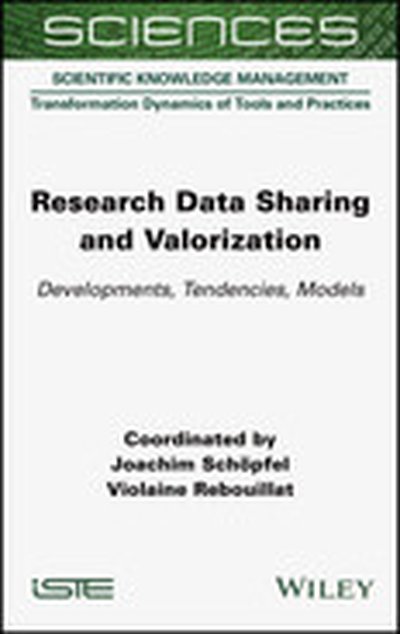
Research Data Sharing and Valorization

As platforms for sharing, re-using and storing data, research data repositories are integral to open science policy. This book provides a comprehensive approach to these data repositories, their functionalities, uses, issues and prospects. Taking France as an example, the current landscape of data repositories is considered, including discussion of the idea of a national repository and a comparative study of several national systems. The international re3data directory is outlined and a collection of six case studies of model repositories, both public and private, are detailed (CDS, Data INRAE, SEANOE, Nakala, Figshare and Data Mendeley). Research Data Sharing and Valorization also includes appendices containing a number of websites and reference texts from the French Ministry of Higher Education, Research and Innovation, and the CNRS. To the authors’ knowledge, it is the first book to be entirely devoted to these new platforms and is aimed at researchers, teachers, students and professionals working with scientific and technical data and information.